Table of Contents
Introduction
Artificial Intelligence is rapidly reshaping how marketing decisions are made. Across Asia Pacific, AI is already influencing personalisation, media optimisation, customer lifecycle management, and real-time engagement at scale.
Yet as AI adoption accelerates, many CMSs are begining to confront a difficult reality: AI-driven marketing without strong data foundations is becoming increasingly risky.
In a region defined by fragmented privacy regulations, rising consumer awareness, and growing scrutiny of automated decision-making, AI can no longer be deployed on top of loosely governed marketing data. This is why Data Clean Rooms in AI Marketing are emerging as a foundational capability – not as a compliance add-on, but as core growth infrastructure. The importance of Data Clean Rooms in AI Marketing in AI-driven marketing cannot be understated.
For CMOs in APAC, data clean rooms are quickly becoming the difference between scalable, trusted AI and innovation that cannot safely move beyond pilot stage.
As businesses look to optimize their strategies, Data Clean Rooms in AI Marketing will be pivotal in ensuring data integrity and consumer trust.
Understanding Data Clean Rooms in AI Marketing will empower teams to innovate responsibly.
Executive summary for CMOs
AI promises speed, scale, and relevance. But in APAC’s regulatory and cultural context, trust is the real multiplier.
To scale AI responsibly, marketing leaders need:
- High-quality first-party data
- Clear consent and purpose limitation
- Secure collaboration with platforms and partners
- Explainable and auditable AI outputs
This is where Data Clean Rooms in AI Marketing play a critical role.
By embedding governance directly into how data is accessed, analysed, and activated, data clean rooms allows CMOs to:
- Unlock AI-driven insights without exposing raw personal data
- Collaborate safely across ecosystems
- Prove compliance without slowing innovation
- Scale AI consistently across multiple APAC markets
The strategic question has shifted from “Should we invest?” to “Can our AI strategy survive without it?”
Understanding the importance of Data Clean Rooms in AI Marketing is essential for fostering innovation while maintaining compliance and trust.
The AI inflection point in APAC marketing
APAC is one of the fastest-moving digital regions in the world. Mobile-first behaviour, super-apps, fintech ecosystems, and e-commerce platforms generate enormous volumes of data and engagement signals.
At the same time, the region presents unique challenges:
- Diverse privacy laws and enforcement models
- Different interpretations of concent
- Data localisation and cross-border transfer constraints
- Increasing regulatory focus on automated decisoning
Most marketing stacks, however, were not designed for this reality. They were built to support:
- Campaign execution
- Channel-level reporting
- Retrospective analytics
They were not built to support AI models that require trusted, well-governed data inputs.
As a result, many organisations are trying to scale AI on top of foundations that were never designed for it. This is where Data Clean Rooms in AI Marketing become essential.
Why AI marketing needs stronger data foundations
AI does not create intelligence on its own. It learns from the data it is given and inherits all the strengths and weakness of that data.
In marketing, three structural risks often emerge when AI is layered onto legacy data practices.
- Consent ambiguity – Data collected for onboarding, servicing, or transactions is reused for personalisation or targeting without clear alignment to consented purposes.
- Data sprawl – Customer data is copied across tools, vendors, and environments to “enable AI”, increasing exposure and operational risk.
- Black-box decisioning – AI outputs cannot be clearly explained, audited, or traced to compliant data sources.
In APAC, where regulators increasingly expect preventive controls rather than reactive fixes, these risks can quickly undermine both trust and scalability.
This is why Data Clean Rooms in AI Marketing are becoming a foundational requiremen rather than a nine-to-have.
What are data clean rooms – in practical CMO terms
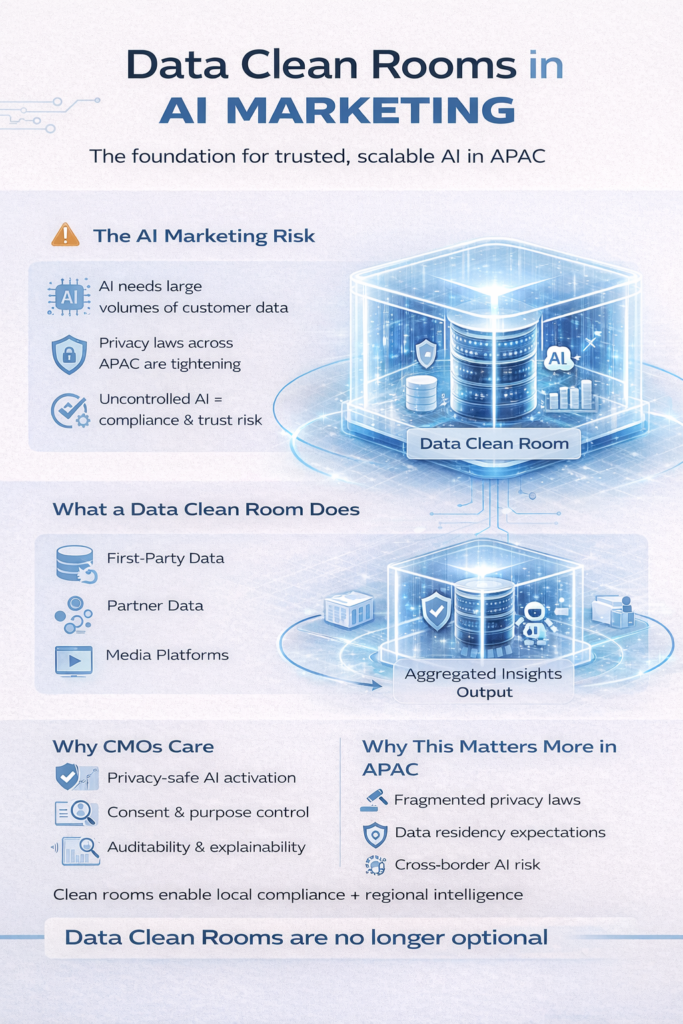
A data clean room is a controlled environment where organisations can analyse data and generate insights without exposing raw or identifiable information.
From a business perspective, data clean rooms enable:
- Secure collaboration between first-party and partner data
- Policy-driven access and usage controls
- Aggregated, anonymised, or threshold-based outputs
- Built-in auditability and governance
Crucially, raw data does not leave the clean room.
This makes data clean rooms fundamentally different from:
- Data lakes
- Customer data platforms
- Traditional data sharing via files or APIs
For AI, this distinction matters. Data Clean Rooms in AI Marketing allow models to learn from patterns and signals – not identities – dramatically reducing privacy and compliance risk.
Why major platforms are betting on clean rooms
Leading platforms have recognised that the future of marketing measurement and AI activation must be privacy-first.
Tjis is why companies such as Google and Meta have invested heavily in clean room technologies to support:
- Privacy-safe audience insights
- Incrementally testing
- Secure advertiser collaboration
Their message to the market is clear: AI without trusted data foundations is not sustainable.
This same logic applies to brands and marketers operating across APAC.
How data clean rooms support responsible AI marketing
Responsible AI is no longer a theoretical concept. Regulators, boards, and customers are now asking very practical questions:
- Can you explain how this decision was made?
- Can you prove customer consent?
- Can you demonstrate controls against misuse or bias?
Data Clean rooms in AI Marketing directly support these expectations.
Consent-aware AI activation
Clean rooms ensure AI models only operate on data aligned to declared purposes and consent conditions.
Privacy-by-design architecture
Instead of spreading customer data across multiple AI tools, clean rooms centralise control and limit exposure.
Auditability and Traceability
Clear lineages exists from data source -> query -> model -> output
Risk containment for generative AI
As marketing teams experiment with generative AI, clean rooms act as a safe sandbox, preventing sensitive data from leaking into external or opaque models.
For CMOs, this transforms AI from a potential brand risk into a trust-building capability.
Why APAC regulation makes data clean rooms even more critical
Unlike regions with more unified frameworks, APAC privacy regulation is highly fragmented.
Examples include:
- Singapore PDPA, which emphasises accountability and purpose limitation
- Vietnam’s Degree 13/2023, which requires explicit, informed consent and does not recoginize silence as consent.
- Indonesia’s PDP Law, which introduces layered requirements for processing and cross-border transfer.
- Philippines Data Privacy Act, which defines consent as freely given, specific, and evidenced.
Across these markets, regulators are increasingly focused on how data is governed in practice, not just on written policies.
This regulatory reality is a major reason Data Clean Rooms in AI Marketing are gaining traction in APAC.
Scaling AI across markets without losing control
one of the hardest challenges for APAC CMOs is balancing local compliance with regional intelligence.
Data clean rooms enable this by:
- Enforcing market-specific rules locally
- Allowing aggregated insights to be shared regionally
- Supporting AI use cases without moving raw data across borders
This allows organisations to scale AI while respecting:
- Data residency expectations
- Local consent requirements
- Different enforcement environments
In practice, Data Clean Rooms in AI Marketing make it possible tp centralise intelligence without centralising risk.
Personalisation without cross the trust line
AI-driven personalisation remains one of the most valuable marketing use cases. However, in APAC, over-personalisation without governance can quickly erode trust.
With data clean rooms, organisations can:
- Train models on behavioural patterns rathern than identities
- Personalise offers and content within consent boundaries
- Automatically supress non-eligable or non-consented audiences
This shifts personalisation from a short-term optimisation tactic to a long-term, trust-based capability.
Measurement and attribution in a privacy-first AI world
Traditional attribution models are under pressure due to :
- Cooke loss
- Platform fragmentation
- Walled gardens
Data clean rooms enable:
- Privacy-safe measurement
- Incrementality testing
- Cross-channel performance insights
For AI-driven marketing, this matters because models need reliable feedback loops. Data Clean Rooms in AI Marketing provide those signals without violating privacy expectations.
Preparing marketing teams for AI-assisted decision-making
Technology alone does not future-proof marketing. CMOs must also evolved their operating model.
With data clean rooms in place, teams can move from:
- Static dashboards to predictive insights
- Rule-based logic to AI-assisted recommendations
- Channel silos to ecosystem collaboration
However, leadership is required in three areas:
- Decision ownership – defining where humans remain accountable
- AI Literacy – helping teams interpret, not just deploy AI
- Governance alignment – ensuring marketing, data, legal, and compliance work together
In this context, Data Clean rooms in AI Marketing become the safe environment where maturity develops.
Build, buy, or partner: a strategic choice for CMOs
As clean rooms gain adoption, CMOs face a strategic decision:
- Build internally
- Buy from a platform provider
- Partner within an ecosystem
Each approach involves trade-offs in speed, control, cost, and scalability. What matters most is the choice itself, but whether the solution:
- Embeds governance by design
- Supports AI use cases, not just reporting
- Aligns with APAC regulatory realities
Why data clean rooms are becoming non-negotiable
From a C-suite perspective, Data Clean Rooms in AI Marketing now sits at the intersection of :
- AI strategy
- Privacy and regulation
- Partner collaboration
- Brand trut
In APAC, where AI ambition is high and regulatory expectations are rising, data clean rooms are no longer optional infrastructure.
The real question for CMOs is simple : Can our AI-driven marketing strategy scale without trust build in?
For most organisations, the answer is no.
Final thoughts: leadership in the age of AI
AI will continue to transform marketing. But in APAC, sustainable advantage will belong to organisations that build trust into their foundations, not bolt it on later.
By embedding governance into data architecture, Data Clean Rooms in AI Marketing allow CMOs to scale intelligence responsibly, collaborate confidently, and future-proof growth.
In the age of AI, leadership is not about moving fastest – it is about moving wisest.
Check out my articles on Marketing Strategies
Frequently Asked Questions (FAQs)
-
What are Data Clean Rooms in AI Marketing?
Data Clean Rooms are secure environments where brands can analyse first-party and partner data to power AI use cases – such as personalisation, measurement, and segmentation – without exposing raw or identifiable customer data. They embed privacy and governance directly into AI activation.
-
Why are Data Clean Rooms important for AI-driven marketing?
AI models require large volumes of data, but uncontrolled data access increases privacy and regulatory risk. Data Clean Rooms allow AI to learn from patterns and signals while enforcing consent, purpose limitation, and auditability – making AI scalable and defensible.
-
Why do Data Clean Rooms support responsible AI?
Data clean rooms support responsible AI by:
– Limiting access to raw personal data
– Enforcing policy-based data usage
– Providing traceability from data input to AI output
– Reducing bias and misuse through controlled environmentsThis helps CMOs demonstrate accountability as AI becomes more embedded in decision making.
-
Are Data Clean Rooms required for AI marketing in APAC?
While not always legally mandated, Data Clean Rooms are increasingly becoming a practical necessity in APAC due to fragmented privacy laws, consent requirements, and cross-border data restrictions. They help organisations operationalise compliance at scale.
-
How do Data Clean Rooms help with personalisation without violating privacy?
Instead of exposing customer identities, data clean rooms allow AI models to work with aggregated or anonymised data. This enables personalisation based on behaviour and intent while respecting consent boundaries and minimising privacy risk.