Table of Contents
Introduction: Why Marketing Operations Is Entering Its AI Moment
For more than a decade, marketing operations across Asia Pacific have been shaped by one dominant idea: automation. However, the emergence of AI Marketing Operations APAC is redefining the landscape.
Automate campaigns. Automate journeys. Automate reporting. Automate activation across channels.
And for a time, automation delivered exactly what organisations needed. It helped marketing teams scale execution, reduce manual effort, and bring consistency to increasingly complex channel environments. In fast-growing APAC markets, automation became the backbone that allowed lean teams to operate at enterprise scale.
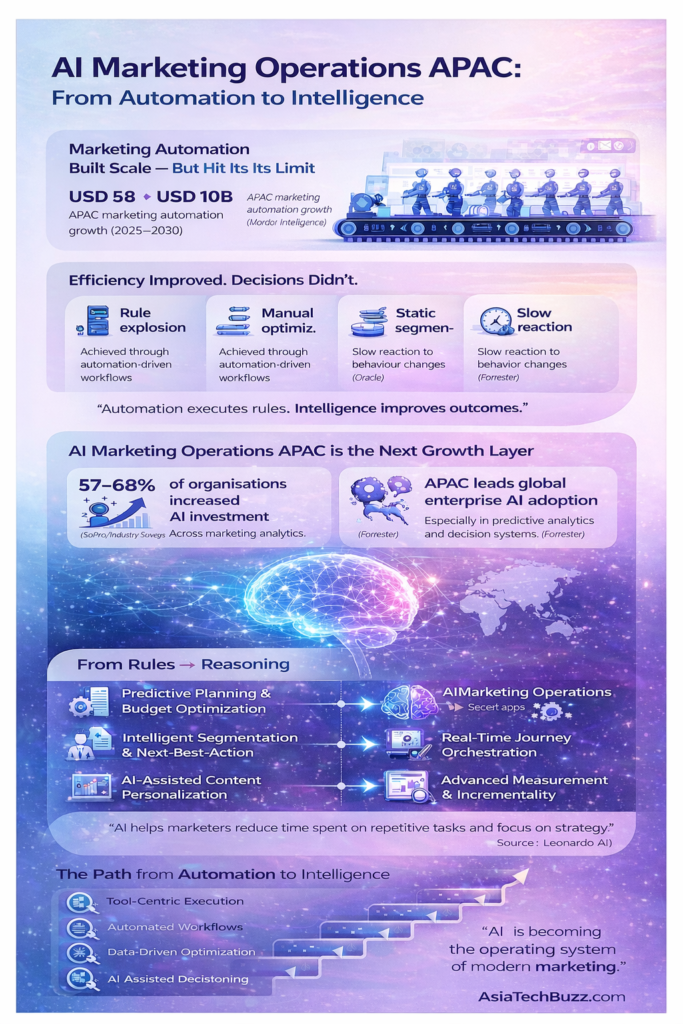
This explains why investment in marketing automation across the region continues to grow. The Asia Pacific marketing automation software market is projected to expand from approximately USD 5.8 billion in 2025 to nearly USD 10 billion by 2030, reflecting sustained demand for workflow efficiency and execution scalability (Modor Intelligence).
Yet despite this growth, a quiet tension is emerging inside many marketing organisations.
Campaigns are automated, but decisions remain manual. Journeys are automated, but relevance still lags. Dashboards are automated, but insights arrive too late to change outcomes. Teams are executing faster, yet struggling to improve effectiveness.
This is the moment where automation reaches its natural ceiling.
Across APAC, leading organisations are recognising that the next phase of advantage will not come from doing more automation, but from operating with intelligence. This is where AI Marketing Operations APAC becomes a strategic conversation, not as another technology layer, but as a new operating model for modern marketing.
What Marketing Operations Really Means in the Age of AI
From Campaign Execution to Growth Infrastructure
Historically, marketing operations was seen as a support function. Its remit focused on campaign execution, platform administration, tagging governance, and reporting. Success was measured by uptime, delivery accuracy, and process efficiency.
In the AI era, that definition is no longer sufficient.
Modern marketing operations has evolved into growth infrastructure. It is the system that connects data, decisioning, activation, and measurement into a continuous loop. It determines how quickly an organisation can sense customer intent, decide on the decision action, and execute consistently across channels.
This shift is especially visible in APAC markets, where speed, scale, and fragmentation demand more than manual coordination. As customer journeys become more nonlinear and platform-driven, marketing operations becmes the only function capable of orchestrating growth at scale.
This is why AI Marketing Operations APAC is increasingly discussed at the leadership level, not just within marketing teams.
Why Marketing Operations Is the First Function AI Disrupts
Marketing operations is uniquely positioned for AI-driven transformation for three structural reasons.
First, it operates in high-density data environments. Every interaction across web, app, messaging, paid media, and offline touchpoints generates signals that can be learned from.
Second, it manages repetitive, high-frequency decisions. Segmentation, prioritisation, channel selection, and timing decisions occur millions of times a day, far beyond human optimisation capacity.
Third, marketing operations already sits at the intersection of channels, platforms, and customer experience. AI does not introduce a new responsibility; it enhances an existing one.
As AI capabilities mature, marketing operations becomes the natural entry point for intelligence at scale.
Automation Was the First Wave – Why It’s No Longer Enough
What Traditional Marketing Automation Does Well
There is no question that automation delivered real value. Marketing automation platforms enabled organisations to standardised workflows, manage complex journeys, and scale campaigns across channels.
In APAC, where teams often operate across multiple markets with limited resources, automation helped reduce operational friction. Industry data shows that marketing automation can reduce marketing overhead by more than 12% by centralising activities and streamlining execution (Source: Oracle).
For many organisations, automation was the first step toward digital maturity.
The Structural Limits of Rule-Based Automation
However, automation has a fundamental limitation: it executes rules, but it does not reason.
Rule-based systems assume that customer behaviour is predictable and stable. They rely on predefine segments, static journeys, and manually tuned thresholds. As environments become more complex, these assumptions break down.
Rules multiply. Maintenance effort grows. Optimisation slows. Teams spend more time managing logic than improving outcomes.
At scale, automation become fragile.
Why Automation Struggles in APAC Markets
These limitions are amplified in APAC. Consumer behaviour varies significantly across countries, platforms, and demographics. Messaging apps, super apps, partner ecosystems, and offline-to-online journeys create fragmented paths that static rules cannot easily manage.
In this environment, marketing teams need systems that can adapt decisions in real time, not just execute predefined flows. This is why many organisations are now shifting toward AI Marketing Operations APAC as the next stage of maturity.
From Rules to Reasoning, The Shift to Intelligent Marketing Operations
What “Intelligence” Really Means in Marketing Operations
Intelligence in marketing operations is often misunderstood.
It does not mean replacing marketers with algorithms. It means augmenting human judgement with systems that can evaluate context, predict outcomes, and learn continuously.
Instead of asking whether a customer meets a specific condition, intelligent systems ask: “What is the best action right now, given eveything we know?”
This shift from deterministic rules to probabilistic reasoning is the defining difference between automation and intelligence.
Core Capabilities of AI-Driven Marketing Operations
AI introduces capabilities that fundamentally change how marketing operates:
- Predictive prioritisation, identifying customers and actions most likely to drive outcomes
- Real-time decisioning, adapting journeys dynamically based on behaviour
- Individual-level personalisation, rather than segment-level assumptions
- Continuous learning loops, where outcomes feed back into future decisions
These capabilities are already shaping how AI Marketing Operations APAC is implemented across industries such as financial services, e-commerce, and platform-based businesses.
How AI Changes the Role of the Marketing Ops Team
As AI takes over repetitive decisioning, marketing operations team shift from execution management to system design. Their role becomes defining decision frameworks, governance model, and success metrics.
This elevates marketing operations from a delivery function to a strategic capability.
Key AI Use Cases Tranforming Marketing Operations in APAC
AI-Powered Planning and Budget Optimisation
Traditional planning cycles struggle to keep pace with fast-changing markets. AI enables continuous optimisation by re-allocating budgets based on real-time performance signals rather than fixed plans.
This is particularly valuable in APAC, where channel costs and customer behaviour can shift rapidly.
Intelligent Segmentation and Next-Best Action
Static segmentation is giving way to contextual decisioning. AI evaluates behaviour, intent, and constraints at the individual level to determine the next best action.
This capability is a cornerstone of mature AI Marketing Operations APAC deployments.
Real-Time Journey Orchestration Across Channels
Customers move fulidly acorss web, app, messaging, and offline touchpoints. AI-driven operations allow journeys to unfold natually, guided by intent rather than predefined paths.
This improves relevance while reducing manual orchestration complexity.
AI for Content Operations and Personalisation
AI increasingly supports content operations by testing variants, learning preferences, and optimising messaging at scale. Many marketers report that AI assistance helps free time from repetitive tasks, allowing greater focus on strategy and creativity (Source: Leonardo AI).
Measurement, Attribution, and Incrementality
AI improves not only activation but measurement. By analysing patterns across touchpoints, it helps teams understand true incremental impact, a critical capability in multi-channel APAC environments.
Why APAC is Becoming a Living Lab for AI Marketing Operations
APAC combines scale, speed, and diversity in ways few regions can match. Mobile-first behaviour, platform ecosystems, and rapid experimentation cycles create fertile ground for intelligent systems.
Research indicates that APAC leads global AI adoption in several enterprise use cases, driven by competitive pressure and digital maturity in key markets (Source: Forrester).
At the same time, regulatory complexity forces organisations to design AI systems with governance and trust at their core. Rather than slowing innovation, this often results in stronger, more sustainable architectures.
The Modern AI-Powered Marketing Operations Architecture
AI marketing operations is not a single platform. It is an architecture built around decisioning.
At a high level, it consists of:
- A unified data foundation
- An AI decisioning layer
- Journey orchestration across channels
- Activation and continuous measurement
Organisations that treat AI as infrastructure, rather than a bolt-on feature, scale more effectively.
Operating Model Changes Leaders Often Underestimate
Technology alone is not enough. Skills, governance, and organistional design mater just as much.
AI-enabled marketing operations require teams that understand data, trust probabilistic outcomes, and design with ethics in mind. Leadership alignment is critical; without it, AI becomes another under-utilised capability.
A Practical Maturity Model, From Automation to Intelligence
Most organisations progress through five stages:
- Tool-centric execution
- Automated workflows
- Data-driven optimisation
- AI-assisted decisioning
- Fully intelligent operations
The goal is not speed, but clarity and sustainability.
How Marketing Leaders Should Start in 2026
Sucessful AI initiative starts with decisions, not tools. Leaders should identify high-impact decision momemnts and apply AI where it can improve outcomes.
Trust, governance, and measurement comes first. Scale comes later.
Final Thoughts: AI as the Operating System for Modern Marketing
AI is not replacing marketing operations. It is becoming its operating system.
In APAC, where complexity is the norm, AI Marketing Operations APAC represents the shift from managing activity to managing outcomes, from efficiency to advantage, and from automation to intelligence.
The organisations that understand this shift early will not just market better, they will operate better.
Read more on my articles on Marketing Strategies.
What is AI Marketing Operations in APAC?
AI marketing operations in APAC refers to the use of artificial intelligence to improve marekting decision-making, orchestration, and performance across Asia Pacific markets, moving beyond rule-based automation to intelligent, data-driven operations.
How is AI marketing operations different from marketing automation?
Marketing automation focuses on executing predefined rules and workflows, while AI marketing operations use predictive models and real-time data to decide the best action dynamically, adapting to customer behaviour and context.
Why is AI marketing operations especially important in APAC?
APAC markets are highly diverse, mobile-first, and platform-driven. AI marketing operations help organisations manage this complexity by enabling real-time decisioning, personalisation at scale, and faster response to changing customer behaviour.
What are the most common AI use cases in marketing operations today?
Common use case include intelligent segmentation, next-best-action decisioning, real-time journey orchestration, AI-assisted content personalisation, and advanced measurement such as incrementality and attribution.
How should marketing leaders start adopting AI marketing operations?
Leaders should start by identifying high-impact marketing decisions, ensuring strong data foundations, and establishing governance and trust before scaling AI across campaigns, channels and markets.