
Table of Contents
Introduction
Search has changed – not in appearance, but in mechanics.
For more than a decade, search engine optimization was largely about ranking. We optimized keywords, earned backlinked, improved page speed, and monitored click-through rates. Success was measured by position one.
Today, discoverability is no longer defined purely by ranking.
It is increasingly defined by retrieval, synthesis, and citation.
AI-generated summaries sit above traditional results. Conversational interface construct answers rather than directing users to multiple pages. Search engines are evolving into answer engines.
This shift has introduced a new discipline: AI Search Optimization.
It is important to be precise at the outset. There is no direct, linear correlation between purchasing a modern CMS and ranking in AI-generated responses. AI systems do not reward brands simply for technology investment.
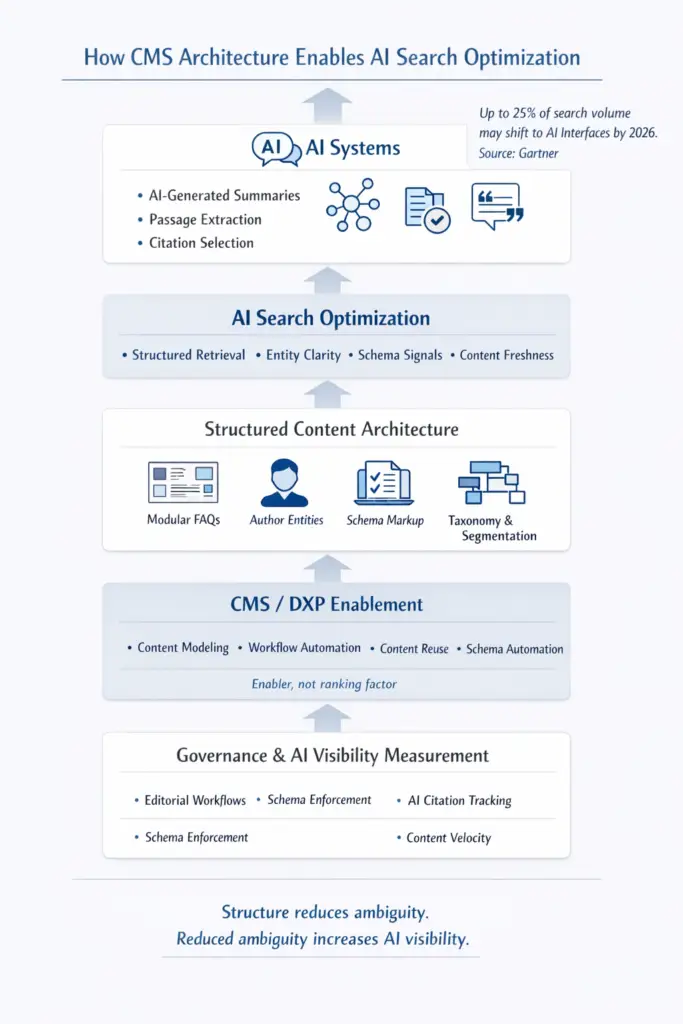
However, a capable CMS or Digital Experience Platform (DXP) enables marketers to scale structure content production, enforce schema consistently, and repurpose modular components. Those capabilities, in turn, make AI Search Optimization operational at scale.
The CMS is not the ranking factor. It is the execution engine.
The Structural Shift: From Ranking to Retrieval
When Google introduced AI-generated summaries into search results, it marked a structural change in how visibility is allocated. At the same time, platforms such as OpenAI and Anthropic began retrieving live web data to synthesize responses.
AI systems now:
- Extract passages rather than listing entire pages
- Interpret structured data to understand context
- Identify and connect entities
- Evaluate freshness and authority signals
- Synthesize multi-source answers
- Attribute slected citations
According to Gartner, generative AI is expected to significantly reshape search behavior, with projections that up to 25% of traditional search engine volume may shift toward AI chat interfaces by 2026 (Source: Gartner).
Even if the exact percentage evolves differently, the direction is clear. When AI answers occupy more screen space, fewer organic listings are visible. Citation slots are limited. Structured clarit¥ becomes decisive.
In this environment, AI Search Optimization is not about ranking higher. It is about being extractable and citable.
Extraction depends on structure.
There is No Direct Correlation, But There Is Strong Enablement
It would be misleading to claim that upgrading a CMS automatically improves AI Search Optimization performance. AI systems evaluate content relevance, authority, clarity, and consistency.
However, without capable infrastructure, organizations struggle to:
- Produce structured content consistently
- Repurpose content modules across multiple surfaces
- Enforce schema at scale
- Maintain entity governance
- Update information rapidly
A modern CMS or DXP does not guarantee AI visibility. But it determines whether your organization can systematically build it.
In other words, AI Search Optimization is an outcome of structured discipline. The CMS enables that discipline.
The Five Capability Pillars That Enable AI Search Optimization
AI Search Optimization does not depend on a single technical setting. It depends on a combination of structural capabilities working together. These five pillars determine whether your organization can execute AI Search Optimization consistently at scale.
AI Visibility Begins with Content Architecture
Traditional SEO focused on:
- Keyword placement
- Backlink acquisition
- Technical crawlability
- Metadata optimization
AI Search Optimization focuses on:
- Structured content modeling
- Passage-level segmentation
- Schema automation
- Entity clarity
- Freshness signals
- Machine-readable metadata
These are architectural decisions.
If content is stored as long, unstructured text blocks, AI systems must infer meaning. Inference reduces confidence. Reduced confidence lowers the probability of citation.
AI visibility improves when structure reduces ambiguity.
Structured Content Modeling: Treating Content as Data
AI systems retrieve semantic units, not layouts.
A CMS built to support AI Search Optimization separates content into structured fields:
- Titie
- Summary
- Key points
- FAQs
- Author reference
- Topic taxonomy
- Publication and update timestamps
When content is modular:
- Passages can stand independently
- Schema can be generated automatically
- Entities remain consistent
- Updates prograte across instances
Structured modeling does not directly influence algorithms. However, it enables marketers to execute AI Search Optimization systematically rather than manually.
Structured content is not about design. It is about machine comprehension.
Passage-Level Segmentation and Retrieval Confidence
AI engines extract specific passages, not entire pages.
A 3,000-word article is rarely retrieved as a whole. Instead, the system selects a relevant section that answers a specific query.
Content that supports AI Search Optimization typically includes:
- Clear H2 and H3 hierachy
- Standalone explanatory paragraphs
- Modular FAQ components
- Explicit contextual framing
Predictable segmentation increases retrieval perecision. When sections are clearly scoped, AI systems can extract them without misinterpretation. Poor segmentation weakens AI visibility.
Schema Markup as Operational Infrastructure
According to Google Search Central, structured data helps search engines understand page content and context (Source: Google).
Schema markup:
- Defines content type
- Identifies authors
- Associates organizations
- Signals publication dates
- Enable FAQ extraction
Manual schema insertion is error-prone and inconsistent. A capable CMS enforces schema at template level, ensuring uniform implementation across hundreds of pages.
Schema automation does not directly guarantee AI citation. But it reduces inconsistency, which strengthen AI Search Optimization reliability.
Consistency improves AI visibility.
Entity Authority and Structured Trust Signals
AI systems evaluate entities – authors, organizations, and topics – as part of their confidence calculation.
A CMS that supports AI Search Optimization should maintain:
- Structured author profiles
- Credential metadata fields
- Organization-article relationships
- Consistent taxonomy mapping
When authority is machine-readable, AI syßtems can connect related content more effectively.
Trus is not assumed. It is structured.
Scaling Content Production Velocity
One of the most overlooked enablers of AI Search Optimization is production velovity.
AI systems prioritize freshness and topical depth. Orgtanizations that publish consistently and update frequently send stronger recency signals.
A capable CMS or DXP enables:
- Template-driven publishing
- Modular page assembly
- Faster editorial workflows
- Reduced developer dependency
Velocity does not directly influence AI alogrithms. But it allows teams to expand coverage, update information qukcly, and respond to evolving queries.
Without infrastructure, scaling AI Search Optimization becomes operationally burdensome.
Content Reuse as a Reinforcement Mechanism
AI systems detect consistency. In traditional workflows, FAQs and disclosures are often rewritten across pages, leading to subtle variations.
Structured reuse enables:
- Centralized FAQ components
- Shared compliance modules
- Standardized product descriptions
- Consistent schema output
When consistent structured modules appear across multiple pages, AI retrieval confidence improves. Repetition of structured truth reinforce signals.
This does not manipulate AI systems. It reduces ambiguity. And ambiguity reduction strengthens AI Search Optimization outcomes.
Case Study: Magnolia CMS deployment at Home Credit Philippines
As brief illustration can be seen at Home Credit Philippines, which uses Magnolia as its CMS platform.
In a regulated financial services environment with strong competition and new threats from AI searches, Home Credit Philippines need to maintain:
- Accurate product explanations
- Transparent loan disclosures
- Structured FAQs
- Frequent updates
- Relevant blog articles to attract customers
Magnolia CMS enables:
- Modular content components
- Centralized disclosure blocks
- Role-based workflows
- Taxonomy-driven topic organization
This infrastructure does not automatically produces AI visibility. However, it enables teams to execute AI Search Optimization and try different tactics and strategy, consistently by scaling structured content production and maintaining schema discipline.
The CMS is not the ranking factor. It. is the operational backbone.
Governance: Translating Capability into Outcome
Technology alone does not ensure effective AI Search Optimization. Governance converts capability into measurable results.
Organization should establish:
- Structured content guidelines
- Schema enforcement policies
- Entity tagging standards
- Editorial review workflows
- AI visibility monitoring processes
Without governance, structure degrades over time. Consistency is essential for sustainable AI visibility.
Measuring AI Search Optimization Performance
Traditional SEO dashboards measure:
- Rankings
- Organic sessions
- Click-through rates
AI Search Optimization requires additional indicators:
- Citation frequency in AI-generated responses
- Inclusion in AI summaries
- Structured data validation health
- Passage extraction consistency
- Content freshness velocity
Many of these can be measured using traditional SEO tools like SEMRush and aHrefs, both platforms now offers AI monitoring modules, adding on to the traditional SEO monitoring capabilities.
Traffic may fluctuate as AI answers reduce click-through behavior. However, citation presence can still increase. Measurement frameworks must evolve alongside behavior.
Implementation Roadmap: Operationalizing AI Search Optimization
To move from theory to execution, organization can follow a structured roadmap.
- Audit Content Structure : This audit clarifies whether infrastructure support AI Search Optimization.
- Review content models
- Identify unstructured text blocks
- Evaluate schema coverage
- Assess entity consistency
- Redesign Content Models : Structured modeling lays the foundation for scalable AI Search Optimization.
- Break long text into modular fields
- Separate FAQs into discrete objects
- Standardize author entities
- Define taxonomy hierachies
- Automate Schema Enforcement : Automation reduces manual inconsistency.
- Apply template-level schema
- Validate structured data automatically
- Monitor errors consistently
- Establish Governance Frameworks : Governance sustains long-term AI visibility
- Define editorial guidelines
- Assign schema accountability
- Review entity tagging regularly
- Monitor and Iterate : AI Search Optimization is continuous, not static
- Track AI citation frequency
- Validate structured data health
- Update outdated modules
The Strategic Question for CMOs
The most important executive question is no longer : “Are we ranking first?”
It is: “Is our infrastructure capable of supporting AI Search Optimization?”
Consider:
- Is our content modular and structured?
- Is schema automated consistently?
- Are entity relationships clear?
- Can we publish quickly without compromising governance?
- Are we measuring AI visibility meaningfully?
If these answers are uncertain, AI Search Optimization may already be constrained.
Final Perspective: Architecture Enable AI Visibility
There is no shortcut.
No plugin.
No one-time configuration.
AI Search Optimization is not a campaign.
It is a capability.
A capable CMS or DXP does not directly cause AI ranking improvements. But it enables marketers to scale structured content, enforce consistency, and govern entity relationships. In a nutshell, a capable CMS or DXP is the base infrastructure that is a necessity for business to operate effectively, just like broadband for modern e-commerce operations.
Those capabilities make AI visibility operational.
Search has evolved from ranking to retrieval.
Content still mattes.
Authority still matters.
Relevance still matters.
But structure determines whether AI systems can confidently surface your brand.
AI Search Optimization begins with architecture.
And architecture begins with enabling infrastructure.
Checkout my other articles artificial intelligence here.
Frequently Asked Questions About AI Search Optimization and CMS
-
What is AI Search Optimization and why it is important today?
AI Search Optimization is the practice of structuring content so that AI systems can retrieve, interpret, and cite it accurately in AI-generated answers. Unlike traditional SEO, which focuses primarily on rankings and traffic, AI Search Optimization prioritizes structured content modeling, schema markup, entity clarity, and passage-level segmentation. As AI-generated summaries increasingly influence discoverability, brands must ensure their content is machine-readable and contextually clear. Organizations that invest in structured infrastructure improve AI visibility and reduce the risk of being excluded from AI-driven search results.
-
How does a CMS support AI Search Optimization?
A CMS does not directly influence AI rankings, but it enables AI Search Optimization at scale. A capable CMS or Digital Experience Plaform allows marketers to structure content into modular components, automate schema markup, maintain consistent entity tagging, and update information efficiently. These capabilities improve content clarity and reduce ambiguity for AI systems. When structured governance is enforced through the CMS, AI visibility becomes more sustainable and repeatable rather than dependent on manual optimization efforts.
-
Why is structured content critical for AI visibility?
Structured content improves AI visibility because AI systems retrieve sematic units rather than entire pages. When content is stored in clearly defined fields – such as FAQs, summaries, author entities, and taxonomy categories – retrieval becomes more accurate. AI Search Optimization benefits when information is modular, consistently tagged, and supported by schema markup. This reduces inference errors and increases citation confidence. In contrast, long unstructured text blocks make it harder for AI systems to extract precise answers.
-
Can AI Search Optimization improve brand authority even if traffic declines?
Yes AI Search Optimization shifts the focus from traffic volume to citation presence and topical authority. As AI-generated summaries reduce traditional click-through rates, being refrenced in AI responses can strengthen brand credibility even if organic traffic fluctuates. Measuring AI visibility should include citation frequency, inclusion in AI-generated summaries, and structured data health. Over time, strong I Search Optimization contributes to sustained authority across conversational and search interfaces.
-
What are the first steps to implement AI Search Optimization?
The first step in AI Search Optimization is auditing your CMS and content structure. Assess whether content is modular, schema is automated, and entity relationships are clearly defined. Next, redesign content models to support passage-level retrieval and consistent taxonomy. Implement governance processes to maint structured discipline and monitor AI visibility metrics regularly. AI Search Optimization is not a one-time project; it is an ongoing capability built on structured infrastructure and editorial consistency.