
Table of Contents
Introduction
For nearly three decades, digital growth strategies revolved around one primary objective: ranking on Google.
Ranking drove traffic. Traffic drove leads. Leads drove revenue.
That model shaped digital teams, budget allocation, agency retainers, and boardroom reporting.
But the visibility model underpinning that strategy has changed.
Search engines no longer simply rank web pages. They generate answers.
And when answers replace links, traffic is no longer the first moment of brand exposure.
We are entering the era of AI Search Optimization – and for CMOs, this shift demands strategic recalibration, not tactical adjustment.
The New Search Reality: From Rankings to AI-Generated Answers
Google’s PageRank alogrithm transformed the web by organizing information through backlinks and authority signals. For decades, the formula was straightforward: optimze pages, earn links, climb rankings.
Today, that paradigm is being reshaped by Large Language Models (LLMs).
Search engines increasingly:
- Synthesize information from multiple sources
- Present AI-generated summaries
- Answer questions conversationally
- Reduce the need to click
This is not incremental change. It is structual change.
AI Adoption is Accelerating Faster Than Search Did
The number illustrate the magnitude of transformation.
AI chatbot usage surged from 3.1 billion visits in April 2024 to 7.0 billon visits by March 2025 – a 124% increase in under a year (source: TTMS).
Meanwhile, ChatGPT now processes over 18 billion messages weakly from approximately 70 million users, representing nearly 10% of the global adult population (source: Nber).
Even Google has pivoted aggressively.
AI Overview now appear in over 50% of search results, doubling within ten months (source: Xponent21.com).
More than half of search interactions now begin with AI-generated summaries – not organic listings. This shift redefines visibility.
Organic CTR is Declining – Quietly but Significantly
The impact is measurable.
Search Engine Journal reports that the click-through rate for the top organic position dropped from 28% to 19% after AI Overview rollout (Source: SearchEngineJournal).
When AI summaries appear, the first organic listing experiences an average 32% decrease in CTR.
Paid search is also affected. Website Planet reports paid CTR falling from 1.7% to 1.5% in AI-influenced SERPs. (Source: Websiteplanet.com).
Ranking still matters. But it no longer guarantees visibility.
That is precisely why AI Search Optimization must move to the center of CMO strategy.
What is AI Search Optimization?
AI Search Optimization is the stuctural evolution of search strategy.
Traditional SEO focuses on ranking web pages. AI Search Optimization forcuses on inclusion, citation, and representation within AI-generated answers.
The shift is subtle but powerful. It moves the strategic question from:
“Do we rank?”
To:
“Are we visible inside AI responses?”
AI Search Optimization combines:
- AI SEO (retrieval-focused content structuring)
- Entity authority building
- Citation tracking
- AI visibibility measurement
- Contextual paid experimentation
It expands the definition of search success.
AI SEO vs Traditional SEO
Traditional SEO optimizes for:
- Keywords
- Backlinks
- Technical health
- CTR
- Page speed
AI SEO – a core pillar of AI Search Optimization – optimizes for:
- Semantic alignment
- Structured answer blocks
- Passage-level clarity
- Entity consistncy
- Citation likelihood
Research shows that appearing in Google’s Top 10 provides only a 25% chance of inclusion in AI Overviews (Source: Ziptie.dev).
Ranking is no longer synonymous with AI visibility. That distinction matters.
From Keywords to Intent: The Semantic Shift
Traditional Google queries average 4.2 words. AI prompts average 23 words (Source: SEMRush).
Longer prompts signal deeper intent. They reflect evaluation-stage thinking.
AI Search Optimization must therefore align content semantically – not mechanically. Large Langauge Models convert content into vector embeddings and measure similarity through cosine scoring (Source: Searchattention.com).
Content optimized for AI SEO must:
- Answer directly
- Structure clearly
- Align contextually
- Maintain authority
Keyword stuffing is obsolete. Intent clarity is decisive.
AI Traffic Converts Differently
The growth impact is emerging. Superprompt analyzed 12 million sessions across 350 brands and found:
- AI-referred visitors convert at 14.2%
- Google Search visitors converted at 2.8%
A fivefold difference (Source: superprompt.com).
AI traffic may be smaller in volume, but it is materially higher in intent.
For CMOs, this changes channel economics.
The Four Strategic Pillars of AI Search Optimization
AI Search Optimization is not a tactical checklist. It is an integrated visibility framework.
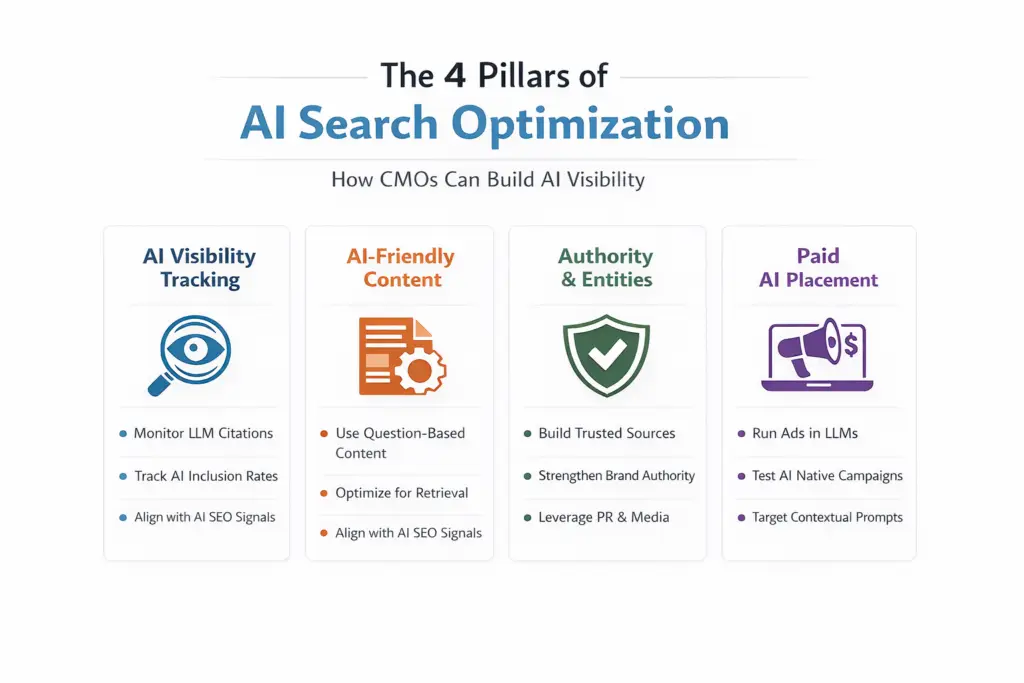
AI Visibility Tracking
You cannot manage what you do not measure. Track:
- Citation share across ChatGPT, Gemini, Perplexity
- Inclusion rate in AI-generated responses
- Competitive share of model
- AI referral traffic
Tools such as Rankshift provide citation tracking visibility (Source: Rankshift.ai). This becomes the new search console.
AI SEO and Retrieval Optimization
AI SEO requires:
- Question-based headers
- Clear 2-3 sentense answer summaries
- Updated timestamps
- Expert author attribution
- Structured schema
- Clean semantic organization
AI Search Optimization prioritizes retrieval precision over ranking position.
Authority and Entity Reinforcement
AI System cite trusted sources. Search Engine Journal reports that AI engines often cite third-party authorities content over owned assets (Source: SearchEngineJournal).
MuckRank’s Generative Pulse Report found journalism cited 27% of the time – and over 49% for recency-based queries (Source: Generativepulse.ai).
Digital PR is no longer optional amplification. It is AI infrastructure.
Paid Placement Inside AI Platforms
AI monetization is accelerating.
- Perplexity is testing sponsored responses
- Google is piloting ads inside AI Overviews.
- ChatGPT supports commerce integrations (Source: ChatGPT)
Advertising is evolving from keyword-triggered to context-triggered. AI Search Optimization must anticipate this convergence.
New KPIs for CMOs
Traditional dashboards measure:
- Rank
- Traffic
- Impressions
- CTR
AI-era dashboards must measure:
- AI Citation Share
- Inclusion Rate
- Share of Model
- AI Referral Conversion Rate
- Citation Authority Strength
Terakeet describe AI visibility as the new performance metrics. (Source: Terakeet.com). Visibility now precedes traffic.
The Strategic Risk of Inaction
If AI Search Optimization is neglected:
- Competitors define your narrative
- Outdated information persists
- Authority shifts silently
The Australian warned of an “AI Moment of Truth” for businesses in 2024 (Source: The Australian). AI models are synthesis engines. Synthesis favours structured authority.
The CMO Action Plan
To operationalized AI Search Optimization:
- Audit AI Visibility across major LLMs
- Identify citation gaps
- Redesign high-value pages for AI SEO
- Strengthen entity authority through PR
- Track AI referral conversion
This is not experimental work. It is structural work.
Conclusion: AI Search Optimization Defines the Next Competitive Era
SEO remains foundational. But it is no longer sufficient.
AI Search Optimization determines whether your brand is:
- Cited
- Contextualized
- Trusted
- Included
Inside the environments where decisions now begin. The strategic question for CMO is no longer:
“Do we rank?”
It is:
“Are we visible inside AI answers?”
In the AI era, visibility compounds before traffic arrives. And that compounding begins with AI Search Optimization.
Check out my other articles on AI here.
Frequently Asked Questions
-
What is AI Search Optimization?
AI Search Optimization ensures a brand is cited and represented within AI-generated search results rather than relying solely on rankings. It focuses on AI visibility inside LLM platforms like ChatGPT and Google AI Overviews.
-
How is AI SEO different from traditional SEO?
AI SEO optimizes for semantic clarity, structured retrieval, and citation inclusion. Traditional SEO optimizes for rankings and traffic.
-
Why is AI visibility important for CMOs?
AI visibility determines how your brand is presented before a website visit occurs. As AI Overviews now apper in over 50% of searches, visibility inside answers shapes perception early.
-
Does AI Search Optimization replace SEO?
No. AI Search Optimization builds upon traditional SEO foundations while expanding into AI-driven discovery.
-
How do you measure AI visibility?
AI visibility can be measured through citation share, inclusion rate, share of model, AI referral traffic and conversion performance.