
Table of Contents
Introduction
Search has changed, not incrementally, but structurally.
For two decades, digital visibility meant ranking on the first page of search engines. Marketing teams optimized for keywords, monitored click-through rates, and reported traffic growth as a proxy for influence.
Today, that model is incomplete.
AI-generated answers are increasingly replacing the traditional list of blue links. Instead of directing users to websites, search engines and AI assistants synthesize responses directly within the interface. Decisions are shaped upstream, often before a click ever happens.
For CMOs and executive leadershop teams, this shift introduces a new strategic imperative:
If your brand is not visible inside AI-generated answers, you are absent at the moment perception is formed.
This is where AI Visibility Measurement becomes essential.
It is no longer enough to ask:
- Where do we rank?
- How much traffic did we receive?
- What is our CTR?
The more relevant executive questions are now:
- Are we included in AI answers?
- Are we positioned as a trusted authority?
- Is AI recommending us in a high-intent queries?
- Does our AI visibility translate into measurable revenue impact?
This article introduces a structured approach to answering those questions through the Executive AI Visibility Framework (AEVF), a five-layer model designed to elevate AI Search Optimization from tactical SEO into a board-level performance dicipline.
The Structural Shift from Search Engines to Answer Engines
To understand why AI Visibility Measurement matters, we must first recognize how discovery behaviour has changed.
Traditional search followed a predictable path:
- User types a query
- Search engine displays ranked results
- User clicks a link
- Website controls the narrative
In contrast, AI-drive search now looks like this:
- User asks a question
- AI synthesizes multiple sources
- AI delivers a direct answer
- User may never click a website
This transition from “search engine” to “answer engine” fundamentally alters the visibility equation.
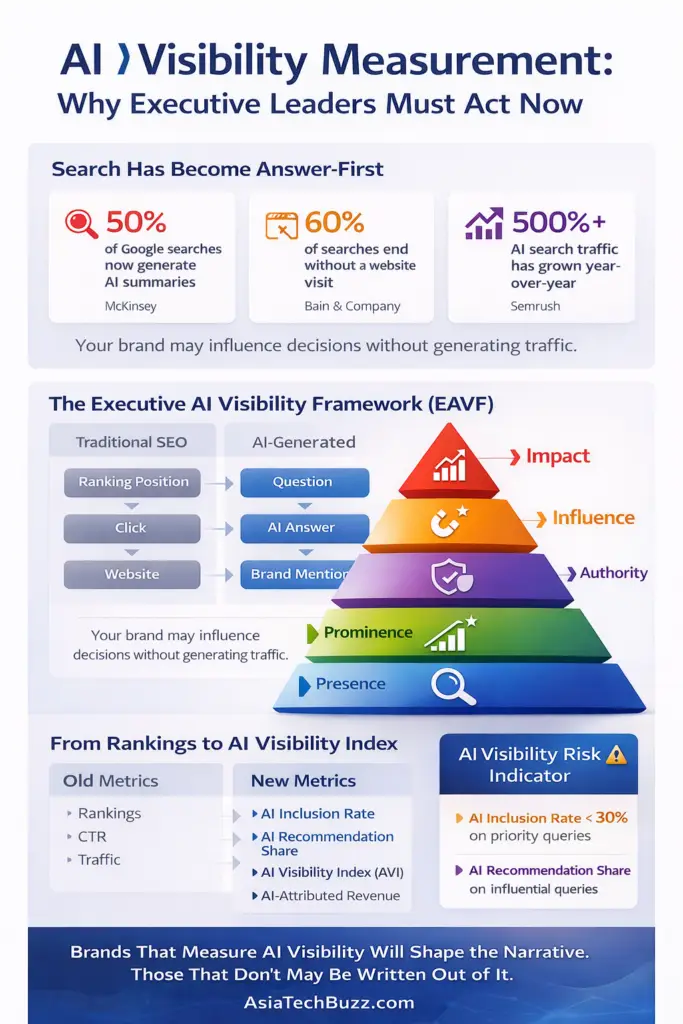
According to McKinsey, approximately 50% of Google searches now generate AI summaries, and that figure is expected to rise toward 75% by 2028 (source: McKinsey).
Bain reports that roughly 80% of users rely on AI-generated summaries at least 40% of the time, and close to 60% if searches end without the user progressing to a website (Source: Bain)
This is not a temporary fluction. It signals a reconfiguration of how brand influence occurs.
For executive teams, the implication is clear:
Visibility is shifting from rankings to inclusion inside AI answers.
And inclusion requires measurement.
Why AI Visibility Measurement Is Now a Leadership Priority
AI Visibility Measurement is not an SEO refinement. It is a strategic governance requirement.
Declining CTR Does Not Equal Declining Influence
As AI summaries answer questions directly, traditional click-through rates are declining. However, this does not necessarily indicate that a brand has lost relevance.
Instead, influence may have moved upstream, embedded within AI responses.
Within AI Visibility Measurement, marketing dashboards risk misinterpreting performance signals.
Brand Perception Is Formed Before Website Interaction
AI-generated answers summarize, compare, and frame information.
If AI describe your brand as “expensive”, “complex”, or “alternative”, that framing influences perception, even if the user never visits your website.
Measurement must therefore extend to narrative positioning.
Competitive Advantage Is Being Rewritten by AI
AI systems often select and prioritize certain sources when generating answers. That selection is not random.
Brands with stronger structural authority, clearer entity recognition, and better semantic architecture are more likely to be referenced.
AI Visibility Measurement enables leaders to understand whether AI ecosystems are amplifying their authority, or favoring competitors.
Defining AI Visibility Measurement in Executive Terms
AI Visibility Measurement is the stuctured evaluation of a brand’s presence, authority, influence, and commercial impact within AI-generated discovery environments.
It answers five critical executive quesitons:
- Are we present?
- Are we prominent?
- Are we trusted?
- Are we influencing decisions?
- Are we driving measurable outcomes?
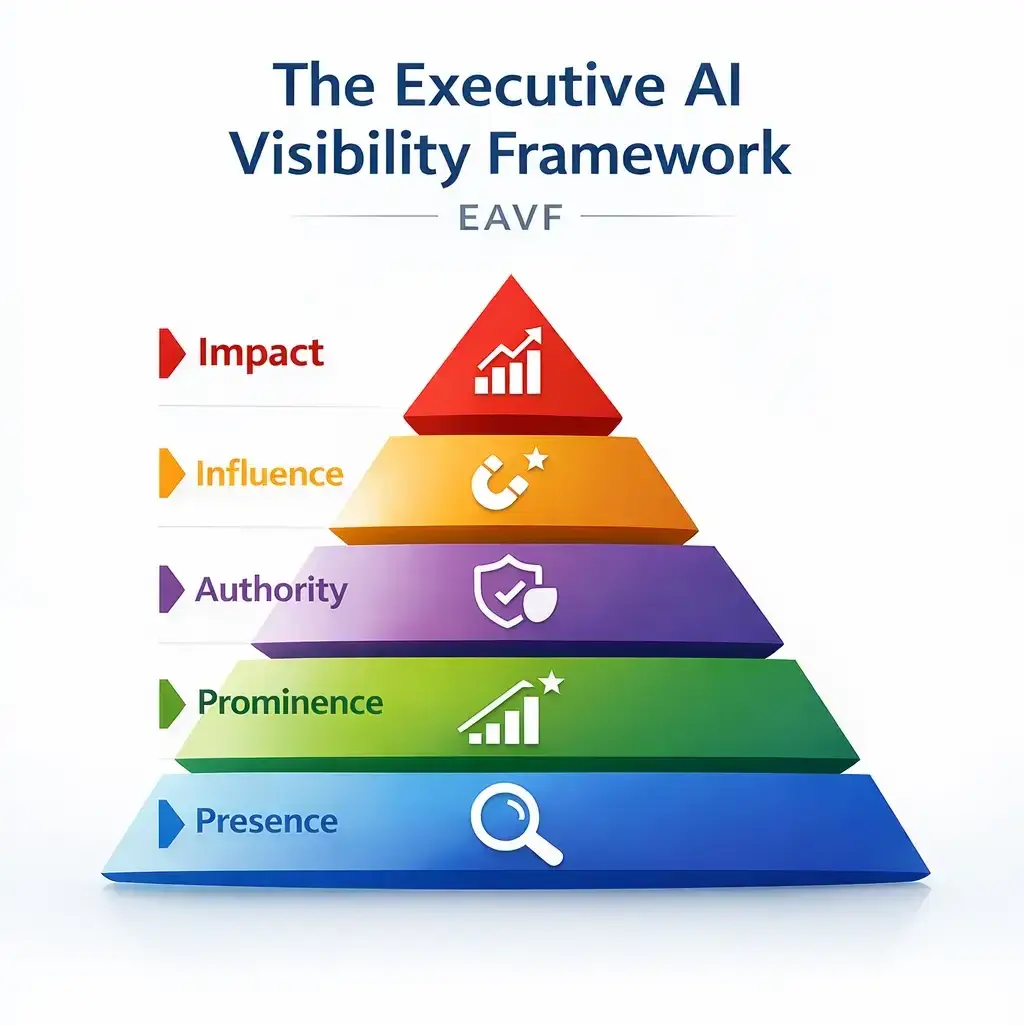
To operationalize these questions, we introduce the Executive AI Visibility Framework (EAVF).
The Executive AI Visibility Framework (EAVF)
The Executive AI Visibility Framework organizes AI Visibility Measurement into five progressive layers:
Presence -> Prominence -> Authority -> Influence -> Impact
Each layer builds upon the previous one.
Together, they provide a comprehensive view of AI Search Optimization performance.
Layer 1: Presence
Are We Appearing in AI Answers?
Presence is the foundation of AI Visibility Measurement. If your brand is not appearing in AI-generated responses across priority queries, your visibility gap is immediate and measurable.
What Presence Measures
- Inclusion in AI summaries
- Appearance across key transactional queries
- Frequency of citation
- Share of AI Voice compared to competitors
Why It Matters
Presence replaces ranking position as the new baseline visibility indicator. Without presence, no downstream influence can occur.
Layer 2: Prominence
Are We Leading or Just Mentioned?
Prominence evaluates positioning within AI answers.
AI-generated responses often:
- Lead with a primary source
- Structure comparative narratives
- Highlight authoritative references
What Prominence Measures
- Citation order
- Mention frequency within answer structure
- Dept of explanation
- Sentiment context
Strategic Implication
Prominence determines narrative power. Appearing second in a comparison may not be equivalent to being described as “industry-leading” in the first paragraph.
AI Visibility Measurement must account for positioning quality, not just inclusion.
Layer 3: Authority
Why Does AI Trust Our Content?
Authority reflects structural credibility.
AI systems evaluate:
- Schema markup
- Content freshness
- Backlink quality
- Entity recognition
- Knowledge graph integration
Organizations investing in structured content architecture often see stronger AI inclusion.
Authority as a Strategic Asset
Authority is not built overnight.
It requires:
- Governance
- Technical alignment
- Consistent publishing standards
- Clear entity mapping
Without authority, Presence becomes unstable and inconsistent.
Layer 4: Influence
Is AI Steering the Decision Toward Us?
Influence measures whether AI-generated answers actively recommend or favor your brand.
According to Semrush, AI search traffic has grown over 500% year-on-year, reflecting rapid adoption (Source: Semrush).
As users increasingly consult AI for recommendations, the ability to influence outcomes becomes commercially significant.
Influence Metrics
- AI Recommendation Rate
- Comparative Query Win Rate
- Competitive AI Share of Voice
- Favorability Indicators
Influence bridges narrative presence with decision impact.
Layer 5: Impact
Does AI Visibility Translate into Revenue?
Impact connects AI Visibility Measurement to financial outcomes.
It evaluates whether:
- AI-assisted sessions convert at higher rates
- Brand trust improves conversion efficiency
- Customer acquisition costs shift
- Revenue increases from AI-driven discovery
Without Impact measurement, AI visibility remains a theoretical metric. With it, AI Search Optimization becomes a growth strategy.
The AI Visibility Index (AVI)
To simplify reporting, organizations can aggregate the five layers into a composite KPI:
AI Visibility Index (AVI)
Each layer may be weighted equally or adjusted based on strategic priorities. The AVI allows executives to:
- Track performance quarterly
- Benchmark competitors
- Justify investment
- Identify structural gaps
It transforms AI Visibility Measurement into a governance tool.
Organizational Implications of AI Visibility Measurement
AI Visibility Measurement requires cross-functional alignment.
It impacts:
- Marketing strategy
- CMS infrastructure
- Data analytics
- Content governance
- Competitive intelligence
This is not a campaign-level initiative. It is an enterprise capability.
The Risk of Ignoring AI Visibility Measurement
Organizations that fail to measure AI Visibility may experience:
- Invisible brand erosion
- Misinterpreted performance metrics
- Competitive narrative disadvantage
- Missed revenue attribution
Silence inside AI-generated answers is not neutral. It is strategically costly.
The Future of Executive Marketing KPIs
The next evolution of marketing dashboards will include:
- AI Visibility Index
- AI Recommendation Share
- AI Authority Score
- AI-Attributed Revenue
Traditional metrics will remain relevant, but insufficient.
AI Visibility Measurement will sit alongside brand equality and market share as a core executive KPI.
Conclusion: Leading in the Age of Answer – First Discovery
AI is not simply enhancing search. It is reshaping it.
- Influence is now formed upstream.
- Visibility exists within synthesized answers.
- Authority is determined structually
- Impact must be measured financially.
The Executive AI Visibility Framework (EAVF) provides a structured approach to measuring this transformation.
For CMOs and EXCO, AI Visibility Measurement is no longer experimental.
It is a leadership responsibility.
And in the era of answer-first discovery, those who measure visibility will shape perception. Those who do not may find their narrative written by others.
Check out my other articles on AI Search Optimization here.
Frequently Asked Questions (FAQs)
-
What is AI Visibility Measurement?
AI Visibility Measurement is the process of evaluating how a brand appears, is positioned, and influences decisions within AI-generated search results. Unlike traditional SEO metrics, it measures inclusion in AI answer, citation prominence, structural authority, recommendation rates, and commercial impact to assess AI Search Optimization performance.
-
How is AI Visibility Measurement different from traditional SEO?
Traditional SEO forcuses on rankings, traffic, and click-through rates. AI Visibility Measurement goes further by analyzing whether your brand is cited inside AI-generated answers, how promimently it appears, and whether it influences decisions before a user clicks. It reflects visibility in answer-first search environments, not just search engine result page.
-
Why is AI Visibility Measurement important for CMOs?
AI-generated summaries increasingly shape brand perception before website visit occur. AI Visibility Measurement enables CMOs to understand whether their brand is present, trusted, and recommended in AI search results, and how that visibility impacts revenue, customer acquisition, and competitive positioning.
-
What metrics are used in AI Visibility Measurement?
AI Visibility Measurement typically includes metrics such as AI Answer Inclusion Rate, Citation Position Index, AI Recommendation Rate, Structured Data Coverage, Competitive Share of AI Voice, and AI Attributed Revenue. These metrics form part of the Executive Visibility Framework (EAVF) and can be consolidated into an AI Visibility Index (AVI).
-
How can organizations improve their AI Visibility?
Organizations can improve AI Visibility by strengthening structured content architecture, implementing schema markup, enhancing entity clarity, maintaining content freshness, and monitoring AI-generated responses across priority queries. AI Visibility Measurement helps identify gaps and prioritze AI Search Optimization initiative strategically.