
Table of Contents
For the last decade, MarTech conversations have been dominated by tools.
- Which CDP should we buy?
- Should we consolidate vendors?
- Is our stack best-in-class?
By 2026, those questions will no longer define MarTech leadership.
Across Asia-Pacific, the most advanced organizations are moving beyond tools and platforms. the conversations is shifting decisively towards outcomes, accountability, and growth impact. MarTech is no longer viewed as a support layer for marketing teams. It is becoming core revenue infrastructure.
This shift is also redefining leadership.
The future of MarTech leader is not a platform owner or a stack builder. They are MarTech Growth Architect, someone who aligns data, technology, operating models, and teams to deliver measurable business results.
Why Traditional MarTech Thinking is Becoming Obsolete
Most organizations still operate MarTech using a mindset formed in the late 2010s. MarTech is often positioned as a collection of tools designed to help marketing teams execute campaigns more efficiently.
That model is breaking down.
Customer journeys today are fragmented, continuous, and non-linear. Customers move seamlessly across:
- Websites and mobile apps
- Physical retail and digital commerce
- Paid media, owned channels, and partner ecosystems
In APAC, this complexity is amplified by:
- Super-apps and ecosystem platforms
- Embedded finance and digital wallets
- Rapid growth of retail media networks
- Fragmented and tightening privacy regulations
A MarTech stack designed primarily for campaign execution cannot support this reality. What organizations now require is end-to-end growth orchestration, where data, decisioning and activation operate as one system.
This is the environment in which MarTech Growth Architect emerges.
MarTech’s Evolution: From Enablement to Revenue Infrastructure
MarTech’s Traditional Role: Enablement
Historically, MarTech focused on enabling marketing teams to operate at scale. Core responsibilities typically included:
- Campaign automation
- Content management and personalization
- Channel execution and reporting
Success was measured through activity-based metrics such as impressions, open-rates, and clicks. While useful, these metrics rarely translated directly into business value.
In this model, MarTech functioned as an enablement layer – important, but not mission-critical.
MarTech’s New Role: Revenue Infrastructure
By 2026, leading organizations are repositioning MarTech as revenue infrastructure.
This means MarTech directly supports:
- Customer acquisition efficiency
- Conversion velocity across channels
- Lifetime value growth
- Cost-to-serve reduction
MarTech platforms are no longer evaluated solely on features or usability. They are assessed based on how clearly they contribute to revenue, efficiency, and trust.
In this environment, the MarTech Growth Architect is accountable not for tool adoption, but for outcomes.
The End of Bloated Stacks and the Rise of Intelligence Layers
Between 2018 and 2025, many enterprises aggressively expanded their MarTech stacks. According to Chiefmartech, the global MarTech landscape grew to over 15,384 solutions by 2025.
Yet more tools did not lead to better results.
By 2026, a clear pattern is emerging:
- Fewer core platforms
- Deeper integration across systems
- Greater investment in intelligence and decisioning
What expands is not the number of tools, but the intelligence layer:
- Real-time customer data unification
- AI-driven decision engines
- Cross-channel journey orchestration
For a MarTech Growth Architect, stack simplification is not about cost reduction alone. It is about increasing speed, clarity, and scalability across the entire growth engine.
AI in MarTech: From Experimentation to Operational Decisioning
The Experimentation Phase (2023 – 2025)
In recent years, AI adoption in MarTech focused heavily on experimentation:
- Generative AI for content
- Chatbots and conversational interfaces
- Copilots to assist marketers
These initiatives generated excitement and visibility, but often delivered limited commercial impact.
The Operational Phase 2026 and Beyond
By 2026, AI becomes embedded into operational decisioning.
AI increasingly:
- Det4ermines next-best actions
- Allocates marketing budget dynamically
- Orchestrates customer journeys in real time
- Optimizes engagement based on context, risk and value
Gartner predicts that by 2026, 80% of customer interactions will be influenced by AI driven decisioning, up from less than 10% in 2022.
This shift fundamentally changes the role of MarTech leadership. Trusting machines with decisions requires governance, transparency, and accountability – core responsibilities of the MarTech Growth Architect.
Privacy Architecture as a Competitive Advantage in APAC
Privacy is No Longer Just Compliance
Across APAC, privacy regulation is tightening rapidly:
- Singapore’s PDPA
- Australia’s Privacy Act reforms
- Indonesia’s PDP Law
- Vietnam’s Personal Data Protection Degree (Degree 13/2023/ND-CP), with stronger enforcement expectations from 2026
Vietnam’s PDPL, for example, introduces explicit consent requirements, purpose limitation, and stricter controls on cross-border data transfers.
These regulations have direct implications for MarTech systems, including CDPs, CRM platforms, personalization engines, and AI models.
Privacy-First Architecture as a Growth Lever
Leading organizations are moving beyond compliance and turning privacy into a competitive differentiator.
Customers are more willing to share data when:
- Consent is transparent
- The value exchange is clear
- Data usage is responsible
According to Deloitte, 88% of consumers are more likely to trust companies that clearly explain how their data is used, directly influencing conversion and retention.
By 2026, privacy-by-design MarTech architectures will outperform those that treat compliance as an afterthought. For the MarTech Growth Architect, trust becomes a measurable driver of growth.
The Convergence of Retail Media, CRM and Commerce
Channel Silos Are Collapsing
One of the most important MarTech shifts in APAC is the convergence of:
- Retail media networks
- CRM and customer data platforms
- Commerce and transaction systems
E-commerce platform such as Shopee and Lazada now offer:
- On-platform advertising
- Closed-loop attribution
- Direct linkage between media spend and revenue
This fundamentally changes how marketing performance is measured – from impressions and click to revenue attribution.
What This Means for MarTech Leadership
The key question is no longer:
“Which channel performs best?”
Instead:
“How do we orchestrate growth across the entire customer lifecycle?”
Answering this question requires a holistic view of data, decisioning, and activation – exactly the mandate of the MarTech Growth Architect.
Why Most MarTech Transformations Fail
Despite significant investment, many MarTech transformations underperform. According to Boston Consulting Group, 70% of digital transformations fail to deliver expected value, largely due to operating model and governance challenges.
Common Failure Patterns
- Channel-centric teams
- Fragmented ownership between marketing, IT, and data
- IT deciding on the MarTech platform and evaluating only from technical perspective without considering end-user experience and/or MarTech ecosystem
- Marketing team not taking ownership and leaving decision making to IT
- KPIs focused on activity instead of outcomes
Technology rarely fails. Operating models do.
The MarTech Maturity Model (2026 Perspective)
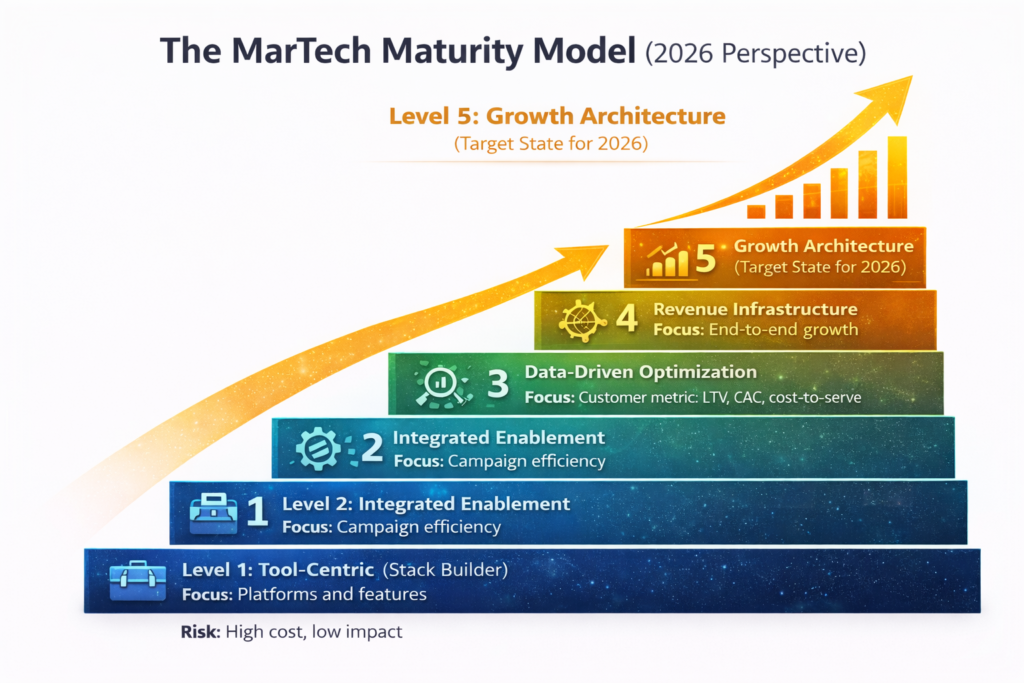
Level: Tool-Centric (Stack Builder)
- Focus: Platforms and features
- Success metric: Adoption
- Risk: High cost, low impact
Level 2: Integrated Enablement
- Focus: Campaign efficiency
- Success metric: Engagement
- Risk: Limited scalability
Level 3: Data-Driven Optimization
- Focus: Customer insights
- Success metric: Conversion uplift
- Risk: Slow decisioning
Level 4: Revenue Infrastructure
- Focus: End-to-end growth
- Success metric: LTV, CAC, cost-to-serve
- Capability: AI-driven decisioning
Level 5: Growth Architecture (Target State for 2026 and beyond)
- Focus: Scalable, trusted growth
- Success metric: Revenue, efficiency, trust
- Leadership: MarTech Growth Architect
Most organizations in APAC today sits between Level 2 and 3.
The Rise of the MarTech Growth Architect
The MarTech Growth Architect is not a platform owner.
They are:
- A growth translator
- A data orchestrator
- A cross-functional integrator
They align:
- Business strategy
- Data and AI
- Technology platforms
- Operating models
Their success is measured not in tool maturity, but in revenue impact, operational efficiency, and customer trust.
How MarTech Will be Judge in 2026 and beyond
By 2026, MarTech success will be evaluated through a different lens:
| Then | Now |
|---|---|
| Number of tools | Revenue Impact |
| Campaign volume | Decision velocity |
| Feature depth | Customer trust |
| Platform usage | Cost efficiency |
Advanced technology without measurable outcomes will no longer be defensible.
Conclusion: Leadership is the Real MarTech Upgrade
The most important MarTech investment in 2026 will not be another platform.
It will be:
- New leadership mindsets
- New operating models
- Clear accountability for growth
Organizations that continue to treat MarTech as a collection of tools will struggle. Those that succeed will be by MarTech Growth Architects – leaders who design systems around outcomes, not vendors.
Final Thought
If your MarTech roadmap still starts with tools, you are already behind. Instead, you should:
- Start with outcomes
- Design backward
That is the mindset of a MarTech Growth Architect.
Click here to read my other articles on MarTech.
-
What is a MarTech Growth Architect?
A MarTech Growth Architect is a leader who designs and governs marketing technology as revenue infrastructure, aligning data, AI, platforms, and operating models to drive measurable business growth.
-
How is a MarTech Growth Architect different from a traditional MarTech leader?
Traditional MarTech leaders focus on tools and platforms. A MarTech Growth Architect focuses on outcomes – such as revenue impact, efficiency, customer trust, and decision speed – across the entire customer lifecycle.
-
Why will MarTech stacks matter less by 2026?
By 2026, competitive advantage will come from intelligence and decisioning, not the number of tools. Organizations will prioritize integrated platforms, AI-driven orchestration, and clear ownership over bloated MarTech stacks.
-
How does AI change the role of MarTech teams?
AI shifts MarTech from campaign execution to operational decisioning. It enables real-time personalization, budget optimization, and next-best-action decisions, requiring stronger governance and leadership accountability.
-
Why is privacy important in modern MarTech strategy?
Privacy is becoming a growth and trust differentiator. Privacy-by-design MarTech architectures help organizations comply with regulations across APAC while increasing customer confidence and long-term value.