
Table of Contents
Introduction
For more than a decade, SEO was largely a keyword optimization discipline. Success was defined by ranking positions, keyword density, backlinks, and incremental gains on a search results page dominated by blue links. The playbook was tactical and predictable.
But search has evolved – structurally.
Today, discovery is increasingly mediate by AI systems. Large Language models (LLMs), semantic retrieval engines, and knowledge graphs interpret meaning rather than match strings. Google’s AI Overviews and generative summaries are reshaping how visibility is earned. Gartner predicts that traditional search engine volume will decline by 25% by 2026 as AI-driven interfaces absorb more query behavior. (Source: Gartner)
This is not a temporary alogrithm update.
It is a shift in how information is processed.
In this environment, keyword optimization alone is insufficient. AI systems prioritize semantic depth, entity clarity, and structured coverage across a domain. They evaluate how comprehensively your content maps to a topic graph and how consistently your organization reinforces related entities.
This is where Topical Authority SEO becomes strategic.
Topical Authority SEO moves organizations from page-level optimization to domain-level authority architecture. It integrates content clusters, entity networks, structured data, and CMS taxonomy design into a coherent system of credibility.
For CMOs, this is no longer an SEO conversation. It is a digital visibility strategy decision.
From Keywords to Topic Graphs
Traditional SEO optimized for isolated queries.
Modern AI search evaluates connected knowledge systems.
When a user ask a question, AI systems retrieve semantically relevant passages based on vector similarity and contextual relationships. The retrieval process favors domains that demonstrate structured coverage across related concepts.
This is the essence of Topical Authority SEO.
A topical graph represents the structured relationships among entities within a domain. If you publish about “AI Search Optimization”, AI systems expect related coverage across:
- Entity-Based SEO
- Semantic SEO Strategy
- Knowlege Graph SEO
- Structured Content CMS
- AI Search Ranking Factors
- Content Clusters Strategy
If your coverage is shallow or fragmented, authority signals weaken.
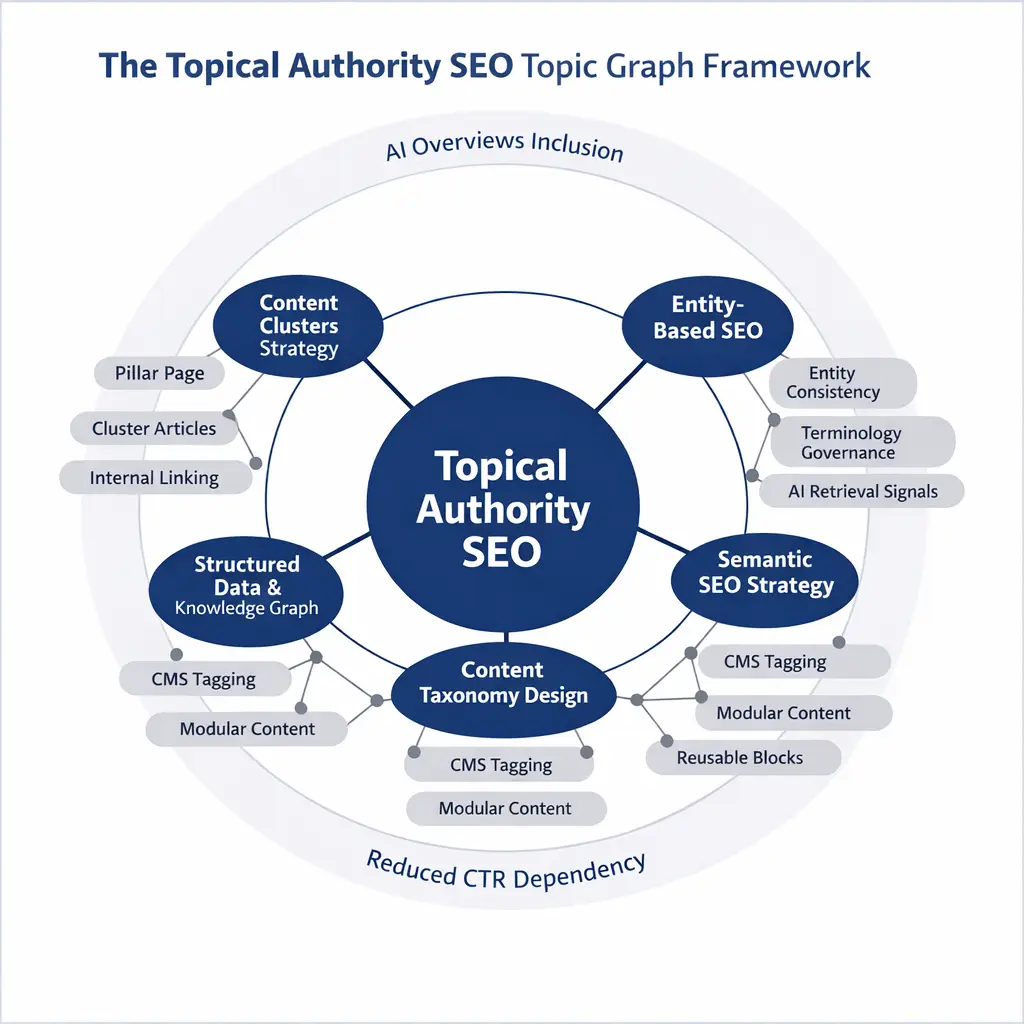
Google’s Helpful Content guidance reinforces this by encouraging content that demonstrates expertise and dept rather than superficial keyword targeting (Source: Google).
Topical Authority SEO aligns directly with this direction.
Why Topical Authority SEO Matters in an AI-Medicated Landscape
Search remains foundational. BrightEdge reports that 68% of online experiences with a search engine (Source: BrightEdge).
At the same time, nearly 60% of Google searches now end without a click (Source: Sparktoro).
This creates a new reality:
- Impressions are rising
- Click-through rates are declining
- AI summaries are consolidating attention
In this environment, visibility depends on being included in AI-generated responses.
Topical Authority SEO increases that probability by strengthening domain-level credibility.
Rather than competing for individual keywords, organizations compete for retrieval priority within AI systems.
Authority compounds. Keywords decay.
Entity Networks and Semantic SEO Strategy
Entities are the foundation of AI understanding.
Google’s Knowlege Graph marked the transition from keyword matching to entity recognition (Source: Google).
An entity has attributes and relationships. AI systems analyze how your content connects entities within a structured semantic network.
For example, a domain focused on Topical Authority SEO should consistently reinforce connections among:
- Topic clusters SEO
- Content taxonomy design
- Structured data
- Internal linking frameworks
- Knowledge graph alignment
Entity-Based SEO ensures clarity and consistency in terminology. Semantic SEO Strategy ensures contextual depth.
Without consistent entity reinforcement, AI systems struggle to interpret domain expertise.
Topical Authority SEO requires discipline in language, structure, and coverage.
Why Content Clusters Strategy Outperforms Keyword Tactics
A Content Clusters Strategy organizes content into:
- A pillar page
- Supportig cluster articles
- Structured internal linking
HubSpot’s research popularized the topic cluster model, demonstrating its effectiveness in reinforcing SEO performance (Source: Hubspot).
This structure mirrors how AI systems interpret knowledge.
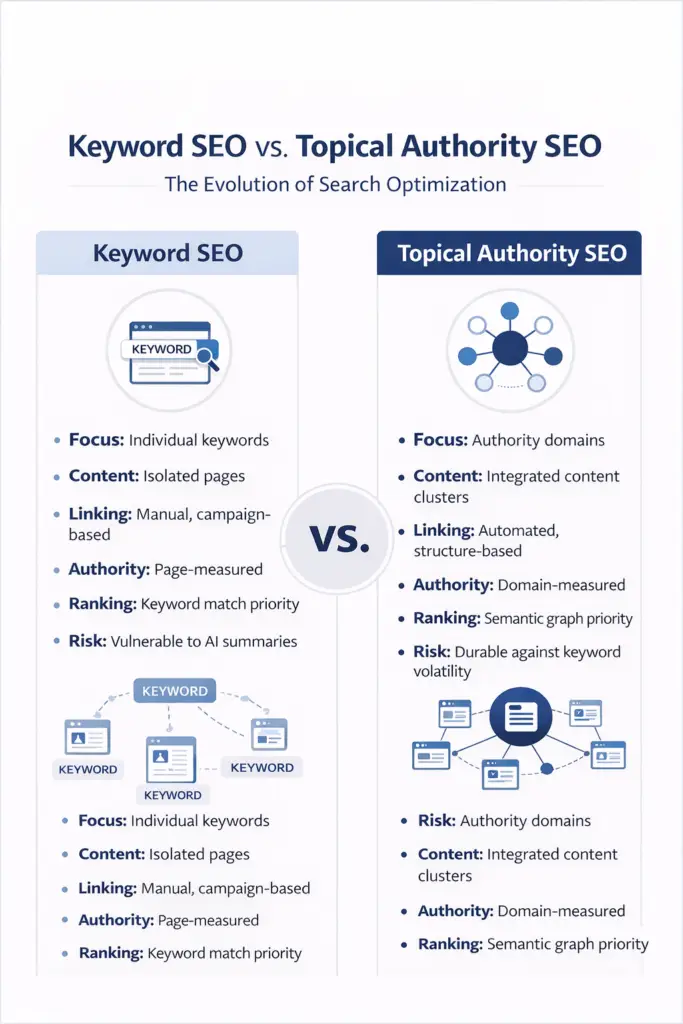
- Pillar content defines scope.
- Cluster content demonstrates depth.
- Internal linking reinforces relationships.
Collectively, this strengthen Topical Authority SEO by signaling comprehensive coverage rather than isolated relevance.
Keyword-centric strategies create scattered assets. Cluster strategies create authority ecosystems.
In AI-driven search, ecosystems win.
CMS Taxonomy Design: Infrastructure Behind Topical Authority SEO
Technology decisions increasingly shape visibility outcomes.
A traditional page-based CMS encourages fragmented publishing. A structured content CMS enables:
- Modular content blocks
- Entity tagging
- Reusable definitions
- Consistent taxonomy governance
CMS taxonomy design determines whether your content forms a coherent topic graph or remains disconnected pages.
Topical Authorigy SEO depends on:
- Controlled vocabularies
- Hierarchical tagging
- Cross-domain categorization
- Automated linking logic
Without structured taxonomy, authority cannot scale.
Enterprise CMS platforms, when properly implemented, enable structured content models that reinforce entity networks across domains.
CMS is no longer a backend decision. It is a strategic authority enabler.
Content Reuse and Structured Reinforcement
One of the most powerful advantages of structured content architecture is reuse.
Reusable content blocks allow standardize definitions and consistent messaging across:
- Articles
- Resource hubs
- FAQs
- Landing Pages
Each reuse reinforces entity clarity.
Consistency strengthens AI confidence.
In regulated industries, where precision matters, structured reuse becomes even more critical. Topical Authority SEO benefits from reinforcement – not repetition, but structured reinforcement.
AI Search Ranking Factors and Authority Signals
McKinsey enstimates that generative AI could contribute $4.4 trillion in annual economic value (Source: McKinsey).
As AI mediates more cunsumer interactions, authority signals gain weight.
AI systems prioritize:
- Structured domains
- Comprehensive coverage
- Trusted entities
- Clear relationships
Structured data further enhances machine interpretability (Source: Google).
Topical Authority SEO aligns content architecture with these emerging signals.
Organizational Implications for CMOs
Adopting Topical Authority SEO requires structural change.
From campaign publishing, to authority building.
From volume metrics, to cluster performance.
From Page optimization, to domain architecture.
CMOs should:
- Define core authority domains.
- Map topical graphs.
- Align CMS taxonomy.
- Develop pillar + cluster frameworks.
- Implement structured data.
- Monitor AI visibility.
This is an infrastructure decision – not a tactical one.
Conclusion: Engineering Authority in the AI Era
Search has evolved from keyword matching to semantic reasoning. AI systems now mediate discovery through knowledge graphs, vector embeddings, and contextual retrieval. In this environment, visibility is no longer earned through isolated page optimization but through structure domain credibility.
This is why Topical Authority SEO represents a fundamental strategic shift. It aligns content architecture with how AI systems interpret expertise. It requires discipline in entity definition, coherence in content clustering, and intentional CMS taxonomy design. It transforms SEO from a tactical channel into a structural advantage.
Organizations that invest in Topical Authority SEO are not simply improving rankings. They are engineering credibility within AI retrieval systems. They increase their likelihood of being cited, summarized, and surfaced in generative environments. They future-proof content investments against declining click-through rates and the expansion of zero-click experiences.
In an intelligence-driven search landscape, authority compounds when it is architected deliberately. Content clusters reinforce semantic depth. Entity networks strengthen contextual clarity. Structured CMS design enables scalable governance.
The brands that understand this shift early will shape how thye are represented in AI-driven search tomorrow.
Because in the AI era, authority is not claimed.
It is built – structurally.
Read my other articles on Marketing Strategy and AI Search Optimization.
Frequently Asked Questions (FAQs)
-
What is Topical Authority SEO?
Topical Authority SEO is a strategy focused on building comprehensive coverage around a specific subject area through interconnected content clusters, consistent entity usage, and structured taxonomy. Instead of optimizing individual keywords, it strengthen domain-level authority, making content more visible in AI-driven search and semantic retrieval systems.
-
How is Topical Authority SEO different from keyword SEO?
Keyword SEO optimizes individual pages for specific search terms. Topical Authority SEO builds authoriuty across an entire subject domain using pillar content, cluster articles, internal linking, and entity consistency. It prioritizes semantic depth and domain credibility over isolated keyword rankings.
-
Why do content clusters matter for AI Search?
Content clusters create structured topic coverage that aligns with how AI systems interpret semantic relationships. By linking pillar pages with related subtopics, clusters reinforce entity networks and improve retrieval signals, increasing the likelihood of appearing in AI summaries and generative search results.
-
How does CMS taxonomy impact Topical Authority SEO?
A well-designed CMS taxonomy enables structured tagging, content reuse, and automate internal linking. This supports Topical Authority SEO by ensuring consistent entity definitions and scalable content relationships, which AI systems rely on to assess domain credibility and contextual relevance.
-
How can CMOs implement Topical Authority SEO?
CMOs can implement Topical Authority SEO by defining core authority domains, mapping topical graphs, restructuring content into clusters, aligning CMS taxonomy, and standardizing entity terminology. This transforms SEO from page-level optimization into a scalable authority architecture for AI-driven search environments.