
Table of Contents
Introduction
Most APAC B2C brands still plan marketing in campaigns. They define segments, build calendars, schedule communications, and measure results after the fact. Next best action marketing APAC changes that operating model. It does not simply ake campaigns more personalised. It replace campaign-first engagement with real-time customer decisioning.
At its core, next best action marketing evaluates every customer interaction as an individual decision. In milliseconds, a brand can decide whether to serve an offer, trigger a service prompt, provide a loyalty nudge, or stay silent. In high-frequency APAC markets, suppression can be as valuable as communication.
This article is the second piece in AsiaTechBuzz’s Hyper-Personalisation at Scale cluster. The first article introduced the APAC Personalisation Architecture Stack (APAS) as a framework for real-time personalisation across data, signals, decisioning, activation and measurement. This article goes deeper into Layer 3: Real-Time Decisioning, where unified customer data becomes action.
The shift is urgent because APAC consumers now move faster than traditional campaign calendars. Southeast Asia’s e-commerce platform GMV reached US$157.6 billion in 2025, growing 22.8% year-on-year, according to Momentum Works. In markets of this scale, advantage goes to brands that can respond while customer intent is still active.
NBA vs NBO – Getting the Strategic Distinction Right
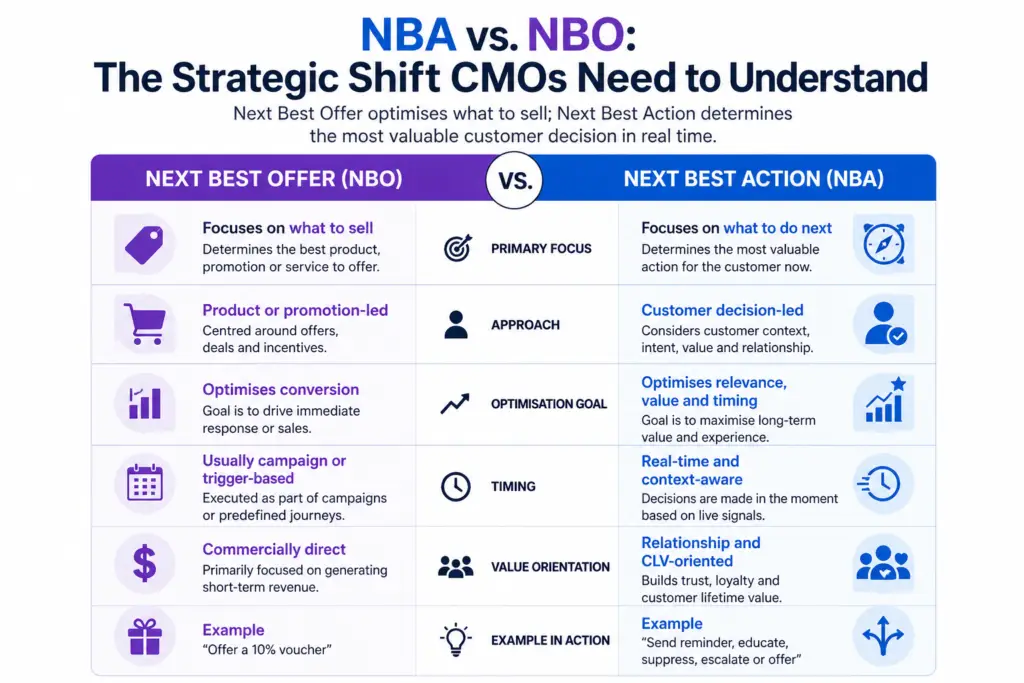
Next best action (NBA) determines the most value action to take for each customer, while next best offer (NBO) focuses specifically on the most relevant product, promotion or service to present.
What is Next Best Action Marketing?
Next best action marketing is a real-time decisioning strategy that uses customer data, behavioural signals, business rules and AI to determine the most relevant action for each individual customer at a specific moment. Pega describes Next Best Action as an approach that uses AI and real-time interaction data to create more relevant customer experiences across channels.
The key word is action. The best action may be a product recommendation, but it may also be a service message, loyalty reminder, onboarding nudge, educational article, call-centre escalation or decision to supress communication entirely.
That is why next best action marketing APAC should not be treated as another campaign automation technique. It asks a broader question: what should the brand do for this customer now, based on context, value, intent, eligibility, consent and relationship state?
What is Next Best Offer Marketing?
Next best offer, or NBO, is narrower. It focuses on the best product, promotion, or service to recommend. CDP.com explains that next best offer is specifically focused on what to sell or promote, while next best action is broader and can include content, service, journey guidance and the decision not to engage.
For many APAC brands, NBO is the natural starting point because it is commercially direct. A retailer can recommend the next product. A telco can recommend a plan upgrade. A bank can recommend a credit card or loan.
However, NBO alone does not solve the deeper customer engagement challenge. It answers what should we sell. NBA answers what shoud we do.
Why NBA Is the Operating System and NBO is One Application
The simplest way to understand NBA vs NBO marketing is this: NBA is the operating system; NBO is one application running on it.
NBO determines the best offer. NBA determines whether any offer should be made, whether the timing is right, which channel is appropriate, whether the customer is eligible, whether contact frequency has been exceeded, and whether the expected value justifies the action.
This distinction matters becaue mature personalisation is not just about selling more. In APAC, where customers may receive email, SMS, App Push, LINE, WhatsApp and marketplace notifications in the same day, customer experience deteriorates quickly when every channel acts independently.
Why Campaign Marketing Is Reaching Its Structural Limit in APAC
Campaign marketing is becoming structurally insufficient because APAC consumers now move faster than segments, batch journeys and campaign calendars can respond.
Campaigns remain useful for coordination. They help marketing teams plan launches, seasonal promotions, lifecycle programmes and commercial priorities. The problem is that campaign planning was not designed for real-time customer intent.
A campaign assumes that a customer remains meaningful similar between the time the segment is built and the time the communication is delivered. The assumption is weakening. A customer may compare products, abandon a cart, search for reviewss, visit a competitor and return through paid search within the same hour. A batch campaign delivered the next day has missed the decision window.
This is where real-time decisioning B2C becomes strategically important. A decisioning engine does not wait for a campaign calendar. It evalutes customer context during the interaction itself.
Segmentation still has value for planning and reporting, but it is not enough for individual-level engagement. A “high-value” customer may be ready to buy, may have just raised a complaint, or may be comparing options but not ready for a discount. Treating them identically does not create true personalisation.
PwC’s 2025 CMO Pulse Survey found that 63% of CMOs say they are missing opportunities because they cannot make decisions fast enough. PwC also reported that 82% say one-to-one personalisation is not realistic right now.
This is the central tension. CMOs want precision, but their operating models are still built around campaign cycles. Next best action marketing APAC addresses this gap by creating a reusable decisioning capability rather than forcing teams to manually design every journey variation.
How a Next Best Action Decisioning Engine Actually Works
A next best action decisioning engine evaluates customer profile data, real-time behavioural signals, business rules and predictive models to determine the most relevant action for each customer interaction.
An NBA decisioning engine is not a black box that magically personalises experiences. It works by combining four structured inputs: the customer profile, live behavioural signals, business constraints and model-based scoring.
Input 1 – The Unified Customer Profile
The decisioning engine is only as good as the customer profile it receives. A complete profile for next best action marketing APAC should include purchase history, browsing behaviour, app engagement, loyalty tier, channel response history, service interactions, consent status, product ownership and prior campaign exposure.
For financial services, telco and subscription categories, the profile may also include payment behaviour, contract expiry, usage patterns, risk indicators, and customer support history. For retail and e-commerce, it may include category affinity, average order value replenishment cycles.
This profile is the foundation of customer lifetime value decisioning. Without it, the decisioning engine can only optimise for short-term conversion. With it, the brand can decide whether the best action is to sell, retain, educate, recover, reassurance or supress.
APAC adds another layer of complexity. Depending on market and integration depth, brands may also draw signals from LINE, WhatsApp Business, wallet behaviour, marketplace journeys and super-app ecosystems.
Input 2 – Real-time Behavioural Signals
The second input is what the customer is doing now. This includes the current session’s clickstream, product searches, cart actions, time spend on page, form abandonment, payment friction, app screen viewxs and repeat visits within a short period.
Real-time signals matter because they reveal intent shifts that historical data may miss. A customer with low historical affinity for premium products may suddenly browse premium skincare, compare reviews and add a luxury item to cart. The decisioning engine should recognise the current intent state.
This is the difference between static personalisation and AI personalisation decisioning APAC. Static personalisation uses what the brand already knows. Real-time decisioning adds what the customer is doing now.
Input 3 – Business Rules and Constraints
NBA engnes do not operate without guardrails. Business rules define what the system is allowed to decide.
These rules may include contact frequency caps, channel consent, offer eligibility, stock availability, loyalty tier requirements, margin thresholds, regulatory restrictions, service suppression rules and strategic priorities. For example, a customer with an unresolved complaint should not receive a cross-sell message simply because the model predicts high conversion probability.
In APAC, business rules must also respect market-specific regulation and operating realities. Singapore and Thailand have PDPA regimes, Indonesia has its Personal Data Protection Law, and Hong Kong has the PDPO. Multi-market NBA deployment cannot rely on one global rulebook.
Input 4 – Propensity and Value Scoring
A propensity model predicts the likelihood that a customer will take a specific action, such as purchasing, churning, upgrading, renewing or responding to a message. Value scoring estimates the commercial value of that response.
A mature next best action decisioning engine evaluates both. A high probability action may no tbe the best action if the expected margin is low, the incentive cost is high or the customer is already fatigued. Conversely, a lower-probability action may be worth prioritising if it protects a high-value customer relationship.
The proven approach is usually hybrid. Rules provide control, compliance and explainability. Machine learningimproves ranking, timing and relevance within those boundaries. Pega’s Next-Best-Action paradigm similarly combines predictive and adaptive analytics with traditional business rules to maximise value from each customer conversation.
The APAC Signal Sets That Drive High-Converting NBA Decisions
The most effective APAC next best action systems rely on behavioural, transactional, loyalty, channel and post-purchase signals rather than broad demographic segments.
A decisioning engine is only as strong as its signal set. In APAC B2C markets, the highest-value signals are often not demographic. Age, gender and income bands can provide context, but they are too coarse to drive individual-level decisions on their own.
Session Recency and Behavioural Velocity
Session recency measures how recently a customer interacted. Behavioural velocity measures how frequently and intensely that behaviour is happening.
A customer who visits three times in two days without purchasing is not the same as a customer who visited once three weeks ago. In e-commerce, travel, fintech applications and telco plan selection, behavioural velocity can be more predictive than static segmentation.
For next best action marketing APAC, these signals help the brand decide whether to remind, incentivise, educate, retarget or wait.
Loyalty Tier Transition Signals
Loyalty programmes are powerful in APAC markets where consumers engage deeply with points, tiers, vouchers, rewqards and member pricing.
A customer approaching a tier upgrade is in a different decisioning state from a customer who is mid-tier with no immediate milestone. The best action may not be a discount. It may be a message showing how close the customer is to the next tier, a preview of next-tier benefits, or an accelerated earn opportunity.
This is where NBA becomes more sophisticated than next best offer. The action is not only “buy this product”. It may be “complete this behaviour to unlock future value’.
Cart Composition and Product Intent Signals
Cart abandonment is a common use case, but the real signal is not simply whether a cart exists. The decisioning engine should evaluate what is in the cart.
A cart with premium skincare and low-value add-on suggests a different intent state from a cart of equivalent value made up of mid-range essentials. A customer removing and re-adding the same product may be hesitating on price or confidence.
The best action may be a reminder, review prompt, product comparision, loyalty message, limited incentive or no message. Blanket discounting can recover some sales, but it can also erode margin and train customers to wait.
Channel Response History
In APAC, channel bejaviour is market-specific. LINE is highly relevant in Thailand. WhatApp Business plays an imortant role in Malaysis and Indonesia. Push notifications and in-app messages are critical for app-first brands. SMS remains important in financial services, logistics and service critical communications.
A next best action decisioning engine should not simply ask what message to send. It should ask which channel is most appropriate for this customer, this action and this moment.
The decision should consider historical response, tie of day, message type, urgency, consent, cost and fatigue.
Post-Purchase Engagement Signals
Post-purchase behaviour is often underused. Customers who track orders, read usage guides, submit reviews, engage with care instructuions or revisit support content are sending strong signals about satisfaction, confidence and future value.
In beauty, wellness, FMCG, pet care and subscription-adjacent categories, post-purchase engagement can inform replenishment timing, upsell readiness and loyalty activation. In financial services, post-application behaviour can indicate whether a customer needs reassurance, education or assistance to complete the next step.
Where APAC Brands Fail at Next Best Action Adoption
Most APAC next bestg action programmes fail not because of technology limitations, but because the organisation has not redesigned ownership, governance and operating processes around real-time decisioning.
Gap 1: The Campaign Team vs. Decisioning Engine Conflict
The most common failure is organisational conflict between scheduled campaigns and real-time decisioning.
Campaign teams plan communications in advance. NBA engines determine actions during the customer journey. When both run independently, the customer may receive contradictory experience. The decision engine may suppress promotional contact because the customer has an unresolved issue, while a campaign calendar sends a sales message the same day.
A practical answer is to separate strategic intent from customer-level execution. Campaigns can define priorities, commercial themes and business objectives. The NBA decisioning engine should detetermine whether those priorities are appropriate for each customer at the moment.
Gap 2: The Model without a Governor
Many brands have propensity models but no governance model. That is risky.
Models can drift. Customer behaviour changes. Product economies shift. Service issues emerge. A model that once performed well may begin recommending high-vale upsells to customers with recent complaints, payment friction or low satisfaction signals.
NBA governance requires a model owner, review cadence, escalation process, performance thresholds and clear documentation. It also requires business accountability. Marketing cannot say “the model decided” when the customer experience goes wrong.
McKinsey reported that 88% of organisations used AI in at least one business function in 2025. but only 7% had fully scaled AI across the organisation. The gap is not adoption, it is operating model maturity.
Gap 3: The Pilot That Never Scales
NBA pilots are common. NBA at scale is much harder.
A brand may deploy a successful cart abandonment pilot, renewal pilot or loyalty trigger. Results look promising. The programme then stalls because the pilot was built on a bespoke data pipeline, a narrow signal set or one channel’s logic.
Scaling requires reusable architecture. In APAS terms, a pilot should not bypass Layer 1 and Layer 2. If the unified customer profile and signal intelligence layer are weak, the Layer 3 decisioning engine will eventually hit a ceiling.
Gap 4: Channel Silos That Break the Customer Experience
NBA also fails when channels continue to operate separate decision rules. The CRM platform sends one message. The app push platform sends another. Paid media retargeting promotes a product the customer already bought. The call centre sees a different offer.
From the customer’s perspective, this is not personalisation. It is fragmentation. The strategic goal should be one decisioning logic across multiple activation channels.
Three APAC Use Cases That Show How NBA Creates Value
The strongest APAC next best action use cases are those where real-time decisioning directly improves conversion, retention, loyalty progression or customer lifetime value.
Use Case 1: SEA E-Commerce Cart Recovery Without Blanket Discounting
Cart recovery is oftehn the first NBA use case because the commercial value is clear. However, many brands still use the same logic for every abandoned cart: send a reminder, then send a discount.
A better approach uses next best action decisioning. A high-intent customer with low price sensitivity may need a reminder. A customer with high price sensitivity may receive a targeted incentive. A loyalty member close to tier upgrade may receive a tier-progress message instead of a voucher. A customer with high fatigue risk may receive no message.
The business value is not only conversion uplift. It is margin protection.
Reuters reported that SEA’s Shopee continued investing in discounts, offers and loyalty benefits as competition intensified, while also investing in AI to improve search recommendations and advertising systems.
Use Case 2: Telco or Fintech Churn Pervention Before Renewal
Telco and fintechs brands often know when a customer is approaching a renewal, repayment milestone, usage drop or inactivity risk. Traditional campaigns may treat all customers in the same renewal window similarly. NBA treats them differently.
A customer with declining usage, recent complaints and low app engagement may need a service recovery action before any commercial offer. A high-value customer with strong usage but low loyalty engagement may need a benefits reminder. A low-risk customer may not need contact at all.
This is where customer lifetime value decisioning become practical. The decisioning engine evaluates churn risk, expected retention value, incentive cost and customer context. The output may be a retention offer, service prompt, education message, call-back task or suppression.
McKinsey’s work on AI-powered next best experience reports that properly calibrated capabilities can improve customer satisfaction by 15-20%, increase revenue by 5-8%, and reduce cost to serve by 20-30%.
Use Case 3: Loyalty Tier Progression in Retail, Travel and QSR
Loyalty programmes are a natural fit for next best action marketing APAC because tier movement, points expiry and reward engagement create clear decision moments.
A customer close to the next tier may receive an encouragement message. A customer who often redeems rewards may receive a reward preview. A customer who is unlikely to respond may be suppressed to avoid waste.
Mastercard Dynamic Yield’s 2026 personalisation maturity research found that 63% of global organisations treat personalisation as a top strategic priority or part of their DNA, yet many still struggle to connect personalisation efforts to measurable outcomes.
The NBA Readiness Assessment for APAC CMOs
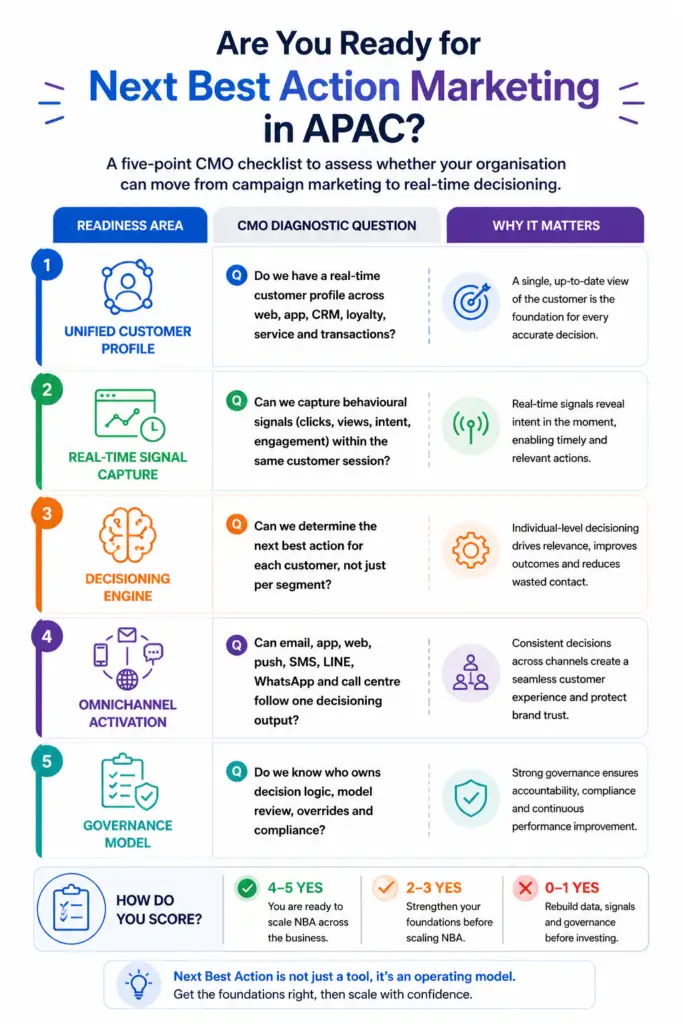
CMOs should access next best action readiness across five areas: customer data, real-time signals, decisioning capability, omnichannel activation and governance.
Before investing in a platform, APAC CMOs should ask whether the organisation is architecturally ready.
1. Do You have a Real-Time Unified Customer Profile?
If the customer profile is fragmented across CRM, app analytics, web analytics, loyalty, service and transaction systems, NBA will be limited. A decisioning engine needs a reliable view of the customer.
2. Can You Capture Behavioural Signals Within a Session?
If the stack cannot capture and route live behaviour during the customer journey, the organisation cannot deliver true real-time decisioning B2C. Batch data may support better segmentation, but it will not support same-session NBA.
3. Do You Have a Decisioning Engine?
A decisioning engine may be rule-based, AI-driven or hybrid. What matters is that it can determine customer-level action output. If every journey still depends on manually selected segments and scheduled campaigns, segment-based marketing remain the ceiling.
4. Are Your Channels Connected to One Decisioning Output?
NBA creates limited value if channels execute independently. Email, push, app, web, messaging and paid media should not each decide separately what the customer receives.
5. Do You Have Governance for Decisioning Logic?
Governance defines who owns decision rules, who reviews models, who approves overides and how compliance is embedded.
Four or five “yes” answers mean NBA deployment is architecturally viable now. Two or three means foundational investment should precede scale-up. Zero or one means the organisation should return to the APAS foundation before attempting enterprise NBA.
Building the Business Case for Next Best Action Marketing APAC
The business case for next best action marketing should be framed around customer lifetime value, decision velocity, retention and margin protection – not only campaign conversion uplift.
The common mistake is to justify NBA only through campaign metrics. Open ratge, click-through rate and conversion uplift are useful, but incomplete.
A stronger executive case includes four value pools. First, revenue growth: NBA increases conversion byh responding to customer intent while it is active. Second, retention and CLV: NBA helps brands intervene before churn and sequence engagement more intelligently. Third, margin protection: NBA reduces unnecessary discounts by determining which customers actually need incentives. Fourth, efficiency: NBA reduces manual journey building and allows decision logic to be reused across channels.
Slow decisioning also has a cost: missed recovery movements, poorly timed offers, irrelevant messages, channel conflict and unnecessary incentives. A customer who abandons an application because they are confused may need guidance, not a discount.
For CMOs, the board narrative should be clear: NBA is not a tool to send more messages. It is an operating model to make better customer decision faster.
A Proven Implementation Path for APAC Brands
The proven implementation path for next best action marketing starts with one high-value journey, builds reusable decisioning infrastructure, and scales only after governance and signal quality are in place.
Start with one journey that is commercially meaningful and operationally manageable, such as cart abandonment, application abandonment, renewal, churn prevention, onboarding completion or loyalty tier progression. The first use case should have available signals, clear decision logic and measurable outcomes.
Next, define the signal set before selecting the tool. Technology cannot compensate for weak data. The CMO and MarTech team should define which customer signals are needed, where they come from, how fresh they must be and how they will be governed.
Most APAC brands should begin with hybrid decisioning: rules for eligibility, compliance and guardrails, plus propensity models and AI scoring to rank eligible actions. This balance control with adaptability.
Finally, connect NBA to activation channels and establish governance before scaling. The decisioning engine must connect to app push, in-app messaging, web personalisation, email, SMS, LINE, WhatsApp, call centre and paid media audiences. The objective is not to build one clever use case. It is to create a reusable customer decisioning capability.
The Future of NBA in APAC: From Real-Time Decisioning to Agentic AI
The next evolution of next best action marketing APAC will combine real-time decisioning with agentic AI systems that can recommend, executge and learn from customer interactions across channels.
Today’s NBA systems recommend the best action. The next wave will increasingly automate parts of execution, testing and optimisation. Agentic AI marketing APAC use cases may include selecting the next best journey, generating compliant creative variants, choosing channels, adjusting frequency, monitoring outcomes and recommending rule changes.
This does not remover the need for governance. It increases it.
McKinsey’s 2025 AI research noted that 23% of respondents were scaling agentic AI systems somewhere in their enterprises, while another 39% were experimenting with AI agents.
For APAC brands, the opportunity is significant. Super-apps already demonstrate what happens when identity, transaction, messaging, loyalty and service signals converge. Their advantage is not only data volume. It is decisioning speed.
Conclusion : NBA is Not Better Campaign Marketing. It is a New Operating Model
Campaign marketing is not failing because marketers are poor at planning. It is reaching its structural limit because the model cannot consistently respond to individual customer intent in real time.
Next best action marketing APAC represents a different way of operating. Every customer interaction becomes a decision. Every decision create feedback. Every feedback loop improves the model. Over time, the gap between NBA-native brands and campaign-dependent competitors compounds.
For CMOs, the strategic implication is clear. The future of personalisation will be won by building the decisioning layer that determines wht each customer should experience next.
That is why APAS Layer 3 matters. It is the layer where data becomes action, where personalisation move beyond segmentation, and where marketing becomes a real-time customer value engine.
To continue exploring how APAC brands can build the architecture, governance, and operating model for hyper-personalisation at scale, read more articles on AsiaTechBuzz.com, including the broader APAS framework and upcoming deep dives into super-app personalisation, dynamic creative optimisation and AI-driven marketing infrastructure.
Frequently Asked Questions (FAQs)
-
What is next best action marketing and how does it work?
Next best action marketing is a real-time decisioning approach that determines the most relevant action for each customer. It uses customer data, behavioural signals, business rules and AI models to decide whether to send an offer, service prompt, content, loyalty message or no communication.
-
What is the difference between next best action and next best offer?
Next best offer focuses on the best product, promotion or service to recommend. Next best action is broader. It decides whether any action should be taken, what type of action is most valuable, which channel should be used and whether suppression is better than communication.
-
How does a next best action decisioning engine work in B2C e-commerce?
In B2C e-commerce, a next best action decisioning engine evaluates live session behaviour, cart content, purchase history, loyalty status, channel response and price sensitivity. It then determines whether to send a reminder, offer a discount, show a product recommendation, trigger a loyalty message or take no action.
-
What data signals does an NBA system need to make real-time decisions?
An NBA system needs unified customer profiles, real-time behavioural events, transaction history, loyalty data, channel response history, propensity scores and business rules. In APAC, additional signals may include LINE, WhatsApp Business, super-app engagement, wallet behaviour and loyalty tier movement where data access is available.
-
What is the difference between NBA marketing and segment-based campaign marketing?
Segment-based campaign marketing groups customers into audiences and sends planned communications. NBA marketing evaluates each customer individually and decides the best action in real time. The shift is from scheduled campaigns to continuous decisioning based on live intent, predicted value and business constraints.
-
How long does it take to implement next best action marketing for an APAC B2C brand?
Implementation timing depends on data readiness, signal quality, channel integration and governance maturity. A focused pilot can begin with one high-value journey, but enterprise-scale NBA requires a unified customer profile, real-time signal capture, decisioning logic, connected activation channels and a clear governance model.