
Table of Contents
Introduction
Marketing technology decisions rarely look dangerous when they are first made.
A new platform promises faster campaigns, better customer data, stronger personalisation and simpler operations. The business case makes sense. The implementation begins. Teams are trained. Integration are built. Customer data starts flowing into the platform.
Then, several years later, something change.
Licence costs increase. A new technology offers better capabilities. Artificial intelligence creates new oppportunities. The business enter another market. Marketing needs greater flexibility. Or the organisation simply wants to reconsider whether the current platform is still the best option.
That is when vendor lock-in becomes visible.
The organisation may technically be free to leave, but moving is no longer simple. Data has been structured around the vendor’s model. Dozens of integration depend on the platform. Marketing processes have been customized around it. Employees have developed platform-specific skills. Historical customer journeys, campaign rules and content are embedded inside the system.
Leaving is possible, but increasingly expensive, disruptive and risky.
This is why MarTech vendor lock-in should concern more than technology teams. It is a strategic issue for CMOs, marketing leaders and senior management.
The goal should not be to avoid strategic technology vendors. Strong platforms can deliver significant value. The goal is to ensure that today’s technology decision does not unnecessarily restrict tomorrow’s business choices.
In an environment where AI, customer expectations and digital channels continue to evolve quickly. the ability to change may become just as important as the capabilities an organisation buys today.
What is Vendor Lock-in in MarTech?
At its simplest, vendor lock-in happens when switching away from a technology provider becomes so difficult, expensive or distruptive that an organisation effectively has little practical choice but to stay.
This does not necessarily mean a vendor is intentionally preventing a customer from leaving.
AWS, in its guide to understanding technology lock-in, makes an important distinction. It describes the issue primarily in terms of switching costs, which can include the time required to migrate data, change technology, retrain people and rebuild capabilities. The organisation may still be gree to switch, but the cost and risk can make doing so unattractive. (Source: AWS, Unpicking Vendor Lock-in)
The distinction is particularly useful in marketing technology.
Vendor Lock-In Is More Than Being Tied to One Software Provider
A company may own its customer data, have access to exports and operate under a contract that allows termination. Yet the organisation can still experience significant vendor lock-in.
Why?
Because the real dependency may sit elsewhere.
It could be inside hundreds of campaign workflows built over several years. It could exist in integrations with CRM, websites, mobile applications, advertising platforms, call centres and analytics systems. It could be hidden inside proprietary customer profiles, personalisation rules or content models.
The challenge is therefore not simply whether the contract allows the company to leave.
The more useful question is:
How difficult would it actually be to operate without the platform?
How MarTech Vendor Lock-In Develops Gradually
MarTech vendor lock-in usually develops over time.
A marketing team starts with one capability. More modules are added. Customer data is consolidated. Campaign automation moves onto the platform. Personalisation follows. Agencies build specialised skills around it. Developers create custom integrations.
Each decision can make sense individually.
Together, however, they increase dependency.
Over several years, a marketing technology stack that was originally selected to enable the business can become difficult to change without disrupting the business.
This makes vendor lock-in particularly difficult to identify. It often not appear as one large architectural decision. It grows through dozens of smaller decisions.
Why Vendor Lock-In Is Becoming a Bigger Marketing Leadership Issue
Marketing technology is no longer a collection of isolated campaign tools.
Modern organisations may operate CRM platforms, customer data platforms, CMS platforms, marketing automation tools, journey orchestration engines, analytics systems, advertising technology, experimentation platforms, personalisation engines and increasingly AI services.
These systems exchange data continuously.
As a result, decisions about MarTech architecture increasingly determine how quickly the organisation can respond to future change.
Marketing Technology Stacks Are Becoming More Interconnected
The more connected a marketing technology stack becomes, the greater the potential impact when on platform becomes deeply embedded.
Consider a customer data platform that feeds:
- email personalisation
- mobile push notifications
- paid media audiences
- website personalisation
- customer service
- analytics
- recommendation models
- journey orchestration
Replacing that platform is no longer a simple software project.
Every downstream dependency must be understood.
This is why modern MarTech strategy needs to consider architecture alongside features.
Gartner’s 2025 Marketing Technology Survey highlights another important challenge. Gartner reported that only 49% of MarTech tools were actively used, while only 15% of organisations qualified as high performers that met strategic goals and demonstrated positive ROI.
Source: Gartner, Maximize ROI With Marketing Technology
This matters because organisations can simultaneously suffer from too much technology and too much dependency on particular technology.
Adding another platform does not automatically solve the problem.
AI Makes Technology Flexibility More Important
Artificial intelligence adds another dimension.
AI-enabled marketing increasingly depends on access to content, customer data, decisioning systems, APIs and workflows. Organisations need to experiment with different models and emerging capabilities without redesigning their entire environment each time the technology changes.
Gartner advises CMOs to prioritise modular and API-friendly MarTech and specifically highlights composability as a way to increase interoperability and reduce lock-in.
This aligns with a broader architectural shift explored in the AsiaTechBuzz article Composable MarTech: Why Modular Platforms Are Powdering AI-Ready Organisations.
The argument is not that every organisation needs dozens of separate tools. It is that critical capabilities should be able to evolve without forcing the entire stack to evolve at exactly the same speed.
Vendor Dependency Is Already an Enterprise Concern
The concern is measurable.
The 2025 State of Your Stack Survey from MarTech asked respondents about their biggest concern for the future of their marketing technology stack.
The survey, based on 169 respondents, found:
- Data silos: 20.7%
- Cost of ownership: 19.5%
- Adaptation to change: 17.2%
- Skils gap: 16.6%
- Data privacy and security: 14.8%
- Vendor lock-in: 9.5%
Importantly, the report noted that vendor lock-in was a larger concern among enterprise respondents.
Source: MarTech, 2025 State of Your Stack Survey
The finding should not be interpreted to mean vendor lock-in is always the largest MarTech problem. It is not.
Instead, it shows that dependency has become part of the strategic risk conversation, particularly for larger organisations where integrations, data and processes tend to be more complex.
The Seven Hidden Risks of MarTech Vendor Lock-In
The financial cost of changing technology is only one part of the issue.
The deeper risk is that vendor lock-in can gradually affect how the organisation makes decisions, allocates investment and innovates.
1. Rising Total Cost of Ownership
Software licence costs are visible.
Dependency costs are not always as obvious.
As a platform becomes more deeply embedded, additional costs may include premium modules, API consumption, data storage, implementation partners, specialist resources, integration maintenance and custom development.
A company may originally select a sutie because consolidation appears cheaper than managing multiple technologies.
Over time, however, the economics can change.
Why Licence Price Alone Hides the Real Cost
Marketing leaders should therefor evaluate total cot of ownership rather than licence fees alone.
A useful calculation should include:
Platform + Integration + Data + People + Partners + Operations + Switching Cost
The last element is frequently overlooked.
The ability to negotiate commercially depends partly on whether leaving remains a credible option.
2. Reduced Negotiating Power
Negotiation changes when a technology platform becomes operationally indispensable.
If changing providers would require two years of migration work, dozen of rebuilt integrations and extensive retraining, the customer enters renewal discussions from a different position.
The vendor may remain an excellent partner. However, the organisation’s practical alternatives have narrowed.
This is one of the lease visible consequences of vendor lock-in.
A procurement team may negotiate the first contract aggressively, but its negotiating position several renewals later depends on architectural choices made during implementation.
3. Slower Marketing Innovation
Imagine that a new AI personalisation capability enters the market.
Marketing sees clear value and wants to experiment.
However, customer data resides inside an existing suite. APIs have restrictions. Moving information introduces security concerns. The new capability does not fit neatly into the incumbent vendor ecosystem.
Suddenly, the question is no longer:
“Is this technology valuable?”
It becomes:
“Will our existing platform allow us to use it?”
That is a very different strategic position.
The marketing technology stack should enable experimentation rather than determine where experimentation is allowed.
This issue will become increasingly important as AI innovation accelerates.
The AsiaTechBuzz article The AI-Ready MarTech Stack: The Strategic Blueprint for Modern Marketing Infrastructure explores this challenge in greater depth, including the importance of APIs, shared data and composable integration for AI-ready organisation.
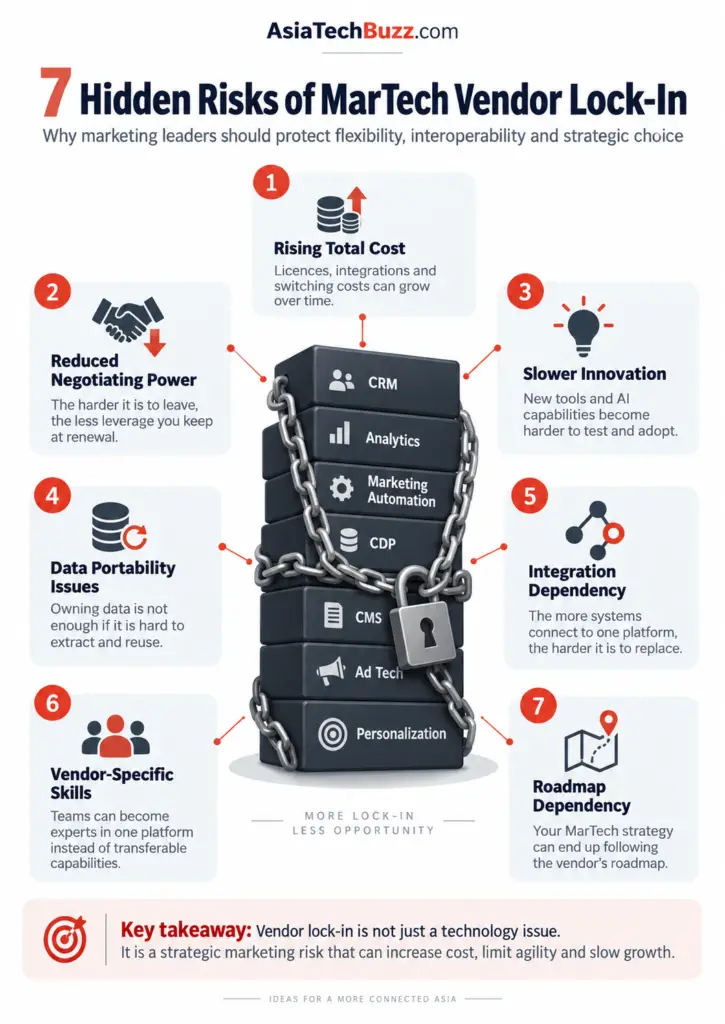
4. Data Become Harder to Move
Organisation often say:
“We own our data”
That statement can be legally correct while being operationally incomplete.
The more important question is:
Can the organisation extract that data in a usable form and operate it somewhere else?
Data Portability Versus Data Ownership
Data portability can be constrained by:
- proprietary schemes
- limited exports
- missing historical detail
- aggregated rather than even-level information
- proprietary identity models
- complex transformations
- API limittation
- migration fees
- undocumented relationships
AWS recommends that organisations understand available export formats, migration processes, technical requirements, timeframes and changes when assessing data portability. (Source: AWS, Six Lock-in Considerations)
For marketers, the lesson is straightforward.
Data ownership matters, but usable portability matters too.
5. Integration Dependency Grows Over Time
A major MarTech platform rarely operates alone.
It may integrate with CRM, data warehouses, websites, mobile applications, advertising networks, customer service, consent platforms and analytics tools.
Each integration increases value.
Each integration can also increase dependency.
After several years, replacing one platform can require rebuilding a significant portion of the surrounding ecosystem.
This is why good MarTech architecture should use clear interfaces and loosely coupled components whenever practical.
The principle is not unique to MarTech. AWS similarly notes that loosely coupled architectures can improve portability and reduce the impact of future changes.
6. Skills Become Vendor-Specific
Technology dependency also affects people.
Marketing operations teams can become experts in a particular platform rather than in the underlying marketing capabilities.
Those capabilities might include:
- customer segmentation
- lifecycle management
- experimentation
- journey design
- personalisation
- content operations
- measurement
- customer intelligence
Vendor expertise remains valuable.
The risk appears when the operating model becomes so platform-specific that changing the platform requires changing how the organisation thinks about marketing itself.
A mature MarTech strategy should therefore develop both platform knowledge and transferable capability knowledge.
7. Your MarTech Roadmap Starts Following the Vendor’s Roadmap
This may be the most strategic consequence of vendor lock-in.
Every technology company has its own priorities.
A vendor may invest heavily in AI agents, commerce, analytics or another capability. It may reduce investment in a feature your organisation considers critical. It may acquire another business, change packaging or alter its product architecture.
Those decisions belong to the vendor.
The problem arises when your organisation’s ability to innovate depends entirely on those decisions.
In April 2026, Gartner published research arguing that application leaders need to regain control of their platform roadmaps as AI agents become more important, including technology lock-in through architectural decoupling. (Source: Gartner, Regain Control of Your Agentic AI and Application Platform Strategies.
A strong vendor relationship should support your strategy.
It should not become your strategy.
How to Recognise Vendor Lock-in Before It Becomes a Problem
The best time to identify vendor lock-in is before the organisation wants to leave.
Marketing leaders do not need to become enterprise architects to assess dependency. They do, however, need to ask better questions.
Five Questions Marketing Leaders Should Ask
Can we Extract Our Customer Data in Usable Formats?
Do not stop at “yes”.
Ask what formats are available, how much history can be exported, whether event-kevel data is included, how long extraction takes and what additional fees apply.
Can We Replace One Capability Without Rebuilding the Stack?
If replacing the personalisation engine requires changing CRM, CMS and analytics, there may be execessive coupling.
Are APIs Open, Documented and Commercially Practical?
A platform having APIs does not automatically make it open.
Organisation should understand API coverage, rate limits, documentation, authentication, real-time support and pricing.
How Much of Our Implementation Is Proprietary?
Custom workflows can create competitive advantage, but heavy customisation also increases migration complexity.
Leaders should know which parts of the environment depend on proprietary configuration or code.
What Would It Actually Cost Us to Leave?
This question should be answered before renewal, not after negotiation fails.
The MarTech Exit Test
One simple executive exercise is what I would call the MarTech Exit Test:
If we decide today that this platform should be replaced within 18 months, what would stop us?
The resulting list may include:
- contracts
- data
- integrations
- skills
- resources
- customisations
- business processs
- migration risk
Those are your real dependencies.
The objective is not necessarily to. remove all of them. It is to make them visible.
Suite vs Best-of-Breed vs Composable MarTech
Discussion about vendor lock-in often become an argument between large suites and best-of-breed technology.
Reality is more nuanced.
Each model has advantages and trade-offs.
The Traditional Integrated MarTech Suite
Integrated suites can offer important benefits:
- fewer vendor relationships
- shared interfaces
- simpler procurement
- integrated workflows
- enterprise support
- standardised processes
For organisations with limited engineering resources, these advantages can be significant.
The weakness appears when integration becomes dependency.
If important customer data, content, automation, analytics and activation capabilities are all tightly coupled to one platform, changing any major component becomes difficult.
Best-of-Breed Marketing Technology Stack
Best-of-breed strategies allow organisations to select specialist tools for specific capabilities.
This can increase access to innovation and reduce dependency on one provider.
However, it can also produce:
- fragmented data
- duplicate functionality
- integration overhead
- inconsistent governance
- higher operational complexity
The answer to vendor lock-in is therefore not simply “buy more vendors”.
That can replace one problem with another.
Composable MarTech Architecture
Composable MarTech offers another apporach.
Rather than designing the marketing technology stack around one platform, the organisation designs around capabilities.
Individual components connect through APIs, shared data and integration services.
This allows parts of the environment to evolve independently.
Gartner recommends a composable approach based on customisable modular and scalable architecture and specifically encourages organisations to prioritise modular, API-friendly tools that reduce lock-in.
For a deeper explanation, read Composable MarTech: Why Modular Platforms Are Powering AI-Ready Organisations.
Composable Does Not Mean Buying Dozens of Tools
This distinction matters.
Composable MarTech is an architectural principle, not permission to buy unlimited software.
Too many components can create another type of dependency: integration complexity.
The best MarTech architecture is therefore no necesarily the one with the largest number of replaceable tools.
It is the one where technology boundaries are intentional, data is governed and the organisation understands which capabilities should remain stable and which need greater flexibility.
Seven Ways Marketing Leaders Can Reduce Vendor Lock-In
Eliminating all vendor lock-in is neither realistic nor desiable.
Technology decisions always create some switching costs.
The object is to prevent those switching costs from becoming strategically restrictive.
1. Own the Customer Data Foundation
Critical customer data should not become accessible only through one activation platform.
Organisations increasingly use warehouses, lakehouses, customer data infrastructure and shared data services to create a more independent foundation.
The 2025 State of Your Stack Survey identified data silos as the leading future concern among respondents at 20.7%. the same report discusses unified data layers as one architectural response to fragmented application data.
A strong data foundation also matters for AI.
AsiaTechBuzz explores this Data Foundations for AI-Driven Marketing, where the emphasis shifts from simply acquiring AI tools to building the infrastructure those tools require.
Separate Systems of Record From Systems of Engagement
Some system hold critical enterprise information.
Others activate it.
Keeping those responsibilities conceptually separate can make future technology changes easier.
2. Make API Openness a Procurement Requirement
When evaluating technology, marketers should ask more than:
“Does it integrate with our stack?”
Ask:
- What APIs exist?
- Which capabilities are exposed?
- Are they real time?
- What are the limits?
- Is API usage separately charged?
- Are webhooks supported?
- Can third parties build against them?
- Is documentation publicly accessible?
Openness should be demonstrated rather then assumed.
3. Prefer Portable Content and Data Models
Content can create vendor lock-in just as easily as customer data.
If product information, FAQs, offers, disclaimers and campaign content exist only inside propriety page templates, moving them can require extensive manual rebuilding.
Structured content reduces this dependency.
AsiaTechBuzz’s CMS Strategy in the AI Era explains why modern CMS platforms increasingly need to manage reusable content components rather than only webpages.
The related article Content Engineering for Marketing explores how content models, structured authoring and modular publishing can turn marketing copy into reusable organisational assets.
Content portability is becoming particularly important as brands distribute information across websites, apps, CRM, partner platforms and AI sinterfaces.
4. Reduce Unnecessary Customisation
Customisation can solve genuine business problems.
But every customisation should answer a simple question:
Is this sufficiently valuable to justify the long-term dependency it creates?
Over-customised systems become harder to upgrade, maintain and eventually replace.
Where standard capabilities deliver acceptable outcomes, standardisation can sometimes create more long-term value than bespoke functionality.
5. Design for Replaceability
Organisation do not need to continuously replace technology.
They should simply retain the ability to do so.
A useful architectural principle is:
Every major MarTech capability should have a defined boundary.
Customer data, content, orchestration, analytics and activation platforms should connect through understood interfaces whenever practical.
This does not eliminate vendor lock-in, but it reduces the blast radius if one component needs to change.
6. Include Exit Planning in Vendor Selection
Most RFPs focus heavily on implementation.
Far fewer spend enough time on exit.
Vendor evaluation should include:
- termination terms
- data exports
- supported formats
- transition support
- migration assistance
- deletion processes
- retention periods
- API continuity
- implementation documentation
Gartner’s August 2026 research on technology dependency argues that organisations often assess providers during sourcing but fail to continuously govern the technical, operational and commercial dependencies that develop after implementation.
Source: Gartner, Avoid AI and Technology Lock-in with a Technology Dependency Assessment Framework
Exit planning should therefore be part of ongoing governance, not a one-time procurement exercise.
7. Review MarTech Dependencies Annually
Marketing leaders already review budgets, campaign performance and strategic priorities.
Technology dependency deserves similar attention.
A simple annual map can show:
Platform -> Data -> Integrations -> Processes -> People -> Contracts
The exercise may reveal that a low-cost platform creates high operational dependency, while an expensive enterprise platform remains relatively replaceable.
That is why licence spend alone is a poor proxy for vendor lock-in
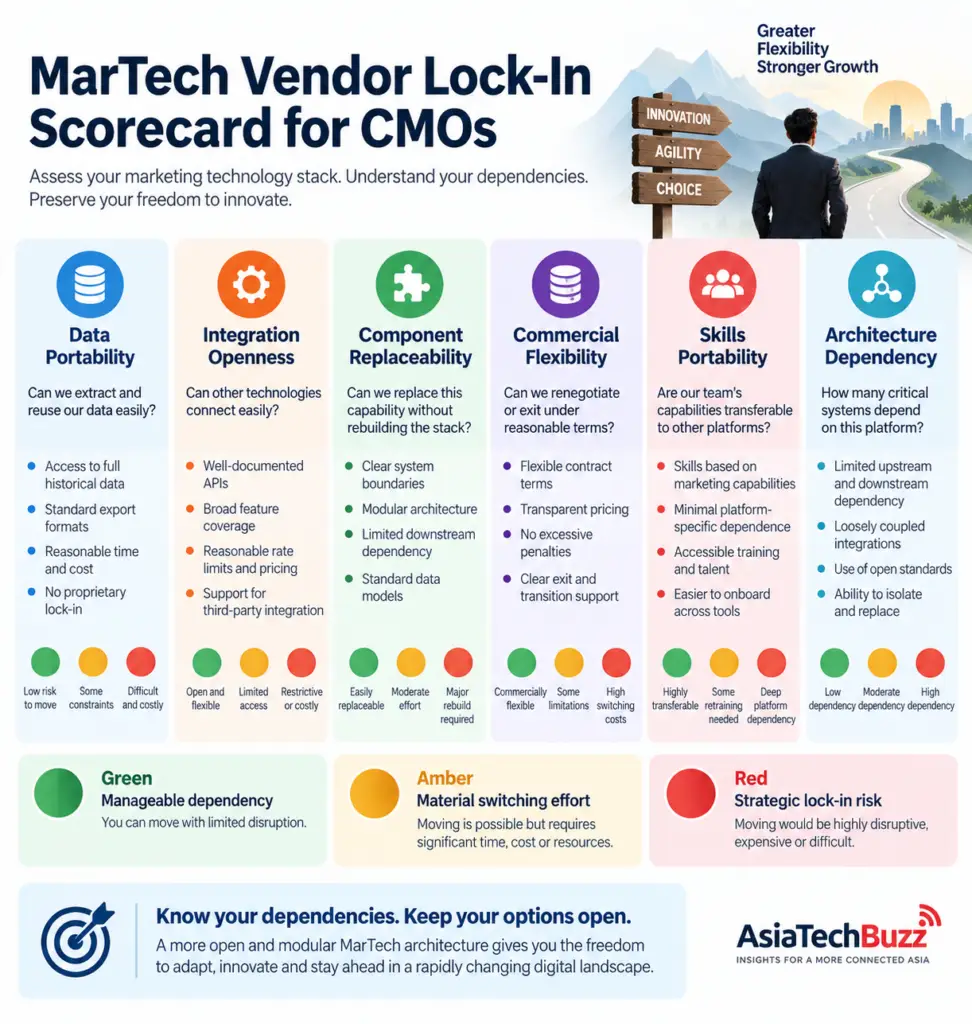
A Practical Vendor Lock-In Scorecard for CMOs
Marketing leaders need a way to make dependency visible before it becomes urgent.
A simple Vendor Lock-in Scorecard can evaluate major technologies across six dimensions.
| Dimension | Leadership Question |
|---|---|
| Data portability | Can our information be exported in useful formats? |
| Integration openness | Can other technologies connect easily? |
| Component replaceability | Can this capability change without rebuilding everything else? |
| Commercial flexibility | Can we renegotiate or exit under reasonable conditions? |
| Skills portability | Are our capabilities transferable beyond one platform? |
| Architecture dependency | How many critical systems depend on this technology? |
Green, Amber and Red Dependencies
Each major MarTech platform can then be classified.
Green: The platform creates value but can be replaced with manageable disruption.
Amber: Changing the platform would require material investment, migration or retraining.
Red: The platform represents a major business dependency and replacement would create significant operational risk.
A red rating does not automatically mean the technology is bad.
Some strategic systems will naturally become deeply embedded.
The purpose of the scorecard is visibility.
A CMO should know which parts of the marketing technology stack carry the greatest dependency before making another five-year investment around them.
Vendor Lock-In Does Not Mean You Should Avoid Strategic Platforms
There is a danger of taking the argument too far.
Not all vendor lock-in is irrational.
Technology creates value partly because organisations commit to it. Teams develop expertise. Integrations improve operations. Data accumulates. Processes become optimised.
If every platform were designed to be replaced immediately, organisations might sacrifice important functionality, integration and efficiency.
Some Dependency is Economically Rational
A large platform may reduce operational complexity.
A suite may provide:
- mature security
- enterprise support
- integrated workflows
- global scalability
- regulatory capabilities
- lower integration effort
These benefits should not be dismissed simply because the platform creates switching costs.
The question is whether the benefits justify the dependency.
The Objective is Optionality, Not Zero Dependency
Marketing leaders should therefore avoid turning vendor lock-in into an ideological debate.
The strategic objective is optinality.
An organisation should understand its dependencies, decide which are acceptable and preserve flexibility where flexibility creates value.
Put simply:
The goal of a modern MarTech strategy is not to eliminate vendors. It is to prevent any vendor from eliminating your choices.
The Future of MarTech Belongs to Architectures That Preserve Choice
Marketing technology has entered another period of rapid change.
AI assistants, generative content, real-time personalisation, predictive decisioning and AI-powered search are creating capabilities that were difficult to imagine only a few years ago.
The technologies organisations need five years from now may not yet exist.
That changes how leaders should think about MarTech architecture.
Move From Platform-First to Capability-First Thinking
Instead of starting with:
“Which platform should we buy?“
Start with:
“What capabilities does the business need?“
Then ask:
- Which capabilities are strategically differentiating?
- Which data must the organisation control?
- Which components need rapid innovation?
- Which capabilities benefit from standardization?
- Where should the organisation accept dependency?
- Where must it preserve choice?
This shifts the conversation from technology acquisition to business architecture.
It also aligns with the evolution toward composable MarTech, where capabilities can be assembled and changed more independently.
Flexibility Becomes a Strategic Marketing Capability
The same principle applies beyond technology.
Modern customer journeys increasingly depend on connected customer data, content, decisioning and execution.
For example, Customer Journey Orchestration: A Powerful Shift Beyond Marketing Automation describes how modern journeys require multiple systems to work together around customer context.
AI governance introduces another dependency question. As AI becomes embedded inside CMS, CRM, CDP, analytics and marketing platforms, leaders also need visibility into vendor processes data, which models are involved and what controls exist. AsiaTechBuzz explores these questions further in AI Governance in Marketing.
All of these trends point toward the same conclusion.
The strongest marketing technology stack is not necessarily the stack with the most features.
It is the stack that can continue changing when the market changes.
Final Thoughts: Control Your MarTech Strategy BEfore Your Stack Controls It
Vendor lock-in rarely announces itself.
It develops slowly through integrations, data structures, customer workflows, contracts, skills and operating habits.
By the time an organisation decides it wants more flexibility, the cost of creating that flexibility may already be high.
This does not mean marketing leaders should distrust large platforms or avoid long-term technology partnerships.
It means they should treat optionality as an architectural and commercial requirement.
Know where your critical data lives. Understand how content can move. Test APIs before buying. Map dependencies. Avoid customisation that creates little strategic value. Include exit considerations in procurement. Review switching risk as the environment evolves.
Most importantly, design your MarTech strategy around business capabilities rather than vendor boundaries.
The next generation of marketing technology will be shaped heavily by AI. New platforms will emerge. Existing platforms will evolve. Some capabilities will consolidate while others become increasingly specialised.
No CMO can predict exactly what that landscape will look like.
But organisations can prepare for it.
They can build marketing technology environments that preserve choice.
Technology platforms should accelerate your marketing strategy, not determine it.
For a deeper look at how modular technology can support this flexibility, read AsiaTechBuzz’s guide to Composable MarTech Architecture and explore more insights on AI-ready marketing infrastructure at AsiaTechBuzz.com.
Frequently Asked Questions About Vendor Lock-In
-
What Is Vendor Lock-In in MarTech?
Vendor lock-in occurs when a marketing organisation becomes so dependent on a technology provider that moving to another solution becomes excessively difficult, costly or risky.
The dependency can come from data, integrations, customised workflows, contracts, specialist skills or business processes.
MarTech vendor lock-in therefore does not necessarily mean an organisation is contractually prevented from switching. It often means the practical switching cost has become high enough that alternatives are difficult to pursue.
-
Why Is Vendor Lock-In a Problem for Marketing Teams?
Vendor lock-in can affect marketing costs, agility and innovation.
When important data, customer journeys or integrations depend heavily on one platform, adopting new technology can become slower. The organisation may also have less commercial leverage during contract renewals because moving to another provider requires significant investment.
The strategic risk is therefore not simply higher software costs. It is reduced freedom to change.
-
How Can Companies Avoid MarTech Vendor Lock-in?
Organisation can reduce vendor lock-in by designing for data portability, open APIs, modular architecture and clear system boundaries.
Marketing leaders should also understand switching costs during procurement, avoid unnecessary customisation and maintain documentation of important integrations.
Regular dependency reviews can identify problems before a platform becomes too difficult to change.
-
Does Composable MarTech Eliminate Vendor Lock-In?
No.
Composable MarTech can reduce dependency by allowing capabilities to be connected and replaced more independently, but does not eliminate switching costs.
A composable environment also requires strong architecture, integration and governance. Without those disciplines, organisations can replace platform dependency with excessive technology fragmentation.
The objective is therefore not maximum modularity. It is appropriate modularity.
-
Should Companies Avoid Large MarTech Suites?
Not necessarily.
Integrated suites can provide meaningful benefits including shared workflows, enterprise support, standardized capabilities and lower integration complexity.
Organisations should assess the business value against the dependency created.
The right questio is not whether a platform creates any vendor lock-in. Almost every important technology decision creates some switching cost.
The better question is whether the organisation understands that dependency, considers it acceptable and retains enough strategic choice to respond when its business needs change.