
Table of Contents
Introduction
Digital experience used to be discussed mainly in the language of websites, mobile, apps, user interfaces and conversion funnels. That view is now too narrow.
A customer may discover a brand through Google, encounter it in an AI-generated answer, visit its website, continue in a mobile app, respond to a message, contact customer service and complete a transaction through another channel. The customer does not think about which team, platform or technology owns each interaction.
Thye simply experience the brand.
That is why digital experience strategy is becoming a boardroom issue rather than only a marketing, UX or technology initiative.
The commercial case is becoming harder to ignore3. McKinsey found that customer experience leaders achieved more than twice the revenue growth of CX laggards between 2016 and 2021. This doe3s not mean experience alone caused the growth but it does show a strong relationship between better customer experience and stronger commercial performance.
At the same time, AI is changing what customers expect. Adobe’s 2026 AI and Digital Trends research found that 80% of organisations believe breakthrough customer experiences over the next two to three years will be highly personalised and anticipatory in real time. Another 72% expect those experiences to be seamless across digital and physical touchpoints.
For senior executives and marketing leaders, the challenges is therefore bigger than improving a website or deploying another platform.
The more important question is this:
Can the organisation consistently turn customer understanding, content, data, technology and AI into better experiences and measurable business outcomes?
That is the role of a modern digital experience strategy.
What Is a Digital Experience Strategy?
A digital experience strategy is an enterprise approach for designing, delivering, connecting, measuring and continuously improving the experiences customers have across digital interactions.
It defines how an organisation will use customer insight, experience design, content, data, technology, and operating capabilities to achieve customer and business outcomes.
The important word is connected.
A company can have a polished website, a highly rated mobile app, sophisticated marketing automation and a modern service platform, yet still deliver a fragmented digital customer experience.
The proble appears when those systems do not work together.
A returning customer may be asked for information the company already holds. Someone who has completed a purchase may still receive acquisition messages. A s ervice issue may have not impact on the next promotional offer. Product information may differ between the website, app and contact centre.
Each channel may work in isolation. The overall experience still fails.
Digital Experience Is More Than UX
User experience, or UX remains a critical part of digital experience. But the two concepts are not interchangeable.
UX focuses on whether someone can use an interface effectively and intuitively. It considers areas such as navigation, accessibility, task completion, information architecture, interaction design and usability.
Digital experience expands the lens.
It asks what happens before, during and after an individual interaction. It also considers how one interaction affects the next.
A loan application form, for example, may be beautifully designe. But if the customer receives an irrelevant offer immediately after completing it, has to repeat information on another channel or cannot understand the status of the application, the overall experience remains poor.
Digital Experience Strategy Is Not the Same as Digital Transformation
Digital transformation is broader. It addresses how an organisation changes processes, technology, operating models and, in some cases, business models through digital capabilities.
A digital experience strategy focuses those capabilities through the lens of customer and business value.
Digital transformation may ask:
What should we digitise?
Digital experience strategy asks:
How should our digital capabilities work together to create better customer outcomes and sustainable growth?
That distinction matters in the boardroom.
Technology deployment is an input. Customer and commercial outcomes are the value.
Why Digital Experience Strategy Has Become a Growth Priority
For many organisations, digital experience was historically treated as a service-quality issue. Todya, there is stronger evidence that poor experience can have direct commercial consequences.
Qualtrics’ latest consumer research estimates that nearly US$3 trillion in global sales is at risk because of poor customer experiences. Its 2026 consumer trends research also found that roughly one in two bad experiences leads customers to cut spending.
For marketing professionals, that has a clear implication. Every friction point can affect more than satisfaction. It can influence acquisition efficiency, conversion, retention, advocacy and customer lifetime value.
For. C-suite leaders, the implication is broader still. Digital experience can shape both growth and cost.
Better Experiences Can Compound Growth
One of the most useful ways to think about digital experience is through compounding value.
A simpler onboarding journey may improve conversion today. The same improvement may also increase digital adoption, reduce support calls and make the customer more likely to return. A clearer servicing journey may reduce cost-to-serve whole strengthening trust.
The impact is rarely confined to a single metric.
This is why senior leaders should avoid evaluating digital initiatives only through immediate conversion.
The better question is:
What customer behaviour changes when the experience improves, and what value does that change create over time?
Digital Experience Creates Offensive and Defensive Value
A mature digital experience strategy should create both offensive and defensive value.
Offensive Value
Better experiences can support:
- Higher conversaion
- Increase digital adoption
- Greater engagement
- Cross-sell and upsell
- Higher retention
- Increased customer lifetime value
- Stronger brand preference
Defensive Value
At the same time, better experiences can reduce:
- Customer abandonment
- Service cost
- Complaints
- Repeated contacts
- Inconsistent information
- Compliance risk
- Brand erosion
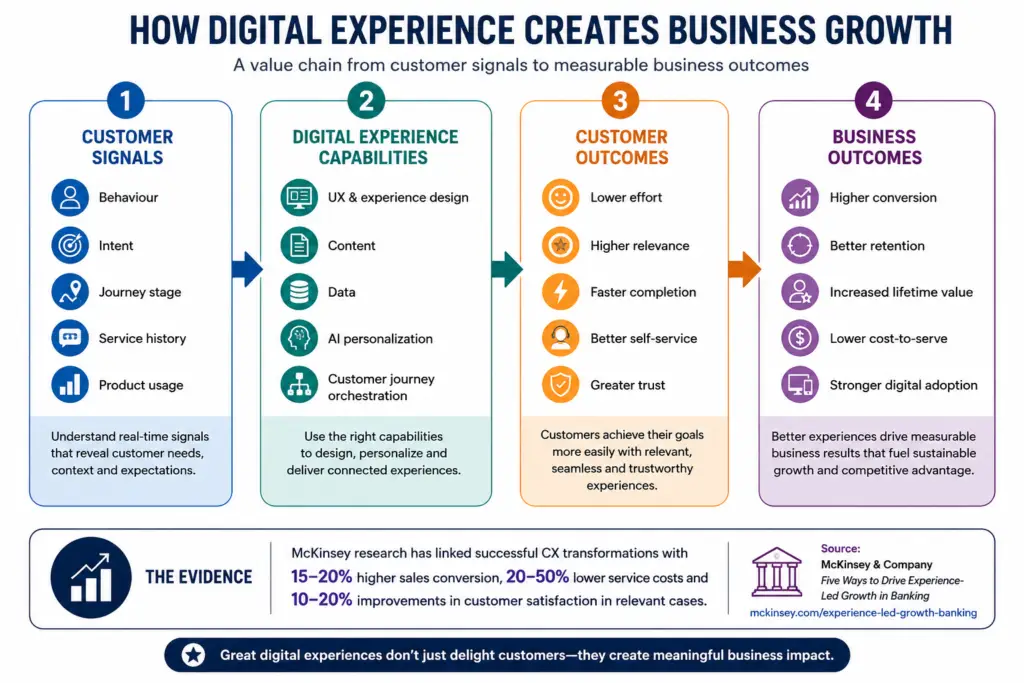
This is why digital experience should not be viewed only as a marketing expense or technology cost. It can become an enterprise value-cretion capability.
The Customer Journey Has Expanded Beyond the Website and App
One reason digital experiencce is harder to manage is that the customer journey itself has expanded.
A decade ago, many organisations could think relatively cleanly in terms of website, email, mobile and physical channels.
Today, customers move between search engines, AI assistants, social platforms, marketplaces, messaging services, websites, apps, customer service and physical locations.
They may begine anonymously, identify themselves later, switch devices and return days afterwards.
Customers Experience Journeys, Not Organisational Silos
Companies organise around functions. Customers organise around goals.
A customer wants to buy, understand, apply, resolve, pay, compare or cancel. They have little interest in whether marketing, product, service or technology owns the next stage.
That is why customer journey orchestration is becoming increasingly important.
Rather than treating every interaction as an isolated campaign, customer journey orchestration uses customer signals, business context and decision logic to coordinate what should happen next.
For deeper explanation of this shift, see AsiaTechBuzz’s Customer Journey Orchestration: Why Marketing Automation Is No Longer Enough for Modern Brands.
The strategic implication is simple:
Optimise the journey, not just the touchpoint.
AI Is Creating a New Experience Layer
AI adds another dimension.
Customer increasingly interact with brands through AI-assisted discovery, recommendation systems, conversational interfaces and automated service experiences.
This means companies now need to consider not only what customers see on owned channels, but also how machines retrieve, interpret and represent their information.
Digital experience is becoming both human-facing and machine mediated.
That change affects content architecture, search visibility, personalisation, service and decisioning.
The Six Pillars of a Modern Digital Experience Strategy
A practical digital experience strategy needs more than a vision statement. It needs an operating framework.
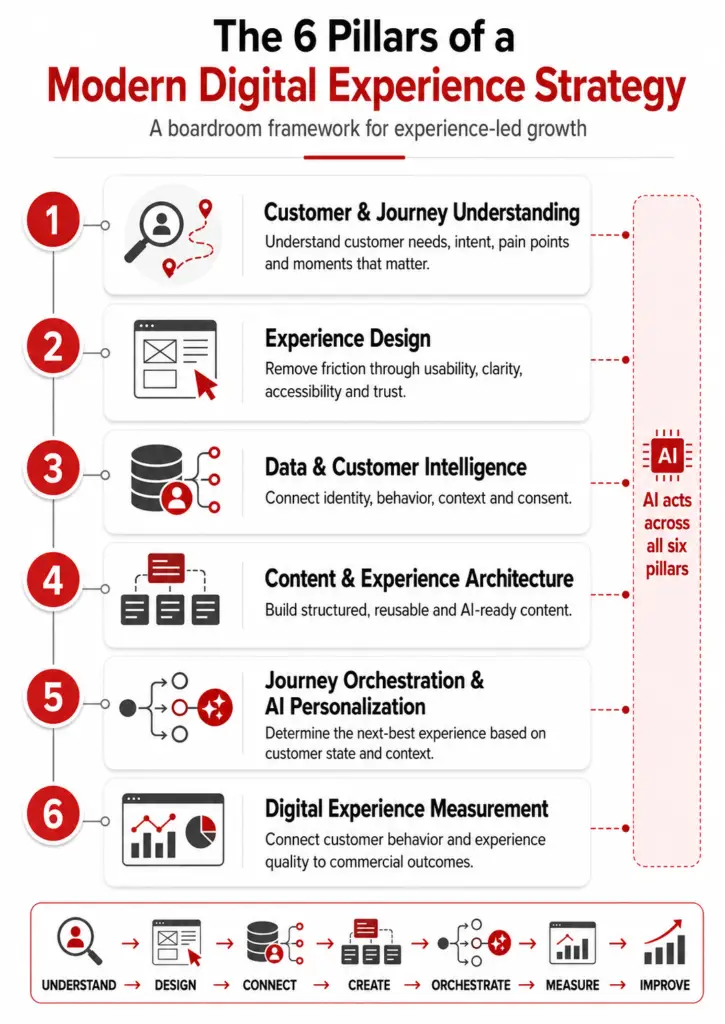
For senior leaders, six interconnected capabilities provide a useful way to think about the problem:
Customer understanding -> Experience Design -> Data -> Content -> Orchestration -> Measurement
AI increasingly operates across all six.
Pillar 1: Customer and Journey Understanding
A digital experience strategy should begin with the customer problem, not the technology platform.
Organisations need to understand what customers are trying to achieve, where friction occurs and which moments have the greatest influence on behaviour.
Useful inputs include:
- Behavioural analytics
- Customer interviews
- Search behaviour
- Journey research
- Transaction data
- Service contracts
- Customer feedback
- Funnel analysis
- Jobs-to-be-done research
The objective is not to document every possible jorney.
It is to identify the moments where experience quality materially affects customer and business outcomes.
Focus on Moments That Matter
Not every interaction deserves equal investment.
Resetting a password should be simple, but it does not need an eleborate personalised experience.
Apply for a financial product, making a major purchase, resolving a disputed transaction or deciding whether to renew may have much greater economic importance.
A strong digital experience strategy therefore prioritises journeys according to customer importance and business value.
Pillar 2: Experience Design
Once high-value journeys are understood, organisations need to remove unnecessary effort.
Experience design should consider:
- Usability
- Accessibility
- Navigation
- Clarity
- Trust
- Performance
- Mobile behaviour
- Content comprehension
- Error prevention
- Recovery when something goes wrong
This sounds straightforward, but organisations often optimise internal processes instead.
A form may request information because a legacy system needs it. A customer may be forced into another channel because two platforms are not integrated. A process may contain unnecessary steps because that is how it has always worked.
From the customer’s perspective, these are all friction.
Good experience design should therefore challenge the process, not only improve the interface.
Pillar 3: Data and Customer Intelligence
Connected experiences require connected context.
Without reliable customer information, personalisation quickly become superficial.
An organisation needs to understand signals such as:
- Who the customer is
- What they have already done
- What products they use
- What they are trying to accomplish
- What communications they are received
- Whether they have an unresolved issue
- What permissions and consent apply
The strategic progression is from:
Who is this customer?
to:
What does this customer appear to need now?
and ultimately:
What is the most useful action we can take next?
This is the intelligence foundation for AI personalisation.
More data is not automatically better. Relevant, governed and accessible data is more useful than a large volume of disconnected information.
Pillar 4: Content and Experience Architecture
Personalisation and omnichannel delivery also create a content problem.
If every webpage, app screen, email, push notification, FAQ and AI response requires separate content creation, complexity eventually overwhelms the organisation.
Modern digital experience therefore requires reusable, structured and governed content.
Instead of treating each webpage as a self-contained document, organisations can structure information into components such as:
- Product descriptions
- Features
- Benefits
- Eligibility criteria
- FAQs
- Pricing
- Calls to action
- Disclaimers
- Offers
- Support information
These components can then be assembled and distributed according to channel, audience or context.
AsiaTechBuzz explores this model in Structured Content for AI-Ready Websites: The Essential Foundation Marketers Cannot Ignore. The article explains how structured content can support reuse, governance, AI search optimisation and scalable content operations.
For organisations reviewing their content technology, Enterprise CMS: The Proven Business Case for Faster Marketing, Stronger Governance and Sustainable Growth also examines how a modern CMS can support more consistent and agile digital experiences.
Pillar 5: Customer Journey Orchestration and AI Personablisation
Traditional marketing automation remains valuable, especially for predictable campaigns and triggered communications.
But predetermined workflows become harder to manage as the number of customer states, channels and possible actions increases.
Customer journey orchestration addresses this by continually considering customer context.
A customer abandoning an application, for example, may not need another reminder.
They may need help understanding a requirement. They may have encountered a technical issue. They may already have contacted customer service. They may no longer be eligible for the original offer.
The right next action depends on context.
Move From Campaign Logic to Customer-State Logic
This represents an important shift.
Traditional campaign thinking often starts with:
Who should receive this message?
Customer journey orchestration starts with:
What state is this customer in, and what should happen next?
AI can strengthen this capability as the number of signals and possible decisions grows.
But AI personalisation should not be reduced to generating more personalised messages.
The more strategic use of AI is becoming decisioning. It can help determine whether to engage, what to offer, what context to present, which channel to use or whether doing nothing is the better experience.
Pillar 6: Digital Experience Measurement and Continuous Optimisation
The final pillar closes the loop.
Many organisations still measure digital performance through disconnected dashboards.
Marketing tracks traffic and leads. Product track usage. UX measure usability. Service tracks contact volume. Finance tracks revenue.
Each metric is useful, but the organisation may still struggle to answer a basic question:
Is the digital experience actually getting better?
That is why digital experience measurement should connect behavioural, perceptual, operational and commercial outcomes.
The operating loop becomes:
Observe -> Understand -> Decide -> Deliver -> Measure -> Learn
A mature digital experience strategy is never finished. It becomes continuously measurable and improvable.
AI Is Redefining What Good Digital Experience Looks Like
AI is often positioned as a productivity tool or new interface.
Its larger impact may be how it changes customer expectations.
Adobe’s 2026 research found that 80% of organisations believe breakthrough customer experiences will become highly personalised and anticipatory in real time, while 72% expect seamless experiences across digital and physical touchpoints.
This points to a very different experience model.
From Reactive to Anticipatory Experiences
Traditional digital experiences are mostly reactive.
A customer performs an action. The organisation responds.
AI creates the possibility of becoming more anticipatory.
A customer shows signals of difficulty. The experience provides help before abandonment.
Behaviour changes. The next recommendation adapts.
A service problem occurs. Promotional communication is suppressed until the issue is resolved.
The objective is not prediction for prediction’s sake. the objective is relevance.
AI Personalisation Requires a Strong Foundation
The attraction of AI personalisation is obvious. It promises more relevant experiences at greater scale.
But AI cannot compensate indefinitely for:
- Fragmented customer data
- Poor journey design
- Conflicting business rules
- Weak content governance
- Unclear product information
- Broken integrations
Applying AI to thouse conditions can simply automate inconsistency faster.
This is why AI personalisation should be treated as an extension of digital experience strategy, not a replacement for it.
The Technology Foundation Behind Digital Experience Strategy
Technology matters, but it should follow the experience model.
A modern technology stack may include several capabilities.
Content Management System or Digital Experience Platform
A CMS manages the creation and governance of digital content.
A digital experience platform can extend this capability through content deliver, personalisation, integration and experience management across multiple touchpoints.
The important distinction is that neither automatically provides a strategy.
Buying a sophisticated digital experience platform without addressing journey design, customer data, operating processes and digital experience measurement often results in expensive technology performing relatively conventional tasks.
Technology enable the strategy. It is not the strategy.
Customer Data and Identity
Customer information may come from CRM systems, transaction platforms, analytics tools, customer data platforms, service systems and apps.
The objective is not necessarily to move everything into one database.
The objective is to make the right information available when a decision is made.
Decisioning and Journey Orchestration
This layer determines what should happen next.
It may use:
- Business rules
- Real-time events
- Customer segments
- Propensity models
- Next-best-action models
- AI decisioning
The level of sophistication should grow with the business need.
Analytics, Experimentation and Experience Monitoring
Experience capabilities also need a learning layer.
This can include:
- Digital analytics
- Funnel analysis
- Journey analytics
- A/B testing
- Product analytics
- Voice-of-customer data
- Operational performance
- Commercial outcomes
Without measurement, organisations risk investing in experiences that look innovative but create little measurable value.
How Should Digital Experience Be Measured?
One of the biggest boardroom challenges is determining whether digital experience investments are actually working.
Traditional measures such as customer satisfaction, Net Promoter Score and usability scores remain useful.
But they tell only part of the story.
Move Beyond What Customers Say
Survey metrics capture perception
Digital behaviour captures action.
A customer may report that an experience was satisfactory while still abandoning the process. Another may complete a journey efficiently without every responding to a survey.
This is why digital experience measurement should combine several dimensions.
Measure Experience Quality
Useful measures include:
- Task completion
- Customer effort
- Error rates
- Page and app performance
- Accessibility
- Abandonment
- Search Success
These indicators help show whether customers can accomplish what they came to do.
Measure Engagement
Depending on the business model, useful metrics may include:
- Active users
- Repeat visits
- Frequency
- Feature adoption
- Journey progression
- Retention
Engagement should not be treated as universally positive.
More time spent on a simple service task may indicate friction rather than engagement.
Context matters.
Measure Customer Outcomes
The next layer asks whether customers successfully achieved their objective.
Examples include:
- Successful application
- Completed purchases
- Self-service resolution
- Successful payment
- Product activation
- Issue resolution
- Renewal
These measure shift management attention from channels to journeys.
Measure Business Outcomes
Finally, digital experience measurement must connect to economic value.
Examples include:
- Conversion
- Revenue
- Retention
- Customer lifetime value
- Cost-to-serve
- Digital servicing rate
- Cross-sell
- Incremental profit
McKinsey’s research on exprience-led growth in banking provides a useful illustration. It reports that successful customer-experience transformation have deliver 15% to 20% increases in sales conversion, 20% to 40% reductions in service costs and 10 to 20% improvements in customer satisfaction in relevant cases.
The boardroom question should therefore become:
If this experience improves, what customer behaviour should change, and what economic outcome should follow?
Building the Business Case for Digital Experience Strategy
Digital experience investments become easier to evaluate when management separates value into three categories.
Growth Value
Growth can come from:
- Higher conversion
- Increased repeat purchase
- Higher retention
- Cross-sell
- Upsell
- Increased digital engagement
- Greater customer lifetime value
The business case should identify which behavioural changes generate the expected financial improvement.
Efficiency Value
Digital experience can also improve economics through:
- Increase self-service
- Reduced customer contacts
- Faster resolution
- More efficient content product
- Reduced manual work
- Better reuse of technology and content
A better experience does not always increase revenue directly.
Sometimes its largest contribution is reducing the effort required by both the customer and the organisation.
Risk and Brand Protection
The third category is often underestimated.
Digital experience can influence:
- Accessibility
- Privacy
- Consent
- Regulatory compliance
- Information consistency
- Brand trust
- Customer complaints
These benefits may not appear immediately in conversion dashboards, but they remain important components of enterprise value.
Digital Experience Strategy Needs an Operating Model, Not Just Technology
One of the hardest aspect of digital experience is ownership.
Marketing may own communications. Product may own the app. Technology owns architecture. Service owns customer support. Data teams manage customer information. Legal and compliance define important constraints.
Yet the customer experiences all of them as one company.
Make Experience Cross-Functional by Design
A modern operating model therefore needs shared outcomes.
Rather than optimising each function independently, teams should agree on priority journeys and the measures that define success.
For example, an organisation trying to improve digital onboarding may need product, UX, marketing, technology, analytics, operations, risk and customer service working toward the same journey outcome.
The goal is not collaboration for its own sake.
It is to remove organisational boundaries that create customer friction.
McKinsey’s work on CX operating models similarly highlights cross-functional collaboration, clear design principles, processes and target setting as important elements of effective transformation.
Five Questions the Board Should Ask
Senior leaders do not need to review every UX metric or technology feature.
They do need to ask the right questions.
1. Which customer journeys create or destroy the most enterprise value?
Prioritisation should begin here.
2. Where is digital friction creating measurable revenue or retention leakage?
Experience problems should be translated into economic language.
3. Can we maintain customer context across channels?
If every channel starts from zero, personalisation will remain superficial.
4. Can our data, content and technology respond quickly enough?
Real-time aspirations mean little if execution still depends on slow manual processes.
5. Can we connect experience improvements to business outcomes?
If the answer is no, the measurement model needs to mature.
A Practical Roadmap for Building a Digital Experience Strategy
Creating a digital experience strategy does not require transforming the entire enterprise at once.
A more effective approach is to build capability around high-value problems.
Step 1: Define the Business Outcome
Begin with the outcome rather than the platform.
Examples might include:
- Increase digital conversion
- Improve retention
- Reduce customer effort
- Increase self-service
- Improve onboarding
- Reduce service costs
Clarity at this stage prevents digital experience from becoming an unfocused transformation programme.
Step 2: Identify High-Value Journeys
Map the journeys that most influence the chosen outcome.
Understand where customers begin, where they encounter friction, what channels they use and where context is lost.
Step 3: Establish the Experience Baseline
Combine:
- Customer research
- Digital analytics
- Journey data
- Service data
- Operational metrics
- Commercial outcomes
This creates an evidence-based starting point.
Step 4: Identify Capability Gaps
Access gap across:
- People
- Process
- Experience design
- Data
- Content
- Technology
- Governance
- Measurement
This prevents the common mistake of treating every problem as a platform problem.
Step 5: Prioritise by Customer and Business Impact
Avoid prioritising based only on stakeholder volume or feature requests.
A practical model can evaluate initiatives using:
Customer impact x Business value x Feasibility
The highest-priority initiatives should create meaningful outcomes on both sides of the eqation.
Step 6: Build the Measurement Loop
Define success measures before implementation.
Determine what should improve, by how much, over what period and compared with what baseline.
This turns experience work into measurable experimentation.
Step 7: Scale What Works
Once an approach proves effective, reuse the underlying capabilities.
A data signal created for one journey may support another.
A reusable content component may support web, app, service and AI.
A customer journey orchestration capability may expand from acquisition into servicing and retention.
This is how isolated initiatives gradually become an enterprise digital experience strategy.
The Next Competitive Advantage Is Experience-Led Growth
Digital transformation has spent years helping organisations digitise processes, migrate infrastructure, build apps and automate marketing.
Those investments remain important.
But the next question is harder:
Do all those digital capabilities work together in a way that customers actually value?
That is where digital experience strategy becomes strategically important.
The organisations that progress will not necessarily be those with the most platforms or the most AI pilots.
They will be those that can connect:
Customer understanding + Experience design + Data + Content + Customer journey orchestration + AI + Digital experience measurement
into a coherent system for growth.
The shift is from managing channels to managing journeys.
From campaigns to customer context.
From isolated personalisation to AI personalisation informed by real behaviour.
From page-based content to reusable experience architecture.
From channel dashboards to digital experience measurement linked with commercial outcomes.
And from viewing the digital experience platform as the strategy to recognising technology as one part of a much broader operating model.
For marketing leaders, this changes the role of digital experience. It becomes a way to connect brand promise, customer journeys, data, content and MarTech execution.
For C-suite executives, it creates a clearer management question: where can better digital experiences create growth, reduce cost or protect enterprise value?
That is why digital experience belongs in the modern boardroom.
If you are building this capability, continue the journey with AsiaTechBuzz’s guides to Customer Journey Orchestration, Structured Content for AI-Ready Websites, Enterprise CMS and AI Search Optimisation.
Together, these topics show how modern marketing, content, data, technology and AI are converging around a more connected customer experience.
Explore more practical perspectives on digital experience, MarTech, AI and modern marketing at AsiaTechBuzz.com.