
Table of Contents
Introduction
Marketing automation has fundamentally changed how brands engage customers.
It has helped marketing teams replace repetitive manual work with scheduled campaigns, triggered emails, lead-nuturing programmes and automated audience segmentation. Without it, most modern marketing operations would struggle to manage the scale and speed of digital communication.
However, automating more activity does not automatically create a better customer experience.
A customer in Singapore may discover a product through Instagram, research it on a brand’s website, compare through a marketplace, ask a question on WhatsApp and complete the purchase in a physical store. A customer in Indonesia may move between a super-app, a merchant’s website and a digital wallet without thinking of them as separate channels. In Vietnam, a financial-services customer may start a loan application on a website, continue it in a mobile app and seek assistance from a call centre when identity verification fails.
During these journeys, the customer’s intent can change several times.
Yet many organisations continue to manage each interaction through separate systems and teams.
The email platform know what the customer open. The website knows what they viewed. The mobile app knows which features they used. The service team knows that they recently raised a complaint. The sales team may know that they are close to making a decision.
The problem is that these systems often do not work together quickly enough to shape the customer’s next experience.
As a result, a brand may continue promoting a product after the customer has already bought it. It may send an upsell message immediately after a service failure. It may repeatedly remind someone to complete an action they have already finished through another channel.
Each system may be operating exactly as configured. The overall experience still feels disjointed.
This is the gap that customer journey orchestration is designed to address.
It represents a shift from automating individual campaigns towards coordinating the most appropriate action across the entire customer relationship. Instead of asking which campaign a customer should enter, the organisation asks a more useful question:
Given what we know about this customer now, what should the brand do next?
The answer may be a message, an offer, a service intervention, a change to the website experience or a decision not to communicate at all.
That shift is becoming more important as customer expectation rise. According to the fifth edition of Salesforce’s State of the Connected Customer, 73% of customer expect companies to understand their unique needs and expectations.
Modern brands therefore face a difficult challenge. They must become more responsive and relevant without becoming intrusive, repetitive or careless with customer trust.
Marketing automation alone was not designed to solve that challenge.
What is Customer Journey Orchestration?
Customer journey orchestration is the process of using customer data, behavioural signals, business events and decision logic to coordinate the next most appropriate interaction across channels.
In practical terms, it enables a brand to:
- Recognise what a customer is doing
- Understand the context behind that behaviour
- Consider what has already happened
- Evaluate the possible next actions
- Select the most suitable response
- Deliver that response through the right channel
- Learn from the outcome
The word “orchestration” matters.
An orchestra contains many different instruments. Each may be excellent on its own, but the audience only hears a coherent performance when those instruments follow the same score and respond to a shared conductor.
Modern brands face a similar challenge.
Email, paid media, mobile applications, websites, contract centre, physical stores, messaging platforms and sales teams can all communicate with customers. The experience only becomes coherent when those touchpoints are coordinated around a shared understanding of the customer.
In APAC, this need particularly visible because customer journeys are often fragmented across marketplaces, super-apps, messaging platforms, brand-owned channels and offline locations. A customer may interact with several commercial ecosystems during a single purchase journey.
Journey mapping and journey orchestration are different
Customer journey mapping helps an organisation visualise how people interact with the brand. A map show journey stages, customer goals, touchpoints, emotions and areas of friction.
This is valuable, but it remains largely an analytical and design activity.
Journey orchestration turns that understanding into coordinated action.
For example, a journey map may reveal that customers frequently abandon a financial-services application when asked to complete identity verification.
An orchestration capability goest further. It can detect that a specific customer has stopped at that stage, identify the source of difficulty, check whether the customer has requested help and decide which support would be most useful.
One customer may receive a simple tutorial. Another may be directed to live assistance. A third may not receive a reminder because the process has already been completed through another channel.
Journey mapping shows what commonly happens.
Journey orchestration helps the brand decide what should happen next.
A visual workflow is not always orchestration
Many marketing platforms allow teams to create sophisticated multistep journeys through visual workflow builders.
A workflow might say:
Send an email, wait two days, check whether the customer opened it and then send a reminder.
This is useful automation, but it remains based on a predefined sequence.
An adaptive journey asks broader questions:
- Has the customer already completed the action?
- Did they move to another channel?
- Has their eligibility changed?
- Have they contacted customer service?
- Are they receiving messages from another campaign?
- Would another communication be helpful?
- Is it better to wait?
The difference is not simply whether an action happens quickly. It is whether the decision reflects the customer’s current circumstances.
That is the foundation of real-time journey orchestration.
Why Marketing Automation Still Matters
The growing discussion around marketing automation vs journey orchestration can create the impression that traditional automation has become obsolete.
That would be the wrong conclusion.
Marketing automation remains a core component of the martech stack. It performs many activities effectively, including:
- Campaign scheduling
- Audience segmentation
- Lead nurturing
- Triggered communcation
- Renewal reminders
- Welcome programmes
- Lead scoring
- Basic content personalisation
- Campaign testing
- Performance reporting
These capabilities continue to save time, improve consistency and allow relatively small teams to manage large customer bases.
Marketing automation works particularly well when the trigger, target audience, sequence and desired outcome are clearly understood.
For example, a brand may want to welcome newly registered customers, remind policyholders about an approaching renewal date or provide product-care guidance following a purchase. These are structured use cases where predictable workflows can perform well.
The limitation is not that marketing automation fails to automate.
The limitation is that it often automates from the perspective of a campaign, platform or department.
A customer does not experience a workflow. They experience the brand.
When several automated programmes operate independently, the organisation can unintentionally automate inconsistency at scale.
Why Marketing Automation is No Longer Enough
Customer behaviour has become more complex than the linear funnels represented in many campaign plans.
People move between devices and channels. They pause and return. They research anonymously before identifying themselves. They begin online and finish offline. They contact service teams in the middle of a buying journey.
Traditional automation can support branches and conditions, but it becomes increasingly difficult to anticipate every possible path.
Several limitations explain why brands are moving towards customer journey orchestration.
Customers do not follow fixed campaign paths
A predefined workflow assumes that an organisation can reasonably predict the sequence a customer will follow.
In reality, a customer may:
- Research several products without being ready to buy
- Being an application and return weeks later
- Switch from a website to a mobile application
- Visit a physical location after starting online
- See help before converting
- Purchase one product while considering another
- Change their intention after a service experience
Marketing teams can keep adding branches to accomodate these behaviours. Over time, however, the workflow becomes a large and gragile decision tree.
It becomes difficult to understand, test and maintain.
Customer journey orchestration takes a different approach. Rather than attempting to predict every possible route, it continuously reassesses the customer’s current state.
The customer does not need to remain on the path originally designed for them.
Channel automation creates channel conflict
Most organisations have different systems for different types of engagement.
Email teams optimise open and clicks. Paid-media teams optimise reach and conversion. Product teams optimise app usage. Sales teams optimise lead progression. Service teams optimise resolution time and satisfaction.
Each objective may make sense on its own.
Together, they can create a confusing experience.
Imagine a banking customer in Hong Kong who has reported a suspicious card transaction. At the same time:
- The email platform sends a credit-card promotion
- The advertising platform serves an acquisition message
- The mobile app presents an upgrade offer
- A relationship manager attempts to cross-sell an investment product
- The service te4am is trying to resolve the original issue
No individual system is necessarily malfunctioning. There is simply no shared decision about which interaction should take priority.
Omnichannel journey orchestration addresses this by coordinating actions across channels. It can prioritise the service response, pause promotional communication and resume appropriate enagement once the issue has been resolved.
Static segments cannot represent changing intent
Segmentation remains useful. It helps brandds organise audiences, plan campaigns and understand broad patterns.
However, a segment is an approximation.
Two customers may share similar demographic characteristics, product ownership and past behaviour while having completely different needs at a particular moment.
One may be ready to purchase. The other may be comparing optins. One may be statisified. the other may have encountered a technical problem.
Real-time journey orchestration adds current context to the segment.
It considers signals such as:
- Recent browsing behaviour
- Product usage
- Purchase history
- Service interactions
- Eligibility
- Customer value
- Channel prefeerences
- Consent
- Contact frequency
- Current journey stage
The objective is not to abandon segmentation. It is to avoid treating a segement as the complete truth about an individual customer.
This is especially relevant in APAC, where language, culture, market maturity and channel behaviour vary considerably. A single regional segment such as “Southeast Asian digital consumer” is too broad to guide meaningful decisions.
As explored in the AsiaTechBuzz article on the APAC personalisation Architecture Stack, scalable personalisation requires more than audience segmentation. It requires connected identity, usable behavioural signals, decisioning, activation, and continuous measurement.
More communication can reduce relevance
Marketing automation makes it inexpensive to create additional campaigns and triggers.
This can encourage every team to communicate more frequently.
The problem is that campaign performance is often measured in isolation. A triggered email may produce a healthy click rate. A push notification may increase app visits. A retargeting campaign may generate conversions.
However, the customer may experience all three within the same day.
This creates a hidden form of marketing pressure. Each activity appears successful, while the combined experience becomes repetitive or intrusive.
A journey orchestration platform can apply contact policies across campaigns. It can manage frequency, resolve competing messages and determine whether another communication should be sent.
This changes the objective from maximising campaign output to improving the overrall customer outcome.
Marketing does not control the entire customer journey
Many of the moments that shape customer perception happen outside marketing.
Sales interactions, onboarding, product usage, delivery, billing and customer service can all influence whether the relationship grows or ends.
Marketing automation platforms may have limited visibility into these interactions. Even when the information exists, organisational structures may prevent teams from acting on it.
Customer journey orchestration connects marketing with products, sales, service and operational events.
A service failure can influence promotional decisions. A complete purchase can change the next recommendation. A product-usage signal can trigger education instead of another acquisition message.
This allows an organisation to respond as one brand rather than several disconnected departments.
Marketing Automation vs Journey Orchestration
The question of marketing automation vs journey orchestration should not be framed as a choice between an old technology and a new one.
Marketing automation remains an execution layer. Journey orchestration provides a wider layer of context, decision-making and coordination.
| Dimension | Marketing Automation | Customer Journey Orchestration |
|---|---|---|
| Primary focus | Campaign execution | End-to-end customer experience |
| Starting point | Audience, trigger or campaign | Customer state and context |
| Typical data | Lists, segments and campaign responses | Behavioural, transactional, product and service data |
| Decision model | Predetermined rules and branches | Contextual and adaptive decisions |
| Channel scope | Often managed by individual channels | Coordinated across channels and teams |
| Timing | Scheduled or event-triggered | Based on current need and context |
| Personalisation | Message and content variation | Action, offer, channel, timing and experience |
| Measurement | Open, clicks, leads and conversion | Journey completion and customer outcomes |
| Ownership | Primarily marketing | Shared across marketing, product, sales and service |
| Main question | Which workflow should run? | What should the brand do next? |
The difference becomes clearer through a practical example.
A customer abandons an online application.
A marketing automation workflow may send a reminder after 24 horus.
A journey orchestration approach first evaluates the situation:
- Did the customer encounter a technical error?
- Did they continue in the mobile app?
- Did they complete the application with an agent?
- Are they still eligible?
- Have they already received another reminder?
- Did they contact customer service?
- Which next action is most likely to help?
The resulting action may still be an automated email.
The difference is that the email is selected because it is appropriate, not simply because the workflow reached its next step.
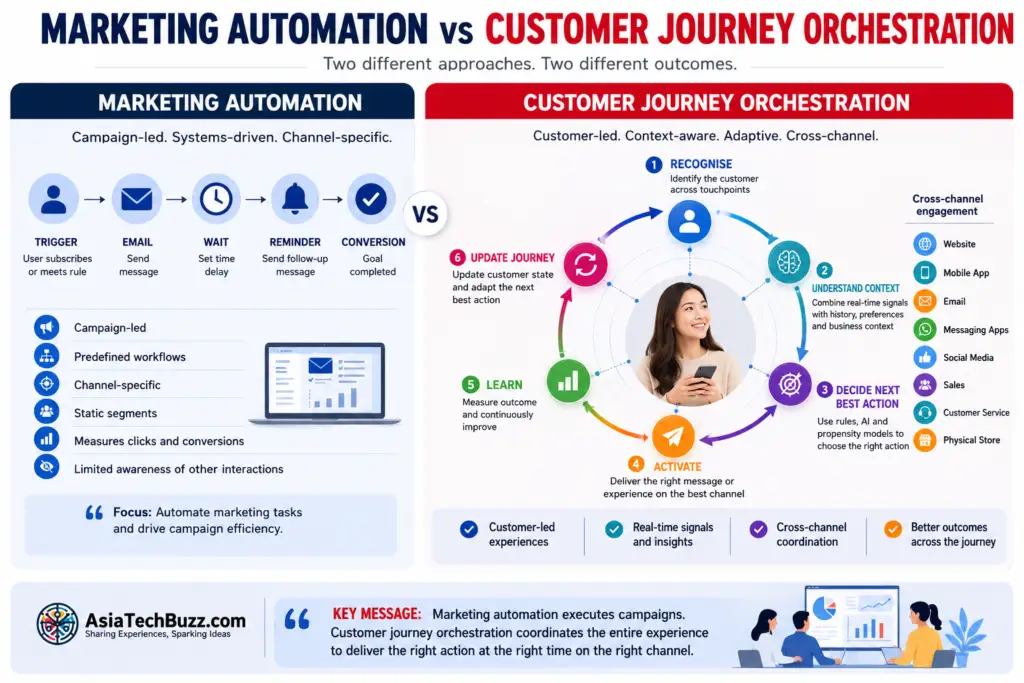
How Customer Journey Orchestration Works
Effective customer journey orchestration is a continuous cycle. The organisation recognises a customer or journey participant, interprets new signals, selects an action, delivers it and learns from the result.
1. Recognise the customer
The organisation first needs to associate interacions with a known or anonymous profile.
Possible identifiers include:
- Customer account numbers
- Login credentials
- Email addresses
- Device identifiers
- Cookies
- Loyalty identifiers
- Household or business relationships
Identity resolution will rarely be perfect. Privacy controls and platform restrictions also limit what brands can identify.
A practical model must therefore support both known and anonymous interactions while respecting consent and data-protection requirements.
APAC adds another level of complexity. Customers may use different identifiers across a marketplace, super-app, loyalty programme, physical store and brand-owned application. In markets where shared devices or multiple SIM cards are common, device identity may not always correspond neatly to one person.
The goal should not be to create an unrealistic “perfect” identity. It should be to establish enough confidence to support an appropriate decison.
2. Capture meaningful signals
A signal is an event that could change the most appropriate next action.
Examples include:
- Viewing a product page
- Abandoning a form
- Completing a purchase
- Missing a payment
- Opening a service case
- Reaching a loyalty threshold
- Experiencing a failed transaction
- Changing an account preference
- Responding to an offer
- Becoming eligible for a product
Not every event requires a response.
A customer viewing the same page twice may not indicate meaningful intent. A failed payment, repeated product search or abandoned application may deserve greater attention.
Good orchestration distinguishes routine activity from signals that indicate a need, risk or opportunity.
Most B2C brands cannot match that data scale. They can, however adopt the same architectural logic. The AsiaTechBuzz analysis of how APAC super-apps approach hyper personalisation explains how brands can build smaller data flywheels by connecting website, app, CRM, loyalty, transaction and service signals.
3. Understand the context
A single signal can be misleading.
An abandoned form might mean the customer become distracted. It could also indicate a technical problem, missing transformation, uncertaintly or a change of mind.
The orchestration layer therefor combines the signal with wider information such as:
- Recent behaviour
- Previous transactions
- Product ownership
- Service history
- Eligibility
- Customer value
- Channel preference
- Consent
- Contact frequency
- Current journey stage
This creates a more useful view of what the customer may need at that moment.
For a telecommunications provider, repeated visits to a network-support page may signal a service problem rather than a cross-sell opportunity. For a bank, a sudden decline in app activity might indicate dissatisfaction, financial stress or simply a customer who no longer needs the service regularly.
Context prevents brands from overreacting to individual events.
4. Select the next best action
Once the customer state is understood, the organisation must decide what to do.
Possible decision methods include:
- Business rules
- Eligibility criteria
- Propensity models
- Recommendation models
- Prioritisation scores
- Controlled experiments
- Artificial intelligence
- Value and risk calculations
The best action is not always a product offer.
It may be educational content, assistance, reassurance, a service intervention or no immediate action.
This is one reason journey orchestration should not be viewed solely as a marketing capability. Some of the most valuable next actions are operational rather than promotional.
This decisioning layer is explored in greater detail in the AsiaTechBuzz guide to next best action marketing in APAC. Next-best-action decisioning provides the intelligence that evaluates possible actions, while journey orchestration orchestration coordinates how the chosen action is delivered within the wider customer experience.
5. Choose the channel and timing
After selecting an action, the organisation needs to decide how and when it should happen.
The right channel may depend on:
- Customer preference
- Urgency
- Cost
- Message complexity
- Recent engagement
- Regulatory requirements
- Channel availability
- Previous interactions
A fraud warning may require immediate contact. A complicated product explanation may be better delivered through a website or assisted conversation. A low-priority recommendation may be suitable for the customer’s next app visit rather than another push notification.
This is what makes omnichannel journey orchestration different from simply distributing the same message through multiple channels.
Each channel plays a deliberate role.
In APAC, channel selection also needs to reflect local behaviour. LINE may play an important role in Thailand and Japan, KakaoTalk in South Korea, Zalo in Vietnam, and WhatApps across markets such as Singapore, Malaysia, Indonesia and India.
A regional orchestration strategy cannot assume that email has the same role in every market.
6. Learn from the response
Every customer response creates a new signal.
Did the customer complete the task? Did they ignore the message? Did they contact support? Did they switch channels? Did the intervention improve teh outcome?
The journey should update accordingly.
This feedback look allows real-time journey orchestration to improve through continuous testing and learning rather than remaining fixed for long periods.
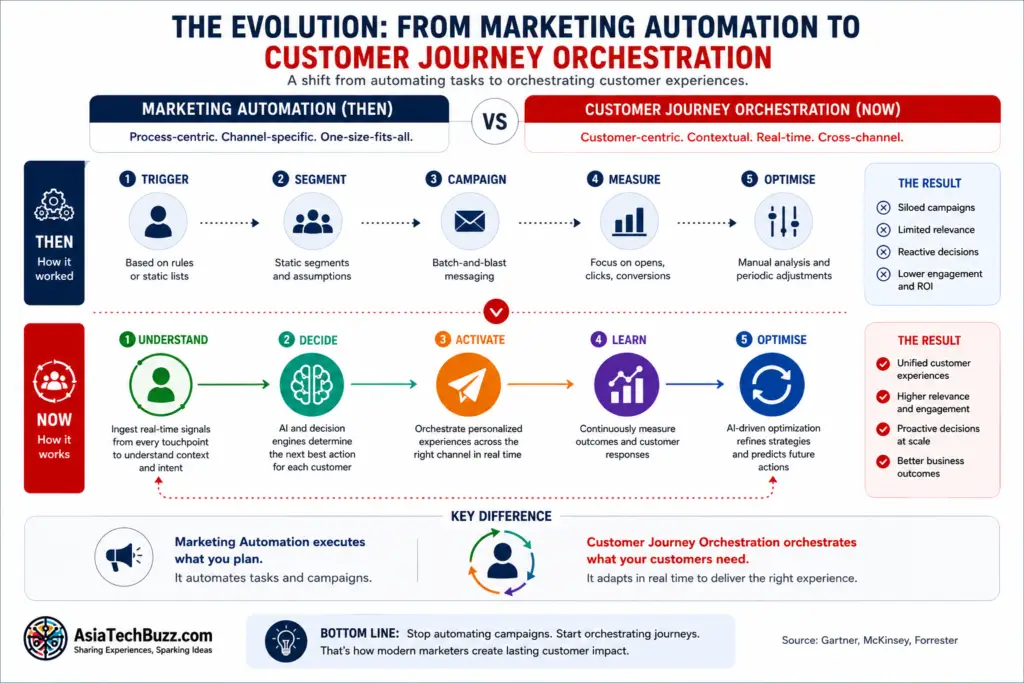
The Core Capabilities of a Journey Orchestration Platform
A technology platform alone will not creat a cutomer-centric organisation.
However, several technical capabilities are normally required to support orchestration at scale.
Unified customer information
A journey orchestration platform needs access to relevant customer information from systems such as:
- Customer relationship management platforms
- Websites and mobile applications
- Transaction systems
- Product databases
- Service platforms
- Campaign tools
- Consent systems
- Offline locations
The. organisation does not necessarily need to move every piece of data into one database.
It does need a reliable way to make the information required for a particular decision available when that decision is made.
Real-time or contextually timed event processing
Some customer moments require an immediate response. Others do not.
Website personalisation may need a decision within milliseconds. A failed transaction may require support within minutes. A renewal reminder may remain relevant for several days.
Real-time journey orchestration should therefore not be treated as a competition to process every interaction as quickly as possible.
The appropriate speed depends on the customer need.
Real time should mean tht the organisation can respond while the action is still useful.
Decisioning and prioritisation
Decision is one of the most important differenes in the marketing automation vs journey orchestration discussion.
Without prioritisation, several journeys may compete for the same customer.
A central decision capability can compare available actions and consider:
- Relevance
- Eligibility
- Customer value
- Urgency
- Risk
- Channel suitability
- Contact frequency
- Business priorities
- Customer experience rules
It can then determine whether a service message, educational intervention or commercial offer should take priority.
Cross-channel activation
A journey orchestration platform does not always need to replace existing delivery technologies.
Instead, it can coordiante actions across email platforms, mobile tools, websites, advertising networks, sales systems and contact-centre applications.
The orchestration layer makes or coordinates the decision. Channel platforms execute it.,
This distinction can help organisations modernise without replacing their entire martech stack at once.
Modular content and offers
A decision engine is only useful when the organisation has suitable actions available.
The system may identify when a customer needs reassurance, but the content te4am may only have a sales promotion. It may identify a highly specific need but have only one generic message for the entire audience.
Journey orchestration therefore creates additional pressure on content operations.
Brands need content that can be reused and adapted by:
- Journey stage
- Customer need
- Product
- Channel
- Lanaguage
- Eligibility
- Level of urgency
This is particularly challenging in APAC, where regional brands may need to support several languages, scripts and cultural contexts. Translating one regional campaign into several languages is not the same as creating content that reflects local intent and customer needs.
Adobe’s content research found that 71% of marketers expected content demand to increase by more than five times by 2027. The same research found that 61% saw growing expectations for personalised experiences as a major factor driving content demand.
The implication is clear. Better decisionign alone does not solve personalisation. Brands also need the operational ability to produce, govern and distribute relevant content.
That is why the content-management foundation matters. The AsiaTechBuzz article on CMS strategy in the AI era explains why modern content operations increasingly need reusable components, structured content and integration with personalisation and decisioning systems.
Consent, trust and governance
Orchestration relies on customer data and increasingly uses predictive models or artificial intelligence.
Governance therefore cannot be treated as a final compliance check.
It should include:
- Consent management
- Channel preferences
- Sensitive-data restrictions
- Data minimisation
- Retention policies
- Explainable decision rules
- Model monitoring
- Human approval
- Audit records
- Contact frequency controls
The trust challenge is significant. Salesforce’s 2024 State of the AI Connected Customer found that only 42% of customers trusted businesses to use AI ethically, down from 58% in 2023. Only 39% were comfortable with brands using AI to understand their needs.
A technically relevant interaction can still damage trust when the customer does not understand why it occurred or how their data was used.
For APAC brands, governance must also reflect different regulatory regimes, cultural expectations and levels of consumer comfort across markets. A model that is legally permissible in one contry may need different controls in another.
Customer Journey Orchestration Examples in APAC
The value of cutomer journey orchestration becomes easier to understand through practical regional examples.
Financial services application completion in Vietnam
A customer begins a personal-loan or credit-card application but stops during identity verification.
A basic automation system sends the same reminder to every applicant.
An orchestrated approach checks:
- The exact stage where the customer stopped
- Whether a technical error occured
- Whether the customer continued on another device
- Whether the application has been completed elsewhere
- Whether eligibility has changed
- Whether the customer requested help
- Whether another reminder has already been sent
The brand might then display an in-app guide, provide a secure deep link, offer live support or decide not to send another message.
For financial institutions, this is not only a conversion issue. It is also a customer-effort, trust, compliance and operational-cost issue.
Retail purchase coordination in Singapore
A customer researches a product through a retailer’s website, adds it to a basket and later buys it in a physical store.
Without omnichannel journey orchestration, the e-commercie platform may continue sending cart reminders while the advertising platform continues showing acquisition messages.
With connected purchase information, the journey can shift from conversion to post-purchase support.
The customer could receive product guidance, warranty information, loyalty recognition or a relevant complementary recommendation instead.
Super-app engagement in Indonesia
A customer uses a super-app for transportation, food delivery and payments. They search for a restaurant but do not place an order.
A simple campaign tool might treat that as an abandoned transaction.
A more contextual system may consider:
- The customer’s current location
- Time of day
- Weather conditions
- Previous food preferences
- Available delivery partners
- Promotiuonal eligibility
- Recent order history
- Whether the customer has moved away from the delivery area
The next action could be a relevant recommendation, but it might also be no action at all.
This illustrates why super-app personalisation is difficult for conventional brands to replicate. The advantage does not come from a single AI model. It comes from the volume, variety and frequency of behavioural signals.
Telecommunications onboarding in the Philippines
A new subscriber activates a moble plan but has not completed several onboarding activities.
The orchestration layer evaluates activation status, app usage, network experience, service cases and previous messages.
It may recommend app setup, payment registration, technical support or no additional action.
The objective is not simply to complete an onboarding campaign. It is to help the customer receive value from the service.
Subscription retention in Australia
A customer’s usage is declining as a renewal date approaches.
A conventional retention workflow may immediately send a discount.
A more advanced journey orchestration platform first assess why engagement is falling.
The appropriate response might be:
- Educational guidance
- A product recommendation
- Technical support
- A temporary subscription pause
- A service conversation
- A retention incentive
Discounting becomes one possible response rather than the default response.
B2B buying journeys across Asia
B2B purchases rarely involve one person, particularly for enterprise technology, financial services and professional services.
Several stakeholders may visit the website, download content, attend events and speak with sales representatives over an extended period. The buying group may also include regional and global decision-makers working in different countries.
Journey orchestration can connect these activities at the account level and help marketing and sales coordinate their actions.
This is more useful than treating every contact as an unrelated lead following an isolated nurture sequence.
Journey Orchestration Is an Operating Model, Not Just Software
Technology is not only one part of the transformation.
A brand cannot coordinate customer experiences when teams continue to optimise isolated goals without shared governance.
Successful customer journey orchestration normally involves:
- Marketing
- Customer experience
- Product
- Sales
- Customer service
- Data and analytics
- Technology
- Operations
- Legal, privacy and compliance
Createe shared journey outcomes
Teams need a common definition of success.
Campaign measures such as open rates and clicks remain useful, but they do not show whether the wider customer journey improved.
Shared outcomes may include:
- Journey completion
- Time to value
- Conversion
- Product adoption
- Customer effort
- Satisfaction
- Retention
- Cost to serve
- Customer lifetime value
A shared outcome also helps teams make better trade-offs.
For example, suppressing a promotional email may reduce campaign volume while improving trust and reducing complaints.
Clarify decision ownership
Organisations must decide who can create, approve and change journey decisions.
Marketing may own communication strategy. Product teams may own in-app experiences. Service teams may own assited interactions. Data teams may manage predictive models. Compliance teams may define restrictions.
Without clear ownership, omnichannel journey orchestration becomes a technology layer without the authority to resolve conflicts.
Organise around priority journeys
Many organisations organise work around channels or platforms.
Journey orchestration becomes more effective when cross-functional teams focus on a shared customer outcome, such as:
- New-customer onboarding
- Application completion
- First purchase
- Product adoption
- Service recovery
- Renewal
- Churn prevention
Starting with one priority journey makes it easier to identify which data, decisions, channels and content are genuinely necessary.
Common Journey Orchestration Challenges
The promise of orchestration is compelling, but implementation is rarely simple.
Fragmented data and identity
Customer information often sits across systems with different identifiers, owners and update schedules.
Brands do not need perfect data before starting.
They do not need enough reliable informaiton to support a defined decision.
Attempting to build a compete enterprise customer view before delivering practical value can turn the initiative into a lengthy transformation programme.
Excessive journey complexity
Teams sometimes try to design every possible customer path in advance.
This produces workflows that are difficult to test, explain and maintain.
A better approach is to define a small number of meaningful customer states and a manageable set of possible actions.
Complexity can be introduced gradually as the organisation learns.
Insufficient content capability
More precise decisions create demand for more precise content.
Brands frequently invest in customer data and decision technology without improving content production.
The result is an advanced system selecting from a small library of generic assets.
Structured content, reusable components and content governance should therefore be treated as part of the orchestration roadmap.
Conflicting Metrics
Marketing, sales product and service teams often assess performance differently.
One tam may celebrate a conversion tht later creates an avoidable service call. Another may improve response time by passing the customer to a different channel.
Journey-level measurement is needed to reveal these trade-offs.
Treating AI as a shortcut
Artificial intelligence can support prediction, journey analysis, content generation and next-best-action selection.
It cannot reliably compensate for poor data, unclear customer consent, weak integrations or conflicting objectives.
AI can strengthen a good orchestration foundation.
It cannot replace one.
A Practical Journey Orchestration Maturity Model
Organisations do not need to move directly from basic email campaigns to fully autonomous real-time journey orchestration.
A staged approach is normally more realistic.
Stage 1: Channel automation
The organisation automates campaigns within individual channels. The main objective is operational efficiency and reliable execution.
Stage 2: Connected campaigns
Channels begin to share audience information, campaign history and contact rules. Teams coordinate timing, but journeys remain largely predefined.
Stage 3: Cross-channel journey management
The organisation connects important customer interactions and designs programmes around journey outcomes rather than channel activity. Journey analytics and shared measuremednt become more important.
Stage 4: Real-time journey orchestration
Important behavioural and operational signals update the customer state quicky. Decisioning determines which action should be take across available channels.
Stage 5: AI-assisted orchestration
Artificial intelligence helps analyse behaviour, predict outcomes, recommend actions and optimise decision policies.
Human teams remain responsible for objectives, boundaries, governance and customer impact.
The goal is not to reach the final stage for every customer interaction.
Some communications do not require sophisticated decisioning. A schedule service notification or regulatory update may be better managed through straightforward automation.
Orchestration should be applied where changing customer context can materially improve the outcome.
How to Start Customer Journey Orchestration
A practical programme can begin with six steps.
1. Choose one valuable journey
Select a journey with:
- A clear customer problem
- Measurable business impact
- Sufficient interaction volume
- Available data
- Cross-channel relevance
- Senior stakeholder support
Application abandonment, onboarding, renewal and service recovery are common starting points.
2. Define the important customer states
Identify the small number of conditions that meaningfully change what the brand should do.
For example:
- Exploring
- Applying
- Waiting
- Blocked
- Completed
- Dissatisfied
- At risk
Avoid documenting every click. Focus on states that influence a real decision.
3. Identify the required signals
Determine which events are needed to recognise each state.
Prioritise signals that influence an action.
Collecting more data does not automatically create better orchestration.
4. Define the available actions
Create a library of possible responses across channels.
These should include:
- Marketing messages
- Educational content
- Service interventions
- Assisted support
- Product experiences
- Suppression actions
- Delibrate waiting
5. Establish decision rules
Define eligibility, priority, timing, frequency and governance rules.
Begin with transparent logic that business teams can understand.
More advanced models can be introduced once the organisation understands baseline performance.
6. Test incremental value
Compare the orchestrated experience with the current approach.
Measure incremental impact on customer and business outcomes rather than relying only on activity measures.
Microsoft cites a commissioned Forrester Consulting study of a composite organisation using Dynamics 365 Customer Insights. The study reported a 324% return on investment over three years, a payback period of less than six months, a 75% reduction in journey-development time and a 15% improvement in conversion per customer journey.
These figures are vendor-commissioned and should not be treated as guaranteed outcomes. They are useful because they illustrate the areas in which organisations can build a business case: revenue impact, operating efficiency and faster journey development.
For an APAC organisation, the initial business cas should also recognise market complexity. Supporting several languages, messaging channels, regulatory environments and local operating teams may increase implementation effort. However, the same regional scale can create greater value when shared orchestration capabilities are reused across markets.
How to Measure Journey Orchestration
A journey orchestration platfom should be judged by the value it creates, not the volume of messages it delivers.
Journey progression
Relevant measures include:
- Journey completion
- Stage-to-stage conversion
- Abandonment
- Time to completion
- Successful channel switching
Customer experience
Brands can monitor:
- Customer effort
- Satisfaction
- Complaint rate
- Opt-out rate
- Contact frequency
- Service recovery
Commercial performance
Measures may include:
- Incremental conversion
- Revenue per customer
- Product adoption
- Retntion
- Churn
- Customer lifetime value
Operational effectiveness
Useful measures include:
- Cost per completed journey
- Cost to serve
- Manual intervention
- Decision-response time
- Content reuse
- Time required to launch a journey
Decision quality
Brands can also assess:
- Next-best-action acceptance
- Suppression effectiveness
- Model uplift
- Eligibility accuracy
- Compliance with contact policies
Measurement should be compared with a meaningful baseline or control group.
A higher conversion rate does not necessarily prove that orchestration caused the improvement unless other influences are considered.
The Future Is Coordinated, Not Simply Automated
Marketing automation is not disappearing.
It will continue to execute campaigns, manage workflows and deliver messages at scale.
Its role, however, is changing.
In a modern customer-engagement model:
- Customer data creates a usuable view of the customer.
- Journey analytics reveals behaviour and friction.
- Decisioning determines the most appropriate response.
- A journey orchestration platform coordinates the experience
- Marketing automation and channel tools execute the action
- Measurement updates future decisions
The important shift is from campaign-first automation to customer-first coordiantion.
This matters particularly in APAC. Customers regularly move between brand-owned channels, marketplaces, messaging platforms, digital wallets, super-apps and physical locations. A journey designed inside one marketing platform will rarely reflect the full experience.
The organisations that succeed will not necessarily be those with the largest technology stacks. They will be the ones whtat can connect the right signals, make responsible decisions and coordinate action across organisational boundaries.
That requires an honest assessment of capability.
Some brands need better identity resolution. Others need stronger real-time data. Many need to improve content operations or create clearer rules for prioritising customer actions. In several organisations, the largest barrier will not be technology at all. It will be ownership.
Customer decisions are shaped over a sequence of connected experiences.
Each interaction must build on what came before. The brand needs to remember the customer’s context, maintain consistency and avoid restarting the cvonversation in every channel.
That is ultimately the promise of customer journey orchestration.
It enables brands to become more relevant without necessarily communicating more often. It helps them recognise when customers need guidance, when they need servive and when they should be left alone.
The transition requires more than a software purchase. It requires reliable data, modular content, clear governance and collaboration across marketing, product, sales, service and technology.
Marketing automation made digital communication scalable.
Customer journey oprchestration can make the overall customer experience coherent.
Frequently Asked Questions (FAQs)
-
What is customer journey orchestration?
Customer journey orchestration is the process of using customer data, behavioural signals and business context to determine and coordinate the most appropriate next interaction across channels.
It helps a brand adapt its response as customer behaviour and needs change.
-
What is the difference between marketing automation and journey orchestration?
The central difference in marketing automation vs journey orchestration is the level of context and coordination.
Marketing automation generally executes predefined campaigns and workflows. Journey orchestration evaluates the customer’s current state and coordinates the next action across channels, systems and teams.
-
Does journey orchestration replace marketing automation?
No.
Journey orchestration normally works with marketing automation. The orchestration layer decides or coordinates what should happen, while marketing automation and channel platforms execute emails, notifications and other communications.
-
What does a journey orchestration platform do?
A journey orchestration platform connects customer information, events, decision logic and channel activation.
It helps brands understand customer context, prioritise possible actions, select suitable channels and update the journey based on the customer’s response.
-
What is real-time journey orchestration?
Real-time journey orchestration uses recent customer and business events to adjust interactions while the response is still useful.
The required speed depends on the situation. Website personalisation may require an immediate decision, while onboarding or renewal actions may remain relevant for several hours or days.
-
What is omnichannel journey orchestration?
Omnichannel journey orchestration coordinates interactions across websites, applications, email, paid media, sales, messaging platforms and customer service.
Its purpose is to maintain context as customers move between touchpoints, rather than sending the same message through every available channel.
-
Why is journey orchestration important for APAC brands?
APAC customers often move between marketplaces, super-apps, messaging platforms, digital wallets, physical locations and brand-owned channels.
Journey orchestration helps brands connect these interactions and adapt engagement to local channel preferences, languages, regulatory environments and customer behaviours.
-
Do brands need a customer data platform?
A customer data platform can help unify customer profiles and event data, but it is not the only possible foundation.
An organisation may also connect CRM, transaction, digital analytics and service systems directly, depending on its architecture and use cases.
-
How should a company start journey orchestration?
Begin with one high-value customer journey and one clearly defined problem.
Identify the key customer states, essential signals, available actions and decision rules. Test the new approach against an existing baseline before expanding it to other journeys.
-
How should journey orchestration be measured?
Useful measures include journey completion, incremental conversion, customer effort, retention, contact frequency, service cost and next-best-action acceptance.
Journey-level outcomes are generally more meaningful than measuring each channel in isolation.
-
Is AI required for customer journey orchestration?
No.
Brands can begin with customer data, event triggers and transparent business rules. AI becomes more useful as the number of signals and possible actions increases, but it should be supported by strong governance and reliable data.