
Table of Contents
Introduction
In an era where digital discovery is rapidly shifting, traditional models of Search Engine Optimization (SEO) are no longer sufficient. The rise of AI-mediated search experiences powered by generative models – from Google’s AI Overviews to AI assistants like ChatGPT and Perplexity – has elevated the stakes for how brands are found, interpreted, and trusted in the first place. This structural shift is exposing foundational limitations in legacy organizational designs and is forcing CMOs and executive teams to rethink how work gets done.
At the hear of this transformation is the need for a redesigned Marketing Operating Model that is natively AI-aware, cross-functionally collaborative, and capable of delivering not just visibility but accurate brand representation across AI search surfaces. This article explores how AI Search Optimization intersacts with organizational design, governance, workflows, and enterprise performance metrics, and why CMOs must approach these challenges at the operating model level, not just as a technology or SEO tactics.
Why AI Search Optimization Is Exposing Flaws in the Traditional Marketing Operating Model
The Consumer Shift: AI Search is Already Mainstream
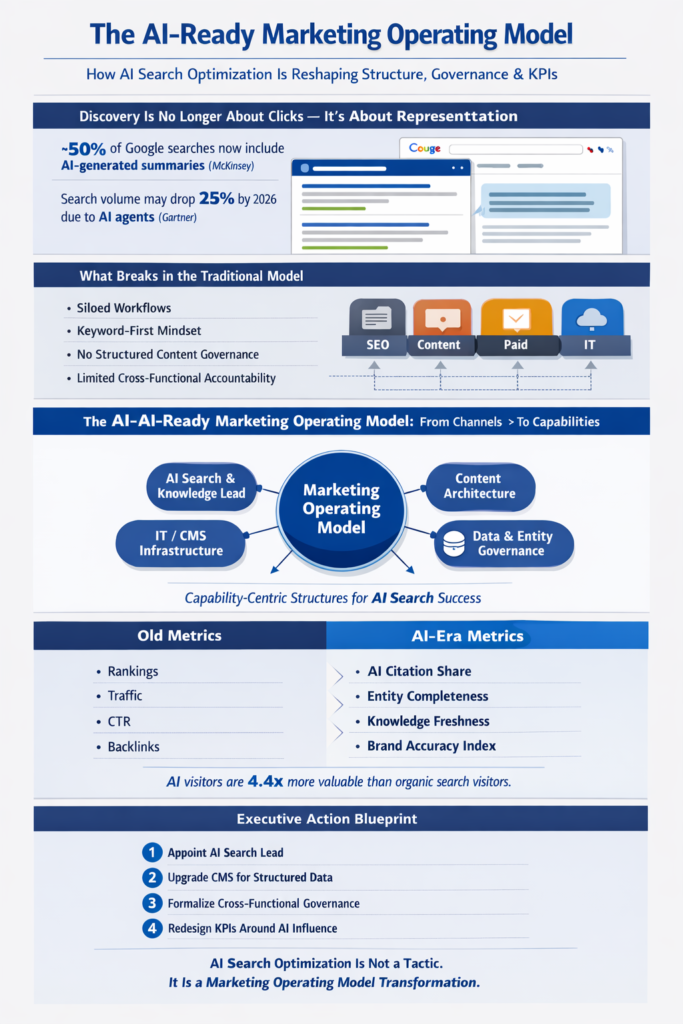
AI-mediated search is no longer an early-adopter phenomenon – it is mainstream. According to McKinsey research, about half of consumers now use AI-powered search and discovery tools, and AI summaries are featured in roughly 50% of Google search results today – a figure projected to exceed 75% by 2028. (Source: McKinsey)
This change has profound implications. Historically, consumers used search engines primarily to find websites – a traffic acquisition model. Today, AI search frequently answers questions directly inside an AI interface, often without requiring a click – a phenomenon known as the zero-click environment. Gartner predicts traditional search engine volume could decline by up to 25% by 2026 as AI chatbots and virtual agents increasingly intercept discovery journeys. (Source: Gartner)
The consequence for marketing organizations isn’t just tactical. It forces them to reassess how they structure strategy, teams, workflows, and value management. A legacy Marketing Operating Model built around channels, tactics, and traffic is insufficient in a world where discovery is mediated by AI summaries rather than hyperlinks.
From Channel Silos to Cross-Functional Complexity
Most traditional marketing organizations are organized around channels – SEO, content marketing, paid media, comms, and social. But AI Search Optimization does not respect these silos. It demands collaboration across:
- Marketing (brand representation, content governance)
- IT/Product (CMS architecture, structured data)
- Data (entity governance, performance measurement)
- Compliance and Risk (accuracy, legal entanglements)
Treating AI search as a niche function under “SEO” is no longer sufficient. If AI search systems are digesting product facts, feature relationships, pricing policies, and nuanced brand positioning to answer consumer questions directly, then the entreprise must ensure consistency and accuracy at the point of discovery, not downstream after publication.
This reality is backed by industry research. A BCG report emphasizes that CMOs who focus solely on technical or productivity improvements with AI are missing the larger opportunity to reinvent the entire operating model. For maximum value creation, organizations must rethink not just tools but how works get done across the enterprise. (Source: BGC)
The Strategic Transformation Imperative of AI Search Optimization
Representation Over Traffic: A New Performance Paradigm
In traditional SEO frameworks, success was measured in clicks, rankings, and sessions. In the age of AI search, however, success increasingly depends on how often a brand’s entity is included in generated AI responses, the accuracy of those responses, and the influence those responses have on downstream metrics like conversions, trust and loyalty.
Consider this: AI search visitors are 4.4x more valuanle than average organic search visitors in terms of conversion propensity, because they generally arrived further down the consideration funnel with more context. (Source: Search Engine Land)
This underscores the urgency for a Marketing Operating Model that embeds AI search performance as a core business outcome, not just a marketing KPI.
AI Search Isn’t SEO 2.0 – It’s a Paradigm Shift
Many still think of “AI SEO” as an extension of SEO tactics – automate keyword research here, or leverage AI content generation there. But that minimalist view misses the deeper impact:
- AI systems synthesize knowlege from structured data, entity relationships, and authorative signals rather than just keywords.
- Generative engines, whether Google’s AI Overviews or standalone agents, are replacing list-based search with contextual, citation-based answers.
- Traditional metrics like domain authority and backlink profiles are no longer the central determinants of visibility in AI outputs.
Emerging terminology like Generative Engine Optimization (GEO) captures this reality, optimizing not for traditional search results but for visibility inside AI-generated answers.
This transformation is structural, not incremental, and it nees to be reflected at the operating model level.
Re-Architecting the Marketing Operating Model for AI Search
From Channel Teams to Capability Clusters
A resilient Marketing Operating Model moves beyond narrow channel ownership toward capability clusters that bridge disciplines and deliver cross-functional outcomes. These capabilities may include:
- AI Search & Knowledge Engineering
- Content Architecture & Structured Data Management
- Cross-functional Analytics & Insight
- Governance & Compliance for AI Representation
Emerging research across firms like BCG and MMA highlights that AI is reshaping key elements of marketing workflows, decision rights, and organizational structures, making cross-functional collaboration essential. (Source: MMA)
For example, instead of an SEO team responsible only for organic rankings, organizations now require roles that own AI search visibility, entity representation, and structured knowledge graphs. This aligns with a broader design philosophy focused on capability, not channel.
Embedding AI Search Optimization Into Core Processes
To embed AI into the heart of the Marketing Operating Mode4l, organizations must redesign core processes from top to bottom. That includes:
- Content Planning: Priortize structured, modular content that supports entity tagging, schema, and AI interpretability.
- Editorial Workflow: Standardize templates for entity relationships, facts verification, and compliance checks before publication.
- CMS Architecture: Invest in modern, API-first Content Management Systems that support structured data, semantic markup, and real-time updates.
- Data Collaboration: Harmonize marketing and analytics systems around entity-centric datasets rather than page-centric KPIs.
These changes are not technical add-ons; they are operational fundamentals that determine whether a brand is accurately perceived by AI search engines.
Content Modeling as a Strategic Capability
One of the most underestimated shifts in the Marketing Operating Model is the rice of content modeling, designing information structures that support both human understanding and machine inferencing.
Traditional content teams craft narratives. AI-ready teams design knowledge blocks – discrete, machine-scannable pieces of information that represent product features, terms & conditions, policies, and use cases in structured formats.
This is more than semantics; it’s about entity conherence. When AI systems synthesize responses, they draw on structured facts, relationships, and knowledge graphs that span the entire organization’s digital footprint.
Marketing must evolve from stroytelling to knowlege engineering – a shift that requires new skills, collaborating patterns, and governance frameworks within the operating model.
Cross-Functional Spine: Marketing, IT, and Data
IT as a Strategic Partner
In the AI era, CMS architecture and data infrastructure are strategic determinants of visibility. Traditional marketing tech stacks are often ill-equipped to deliver structured data at scale or support real-time synchronization of AI systems.
Bringing IT into the strategic core of Marketing Operating Model ensures that technical platforms – from headless CMS to data lakes – support not only campaign executions but knowledge representation and AI indexing workflows.
This helps eliminate operational friction and accelerates response times for rapidly evolving AI search environments.
Data Teams as Entity Governors
In traditional models, data teams are downstream analytics functions. In an AI-driven environment, they become entity governors – managing structured datasets, performance dashboards, signal prioritization, and real-time representation metrics across AI surfaces.
This shift is not academic. Organizations that integrate marketing and data capabilities at the governance level are more likely to:
- Surface entity completeness scores
- Track inclusion in AI answer outputs
- Correlate AI visibility metrics with commercial outcomes
These are not generic analytics tasks – they are enterprise-level decisioning assets.
Governance, Risk, and Brand Control in the AI Era
Representation Risk Is a Real Business Risk
Unlike traditional SEO, AI Search Optimization exposes brands to reputation, compliance, and legal risk. When AI systems generate incorrect answers about product eligibility, fees, or policy fine print, the ramifications can extend beyond lost traffic to liability and brand trust erosion.
This requires governance mechanisms that ensure:
- Data accuracy verification
- Regulatory compliance integration into publishing workflows
- Versioned knowledge bases
- Cross-enterprise audit trails
Governance becomes a cornerstone of the Marketing Operating Model, ensuring that brand representation in AI answers is accurate, compliant, and controlled.
The CMO’s Expanded Mandate
The shift toward AI Search Optimization redefines the CMO’s role. CMOs must now be:
- Champions of cross-functional collaboration
- Stewards of data and content governance
- Sponsors of operating model transformation
- Connectors between marketing, IT, data, and compliance domains
This office is no longer just responsible for visibility – it must safeguard brand trugh and consistency at the point of discovery.
Redefining KPIs in the Modern Marketing Operating Model
From Traffic to Impact Metrics
Traditional KPIs like organic traffic, click-through rates, and search rankings are becoming less decisive in the age of AI Search Optimization.
New performance metrics include:
- AI Citation Share: How often entities appear in AI reponses
- Entity Completeness Score: The comprehensiveness of structured knowledge
- Knowledge Freshness Index: Timeliness of data used by AI systems
- Brand Accuracy Index: Alignment between published facts and AI output
These metrics align better with enterprise outcomes, including conversion lift, trust signals, and decision velocity.
Commercial Linkages and Attribution
Measuring the commercial impact of AI search requires rethinking attribution models. AI search surfaces often assist discoverability without generating clicks. Yet, these interactions can accelerate decision cycles and assist conversions that are realized downstream.
Increasingly, businesses are augmenting attribution frameworks to map AI touchpoints to revenue outcome – an essential evolution of the Marketing Operating Model.
A Blueprint for the Future Marketing Operating Model
Structural Actions CMOs Must Take Now
- Appoint Cross-Functional AI Search Leadership: Build roles that own AI search visibility across disciplines.
- Invest in AI-Ready CMS and Knowledge Platforms: Support structured data and real-time indexing.
- Formalize Cross-Enterprise Governance: Embed compliance and brand accuracy into publishing workflows
- Redesign KPIs Around AI Influence and Impact: Move beyond clicks to business outcomes.
- Upskill Teams for Knowledge Architecture: Transition SEO specialists into AI search strategists.
Organizational Design Principles for the AI Era
Future-ready operating models share several principles:
- Capability-centric structures over channel silos
- Governance embedded into workflows, not isolated functions
- Data and marketing tightly integrated
- Performance models aligned with business outcomes, not just traffic
- Continuous measurement and feedback loops tied to AI realities
This design foundational ensures that organizations are not only adapt to AI search evolution but win in it.
Conclusion: A Structurl Reset, Not an Incremental Upgrade
AI Search Optimization is not a trend. It is a structural reset of digital discovery and brand representation. Organizations that attempt to retrofit AI SEO into outdated frameworks will face fragmentation, risk, and dimished impact. Those that redesign their Marketing Operating Model around structured knowledge, cross-functional collaboration, and AI-aligned performance metrics will lead the next ear of consumer engagement.
For CMOs and EXCO teams, the mandate is clear:
Marketing is no longer just about optimizing pages – it’s about architecting a Marketing Operating Model built to compete in an AI-mediated world.
And that transformation must begin now.
Read my other articles on AI Search Optimization here.
Frequently Asked Questions (FAQs)
-
What is a Marketing Operating Model?
A Marketing Operating Model defines how marketing teams are structured, governed, and measured to deliver business outcomes. It outlines roles, workflows, decision rights, technology integration, and performance metrics. In the AI era, it must evolve to support AI Search Optimization, structured content governance, and cross-functional collaboration.
-
Why must the Marketing Operating Model change for AI search?
AI search changes discovery from keyword rankings to AI-generated answers. This shift requires a Marketing Operating Model that supports structured data, entity governance, and cross-team collaboration. Without redesigning workflows and governance, organizations risk inaccurate AI repreentation and declining visibility.
-
How does AI Search Optimization impact marketing teams?
AI Search Optimization impacts marketing teams by requiring structured content modeling, schema implementation, and AI visibility tracking. It shifts the focus from traffic acquisition to brand representation inside AI answers. This demands a Marketing Operating Model that integrates marketing, IT, data, and compliance.
-
What KPIs should be included in an AI-ready Marketing Operating Model?
An AI-ready Marketing Operating Model should include AI citation share, entity completeness, knowledge freshness, and brand accuracy metrics. Traditional KPIs like traffic and rankings remain relevant but must be complemented with AI visibility indicators that measure representation inside generative search results.
-
Who owns AI Search Optimization within an organization?
AI Search Optimization should not site solely within SEO. Owernership should be embedded within the broader Marketing Operating Model, often led by a cross-functional AI Search Lead. This role coordinates marketing, IT, and data teams to ensure structured knowledge governance and accurate AI representation.