
Table of Contents
Introduction: Marketing is Becoming Machine-Readable
Why content alone is no longer enough
For years, marketing success was largely shaped by content quality, campaign creativity, channel execution, and media efficiency. Those factors still matter. But in today’s environment, they are no longer sufficient on their own.
Marketing is entering a new phase in which content is not only created for people. It is also being inteerpreted by machines. Search engines, AI assistants, recommendation engines, analytics platforms, and personalization systems now play a growing role in how customers discover, evaluate, and act on information. That means content must do more than read well. It must also be structured in ways that machines can understand.
This is where structured marketing data becomes strategically important. It gives systems the context they need to interpret meaning, idenifying relationships, and activate content more intelligently across the digital ecosystgem. It tells machines what a page is about, which product or topic it refers to, who the intended audience is, how it connects to other assets, and when it should be surfaced.
Without that layer, even strong content can remain underutilized. It may still be published, indexed, and consumed, but it will often be harder to retrieve, harder to personalize, and harder to analyze in a meaningful way.
Why this matters now
This is not a fringe technical trend. It reflects a broad shift in how the digital environment works.
Schema.org notes that, as of 2024, more than 45 million web domains use Schema.org markup, representing over 450 billion objects. That scale matters because Schema.org exists to describe entities, relationships, and actions in ways machines can interpret (Source: Schema.org).
Google is equally clear about the role of structured data. It states that structured data helps it understand the content of a page and can make that page eligible for richer search experiences (Source: Google).
Taken together, those signals point to the same conclusion: marketing content is increasingly expected to function as structured knowledge, not just digital copy.
For marketing leaders, this changes the conversation. Structured data is no longer an SEO enhancement or a technical implementation detail. It is becoming part of the operating foundation for AI visibility, personalization, and measurement.
What Structured Marketing Data Actually Means
Structured content vs structured data
One of the most common points of confusion is the difference between structured content and structured data. The two are closely related, but they serve different purposes.
Structured content is about how content is modeled. Instead of storing everything in a single text field, a structured content model breaks content into reusable components such as title, summary, author, product reference, audience type, region, topic, and call to action.
Structured data, by contrast, is about meaning. It is the layer of metadata, labels, schema, attributes, and relationships that helps machines interpret what each content object represents.
A useful way to think about it is this: structured content makes content modular, while structured marketing data makes content understanable and actionable across systems.
That distinction matters because many organizations have some level of content structure in their CMS, but they still lack a clear data layer that connects content to entities, products, audiences, journeys, and analytics. In those cases, the organization may be creating content efficiently without making it fully usable in an AI-driven environment.
The four layers of structured marketing data
To make the concept more practical, it helps to think of structured marketing data as four connected layers.
This first is the content layer. This is the field-level structure inside the CMS or content platform.
The second is the metadata layers. This includes taxonomies, schema types, attributes, content labels, and audience markers that explain what the content means.
The third is the relationship layer. This is where content connects to products, topics, industries, authors, campaigns, or customer segments.
The fourth is the activation layer. This is how tat data is used by AI systems, search engines, recommendation engines, personalization tools, and analytics platforms.
When these layers work together, content becomes more than a published asset. It becomes part of a reusable knowledge system.
Why marketing leaders must think like data architects
This is why the role of modern marketer is expanding. It is no longer enough to think only in terms of campaigns and channels. Increasingly, marketing leaders must also think in terms of information architecture, governance, semantic consistency, and data usability.
That does not mean every CMO need to become a technologist. It does mean that marketing function must becomer more intentional about how information is modeled, tagged, connected, and activated.
Becvause in the AI era, the brands that win will not simply be the ones that publish the most. They will be the ones whose content ecosystems are best understood by both people and machines.
The S.E.M.A.N.T.I.C™ Framework
Why a new framework is needed
Many discussions about structured data remain too narrow. They focus on page markup, SEO compliance, or isolated schema types. Those are useful topics, but they do not relect the full strategic role that structure now plays in modern marketing.
To address that gap, this article introduces the S.E.M.A.N.T.I.C™ Framework – a proprietary model for understanding how structured marketing data supports AI retrieval, personalization, analytics, and infrastructure design.
The purpose of the framework is simple: to move the conversation from technical implementation to strategic capability.
The S.E.M.A.N.T.I.C™ model
This framework consists of eight layers:
- S – Structured content models
- E – Entity indentification
- M – Metadata and schema
- A – AI-ready indexing
- N – Knowledge networks
- T – Targeted personalization
- I – Intelligence and analytics
- C – Connected MarTech stack
Taken together, these layers show that structured marketing data is not one tool or one field in a CMS. It is a cross-functional capability that spans content operations, SEO, AI readiness, measurement, and platform architecture.
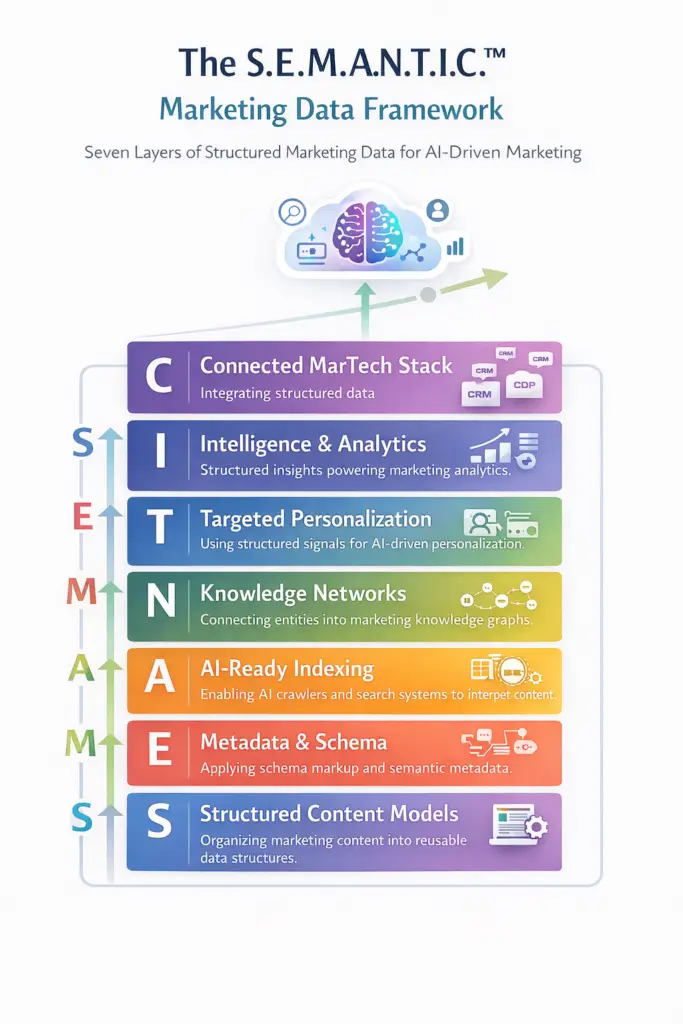
S – Structured Content Models
Why CMS design is now a marketing decision
The first layer of the framework is content structure. This is where many organizations either create a strong foundation or set themselves up for long-term inefficiency.
If content lives primarily as unstructured pages, every downstream task becomes harder. Search teams need to retrofit schema. Analytics teams struggle to compare content types consistently. Personalization teams lack reusable building blocks. AI systems are forced to infer meaning from loose signals rather than governed fields.
A modern CMS should do more than publish pages. It should model content as reusable data objects.
That means an article should not simply have a title and a body. It should be able to reference a product, a topic cluster, an author entity, a funnel stage, an audience segment, and potentially even a use case or industry. Once that model is in place, structured marketing data becomes an output of normal content operations rather than a separate layer added later.
Why this matters for scale
The value of structure becomes more obvious as content volume grows. A small site can survive with inconsistent models and manual fixes. A large content estate cannot.
As organizations expand across products, regions, channels, and teams, content complexity rises quickly. Without structured models, duplication increases, governance weakens, and activation becomes inconsistent.
This is why content modeling is no longer just a CMS design issue. It is a strategic enabler for scale. It defines how easily content can be reused, interpreted, measured, and personalized.
And in an environment increasingly shaped by AI systems, that usability matters more than ever.
E – Entity Indentification
From keywords to entities
The next layer of the framework is entity identification.
Traditional digital marketing has long relied on keywords. Keywords still matter, but they are no longer enough to explain how machines interpret relevance. Search and AI sysstems increasingly rely on entities – distinct, indentifiable concepts such as a brand, a product, a company, a person, a location, or an industry.
This shift is important because entities reduce ambiguity. A keyword may have multiple meanings. An entity is more precise.
For marketers, that precision matters acorss the entire content ecosystem. If a product is referred to by different names in different places, systems may struggle to connect those signals. If a topic is described inconsistently across authors or regions, reporting and retrieval both become weaker.
Why entity consistency matters
Entity consistency is one of the most overlooked benefits of structured marketing data.
When products, topics, industries, and audience groups are governed as structured entities rather than loose text references, several things improve at once. Editorial consistency becomes easier. Internal linking becomes smarter. Search interpretation becomes clearer. AI retrieval becomes more reliable. Analytics becomes more meaningful.
In other words, entities are not only useful for SEO. They create shareed business language across the stack.
That is especially valuable for enterprise marketing teams, where multiple functions oftten work from different naming conventions and different systems. A governed entity model helps reduce fragmentation and create a more coherent digital footprint.
M – Metadata and Schema
How structured data makes meaning explicit
Metadata and schema are where meaning becomes machine-readable.
If structured content models defines the fields, metadeta explains those fields, and schema helps external systems interpret them in a standardized way. This is the layer that translate internal structure into broader machine understanding.
Google’s documentation states that structured data helps it understand page content and support enhanced search appearances (Source: Google).
Schema.org explains that its vocabulary is organized through types and properties, allowing entities and their relationships to be described consistently across the web (Source: Schema.org).
For marketers, the strategic lesson is clear. Metadata is not administrative overhead. It is the language that enables machines to interpret what the brand is publishing.
Why schema should not be treated as a bolt-on
A common mistake is to treate schema as a technical add-on applied after content is created. That approach can work at a basic level, but it usually limits value.
The strongest results happen when metadata and schema reflect the actual structure of the content model. When products, FAQs, authors, articles, categories, and organizations are already governed as structured objects, schema becomes foare more consistent and scanable.
This is another reason structured marketing data matters so much. It reduces the gap between internal content operations and external machine interpretation.
When that gap is small, content becomes easier to discover, easier to trust, and easier to reuse.
A – AI-ready Indexing
Why AI systems depend on structured inputs
As AI search and retrieval models become more influential, the quality of input data becomes a central issue.
AI systems do not simply need content. They need accessible, consistent, machine-readable information. That includes stable content models, clear metadata, explicit entity references, governed relationships, and reliable attributes.
This is where structured marketing data becomes far more than an SEO consideration. It becomes part of AI readiness.
Gartner reported in 2025 that data availability and quality are among the top implemenation challenges for AI, cited by 35% of leaders in low-maturity organizations and 29% in high-maturity organizations (Source: Gartner).
Gartner also predicted in 2024 that at least 30% of generative AI projects would be abandoned after proof of concept by the end of 2025 due to poor data quality, inaccurate risk controls, escalating costs, or unclear business value (Source: Gartner).
Why this matters for marketing leaders
These figures should matter to marketing leaders because they underline an uncomfortable truth: AI performance is not just about choosing the right model or deploying the latest tool. It is also about whether the underlying information is fit for retieval, interpretation, and activation.
A brand may invest heavily in AI-generated experiences, conversational interfaces, or intelligent recommendations. But if the underlying content and product information are weakly structured, the quality of those outputs will remain inconsistent.
Thus is why AI-ready indexing must start upstream. Structure is not an afterthought. It is a prerequisite.
N – Knowledge Networks
Why connected relationships matter more than isolated pages
The full value of structured marketing data emerges when content stops behaving like isolated pages and starts functioning like a connected knowledge system.
An article can reference a topic. That topic can connect to a product family. That product family can align to an audience need. That audience need can connect to a campaign or lifecycle stage. Those relationships create a network of meaning that is much more useful than a flat collection of URLs.
This does not require every organization to build a formal enterprise knowledge graph on day one. But it does require a mindset shift.
Instead of asking only, “What page are we publishing?” organizations should also ask, “What knowlege object are we creating, and how does it connect to the rest of the ecosystem?”
Why knowledge layers are becoming a marketing advanatage
Knowledge layers improve more than discovery. They also improve resilience and adaptability.
When relationships are structured clearly, the same content can support multiple use cases. It can feed search engines, recommendation systems, AI assistants, analytics platforms, and personalization engines without being recreated from scratch.
That reuse is especially important as marketing technology becomes more fragmented and content demand keeps rising. The organizations that build connected knowledge layers will be able to adapt more quickly than those still managing content as disconnected page inventory.
In that sencse, structured marketing data is not only about visibility. It is about organizational leverage.
T – Targeted Personalization
Why personalization depends on structure, not just algorithms
Personalization is often described as an AI or analytics challenge. In reality, it is just as much a content structure challenge.
A personalization engine can only make high-quality decisions if the conent supply itself is addressable. It needs to know what each content object is for, which audience it serves, which product is relates to, which journey stage it supports, and which context makes it relevant.
That is exactly what structured marketing data provides.
Without that layer, personalization systems fall back on weak proxies. They may recommend content based on recent clicks, page similarity, or generic segment assumptions. With stronger structure, they can work with more precise signals.
The commercial case for better structure
McKinsey’s research shows why this matters commercially. It reports that personalization can reduce acquisition cost by up to 50%, increase revenues by 5 to 15%, and improve marketing ROI by 10 to 30%. It also notes that faster-growing companiese derive 40% more of their revenue from personalization than slower-growting peers (Source: McKinsey).
Those are meaningful outcomes. But they are difficult to achieve if the content and product layers underneath are poorly structured.
The strategic point is simple: personalization does not begin with AI. It begins with structure.
I – Intelligence and Analytics
From page-level reporting to entity-level insight
Most marketing analytics still revolves around surface metrics such as sessions, clicks, bounce rates, and conversions. Those metrics remain useful, but on their own they often fail to explain why content performs the way it does.
When structured marketing data is in place, analytics can become much more insightful. Teams can analyze performance by topic, product entity, audience segment, funnel role, use case, or region. They can identify not only which pages perform, but which knowledge objects and content relationships create value.
This is a major step forward because it shifts measurement from output tracking to business understanding.
Why so much data still goes unused
Forrester observed that between 60% and 73% of enterprise data goes unused for analytics (Source: Forrester).
That statistic is often cited in enterprise data discussions, and it is highly relevant here. One reason data remains unused is that it lacks context, consistency, or connection. Data may exist, but without structure it is difficult to interpret and harder to activate.
This is where structured marketing data creates value beyond content operations. It makes marketing information more legible, more comparable, and more useful for decision-making.
That matters not only for reporting, but also for prioritization. Teams can see which content themes influence commercial outcomes, which product narratives drive engagement, and which audience patterns deserve deeper investment.
C – Connected MarTech Stack
Why structured marketing data connects CMS, AI, and analytics
The final layer of the framework is where the broader infrastructure value becomes clear.
A well-structured marketing environment allows the same governed data pbjects to be used acoss multiple sysstems. A topic from the CMS should support internal linking, search visibility, content recommendations, analytics rollups, and AI retrieval. A product attribute should inform markup, content assembly, reporting, and personalization. An audience field should support both campaign orchestration and performance analysis.
This is why structured marketing data connects the CMS article with broader infrastructure design. It makes content usable beyond the page itself.
Why this matters for digital transformation
Gartner reported in 2024 tht only 48% of digital initiatives meet or exceed thei business outcome target (Source: Gartner).
That is a useful reminder that digital success is not simply about tool adoption. It is about operational coherence. When information is fragmented, disconnected, and inconsistgently defined, een well-funded initiaitves struggle to scale value.
This is why structured marketing data should be treated as foundational infrastructure. It improves interoperability, reduces duplication, supports reuse, and makes the stack more inteilligent as a whole.
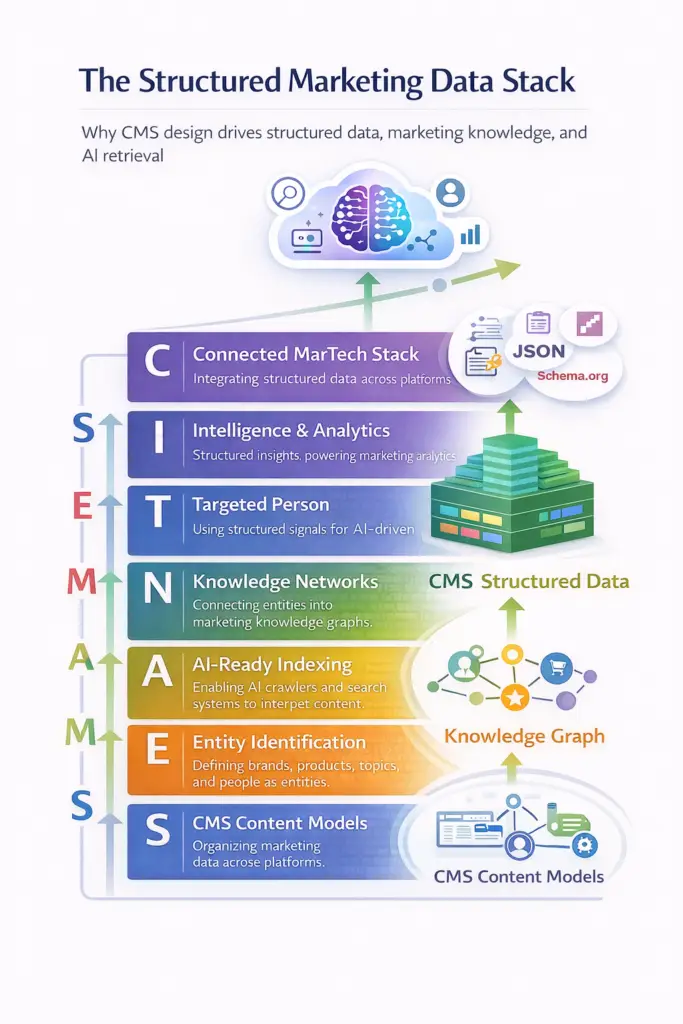
Where Structured Marketing Data Often Breaks Down
Common execution pitfalls
Even when the strategic case is clear, execution often falls short.
One common issue is taxonomy sprawl. Different teams create their own labels for products, segments, topics, or journey stages. Over time, the organization ends up with multiple versions of the same concept.
Another issue is shallow implementation. Some organizations add schema to pages but never improve the underlying content model. That creates the appearance of structure without the resilience of true governance.
A third issue is fragmented ownership. Editorial teams manage content quality. SEO teams manage markup. Analytics teams manage measurement. Platform teams manage systems. Everyone touches structured marketing data, but no one owns it end to end.
And finally, many teams measure too narrowly. They focus on rich results or search visibility but overlook the broader value of structure in personalization, reuse, and intelligence.
Why governance matters
This is why governance is so important. Structured marketing data works best when there is clarity around who defines entities, who governs taxonomies, who maintains standards, and how data quality is monitored over time.
Without that discipline, structure degrades quickly. With it, marketing can build a more scalable and intelligent operating foundation.
How to Build a Structured Marketing Data Strategy
A phased roadmap for modern marketing teams
For most organizations, the best approach is not to transform everything at once. It is to build in phases.
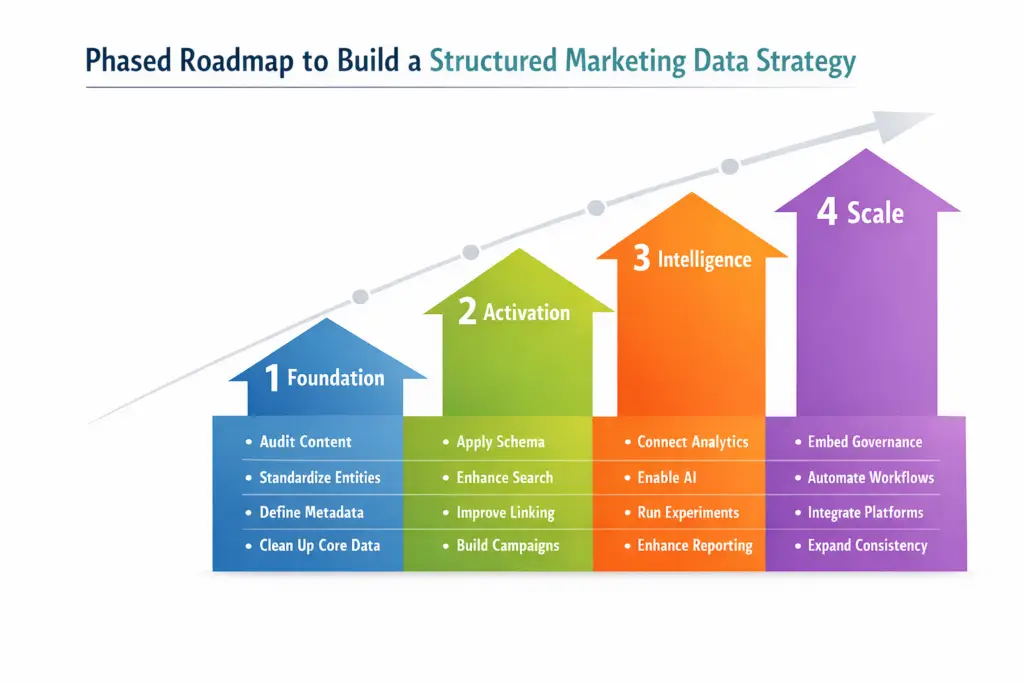
The first phase is foundation. Audit the highest-value content types. Standardize core entities. Define missing fields. Clean up metadata where it matters most.
The second phase is activation. Apply structure to search, schema, internal linking, recommendations and campaign workflows.
The third phase is intelligence. Connect structured marketing data to analytics, experimentation, AI use cases, and reporting.
The fourth pahse is scale. Embed the model into governance, editorial workflows, QA processes, and platform roadmaps so that structure becomes part of how marketing operates every day.
Executive questions worth asking
Senior leaders do not need to manage schema directly, but they should ask sharper strategic questions.
- Are we creating reusable data objects or mostly publishing pages?
- Do we have governed entities for products, topics, industries, and audiences?
- Can the same structured information support AI retrieval, personalization, and anlytics at once?
- Are our AI ambitions outpacing our information architecture?
- Are we measuring content by business meaning or only by page traffic?
Those questions matter because they reveal whether the marketing function is truly building an AI-ready foundation or simply layering new tools onto old structures.
Conclusion: Structured Marketing Data is Now Strategic Infrastructure
Why the next wave of AI marketing will reward structured brands
The next era of marketing will not be shaped only by who creates the most content or adopts the newest AI tool the fastest. It will be shaped by which organizations make their content, products, and knowledge most understandable to machines.
That is why structured marketing data is becoming the backbone of modern marketing.
It improves retrieval because it makes meaning explict. It improves personalization because it makes content addressable. It improves analytics because it gives interactions more business context. And it improves execution because it allows the same knowledge assets to be activated across the MarTech stack.
For AsiaTechBuzz readers, the strategic message is straightforward. In an AI-mediated environment, content alone is no longer enough. Marketing organizations need structured marketing data that is deliberately modeled, consistently governed, and connected across systems.
The brand that invest in that foundation now will do more than improve SEO or clean up metadata. They will build stronger marketing knowledge systems. And those systems will increasingly determine who gets discovered, who gets recommended, who gets trusted, and ultimately who gets chosen.
Read my other articles on Marketing Strategy.
Frequently Asked Questions (FAQs)
-
What is structured marketing data?
Structured marketing data is machine-readable information that describes marketing content, products, audiences, and relationships. It helps AI systems, search engines, and analytics tools understand and use content more effectively.
-
Why is structured marketing data important for AI-driven marketing?
It gives AI systems the context they need to interpret content, identify entities, and retrieve relevant information. This improves AI visibility, personalization, and content activation across channels.
-
How is structured marketing data different from structured content?
Structured content refers to how content is organized into reusable fields in a CMS. Structured marketing data adds metadata, schema, and relationships so that machines can understand the meaning of that content.
-
How does structured marketing data improve personalization?
It makes content easier to classify by audience, product, topic and journey stage. This allows personalization engines to match the right content to the right user more accurately.
-
What role does a CMS play in structured marketing data?
A modern CMS helps create the foundation by storing content in structured models with reusable fields and metadata. This makes it easier to support schema, AI retrieval, personalization, and analytics.