
Table of Contents
Introduction
Marketing technology is entering a new phase.
For more than a decade, organizations invested heavily in digital marketing platforms. Customer relationship management systems, marketing automation tools, analytics engines, and content management platforms become the operational backbone of modern marketing teams.
These technologies helped companies scale campaigns, automate engagement, and measure customer interactions more effectivesly.
But artificial intelligence is now changing what marketing infrastructure must deliver.
AI i s no longer an experimental capability used only by innovation teams. It is rapidly becoming embedded into everyday marketing operations – from recommendation engines and AI assistants to predictive segmentation and generative content creation.
This shif is redefining how marketing systems should be designed.
Traditional marketing stacks were built primarily to execute campaigns. They supported workflows where marketers designed campaigns, published content, and analyzed reports.
Artificial intelligence operates very differently.
AI systems require structured information, unified customer data, and real-time signals across multiple platforms. They rely on machine-readable knowedge and integrated data pipelines to generate insights and recommendations.
Because of this, organizations are rethinking their marketing architecture.
Instead of disconnected tools designed for specific tasks, companies are beginning to build integrated infrastructures that allow artificial intelligence to operate across the marketing ecosystem.
This is where the concet of the AI-ready martech stack becomes critical.
An AI-ready martech stack is not simply a modern collection of marketing tools. It is an architecture designed to support intelligence, automation, and real-time decision-making across customer engagement channels.
This architecture integrates multiple technology layers including structured content platforms. customer data platforms, knowldge graphs, real-time data pipelines, and AI orchestration systems.
Together, these components allow marketing infrastructure to evolve from a campaign execution engine into a platform capable of intelligent engagement.
The urgency of this transformation is increasing.
According to Gartner, traditional search engine volume is expected to decline by 25% by 2026 as AI chatbots and virtual agents reshape how people discover information (Source:Gartner).
In a world where AI increasingly intermediates how customers discover brands, marketing infrastructure must evolve.
Organizations that invest early in building an AI-ready martech stack will be better positioned to compete in this new environment.
Why Traditional MarTech Stacks Are Not Built for AI
Most organizations did not intentionally design their marketing technology ecosystems. Instead, their stacks evolved gradually over time as new capabilities were needed.
A CRM system was added to manage customer relationships. Marketing automation platforms were introduced to run email campaigns. CMS platforms were deployed to publish websites. Analytics tools were layered on top to measure performance.
This incremental approach enabled digital growth but also created fragmented infrastructures.
Today many enterprises operate with dozens – sometimes hundreds of marketing tools. These systems often operate independently, each storing its own data and managing its own workflows.
Customer data may exist across websites, mobile apps, CRM systems, loyalty platforms, and advertising networks.
Marketing content may be stored across CMS platforms, digital asset systems, campaign tools, and document repositories.
This fragmentation limits the effectiveness of artificial intelligence.
AI systems require unified data and consistent signals across channels. When information is scattered across disconnected platforms, AI models struggle to generate reliable insights.
The scale of unused data within organizations is significant.
Research from Forrester shows that between 60% and 73% of enterprise data remains unused for analytics and decision making (Source: Forrester).
For marketing leaders, this represents a majority opportunity.
Artificial intelligence can only generate meaningful value when it has access to unified, high-quality data.
Another limitation of traditional marketing stacks is how content is structured.
Marketing assets were designed primarily for human audiences. Web pages, landing pages, and brochures were built to communicate visually.
AI systems, however, ned content to be structured in ways machines can interpret.
They rely on metadata, semantic tagging, and relationships between information objects.
Without these structures, AI systems struggle to extract meaning from content.
These limitations explain why many organizations are redesigning their technology architectures to support an AI-ready martech stack.
The S.T.A.C.K Framework for an AI-Ready MarTech Stack
To understand how marketing infrastructure is evolving, it is useful to think about the architecture in layers.
One useful model is the S.T.A.C.K Framework, which outlines the five essential layers required for a modern AI-ready martech stack.
Each layer provides a critical capability that artificial intelligence needs to function effectively within marketing operations.
This framework includes:
Structured Content Layer
This layer provides the foundation for AI-readable marketing content. It is typically powered by modern CMS or digital experience platforms that support structured content models.
Trusted Data Layer
This layer consolidates customer intelligence using technologies such as Customer Data Platforms. It ensures AI systems have access to unified cutomer profiles and behavioral signals.
AI Intelligence Layer
This layer introduces semantic intelligence using technologies such as knowledge graphs. It connects customers, products, and content through contextual relationships.
Composable Integration Layer
This layer connects the marketing ecosystem using APIs, microservices, and real-time data pipelines.
Knowledge Activation Layer
This top layer orchestrates artificial intelligence capabilities including personalization engines, recommendation systems, and AI assistants.
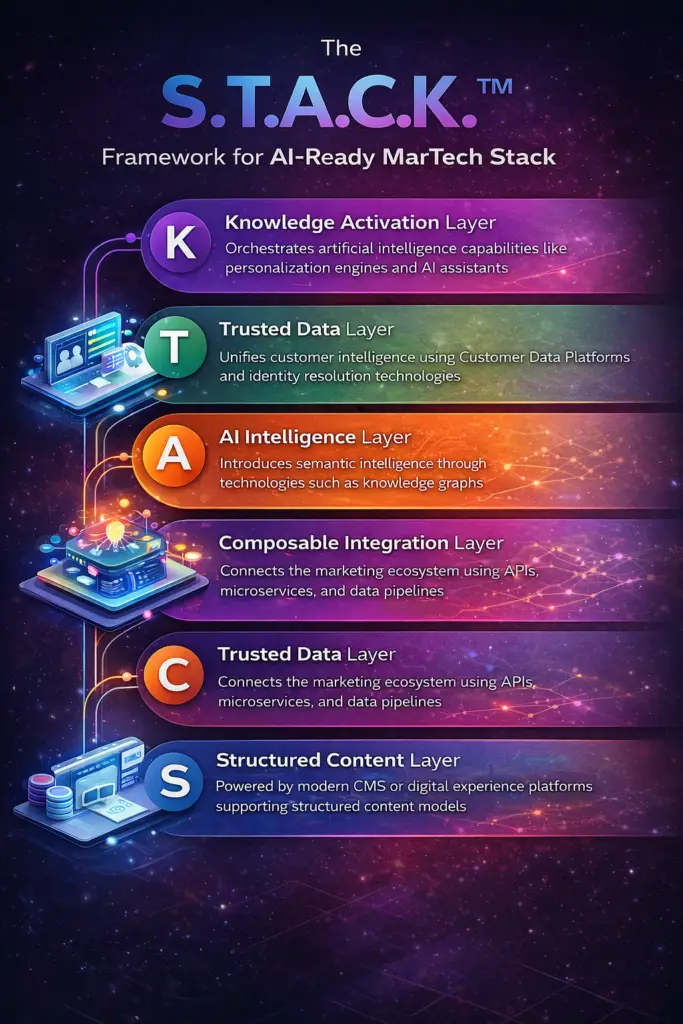
Together these layers form the foundation of an AI-ready martech stack.
Layer 1: Structured Content – The CMP and DXP Foundation
Content remains the primary interface between brands and customers.
However, the way content is structured inside technology systems is evolving rapidly.
Traditional CMS platforms were designed primarily for publishing web pages. Content was stored as large HTML documents tightly linked to visual layouts.
While effective for web publishing, this model limits AI-driven marketing.
Artificial intelligence systems require content in smaller, reusable components. Instead of pages, AI system need information elements such as product attributes, benefits, FAQs, pricing data, and structured metadata.
Modern headless CMS platforms support this approach.
They allow marketers to redefine structured content models and deliver content through APIs across multiple channels including website, mobile apps, conversational interfaces, and AI assistants.
This capability is foundation for organizations building an AI-ready martech stack.
Structured content also improves disoverability with AI-powered search environments.
Generative search engines rely heavily on structured signals to indentify authoritative information sources.
Organizations that structure their content effectively increase the likelihood that their information will be surfaced inAI-generated responses.
Layer 2: Trusted Data – The Role of the Customer Data Platform
While content communicates a brand’s message, customer data provides the intelligence that powers personalization.
The trusted data layer of an AI-ready martech stack ensures that marketing systems can understand customer behavior across channels.
Customer Data Platforms play a critical role here.
A CDP aggregates information from websites, mobile apps, CRM systems, transactions, and marketing platforms. It then builds unified customer profiles that allow organizations to understand customer journeys more clearly.
These profiles enable AI systems to detect patterns, predict intent, and personalize experiences.
The business. impact of unified customer data is substantial.
According to McKinsey, companies that effectively leverage personalization generates 40% more revenue from those activities compared with companies that do not (Source: McKinsey).
This highlights why customer data infrastructure is a core component of the AI-ready martech stack.
Layer 3: AI Intelligence – The Knowledge Graph Layer
Once content and customer data are structured, organizations can begin building deeper intelligence. This is where the knowledge graph layer becomes important.
A knowledge graph connects information throuygh entities and relationships rather than isolated tables.
For example, it may connect a customer’s interests with product categories, relevant content, and recommended services.
This contextual understanding allows AI systems to deliver more relevant recommendations and insights.
Knowledge graphs also strengthen search visibility.
Search engines and generative AI models rely on semantic relationships to identify authoritative information sources.
By structuring knowledge in this way, organizations improve the intelligence layer of their AI-ready martech stack.
Layer 4: Composable Integration – APIs and Data Pipelines
Modern marketing ecosystems contain many specialized platforms.
To function effectively together, these systems must be connected through flexible integration architecture.
Composable architecture enables this.
Instead of relying on large monolithic systems, composable architectures connect specialized tools through APIs and data pipelines.
APIs allow systems to exchange information in real time.
Modern event-driven pipelines allow organizations to process customer interactions as they occur.
These capabilities allow AI models to operate on fresh data signals rather than delayed reports.
This integration layer acts as the nervous system of the AI-ready martech stack.
Layer 5: Knowledge Activation – The AI Orchestration Layer
The final layer of the AI-ready martech stack activates intelligence across marketing channels.
AI orchestration platforms analyze customer signals, apply predictive models, and trigger actions in real time.
These actions may include:
- personalized recommendations
- optimized marketing journeys
- AI-generated content
- coversational assistants
Instead of relying solely on manual campaign planning, AI systems increasingly guide marketing decision dynamically.
What an AI-Ready MarTech Stack Looks Like in Practice
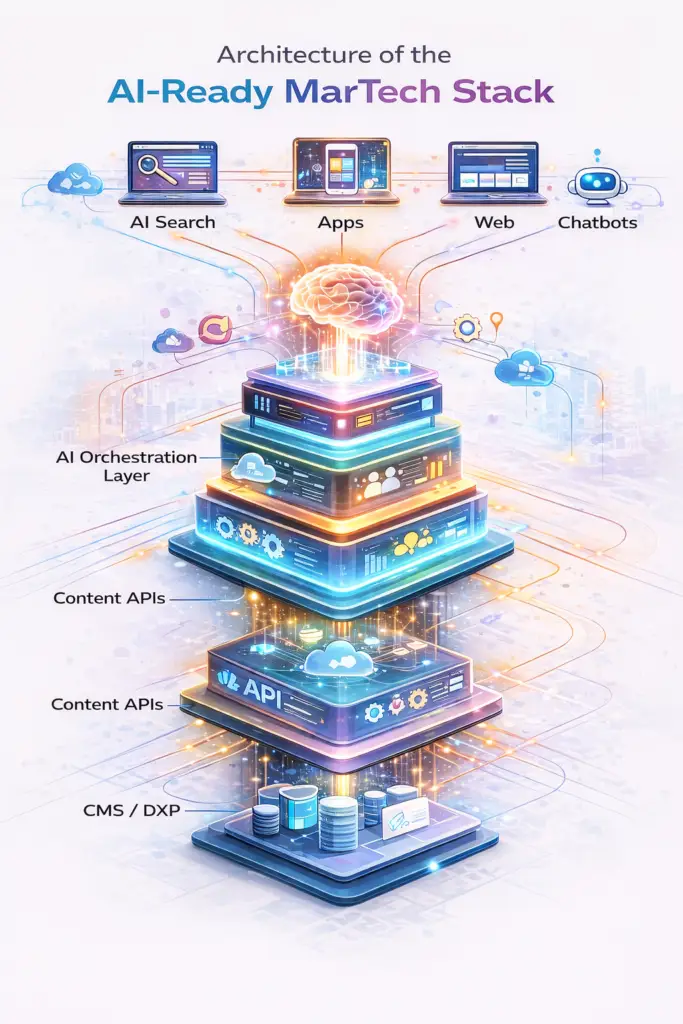
When the layers of the AI-ready martech stack operate together, marketing technology begins to function as an integrated intelligence platform.
- Content platforms deliver structured information
- Customer data platforms unify behavioral insights
- Knowledge graphs connect information into meaningful relationships
- APIs integrate platforms into a composable architecture
- AI orchestration engines activate insights across digital channels
Together these capabilities enable highly personalized customer engagement at scale. The AI-ready martech stack therefore transforms marketing infrastructure into a strategic growth engine.
Conclusion
Artificial Intelligence is redefining how marketing operates.
Traditional marketing stacks were designed for campaign execution rather than machine intelligence.
The AI-ready martech stack provides a new blueprint for modern marketing infrastructure.
By combining structured content platforms, unified customer data, semantic knowledge models, composable integrations, and AI orchestration layers, organizations can build infrastructure capable of powering the next generation of marketing innovation.
In the AI era, marketing success will increasingly depend on the strength of this infrastructure.
Organizations that build an AI-ready martech stack today will shape the future of marketing tomorrow.
Click here to read my other articles on AI
Frequently Asked Questions (FAQs)
-
What is an AI-ready MarTech Stack?
An AI-ready martech stack is a modern marketing technology architecture designed to support artificial intelligence across the marketing lifecycle. It integrates systems such as CMS platforms, customer data platforms, data pipelines, APIs, and AI orchestration layers so that data, content, and intelligence can work together seamlessly.
-
Why do companies need an AI-ready martech stack?
Companies need an AI-ready martech stack because artificial intelligence relies on structured data, accessible content, and connected systems. Without modern infrastructure, AI initiatives struggle to scale. An AI-ready stack enables personalization, predictive analytics, automation, and intelligent customer experiences across digital channels.
-
What technologies are typically included in an AI-ready martech stack?
An AI-ready martech stack usually includes several core technology layers: a CMS or digital experience platform for structured content, a customer data platform for unified customer profiles, data pipelines for integration, knowledge graphs for semantic relationships, and AI orchestration layers to activate intelligence across channels.
-
How does a CMS support an AI-ready martech stack?
A modern CMS or DXP supports an AI-ready martech stack by managing structured, reusable content that can be delivered through APIs to multiple channels. This structured content model allows AI systems to retrieve, analyze, and generate insights more effectively, making the CMS a foundational component of AI-driven marketing.
-
What are the benefits of building an AI-ready martech stack?
Building an AI-ready martech stack enables organizations to unlock advanced capabilities such as hyper-personalization, automated decision-making, predictive marketing insights, and AI-powered customer engagement. It also improves agility by allowing marketing teams to integrate new AI tools without rebuilding their entire technology architecture.