
Table of Contents
Introduction
Artificial intelligence has shifted from innovation agenda to enterprise imperative. Across boardrooms, AI is no longer discussed as a pilot initiative; it is treated as core infrastructure. Marketing, in particular, sits at the center of this shift.
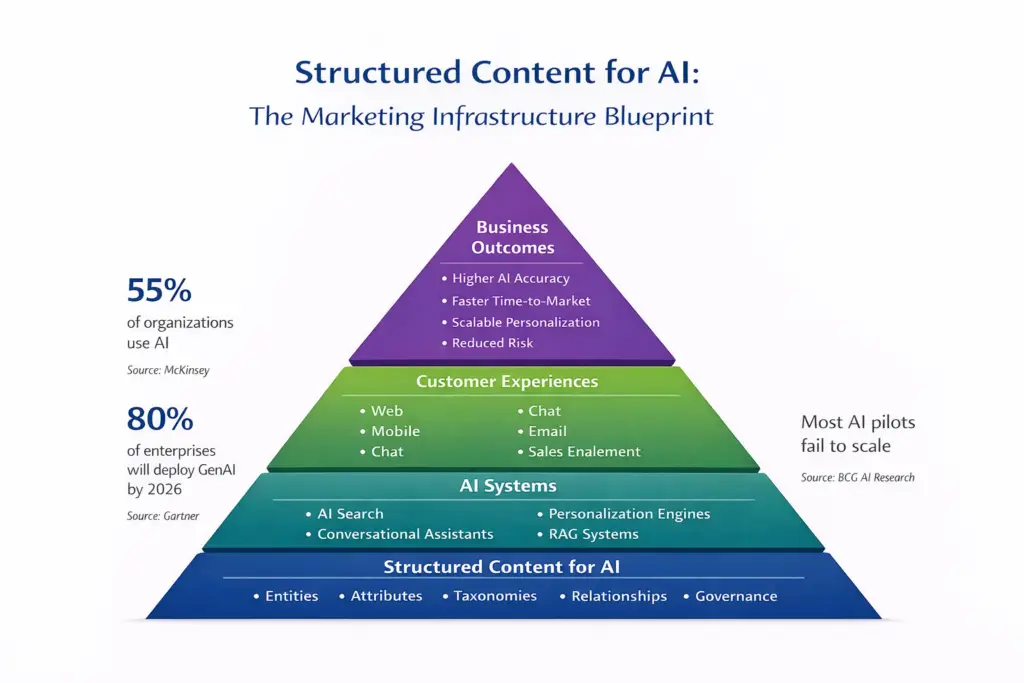
McKinsey’s State of 2023 report highlights that 55% of organizations have adopted AI in at least one business function, with marketing and sales among the leading areas of application (Source: McKinsey).
Gartner further forecasts that by 2026, more than 80% of enterprises will have used generative AI APIs or deployed generative AI-enabled applications in production environments. (Source: Gartner).
The trajectory is clear. AI is becoming foundational.
Yet the majority of discussion around AI in marketing focus on tools – copilots, generative engines, conversational bots, personalization platforms. Far fewer conversations focus on the structural layer beneath those tools.
That structural layer is Structured Content for AI.
Structured Content for AI represents a shift from publishing content as pages to designing content as structured knowledge. It ensures that marketing information is modular, machine-readable, semantically connected, and governed. As AI systems increasingly mediate customer interactions, Structured Content for AI becomes the strategic foundation that determines whether those systems operate intelligently or inconsistently.
The AI Era Requries Content Architecture Discipline
The evolution of marketing technology has always required structural adaptation. SEO required metadata and schema. Mobile demanded responsive frameworks. Omnichannel marketing required centralized content repositories.
The AI era requires something deeper: entity-level clarity.
Artificial intelligence systems do not consume narrative the way humans do. They retrieve entities, attributes, and relationships. When content is buried inside layout-dependent templates, AI must infer meaning from unstructured text. Inference introduces risk.
Structured Content for AI removes that ambiguity by making meaning explicit.
From Page-Centric Thinking to Entity Modeling
Traditional CMS workflows encourage teams to think in pages. A campaign equal a a landing page. A product equals a microsite. A policy equals a PDF.
In contrast, Structured Content for AI introduces entity modeling:
- Products become structured objects
- FAQs become reusable knowledge entities
- Policies become version-controlled components
- Campaign messages become modular content blocks
Each element is defined independently from presentation. Layout becomes a layer on top of structured knowledge rather than the container of it.
This transition from page-centric publishing to entity-centric modeling is the defining characteristic of Structured Content for AI.
Why AI Scaling Fails Without Structure
Boston Consulting Group’s AI research emphasizes that while many enterprises experiment with AI, fare fewer achieve scaled transformation (Source: BGC).
One consistent barrier is fragmented data and knowledge architecture. AI initiative layered on top of inconsistent content structures struggles to produce reliable outcomes.
In marketing, this challenge manifests in:
- Inconsistent chatbot responses
- AI hallucinations
- Conflicting product descriptions
- Poor AI search visibility
- Duplicate content across channels
Structured Content for AI addresses these scaling barriers by creating a coherent knowledge layer across the organization.
What Structured Content for AI Actually Means
Structured Content for AI is not about adding tags after publication. It is about designing content as structured, reusable knowledge from the outset.
This includes:
- Clearly defined entities
- Explicit attributes
- Standardized taxonomies
- Defined relationships
- Version-controlled components
When content is modeled this way, AI systems can retrieve and recombine it reliably.
Content as Structured Knowledge Assets
Consider a financial product offering. In a traditional environment, eligibility, pricing, and benefits may be described across multiple pages. In a structured model, each attribute exists as defined field:
- Interest rate
- Tenure range
- Eligibility criteria
- Fees
- Compliance disclosures
Under Structured Content for AI, those fields become reusable across:
- Website pages
- Mobile applications
- Conversational assistants
- AI search responses
- Internal advisory tools
This modularity enhances consistency and reduces duplication.
Semantic Relationships Matter
AI systems improve when relationships between entities are clear. Structured Content for AI explicitly defines:
- Product-to-feature relationships
- Feature-to-benefit connections
- Policy-to-regulation mappings
- Segment-to-offer alignment
These relationships enable contextual reasoning rather than surface-level keyword matching.
Strategic Business Impact of Structured Content for AI
For CMOs, the value of Structured Content for AI must be measured in outcomes, not architecture diagrams.
AI Search and Discoverability
As AI-generated summaries increasingly shape customer discovery journeys, structured signals determine visibility. Conten that is entity-rich and semantically consistent is more likely to be interpreted correctly by AI systems.
Structured Content for AI strengthens discoverability by ensuring that brand information is sturctured clearly enough to be cited accurately.
Conversational Accuracy and Trust
Conversational AI systems rely heavily on retrieval precision. Structured Content for AI reduces hallucination risk by constraining responses to validated attributes.
This is particularly critical in regulated industries, where incorrect AI responses can damange trust and expose organizations to risk.
Enterprise-Scale Personalization
Personalization engines depend on modular content components. Structured Content for AI enables dynamic assembly of:
- Segment-specific offers
- Journey-stage messaging
- Context-aware product recommendations
Because content components are reusable and clearly labeled, AI systems can orchestrate personalization at scale without manual duplication.
A Structured Content for AI Maturity Model
To operationalize structured content, organizations must assess their maturity.
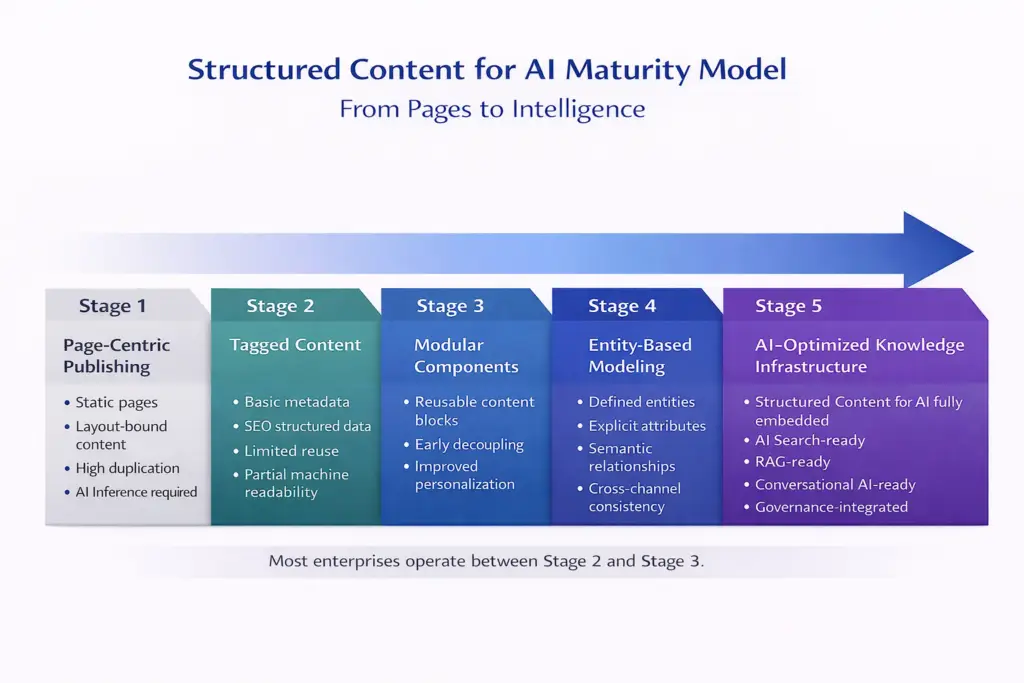
Level 1: Page-Centric Publishing
Content exists primarily in layout-bound pages. AIretrieval relies on scraping and inference.
Level 2: Tagged Content
Basic metadata exists, but entities are not consistently defined.
Level 3: Modular Content Components
Reusable content blocks emerge, but relationships remain loosely structured.
Level 4: Entity-Based Knowledge Modeling
Core business entities are defined with attributes and relationships.
Level 5: AI-optimized Knowledge Architecture
Structured Content for AI is embedded across systems, powering AI search, personalization, and conversational interfaces.
Most enterprises operate betweel Level 2 and Level 3. Achieving Level 5 requires cross-functional deliberate structural transformation.
Governance and Operating Model Implications
Structure content is not solely a technical initiative. It requires cross-functional governance.
- Marketing defines messaging
- Product teams define attributes
- Compliance defines disclosures
- Technology defines schemas
A unified governance model ensures that structured entities remain accurate an version-controlled. Without governance, structure deteriorates over time.
ROI Model for Structured Content for AI
While structural transformation may appear technical, the ROI is tangible.
Reduced Content Deduplication
Reusable entities lower content production effort.
Faster Campaign Deployment
Modular blocks accelerate go-to-market cycles.
Lower AI Error Rates
Structured retrieval improves AI response reliability.\
Reduced Technical Debt
Strandardized schemas simplify integration across systems/
Over time, Structured Content for AI compoundsthe value of every AI investment layered above it.
A Practical Roadmap to Implementing Structured Content for AI
Transitioning to Structured Content for AI is not a tooling upgrade. It is an organizational shift that requires architectural clarity, goveranance aliognment, and phased execution. Attempting a full transformation in one step often leads to over-engineering and resistance. Instead, successful organizations adopt a structured, maturity-driven approach.
Below is a pragmatic roadmap designed for CMOs and digital leaders overseeing enterprise transformation.
Phase 1: Conduct a Content Architecture Audit
Before designing new models, leaders must understand their current state.
This audit should evaluate:
- How content is currently stored (page-based vs modular)
- Whether entities are clearly defined
- Duplication levels across channels
- Governance ownership clarity
- Metadata and taxonomy consistency
- AI retrieval performance (if applicable)
The goal is not critique past design decisions, but to identify fragmentation risks. Many organizations discover that product descriptions, FAQs, and compliance disclosures exist in multiple inconsistent versions across platforms.
This phase establishes the baseline from which Structured content can evolve.
Phase 2: Identify High-Impact Entities
Not all content needs to be structured at once. The most effective transformation begins with high-impact knowledge domains.
Common starting points include:
- Core products or services
- Frequently asked questions
- Regulatory disclosures
- Campaign messaging blocks
- Pricing models
- Customer eligibility rules
By focusing on these areas first, organizations demonstrate immediate value from Structured Content for AI without overwhelming teams.
The principle here is leverage. Prioritize entities that are reused across multiple channels or that power AI interactions directly.
Phase 3: Design the Content Model
Once priority entities are identified, the next steps is modeling. This involves defining:
- Core entity types
- Required and optional attributes
- Relationships between entities
- Taxonomy structures
- Version control logic
- Governance ownership
At this stage, collaboration is critical. Marketing defines messaging logic. Product teams define attribute clarity. Compliance teams validate regulatory fields. Technology ensures schema consistency.
The outcome should be a documented content model that reflects how knowledge is structured, not how pages are designed.
Structured Content for AI becomes durable only when modeling is deliverate rather than improvised.
Phase 4: Decouple Content from Presentation
A common barrier to transformation is legacy CMS architecture. In many organizations, content is deeply embedded within layout templates.
Transitioning to Structured Content for AI requires decoupling content from presentation.
This does not always require replacing the CMS immediately. It may involve:
- Introducing structured components within existing systems
- Creating reusable content blocks
- Establishing API-based access layers
- Gradually migrating high-impact content domains
The objective is to ensure that knowledge can be accessed independently from visual layout. AI systems retrieve data, not design.
Phase 5: Establish Governance and Operating Model
Structured Content for AI will degrade without governance.
Clear ownership must be defined:
- Who owns each entity type?
- Who approves attribute changes?
- How are regulatory updates managed?
- How are version histories tracked?
Governance frameworks should define:
- Review cycles
- Approval workflows
- Audit checkpoints
- Change documentation standards
At enterprise scale, Structured Content for AI becomes a shared capability. Without operating model clarity, structural integrity erodes over time.
Phase 6: Pilot AI Activation
Before scaling organization-wide, activate Structured Content for AI in one controlled domain. Examples include:
- A single product category
- A chatbot knowledge base
- An AI search optimization initiative
- A personalization pilot
This phase tests retrieval precision, integration flows, and governance robustness. It also builds internal confidence by demonstrating measurable improvements in AI accuracy and operational efficiency.
Pilot outcomes should be documented and shared internally to support scaling decisions.
Phase 7: Scale Across Enterprise Systems
Once the model is validated, Structured Content for AI can scale across:
- Web properties
- Mobile applications
- Conversational assistants
- Sales enablement tools
- Internal advisory platforms
Scaling requires synchronization across teams. Structured entities must remain consistent regardless of channel.
At this stage, structured knowledge becomes an enterprise asset rather than a marketing initiative.
Phase 8: Measure AI Readiness and Structural Maturity
Transformation must be measurable.
Key indicators may include:
- Reduction in duplicate content
- Improved AI response accuracy
- Faster campaign deployment cycles
- Reduced content update inconsistencies
- Increased reuse of modular entities
Organizations can assess maturity using a five-level fraework:
- Page-based publishing
- Tagged content
- Modular components
- Entity-based architecture
- AI-optimized knowledge infrastructure
Progression toward Level 5 indicates true Structured Content for AI capability.
Common Pitfalls to Avoid
Even well-intented initiatives can falter. The most common risks include:
- Treating structured modeling as purely technical
- Over-engineering schemas at the outset
- Neglecting governance
- Attempting full migration too quickly
- Failing to demonstrate early business value
The key is balance. Structured Content for AI must be ambitious in vision but pragmatic in execution.
Conclusion: Structure is the Real AI Advantage
Artificial intelligence will continue to evolve. Models will become more powerful. Interfaces will become more conversational. Automation will become more autonomous. The pace of innovation will not slow down.
What will remain constant is this: AI systems depend on clarity.
Thye depend on defined entities, explicit attributes, governed relationships, and reliable knowledge layers. When those foundations are weak, AI become inconsistent. When those foundations are disciplined, AI become dependable.
That is why Structured Content for AI is not a technical enhancement – it is a strategic capability.
It reframes content from being a collection of pages into a structured knowledge asset. It transforms marketing from publishing campaigns into modeling intelligence. It shifts the conversation from “How do we use AI?” to “Is our foundation ready for AI?”
For CMOs and digital leaders, this is the real inflection point.
AI tools will continue to proliferate. Vendors will promise acceleration. Pilots will demonstrate short-term gains. But sustainable advantage will not come from tools alone. It will come from architectural discipline – from building systems that allow AI to operate with precision, consistency, and scale.
Organizations that invest in structural clarity today will find that their AI initiaitves compound in value over time. Those that neglect it may find themselves continuously retrofitting fragmented systems to keep pace with technology.
In years ahead, intelligent marketing will not be defined by who experimented with AI first. It will be defined by who built the strongest, most conherent content foundation beneath it.
And that foundation begins with structure.
Read my other articles on AI Search Optimization here.
Frequently Asked Questions (FAQs)
-
What is Structured Content for AI
Structured Content for AI is the practice of designing content as modular, machine-readable entities with defined attributes and relationships. Instead of storing information only as page-based text, content is modeled as structured knowledge that AI systems can retrieve, interpret, and activate accurately across search, chat, and personalization engines.
-
Why is Structured Content for AI important for marketing?
Structured Content for AI improves AI accuracy, personalization, and search visibility. It enables AI systems to access clearly defined entities rather than ambigious text, reducing hallucination risk and improving customer experience. For CMOs, it strengthens scalability, governance, and long-term ROI from AI investments.
-
How does Structured Content for AI reduce AI hallucinations?
AI hallucinations often occur when systems retrieve incomplete or ambiguous information. Structured content for AI reduces this risk by providing clearly defined attributes, semantic relationships, and validated knowledge entities. This structured foundation improves retrieval precision and response consistency.
-
How is Structured Content for AI different from traditional SEO?
Traditional SEO focuses on optimizing pages for search engines using keywords and metadata. Structured Content for AI goes deeper by modeling content as entities and structured knowledge. It supports AI search, conversational assistants, and retrieval-augmented generation systems – not just keyword rankings.
-
How can organizations start implementing Structured Content for AI?
Organizations should begin by auding their current content architecture, identifying high-impact entities such as products and FAQs, and modeling them with defined attributes and governance workflows. A phased rollout – starting with one domain before scaling enterprise-wide – ensures sustainable adoption.