
Table of Contents
Introduction
For years, marketing teams have treated content as an output. A campaign needed a landing page, so a page was written. A product launch needed email copy, so email copy was created. A new proposition needed app banner, paid ads, sales enablement, FAQs, and service scripts, so each team produced its own version. That model was manageable when channels were fewer, personalization was ligheter, and content velocity was lower.
That model is now under strain.
The AI era is pushing marketing organizations into a very different operating environment. Content demand is rising shaply, customers expect relevance in real time, and brands increasingly need the same message to travel across websites, apps, CRM journeys, sales flows, services journeys, and AI-powered interfaces. Adobe reported in 2025 that 96% of marketers has seen content demand at least double over the previous two years, 62% siad it had grown fivefold or more, and 71% expected demand to grow more than 5x again by 2027. At the same time, Salesforce reported that 75% of marketers were already experiementing with or had fully implemented AI in their operations. Yet Salesforce’s 2026 State of Marketing found that 84% still run generic campaigns and 69% still struggle to respond promptly to customers. The message is hard to miss: the industry is adopting AI faster than it is modernizing the content system underneath it.
That gap is exaclty why a new discipline is begining to matter inside modern marketing organizations: content engineering for marketing.
This is not a fashionable relabeling of content operations, nor is it a call to turn marketers into software eingieers. It is a practical response to a structural problem. Marketing content now has to do more than persuade. It has to be structured, reusable, governed, machine-readable, and ready to move through workflows, channels, and AI systems without being recreated from scratch each time. That is the operating promise of content engineer for marketing.
The organizations that understand this shift early will be in a stronger position to scale personalization, improve speed to market, reduce duplication, and make their AI investments more useful. The ones that ignore it may find themselves generating more content, but not building better marketing systsems.
The New Marketing Bottleneck Is Not Ideas. It is Content Operations
Most enterprise marketing teams do not suffer from a shortage of creativity. They suffer from fragmented execution.
In many organizations, the work still flows through an asset-first model. A campaign brief is approved. Copywriters draft a page. Designers build the visual layout. Email teams adapt the same message in parallel. Social teams rewrite it again. Product teams request an in-app version. Local markets create their own edits. Legal reviews every version separately. When the proposition changes or a disclaimer is updated, the cycle starts again.
This approach is expensive in ways that rarely show up clearly on a single dashboard. It create duplication, slows down approvals, introduces inconsistency, and makes reuse harder than it should be. Most importantly, it traps strategic messaging inside final deliverables instead of preserving it as reusable source content.
AI has made this weakness more visible. It can generate variants quickly, but it does not fixa weak structure. If the source content is bried inside pages, duplicated across files, or tagged inconsistently, AI simply accelerates the mess. That is one reason Salesforce’s data is so revealing: while AI adoption is already widespread, many teams still admit their campaigns feel generic and their response capability remains to slow. The issue is not a lack of tools. It is the lack of reusable data. (Source: Salesforce)
For senior leaders, this should reframe the problem. The next marketing bottleneck is not content generation. It is content architecture and operational flow. Teams need a way to define content once, govern it properly, reuse it intelligently, and assemble it dynamically across touchpoints. That is the managerial logic behind this emerging discipline.
What Content Engineering for Marketing Actually Means
Content engineering for marketing is the discipline of designing marketing content so that it can be structured, reused, governed, assembled, and delivered across channels, workflows, and AI-enabled experiences.
That definition matters because it moves the conversation beyond creation alone. In a traditional model, content is often treated as a finished artifact: the page, the email, the brochure, the ad. In an engineered model, content is treated as a set of meaningful components with fields, rules, metadata, relationships and approved users.
This is where several established practices come together. In practice, content engineering for marketing pulls those practices into one operating model. Content modeling provides the structural blueprint. Structured authoring changes how teams create content. Modular publishing enables assembly across channels. Content pipelines govern how material moves from planning to delivery. Collaboration between marketing and engineering ensures the model works both editorially and technically.
The phase may still be emerging, but the building blocks are already well established. Contentful describes content models as the structure and organization behind content, including the definition of content types and reusuable elements. Heretto describes structured authoring as breaking content into smaller reusable pieces and separating content from presentation. Sanity defines modular content as self contained units that can be reused and rearranged across channels. Together, these practices describe something larget than a CMS technique. They point to an operating discipline (Source: Content Marketing Institute).
That is why it is best understood as the layer between strategy and execution. It translates brand and business intent into content structures that machines, workflows, and channel teams can actually use.
Why Marketing Needs This Discipline Now
1. Content demend is compounding faster than mos teams can scale manually
The first reason is volume. Adobe’s 2025 research shows that the pressure is already severe and still increasing. Marketers are not just producing more campaigns. They are being asked to produce more formats, more variants, and more personalized experiences, often at the same time (Source: Adobe).
A page-based production model does not scale well in that environment. The more channels and audiences the business adds, the more duplication it creates. Without structured reuse, every new demand multiplies effort.
2. AI raises the value of structure, not just the speed of creation
The second reason is AI. Many organizations initially approached generative AI as a productivity layer. That is understandable, but incomplete. AI works best when it can access governed source material, distinguish content types clearly, and pull from structured fields rather than loosely formatted documents.
When the underlying content is well organized, AI can support drafting, summarization, metadata enrichment, translation support, recommendations, and dynamic assembly more reliably. When the underlying content is messy, AI often creates inconsistency at scale.
3. Customer experience has become composable
Thee third reason is delivery. Brands are no longer experienced only through full pages or full campaigns. Customers encounter modular experiences: product cards, snippets, recommendation blocks, onboarding screens, chatbot answers, search summaries, service prompts, and app notifications. Those experiences draw from fragments of content assembled in context.
If marketing content is still managed mainly as long-form documents and channel-specific files, the organization will struggle to support this new reality. This discipline gives teams a way to build for composability rather than retrofitting every request manually.
The Five Pillars of Content Engineering for Marketing
To make the discipline practical, it helps to break content engineering for marketing into five connected pillars.
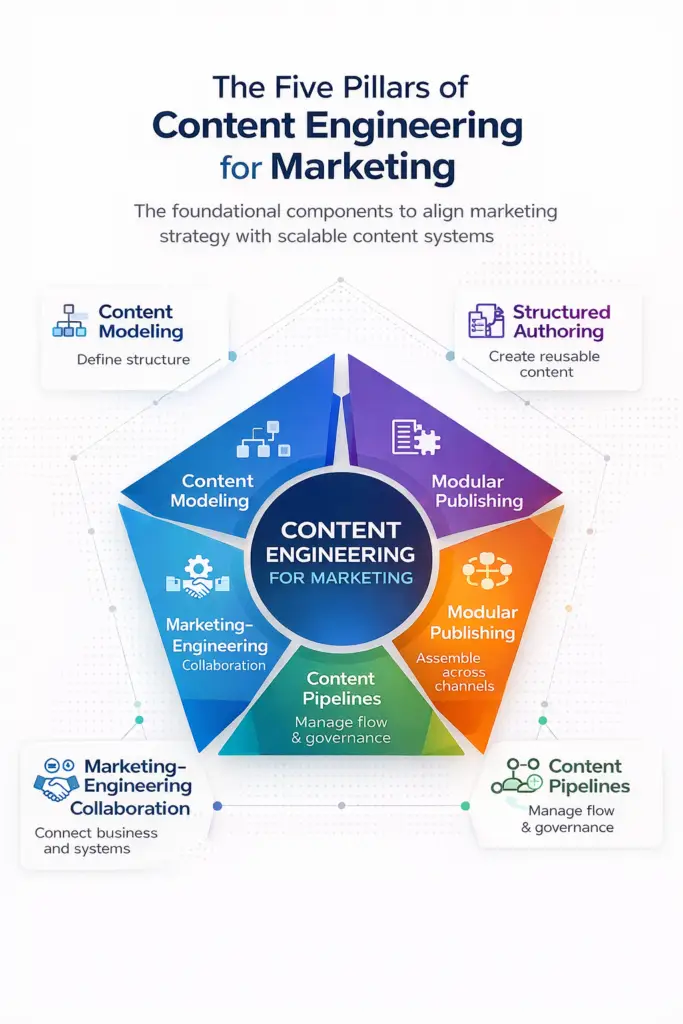
Content Modeling
Content modeling defines what content exists, what fields it includes, how content types relate to one another, and which pieces are meant to be reusable. It is the structural layer that ensures content is not just written, but designed. If a product proposition includes a headline, proof point, CTA, disclaimer, segment tag, and validity window, those should not live as accidental formatting choices inside a page. They should exist as structured fields.
Good content models reduce ambiguity, improve governance, and make reuse possible. Poor models bury logic inside layouts and create downstream inefficiency.
Structured authoring
Structured authoring changes how teams write. Instead of authoring toward a single finished page, writers create content in reusable units with defined purpose and controlled variation. This might include a benefit statement, a product explanation, a warning, a customer quite, or an eligible rule.
This does not make writing robotic. It makes the output more portable. Teams can still produce strong brand language, but they do so in a whay that can travel across channels without constant rewriting.
Modular publishing
Modular publishing is the practice of assembling experiences from reusable content blocks rather than recreating full assets each time. This is increasingly important in omnichannel marketing, where the same message may need to appear in a web hearo, a CRM journey, an app card, and an AI-generated response.
Sanity highlights that modular content improves flexibility, reuse, and consistency across channels. That is exactly the business advantage here (Source: Content Marketing Institute).
Content pipelines
Content pipelines govern how content moves from request to planning, drafting, approval, localization, publishing, measurement, and maintenance. Adobe often frames this more broadly as the content supply chain: the end-to-end process required to deliver content for campaigns and personalized experiences at scale (Source: Adobe).
Without a pipeline, organizations see content as a series of requests. With a pipeline, they can manage a flow, find bottlenecks, and build automation where it actually helps.
Collaboration between marketing and engineering
This pillar is what makes the rest sustainable. Content structure only works when editorial needs and technical implementation are aligned. Marketing understands audience and message. Engineering understands systems and delivery. Product and UX understand journey logic. Legal and compliance understand boundaries. It creates teh shared layer where those perspectives can meet.
Content Modeling Is the Foundation Most Teams Skip
Many organizations still jump directly from campaign planning to asset production. That feels efficient in the moment, but it usually creates long-term drag.
A better starting point is to identify the repeatable content entities in the business. These might include offers, feature summaries, product benefits, proof points, disclaimers, onboarding steps, customer testimonials, eligibility rules, FAQs, and service responses. Once those entities are clear, the team can define the fields, relationships, and governance rules around them.
This is where content modeling becomes powerful. It forces the business to decide what a piece of content actually is. Is a CTA just a line of copy, or is it an object with a label, destination, audience condition, lifecycle status, and channel suitability? Is a testimonial just a quote on a page, or a governed asset with a permission, status, customer segment, topic tag, and approved usage context?
These are not academic questions. They affected speed, compliance, and reuse. A strong model allows an update to propagate more predicitably. This is one reason content engineering for marketing starts to create enterprise value quickly once the model is in place. It supports central governance. It helps teams locate what thye need faster. And it makes AI outputs more reliable because the source material is clearer.
This is why the work should begin with structure rather than templates. Templates matter, but they should sit on top of the model, not substitute for it.
Structured Authoring Turns Copy Into Reusable Content Assets
Traditional copywriting is usually oriented toward a final deliveable. Structured authoring is oriented toward future use.
Consider a product explanation. In a page-first model, it is written inside one landing page and copied elsewhere later. In a structured model, it is create3d as a reusable object with clear fields, definitions, and governance. That same explanation can then power web content, app onboarding, CRM nurture flows, sales enablement, and AI-driven response layer without being reinvented repeatedly.
This approach is particularly valuable in complex and regulated environments, which is where content engineering for marketing often proves its worth fastest. When disclosures, conditions, or eligibility rules change, centrally governed components can be updated faster and more safely than manually editing dozens of downstream assets.
Structured authoring also improves editorial consistency. Writers work from shared definitions and controlled patterns, not just personal habit. That creates a stronger relationshop between brand voice and operational discipline. The output feels more coherent because the system behind it is more coherent.
In that sense, the discipline does not reduce creativity. It protects it from waste.
Modular Publishing Is the Operating Model for Omnichannel Scale
Most channel inconsistency is not a brand problem. It is a publishing model problem.
When each team creates content separately for each destination, inconsistencies are most inevitable. Even when everyone starts from the same brief, local adaptations, format differences, timing gaps, and approval cycles create drift.
Modular publishing solves this by shifting the unit of work. Instead of producing every output as a self-contained asset, teams publish from a shared set of approved modules. The experience may still look different in each channel, but the source content remains aligned.
This is where the economic value becomes esaier to see. Reusable modules reduce prodcution effort. Central updates reduce maintenance cost. Structured assembly speed up launch. More consistent source content reduces the compliance burden.
It also creates the conditions for more realistic personalization. Many teams still assume personalization means producing endliess bespoke versions manually. In practice, scalable personalization usually depends on modular assembly: selecting the right approved components for the right user in the right context. That is much easier when content is built for reuse from the start.
It makes this possible by treating publishing as assembly, not just output.
Content Pipelines Turn Content Into a Manage Flow
A recurring weakness in many organizations is that content still behaves like project work rather than operational flow.
A requet comes in. A team reacts. Deadlines tighten. Review loops become unclear. Measurement happens too late to inform the next cycle. The organization gets content out, but the process remains fragile and expensive.
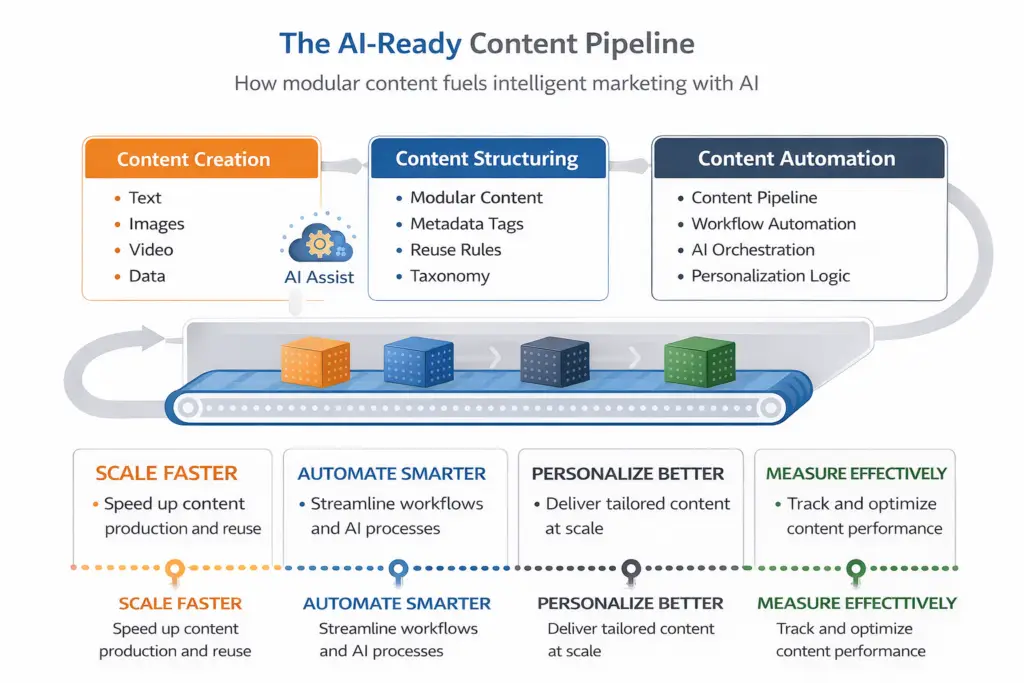
Content pipelines change that by making the flow visible. Work is mapped from intake to retirement. Ownership is clearer. Bottlenecks can be identified. Repeated approval pain points can be redesigned. Automation can be applied to steps that are actually repeatable.
This is one reason the content supply chain idea has gained traction. It expands the conversation beyond a single CMS and looks at how content moves across planning, production, delivery, and optimization. Adobe’s research on scaling content demand reinforces why the end-to-end view matters. When demand is multiplying, disconnected workflows become a strategic liability. (Source: Adobe)
For leadership teams, the pipeline lences is useful because it translates content into operational terms. Done well, content engineering for marketing makes content flow visible in the same way strong operations make financial or service flow visible. Which steps create the most delay? Which content types are reused most? Where does compliance work create friction? Which assets are repeatedly recreated when they should be centrally managed? These are the questions that drive process redesign and investment decisions.
This is also where AI can be deployed more intelligently. AI can help with drafts, summaries, tagging, recommendations, and analysis. But its value compounds when it is embedded inside a well-designed content pipeline rather than sitting outside it as a disconnected productivity tool.
Why Marketing and Engineering Must Work as One Team
One of the most important organizational implications of this discipline is that the old handoff model no longer holds.
In many businesses, marketing still creates content and then “hands it over” to digital, product, or IT for implementation. That division worked tolerably when the primary goal was to publish full pages and static assets. It works far less well when content has to be structured, assembled dynamically, and exposed through multiple systems and interfaces.
At that point, editorial decisions are also system decisions. Defining a content type affects authoring. Defining a field affects governance. Defining a taxonomy affects searchability and reuse. Defining relationships affects how content can be assembled downstream.
That is why it depends on deeper collaboration between marketing and engineering. Both groups need shared visibility into the content model, workflow design, metadata rules, and delivery logic. Product, UX, legal, and data teams often need a seat at the table as well.
This collaboration does not need to be bureaucratic. In fact, it works best when it is anchored in a few shared artifacts: common taxonomies, agreed content types, component libraries, workflow states, and clear publishing rules. Those shared artifacts reduce ambiguity and make cross-functional decisions faster.
When organizations fail here, they often end up rebuilding the same content structures repeatedly in different projects. When they get it right, they create a durable operating layer that scales.
The Emerging Role Inside Marketing Organizations
As the discipline matures, many organizations will need someone to own it more explicitly.
The title may differ. Some businesses may call the role a content architect, structured content lead, content systems manager, or content operations strategist. But the responsibilities are converging. Someone needs to define models, guide authoring standards, manage metadata logic, connect workflows across teams, and ensure that content structures support both business needs and technical delivery.
This is the emerging role behind the shift.
It is a hybrid role. It requires enough editorial understanding to know how content should work for audiences and enough systems literacy to translate that into reusable structures. It requires comfort with CMS design, workflow orchestration, governance, taxonomy, and collaboration across technical and non-technical stakeholders.
The case for such a role is becoming stronger as AI adoption increases. Content Marketing Institute’s 2026 enterprise research found that among enterprise marketers using AI-powered content creation tools, 84% said productitivy improved and 76% said operational efficiency improved. Those are meaningful gains. But the same research also raises the more important question: whether efficiency is translating into better outcomes and stronger content quality. That is exactly where structural discipline matters most. (Source: Content Marketing Institute)
In other words, the opportunity is no longer just to create faster. It is to create from a better system. THat is why more organizations will eventually need explicit ownership for this capability, whether or not they adopt the title immediately.
What an AI-Ready Content Operating Model Looks Like
A practical model for content engineering for marketing has 5 layers.
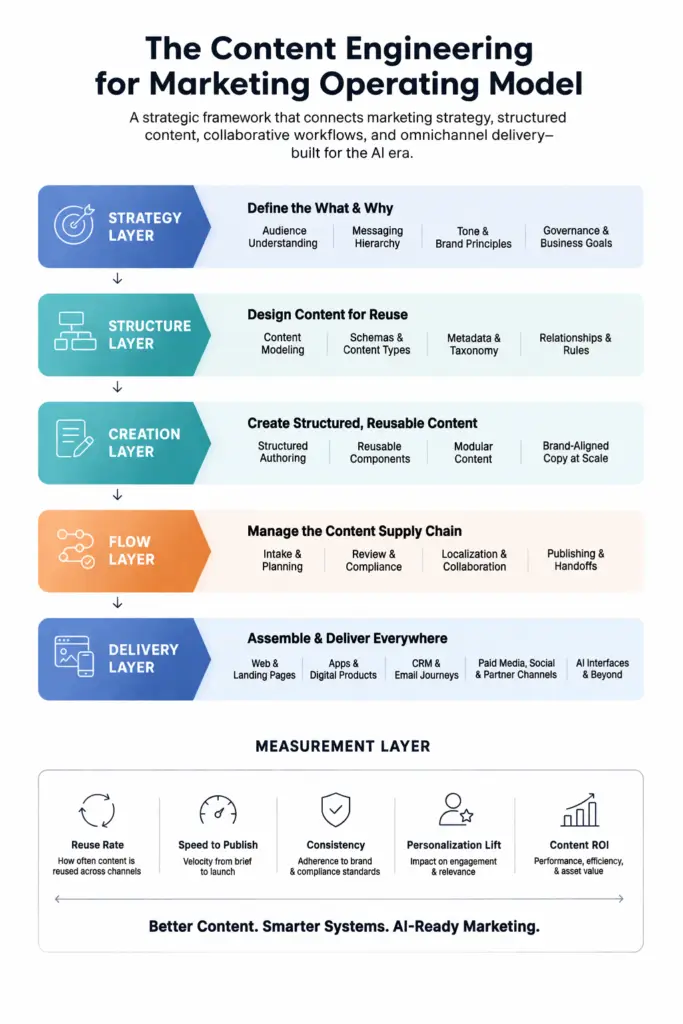
Strategy Layer
This layer defines audiences, proposition architecture, messaging hierachy, tone principles, and governance boundaries. It answers what the business is trying to say and to whom.
Structure layer
This layer defines content types, schemas, metadata taxonomies, and relationships. It determines how content should exist as reuseable objects rather than as one-off files.
Workflow layer
This layer defines intake, planning, drafting, review, approval, localization, publishing, maintenance, and retirement. It makes flow manageable and measureable.
Delivery layer
This layer defines how content appears across web, app, CRM, paid media, service journeys, partner channels, and AI interfaces. It is where assembly happens.
Measurement layer
This layer tracks reuse, speed to publish, approval cycle time, consistency, engagement, personalization lift, and content ROI. Without this layer, the discipline remains conceptual rather than operational.
This discipline connects all five. It ensures strategy is not lost in translation, structure is not separated from delivery, and AI is not treated as a shortcut around governance.
Common Barriers to Adoption
If the logic is sound, why has this not become standard practice already?
One reason is legacy technology. Many content environments were built for publishing pages, not for managing structured content across multiple downstream uses.
A second reason is siloed ownership. Marketing, product, engineering, legal, and operations often each control part of the content lifecycle, but no one owns the structure across. the whole system.
A third reason is capability. Content modeling and structured authoring are still not widely developed skills inside many marketing organizations. Teams may have excellent copywriters and campaign managers without having anyone who design the content model beneath the work.
A forth reason is mindset. Some businesses still see AI as shortcut that allows them to bypass the harder work of improving systems. In practice, AI usually increases the return on disciplined content operations. It rarely substitutes for them.
These barriers are real, but they are manageable. What matters is starting with a high-value domain and proving the benefit through reuse, speed, and governance.
A Practical Roadmap for CMOs and Marketing Leaders
Most organizations. do not need a big-bang transformation. They need a structured starting point.
Phase 1: Audit the current state
Identify duplicated content, workflow bottlenecks, approval pain points, inconsistent metadata, and high-friction journeys. Look for content that is repeatedly recreated in multiple places.
Phase 2: Priotize one reusable content domain
Start where the value is easiest to prove. Product detail content, onboarding steps, FAQs, service content, and offere modules are often strong candidates because they are reused frequently and affect multiple journeys.
Phase 3: Define the content model
Clafrify content types, fields, metadata, relationships, and governance rules. Decide which elements should be reusable globally and which should remain local or channel-specific.
Phase 4: Introduce structured authoring and modular publishing
Train teams to create governed components rather than only final assets. Align workflows and templates to the new logic.
Phase 5: Build measurement and ownership
Track resuse rate, time to publish, approval cycle time, update effort, consistency, and performance impact. Assign clear ownership for the content model and its evolution.
This phased path is important because. itis best adopted as an operational capability, not a one-time project. The goal is not just redesign content. It is to create a better system for how marketing works.
The Strategic Takeaway
The next chapeter of marketing will not be won by the organizations that simply generate more content. It will be won by the organizations that build better content systems.
That is the real significance of the shift. It gives leaders a way to connect structure, workflow, governance, modularity, and AI readiness into one coherent discipline. It refames content from a collection of outputs into a set of managed assets that can scale across channels and over time.
This matters because the market pressures are not temporary. Content demand is still rising. AI adoption is already mainstream. Yet many teams still admit their campaigns remain generic and their response capability still lags customer expectations. Those facts point to a deeper conclusion: the competitive advantage will not come from AI tools alone. It will come from the quality of the operating model underneath them.
For C-suites and senior marketing leaders, the implication is straightforward. If your organization wants AI-ready marketing, it needs AI-ready content. And AI-ready content does not emerge by accident. It has to be intentionally modeled, authored, governed, and delivered.
Tha is why it is not a technical side topic. It is becoming a strategic management discipline.
Read my other articles here.
Frequently Asked Questions (FAQs)
-
What is content engineering for marketing?
Content engineering for marketing is the practice of structuring, governing, and managing content so it can be reused across channels, workflows, and AI-powered experiences.
-
Why does content engineering matter in the AI era?
It matters because AI works better when content is structured, tagged, and reusable rather than trapped in disconnected pages, files, and manual workflows
-
How is content engineering different from content operations?
Content operations focuses on planning, workflow, and governance, while content engineering adds the structural layer that makes content modular, machine-readable, and scalable.
-
What are the core pillars of content engineering for marketing?
The five core pillars are content modeling, structured authoring, modular publishing, content pipelines, and marketing-engineering collaboration.
-
Who should own content engineering in an organization?
It usually sits across marketing, digital platforms, and content operations, with close collaboration between marketing, product, UX, and engineering teams.