
Table of Contents
Introduction
Marketing teams have never had more information about their customers.
Every website visit, app session, purchase, enquiry, campaign response, service interaction and loyalty leaves behind useful signals. Yet many organisations still struggle to answer some surprisingly basic questions with confidence.
- Which customers are most valuable?
- What are they likely to need next?
- Which message will help rather than annoy them?
- Which customers are starting to disengage?
- Where should marketing investment go?
This is the gap Customer Intelligence is designed to close.
At its simplest, Customer Intelligence is the ability to turn customer data into understanding, better decisions and timely action.
It is not just another name for analytics, CRM or a customer data platform. Those capabilities may contribute to it, but they do not define it.
The real value comes from connecting what an organisation knows about a customer with what the business should do next.
For senior management, the case is straighforward. Better customer understanding can improve acquisition efficiency, increase conversion, strengthen retention, support cross-sell and improve customer lifetime value.
For marketers, it creates the foundation for more relevant experiences across the customer lifecycle.
The opportunity is becoming even more important as artificial intelligence changes how organisations analyse customer behaviour and make decisions.
According to McKinsey & Company, 71% of consumers expect companies to deliver personalised interactions, while 76% become frustrated when this does not happen. McKinsey also found that faster-growing companies generate 40% more revenue from personalisation than slower-growing counterparts (Source: McKinsey & Company – The Value of Getting Personalisation Right – or – Wrong – is Multiplying)
These figures do not mean personalisation alone creates growth. What they do show is that understanding customer, and acting on that understanding, has become commercially important.
The challenge is no longer simply collecting more information.
It is building the capability to understand it, trust it, act on it, and learn from the result.
What is Customer Intelligence?
Customer Intelligence is the structured use of customer information to understand behaviour, needs, value, intent and context so that a business can make better customer-related decisions.
Customer Analytics is an important part of this process.
IBM describes customer analytics, also known as customer data analytics, as the use of customer information to understand needs and expectations and support more informed decisions.
IBM also notes that these insights can influence marketing, customer experience, product development and wider business priorities. (Source: IBM – What is Customer Analytics?)
The important difference is that Customer Intelligence goes one step further.
Analytics may explain what happened.
Intelligence connect that understanding to a decision.
A useful way to think about the relationship is:
Customer Data -> Customer Insights -> Customer Intelligence -> Decision -> Action -> Business Outcome
Each stage adds another layer of value.
Customer Data Is the Raw Material
Customer data can come from many sources.
It may include:
- demographic and profile information
- website and app behaviour
- purchase and transaction history
- campaign engagement
- product ownership
- service and support interactions
- loyalty activity
- stated preferences
- consent and communication preferences
- contextual signals, where appropriate and permitted
But collecting these signals is only the begining.
Information sitting across multiple systems does not automatically create customer understanding.
Customer Insights Explain What the Data Means
Customer Insights turn raw information into something the business can interpret.
For example, analytics may show that customers who buy one product often research another complementary product within the following 30 days.
That is more useful than simply knowling the first purchase happened.
A stronger insight might reveal that customers who use a certain digital feature during their first week are more likely to remain active three months later.
The organisation has now moved beyond counting activity and started to understand behaviour.
Customer Intelligence Helps Decide What to Do
The final step is turning understanding into action.
If a customer is showing strong purchase intent, should the brand send an offer, provide more information or simply leave the customer alone?
If someone appears likely to churn, should the organisation intervene through service, education, loyalty benefits or a commercial offer?
If a customer repeatedly ignore email but responds to app notifications, should the preferred engagement channel change?
Customer Intelligence helps make these decisions more informed.
That is the difference between reporting and intelligence.
Reporting tells the organisation what happened. Intelligence helps it decide what should happen next.
Customer Intelligence vs Customer Data, Analytics, CRM and CDP
One reason the topic can feel confusing is that several related terms are often used as if they mean the same thing.
They do not.
Customer Data
Customer Data is the information an organisation collects or receives about customers and their interactions.
It answers:
“What do we know?”
Customer Analytics
Customer Analytics examines that information to identify patterns, trends and relationships.
It answers:
“What happened, and why?”
Customer Insights
Customer insights interpret those findings in business and customer terms.
They answer:
“What does this mean?”
Customer Intelligence
Customer Intelligence connects data, analysis and insights with decison-making.
It answers:
“What should we do?’
That final question is what makes it commercially valuable.
Customer Intelligence vs CRM
A customer relationship management system helps organisations manage sales activity, service history, customer relationships and related records.
CRM can therefore be an important source of information.
But is is not the complete intelligence capability.
A broader approach can combine CRM information with:
- digital behavioyr
- transactions
- campaign responses
- product usage
- service events
- mobile app activity
- external information where permitted
The objective is to understand the customer across the relationship rather than through one system.
Customer Intelligence vs Customer Data Plaform
A customer data platform, or CDP, is another important part of the picture.
A CDP can collect information from multiple sources, resolve identities, create persistent customer profiles and make those profiles available for analysis and activation.
That makes it a potentially important technology foundation.
But a CDP is not the strategy.
An organisation can implement an advanced CDP and still struggle with weak data quality, fragmented decision making or disconnected customer journeys.
The technology creates the foundation.
Customer Intelligence is the wider capability built on top of it.
This distinction also matters when designing the broader MarTech architecture. As explored in the AsiaTechBuzz article The AI-Ready MarTech Stack, modern marketing increasingly depends on trusted data, connected platforms, structured content and an intelligence layer capable of influencing customer experiences.
Why Customer Intelligence Matter More in the AI Era
Artificial intelligence is changing the economics of customer understanding.
Traditional analytics often depended on predefined reports, manual segmentation and human interpretation.
AI and machine learning can process more signals, identify patterns faster and support predictive decisions at a scale that would be difficult to manage manually.
But AI does not remove the need for good information.
It makes good information more important.
If the underlying customer data is incomplete, inconsistent or poorly governed, AI can produce faster answers to the wrong questions.
If identities are fragmented, one person may appear to be several different customers.
If consent is unclear, personalisation can create risk rather than value.
The Personalisation Execution Gap Is Still Large
Adobe’s 2025 AI and Digital Trends research highlights the challenge.
Among the practitioners suerveyed:
- 47% used data and analytics to predict customer needs by segment or persona
- 42% made recommendations based on previous purchasing and browsing behaviour
- 39% routinely personalised and website experiences
- only 31% updated offers in real time based on recent customer behaviour
Source: Adobe – 2025 AI and Digital Trends, Data and insights
The gap is important.
Many organisations have data and analytics.
Far fewer have successfully connected them in real-time action.
That is where Customer Intelligence becomes strategically valuable.
AI Moves Customer Intelligence from Descriptive to Predictive
At a basic level, Customer Analytics describes behaviour.
More advanced models can estimate what may happen next.
Examples include:
- likelihood to purchase
- probability of churn
- product affinity
- response propensity
- next likely product
- customer lifetime value
- preferred engagement channel
- expected service need
- likelihood of journey abandonment
Instead of simply reporting that a customer has stopped interacting, a predictive model can estimate whether the customer is likely to disengage completely.
Instead of shoing that someone has viewed the same product several times, the model can estimate purchase propensity.
That changes the role of marketing.
The organisation can increasingly respond to probability and intent, rather than waiting for the final action to happen.
AI Can Improve Decision Speed
The more important advantage may ultimately be decision velocity.
Customer journeys change quickly.
Someone may compare products, leave a website, return through another channel, open a mobile app, contact customer service and complete a transaction within the same day.
A weekly segmentation process cannot always respond to that behaviour in time.
McKinsey’s research into AI agents for growth suggests that AI-driven personalisation can potentially improve customer satisfaction hy 15% to 20%, increase revenue by 5% to 8%, and reduce cost to serve by up to 30% in relevant use cases.
These are not guaranteed results for every organisation, but they illustrate the potential when customer context, AI and real-time decision-making work together.
Source: McKinsey & Company – Agents for Growth: Turning AI Promise Into Impact
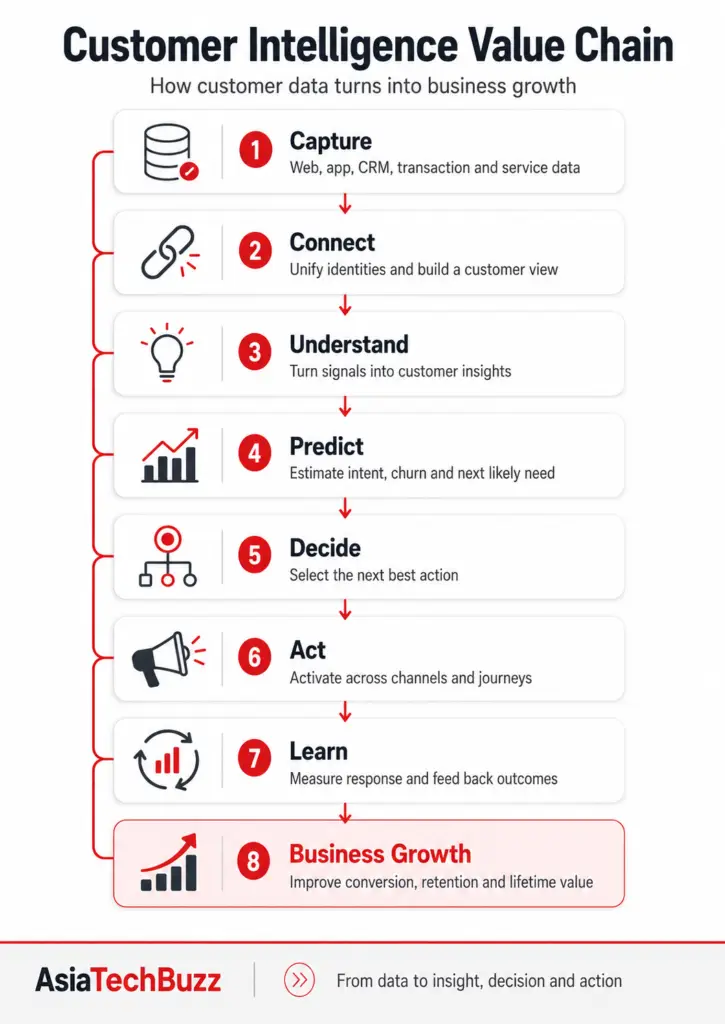
The Customer Intelligence Value Chain
A practical strategy can be understood through a seven-stage value chain:
Capture -> Connect -> Understand -> Predict -> Decide -> Act -> Learn
The model is useful because it stops organisations from treating data collection as the end goal.
1. Capture the Right Customer Data
The objective is not to capture everything.
It is to capture information that helps answer important business questions.
For a retailer, this might include:
- browsing behaviour
- basket value
- purchase frequency
- product affinity
- loyalty activity
For financial services, it could include:
- product ownership
- application status
- digital behaviour
- transaction patterns
- service needs
- channel usage
- consent
For a subscription business, useful information might include:
- feature adoption
- product usage
- engagement frequency
- payment history
- cancellation signals
The principle is the same.
Start with the decision, not the data.
2. Connect Customer Identity
Customers rarely interact through a single system.
One person may:
- browse a website anonymously
- register later
- log into a mobile app
- respond to an email
- speak with customer service
- visit a physical location
- make a transaction throuygh a partner channel
If these interactions remain disconnected, the organisation sees fragments rather than a customer.
Identity resolution helps connect those fragments where there is a lawful and reliable basis to do so.
This is one reason CDPs and identity technologies have become important components of modern MarTech architecture.
3. Build Customer Understanding
Once the information is connected, it needs to be interpreted.
Useful dimensions may inlcude:
- lifecycle stage
- engagement level
- product affinity
- customer value
- service history
- channel preference
- recent behavioural changes
- intent signals
This is where Customer insights start becoming operationally useful.
Instead of seeing thousands of disconnected events, the organisation begins to understand the customer’s current state.
4. Predict Customer Needs and Intent
Predictive Customer Analytics adds probability.
Instead of saying:
“This customer purchase Product A.”
the organisation may be able to estimate:
“This customer has not logged into the app for 30 days.”
the model may indicate:
“This customer now has a much higher churn probability than similar customers”.
These predictions do not mean every signal should trigger a marketing action.
They provide additional evidence for making a better decision.
5. Decide the Next Best Action
Decisioning is the bridge between insight and customer experience.
A strong next-best-action approach considers more than purchase propensity.
It may include:
- eligibility
- customer value
- lifecycle stage
- contact frequency
- recent service issues
- channel preference
- consent
- business priorities
- regulatory rules
- previous customer responses
Sometimes the Best Action is No Action
This distinction matters.
The best action may be an offer.
It may also be:
- educational content
- a service reminder
- an onboarding message
- a loyalty benefit
- an assisted support option
- a request for additional information
Or it may simply be:
Do nothing.
Customer Intelligence should help businesses communicate more intelligently, not simply communicate more often.
6. Activate Across the Customer Journey
Intelligence only creates value when it reaches the channels where customers actually interact.
These may include:
- website
- mobile app
- messaging
- advertising
- contact centre
- sales teams
- physical locations
- partner ecosystems
Activation should be coordinated.
Otherwise, one channel may react to current customer information while another continues to use an outdated campaign segment.
this is where the topic starts to overlap with customer journey orchestration.
As discussed in Customer Journey Orchestration: Why Marketing Automation Is No Longer Enough for Modern Brands, orchestration moves organisations away from isolated campaigns and towards interactions coordinated around shared customer context.
7. Learn From the Outcome
Every action creates another signal.
Did the customer engage?
Did they convert?
Did they ignore the message?
Did they contact customer service?
Did the recommendation reduce friction?
Did the intervention improve retention?
These outcomes should feed back into the intelligence process.
This creates a continuous loop:
Observe -> Understand -> Decide -> Act -> Learn
The learning loop is what transforms analytics from one-off exerciese into an organisational capability.
How Customer Intelligence Drives Business Growth
The strongest business case is not that Customer Intelligence creates better dashboards.
It is that it can improve the quality of decisions affecting revenue, cost and long-term customer value.
More Efficient Customer Acquisition
Marketing teams often spend heavily acquiring customers without clearly understanding which prospects are most likely to convert or which are likely to become valuable over time.
Better Customer Analytics can help identify:
- stronger intent signals
- high-value audience characteristics
- poor-quality traffic sources
- audiences that should be suppressed
- channels associated with better long-term customers
That can improve:
- audience targeting
- budget allocation
- media suppression
- lookalike modelling
- campaign optimisation
- acquisition quality
The objective should not simply be lower cost per click or even lower cost per acquisition.
The better question is:
What does it cost to acquire a valuable customer?
Higher Conversion
Customer Intelligence can also help organisations understand where customers hesitate and what information they need.
Someone repeatedly visiting the same product page may need reassurance rather than a discount.
A customer abandoning an application at the same stage twice may need guidance rather than another acquisition advertisement.
A returning customer may benefit from a shorter path rather than being forced through the same journey as a first-time visitor.
These distinctions create opportunities to improve conversion without depending on constant promotional incentives.
Better Cross-Sell and Upsell
Traditional cross-sell often starts with a product target:
“Who can we sell this product to?”
A better approach asks:
“What is relevant for this customer now?”
The change may apple subtle, but it represents a significant shift in marketing thinking.
Product affinity, customer need, lifecycle stage, previous behaviour, eligibility and context can all influence whether a recommendation is appropriate.
The objective is not simply to maximise the number of offers.
It is to increase the relevance of each interaction.
Stronger Retention
Retention is another important application.
Signals such as:
- declining engagement
- lower transaction freqency
- repeated service issues
- reduced product usage
- failed journeys
- inactivity
may indicate that the relationship is weakening.
Predictive analytics can help identify these signals earlier.
That gives the organisation more optins.
The response may involve:
- service recovery
- education
- product support
- loyalty treatment
- a relevant offer
- human intervention
The important point is that the action is based on eveidence rather than applying the same retention campaign to everyone.
Higher Customer Lifetime Value
Customer lifetime value changes the time horizon of marketing.
If acquisition is the only goal, teams naturally optimise towards the cheapest possible conversion.
Once lifetime value is considered, different questions appear.
Which customer are likely to:
- stay longer?
- become more active?
- purchase additional products?
- use more services?
- develop stronger loyalty?
- become advocates?
Customer Intelligence helps connect acquisition with the wider customer lifecycle.
It enables businesses to move from optimising individual transactions towards managing relationships.
Better Marketing Efficiency
There is also evidence that better use of data can improve marketing efficiency.
In a 2025 survey of more than 400 US marketers, Adobe found that 72% said improved marketing efficiency was the leading benefit of data-driven marketing strategies.
The same research found that one in seven marketers had experienced financial losses because of poor data quality during the previous year, averaging approximately US$91,000 among affected respondents.
Source: Adobe – What 400 Successful Marketers Reveal About Data-Driven Marketing
The lesson is important.
More data is not automatically better.
Trusted information that improves a decision is more valuable than a larger volume of unreliable data.
Customer Intelligence and Personalisation
Personalisation is one of the most visible applications of Customer Intelligence.
But the two are not the same thing.
Customer Intelligence is the capability.
Personalisation is one possible output.
The same understanding can also support:
- customer service
- retention
- channel prioritisation
- product development
- journey design
- sales prioritisation
- pricing
- risk or fraud processes where appropriate
When personalisation is used, relevance matters more than novelty.
Personalisation Is More Than Using a Customer’s Name
Useful personalisation is not simply adding a first name to an email.
It attempts to understand:
- what the customer is trying to achieve
- which information is relevant
- which product fits the need
- when communication is appropriate
- which channel is preferred
- whether a commercial message is suitable
- when the organisation should remain silent
The last point is often overlooked.
Better intelligence should help organisations avoid unnecessary communication, not simply create more targeted communication.
Relevance Must Be Balanced with Trust
Personalisation also has limits.
Using more customer information does not always improve the experience.
The Personalisation Paradox
Gartner’s 2025 research illustrates this tension.
Its survey of 1,464 B2B buyers and consumers across North America, the UK, Australia, and New Zealand found that customers experiencing personalisation were 1.8 times more likely to pay a premium.
However, those same customers were also:
- 2 times more likely to feel overwhelmed by information
- 2.8 times more likely to feel time pressure
Gartner also found that poorly judged personalisation could increase the likelihood of purchase regret.
Source: Gartner – Personalisation Can Triple the Likelihood of Customer Regret at Key Journey Points
The implication for marketers is clear:
Better Customer Intelligence should increase relevance and reduce friction. It should not make customers feel they are being watched.
The Technology Behind Customer Intelligence
There is no single platform that creates Customer Intelligence.
The capability normally emerges from an ecosystem of technologies working together.
Customer Data Sources
The foundation consists of systems that generate customer signals.
These may include:
- CRM
- websites
- mobile apps
- e-commerce platforms
- transaction systems
- loyalty platforms
- contact centres
- marketing platforms
- service systems
- physical-channel systems
Data Infrastructure and Identity
Data warehouses, data lakes, lakehouses and integration pipelines may then store and process this information.
Identity capabilities help organisations connect interactions that belong to the same person where there is a valid basis for doing so.
Without this foundation, analysis may remain fragmented by channel.
Customer Intelligence Platform and CDP Capabilities
A Customer Intelligence Platform may combine capabilities such as:
- customer profiles
- segmentation
- analytics
- modelling
- prediction
- activation
In other organisations, these functions ma be spread across several platforms.
A CDP often supports this architecture by creating unified customer profiles and making attributes or audiences available to other systems.
Customer Analytics, AI and Decisioning
Customer Analytics explains behaviour and measures outcomes.
Machine learning can add:
- scoring
- prediction
- recommendations
- propensity modelling
Decisioning then helps determine what the organisation should do next.
Journey orchestration connects those decisions to real customer interactions.
The architecture matters because an insight sitting inside a dashboard has limited operational value.
Intelligence becomes commercially useful when trusted information can influence a real customer interaction at the right moment.
Building a Customer Intelligence Strategy
Technology should not be the starting point.
The best starting point is a business question.
Step 1: Define the Decisions You Want to Improve
Examples include:
- Which customers should we priortise for retention?
- Which prospects are most likely to convert?
- Which product is most relevant next?
- Which customers are receiving too many messages?
- Which journey stage creates the greatest opportunity for intervention?
- Which behaviours predict long-term value?
Clear questions make the required data easier to identify.
Step 2: Identify the Minimum Data Needed
Do not begin by trying to create the largest possible customer profile.
Begin the signals required to improve the decision.
This keeps the initiative focused and reduces unnecessary complexity.
Step 3: Improve Data Quality and Identity
Data quality is often the hidden constraint behind Customer Intelligence initiatives.
Adobe’s 2025 research found that almost 50% of marketers struggled to ensure their data accurately represented their target audience.
The same study highlighted accuracy, completeness, fragmented systems and inconsistent data hygiene as major barriers to making better use of marketing information.
Source: Adobe – What 400 Successful Marketers Revealed About Data-Driven Marketing
What Good Data Quality Requires
Common issues include:
- duplicate customer records
- inconsistent definitions
- missing attributes
- delayed data
- disconnected customer identities
- conflicting source systems
- weak consent management
These should be treated as business issues, not just technical ones.
Step 4: Create Share Customer Definitions
Marketing, sales, product and service teams may define the same customer differently.
One team might classify an active customer based on an recent transaction.
Another may use app usage.
Another may look at campaign engagement.
The capability becomes stronger when important concepts have shared definitions.
These might include:
- active customer
- high-value customer
- churn risk
- engaged customer
- prospect
- qualified lead
- dormant customer
- product owner
A shared customer language improves both analysis and decision-making.
Step 5 : Progress From Descriptive to Predictive Intelligence
Organisations do not need to jump immediately into complex AI.
A more sustainable progression is:
Descriptive -> Diagnostic -> Predictive -> Prescriptive
Descriptive: What happened?
Diagnostic: Why did it happen?
Predictive: What is likely to happen?
Prescriptive: What should we do?
Each level depends on confidence in the one before it.
If the organisation cannot reliably explain what happened, sophisticated prediction may create an illusion of intelligence rather than genuine understanding.
Step 6: Connect Intelligence to Real Decisions
This is where many analytics programmes struggle.
A model may accurately identify customers at risk of leaving.
But if marketing, product or service teams cannot change what happens next, the insights creates little commercial value.
Every use case should therefore include an activation plan.
Ask:
- Who receives the insight?
- Which platform uses it?
- How quickly must it become available?
- What action can be taken?
- What business rules apply?
- Which customer permissions apply?
- How will the outcome be measured?
Step 7: Measure Incremental Business Value
Do not measure only through model accuracy, data volume or dashboard adoption.
Measure whether better intelligence improved the outcome.
Business Metrics to Track
Relevant measures may include:
- incremental conversion
- incremental revenue
- retention improvement
- churn reduction
- customer lifetime value
- lower marketing cost
- lower media waste
- response rate
- journey completion
- complaint reduction
- service cost
- digital engagement
Where possible, use control groups or experiements.
A customer who convers after receiving an offer does not necessarily mean the offer caused the conversion.
Incrementality matters.
Customer Intelligence Must Be Built on Trust
Customer Intelligence requires access to customer information.
That creates responsibility.
Customers may be willing to share information when the value they receive is clear.
Trust can deteriorate quickly when data collection or personalisation feels unnecessary, unclear or intrusive.
Salesforce’s State of the AI Connected Customer found that 71% of customers are increasingly protective of their personal information.
It also reported that only 49% believed companies used their information in ways that benefited them, compared with 60% in 2022.
In addition, 64% believed companies are reckless with customer data.
Source: Salesforce – State of the AI Connected Customer
For senior management, this makes trust more than a compliance issue.
It is part of the Customer Intelligence strategy.
Privacy and Consent
Organisations should understand:
- what information they collect
- why they collect it
- how long they retain it
- what permissions apply
- where it can be used
Consent also needs to be operational.
It should influence downstream marketing and decision systems rather than exist only as a legal record.
Responsible AI
Models should be monitored for:
- bias
- drift
- inappropriate use
- unintended outcomes
- excessive automation
Governance should also define which decisions can be automated and where people need to remain involved.
Value Exchange
A useful test is simple:
Does using this customer information create a clear benefit for the customer as well as the business?
If the value is difficult to explain, the use case deserves further scrutiny.
A useful principle is:
Collect less. Understand better. Use responsibly. Deliver more value.
A Five-Level Customer Intelligence Maturity Model
Organisations do not become customer-intelligent through a single technology implementation.
The capability develops over time.
A practical way to assess progress is through five maturity levels.
Level 1: Fragmented
Customer information exists across disconnected platforms.
Reporting is inconsistent.
Campaigns depend heavily on board audience segments.
Different channels operate independently.
The organisation has customer data, but no common view.
Level 2: Connected
Important data sources begin to integrate.
Common identifiers improve.
Teams start developing unified customer profiles.
Information can increasingly move between platforms.
Basic activation becomes easier.
Level 3: Insight-Driven
Customer Analytics becomes embedded in decision-making.
Teams develop a better understanding of:
- customer behaviour
- journey performance
- value
- engagement
- product usage
Customer insights start influencing marketing, product and service priorities.
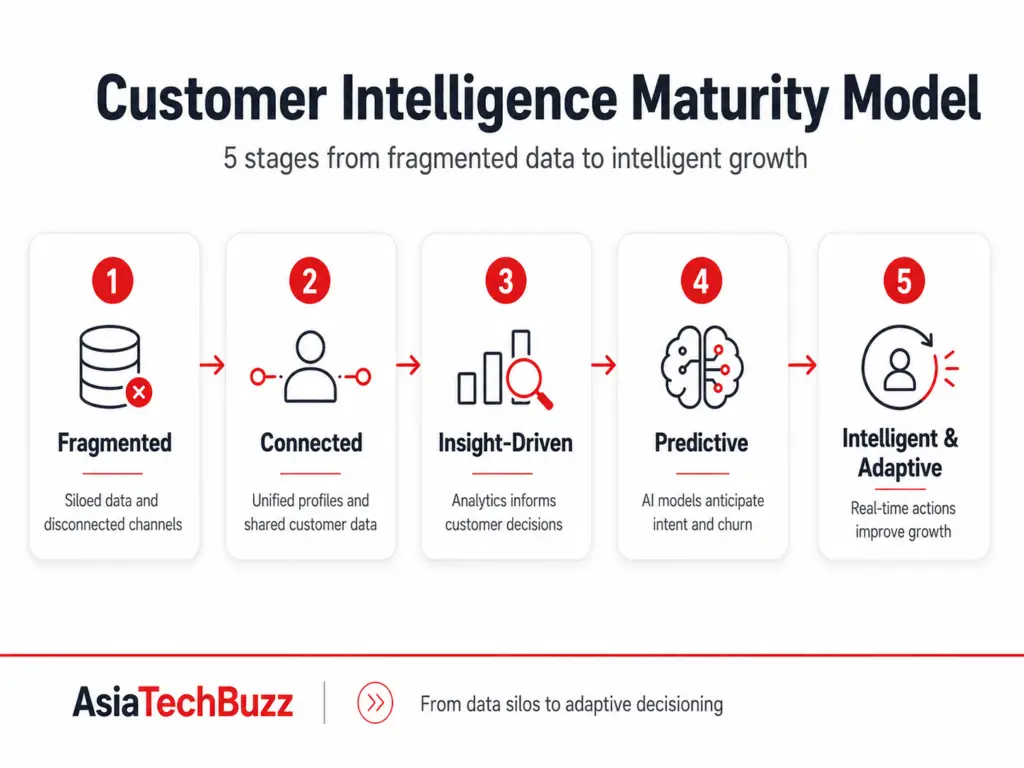
Level 4: Predictive
Machine learning and predictive models estimate:
- intent
- churn
- customer value
- product affinity
- engagement probability
- likely next behaviour
The organisation becomes more proactive.
It starts responding to what may happen rather than simply reporting what already happened.
Level 5: Intelligent and Adaptive
Customer Intelligence becomes part of the operating model.
Signals are processed continuously.
Decisions adapt in near real time.
Actions are coordinated across channels.
Customer responses feed back into models and decision rules.
The business moves towards a continuous intelligence loop.
This maturity model is useful because it shifts management conversations away from:
“Which Customer Intelligence Platform should we buy?”
towards:
“What capability do we have today, and what capability must we build next?”
Technology then becomes part of the answer rather than the entire strategy.
The Future of Customer Intelligence
The future of Customer Intelligence will be less about creating more dashboards.
It will be about embedding intelligence directly into customer and business decisons.
From Segmentation to Individual Context
Segments will remain useful.
They help organisations understand broad customer groups, plan investments and develop propositons.
But more operational decisions will increasingly use live customer context.
The question changes from:
“Which campaign does this customer belong to?”
to:
“What does this customer need now?”
That is a significant shift.
It moves marketing away from organising customers around campaigns and towards organising interactions around customer needs.
From Recommendations to AI-Assisted Action
AI agents and orchestration platforms will increasingly support activities such as:
- selecting next-best-actions
- choosing suitable channels
- adapting content
- suppressing unnecessary communication
- identifying service needs
- escalating interactions to people
- learning from customer responses
The opportunity is significant.
But so is the responsibility.
As automation expands, strong data governance, consent, model oversight and clear accountability become more important.
The strongest organisations will not be those that automate the most.
They will be those that make better decisions at scale while maintaining customer trust.
Conclusion: Turn Customer Data Into a Growth Capability
Most organisations do not suffer from a shortage of customer data.
They suffer from a shortage of connected understanding and coordinated action.
That is why Customer Intelligence matters.
It provides the link between what the organisation knows and what the business should do next.
At its best, it helps marketers move beyond broad campaigns and static reporting.
It allows an organisation to:
- understand customer behaviour
- identify changing needs
- anticipate likely actions
- improve decision timing
- coordinate experiences
- learn from every customer response
The commercial impact can extend across:
- acquisition
- conversion
- cross-sell
- retention
- customer lifetime value
- marketing productivity
- service efficiency
But successful programmes do not begin with artificial intelligence, a CDP or another new platform.
They begin with a business decision.
What are we trying to understand?
What customer outcome are we trying to improve?
What information do we need?
What action can we take?
How will we know whether it worked?
Technology then becomes an enabler rather than the strategy.
As AI becomes more deeply embedded in marketing, this distinction will become even more important.
Models can process more information.
They can identify patterns faster.
They can make predictions at a scale that human teams cannot match.
But the quality of those decisions will still depend on the quality of the information, clarity of the business objective and trust established with customers.
The future belongs to organisations that connect these capabilities into a continuous intelligence loop:
Data -> Insight -> Prediction -> Decision -> Action -> Learning
For marketing leaders, that is the real promise of Customer Intelligence.
It is not simply a better way to analyse customer data.
It is a way to turn customer understanding into measurable business growth.
For more perspectives on how data, AI, MarTech and customer experience are reshaping modern marketing, explore the latest strategy and technology articles on AsiaTechBuzz.com
Frequently Asked Questions (FAQs)
-
What is Customer Intelligence?
Customer Intelligence is the process of turning customer data into useful insights that help a business make better decisions. It combines data, analytics and context to understand customer behaviour, needs and value and likely next actions.
-
How is Customer Intelligence different from Customer Analytics
Customer Analytics focuses on analysing customer behaviour and identifying patterns. Customer Intelligence goes further by using those insights to guider decisions, such as what action to take, which customer to prioritise on how to improve an experience.
-
Why is Customer Intelligence important for marketing?
Customer Intelligence helps marketers improve targeting, personalisation, conversion, retention and customer lifetime value. It allows marketing teams to move beyond broad segments and make decisions based on more relevant customer signals and context.
-
Do business need a Customer Intelligence Platform?
No necessarily. A Customer Intelligence Platform can help combine customer profiles, analytics, prediction and activation, but the capability can also be built across several systems. The most important requirement is having trusted data, clear business objectives and a way to turn insights into action.
-
How can a company start building Customer Intelligence?
Start with a business question rather than a technology purchase. Identify the decision you want to improve, define the customer data needed, improve data quality and identity, then connect analytics and insights to measurable customer actions and business outcomes.