
Table of Contents
1. Introduction
Modern marketing leaders are entering a very diferent content environment from the one they managed five years ago. Search is no longer only a list of blue links. AI assistants, answer engines, AI Overviews, recommendation alogrithms and conversational interfaces are changing how customers discover, compare and evaluate brands.
A content management systems, or CMS, was once treated mainly as a publishing tool. It helped teams upload pages, manage banners, publish blog posts and update campaign landing pages. That definition is now too narrow.
Today, CMS strategy in the AI era is about much more than managing web pages. It is about building a trusted content foundation for customer experience, brand authority, AI visibility, compliance, personalisation and marketing productivity.
This shift matters because the economics of digital discovery are changing. Gartner predicted that traditional search engine volume will drop 25% by 2026 as AI chatbots and virtual agents take market share from search marketing. SparkToro’s 2024 zero-click search study also found that, for every 1,000 Google searches in the United States, only 360 clicks went to the open web. In the European Union, the number was 374 clicks.
In simple terms, more customer journeys are being influenced before a user clicks into a brand website. That does not mean websites or content are becoming less important. It means owned content needs to work harder. It must be accurate, structured, fresh, relevant and easy for both humans and AI systems to understand.
Thay is why CMS strategy in the AI era deserves serious attention from marketing leaders. The question is no longer simply, “Can we publish a page?”. The more important question is, “Can we create, structure, govern, optimise and distribute trusted content fast enough for an AI-shaped customer journey”?
In this article, I will occasionally reference Magnolia CMS based on my personal experience using the platform. This is not a product recommendation or vendor endorsement. Magnolia is used only as a practical enterprise CMS example to illustrate broader strategy principles. In my experience, the value of an enterprise CMS is not only in its platform capabilities, but also in the customer success, local support and implementation guidance that help customer turn a CMS investment into business impact.
2. Why CMS Strategy Matters More in the AI Era
2.1 AI Search is changing how customers discover brands
Search behaviour is shifting from keyword-based browsing to answer-led discovery. Customers increasingly ask direct questions such as “Which financial product is best for me?”, “What should I know before apply for a loan?” or “Which enterprise software is suitable for my business?”
Instead of visiting multiple websites, users may receive an AI-generated summary that blends information from brand websites, review sites, comparision platforms, publisher content, community forums and third-party aggregators.
For marketers, this creates a strategic challenge. If your owned content is outdated, poorly structured or difficult to crawl, AI systems may rely on other sources to describe your brand. That creates the risk that your brand narrative is shaped by third parties instead of your own trusted channels.
This is especially important for industries where trust, accuracy and reputation matter. Financial services, insurance, healthcare, education, telecoms and enterprise technology brands cannot afford inconsistent or outdated product information to become the basis of AI-generated answers.
That is why CMS strategy in the AI era is a brand control issue. It helps marketers ensure that the most accurate, current and authorative information sits on owned channels and is structured in a way that search engines, AI systems and customers can understand.
2.2 Zero-click journeys make owned content work harder
Zero-click search does not reduce the importance of content. It changes the role of content.
In the past, many marketers focused heavily on winning the click. Ranking on Google and driving traffic to the website were central objectives. Those goals still matter, but they are no longer enough. In an AI-influenced search environment, the customer may form an impression of the brand before visiting the website.
SparkToro’s zero-click study shows why this matters. If only 360 out of every 1,000 Google searche3s in the US results in a click to the open web, brands need to think beyond traditional traffic metrics. They need to influence the answer layer, the search results page, the AI summary and the customer’s perception before the click.
This is where AI search optimisation becomes a natural extension of SEO. The goal is not only to rank. The goal is to become understandable, credible and quotable by AI-powered discovery systems.
A modern CMS supports this by helping teams manage metadata, internal links, schema markup, content hierachy, canonical pages, authorship, FAQ structures and content freshness. Without the right CMS foundation, AI search optimisation becomes difficult to scale.
2.3 Content operations are becoming a competitive advantage
Marketing has become more content-intensive. Teams need campaign pages, product explainers, thought leadership, educational guides, app content, CRM content, paid media landing pages, FAQs, compliance updates, local market adaptions and personalised experiences.
At the same time, many organisations are still working with fragmented content processes. Adobe’s 2026 AI and Digital Trends report found that 53% of organisations say their content supply chain remains largely linear and resource-intensive, while only 47% are using generative or agentic AI for journey design or omnichannel activation.
This gap explains why content velocity has become a leadership priority. Marketing teams are under pressure to move faster, but speed without governance can create risk. The answer is not simply to publish more. The answer is to build a content operating model that allows teams to publish faster, reuse content, maintain quality and govern risk.
A strong enterprise CMS strategy helps solve this problem by giving marketers reusable templates, structured components, controlled workflows, scheduled publishing, preview capabilities, localisation support and better governance.
3. What CMS Strategy in the AI Really Means
3.1 From page management to marketing infrastructure
CMS strategy in the AI era is the plan for how an organisation creates, manages, governs, optimises and distributes content across digital touchpoints.
It includes the CMS platform, but it is not limited to the platform. It also includes the content model, workflow design, governance rules, SEO standards, approval processes, analytics integration, technical architecture and team operating model.
This distinct matters. A company can buy a powerful CMS and still fail if the operating model is weak. The platform may have advanced features, but if teams do not define ownership, workflows, reusable components and measurement standardcs, the business impact will be limited.
A modern content management system should enable marketers, not trap them. It should help teams launch pages, reuse content, manage translations, personalise experiences, maintain compliance, connect data and learn from performance.
In the AI era, content is no loger just a marketing asset. It is a digital infrastructure layer. It fees search engines, AI assistants, apps, campaign journeys, CRM programmes and partner ecosystems.
3.2 Why traditional CMS thinking is no longer enough
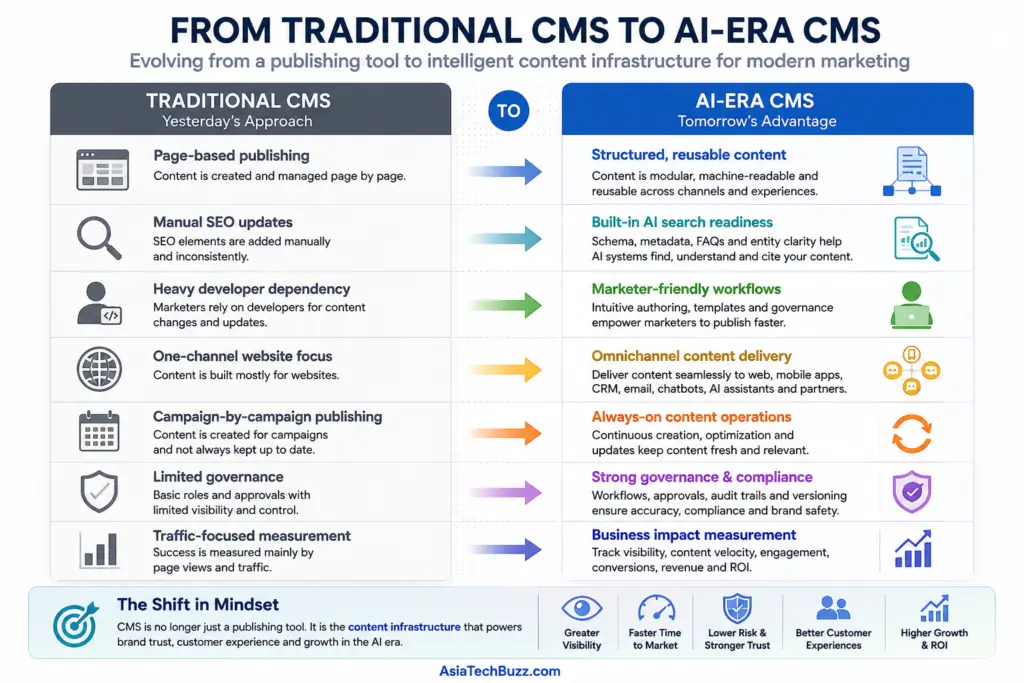
Traditional CMS thinking is usually page-centric. The team creates a page, add content, publishes it and then repeats the process for the next campaign or product update.
This works for simple websites, but it becomes limiting when the organisation needs speed, personalisation and omnichannel delivery.
The AI era rewards content that is modular, consistent and machine-readable. A product description should not be rewritten differently across the website, mobile app, chatbot, email and partner landing page unless there is a deliberate reason. An FAQ should be reusable. A legal disclaimer should be governed. An author profile should be consistent. A product eligibility field should be structured instead of hidden inside a paragraph that only human can interpret.
This is why structured content is now a strategic CMS capability. It turns content from static page copy into reusable, machine-readable assets that can support search, AI assistants, personalisation and customer journeys.
3.3 What makes an AI-ready CMS different
An AI-ready CMS helps marketers prepare content for a world where both people and machines consume information. It should support structured fields, metadata, schema, reusable components, content governance, workflow automation, API delivery, localisation, and analytics.
It should also support different users. Marketers need intuitive authoring. Developers need flexibility Compliance team need auditability. SEO teams need control over technical signals. Senior leaders need evidence that the CMS improves speed, quality, conversion and risk management.
Magnolia CMS is one useful example from my personal experience. Again, this is not a product recommendation. Magnolia is referenced here because it illustrates a practical point: enterprises often need both marketer-friendly authoring and developer flexibility. Magnolia positions its headless CMS around delivering content to apps and touchpoints through ti Delivery API while keeping web pages editable for marketing team through its Templating API.
The broader lesson is that an AI-ready CMS should not force organisations to choose between business usability adn technical flexibility. Modern marketing needs both.
4. The New CMS Mandate for Modern Marketing Leaders
4.1 Take control of the brand narrative
In an AI-shaped discovery environment, brand narrative must be deliberately managed.
If customer ask AI tools about your product, pricing, reliability, policies, benefits or reputation, the answer may be assembled from multiple sources. Some may be accurate. Others may be outdated, incomplete or biased.
Marketing leaders therefore need a strong owned-content strategy. The brand website should clearly explain who the company services, what products it offers, what the terms mean, what customers should expect, how the company protects them and why the brand can be trusted.
This is not only a communications issue. It is a content architecture issue. Your content needs to be structured, maintained and governed so that it can become the most reliable source of truth.
That is why CMS strategy in the AI era must support accuracy, content ownership, review cycles, structured publishing and fast updates.
4.2 Build once and reuse everwhere
One of the most important shift in enterprise CMS strategty is the move from page creation to content reuse.
Instead of rebuilding similar content for every channel, teams should create reusuable content modules. These may include product benefit blocks, FAQ answers, eligibility criteria, campaign banners, call-to-actions modules, legal disclaimers, author profiles, comparison tables and educational snippets.
These modules can then be reused across product pages, landing pages, articles, app screens, CRM messages, chatbots and AI assistant knowledge bases.
This approach increase consistency and reduces waste. It also improves content velocity because teams no longer need to start from zero for every new campaign or page.
4.3 Shift from campaign publishing to always-on content operations
Many marketing teams still operate around campaign bursts. A product campaign launches, pages are created, banners go live and then the team moves on.
In the AI era, this is not enough.
Content needs to be continuously monitored, refreshed and improved. Product pages need updates. FAQ content needs review. Articles need to stay current. Schema needs to be maintained. Internal links need to support topical authority. Landing pages need conversion optimisation. AI search optimisation needs to be tracked.
This requires a CMS operating model, not just a publishing calender.
It also requires strong implementation and adoption support. This is where my experience with Magnolia CMS is relevant as ana example. The value of a CMS does not come only from its functions. It also comes from how well the vendor, partners and customer success teams help the organisation design the right content model, train authors, implement workflows and sustain adoption after launch.
For any enterprise CMS, customer success should be part of the evaluation, not an afterthought.
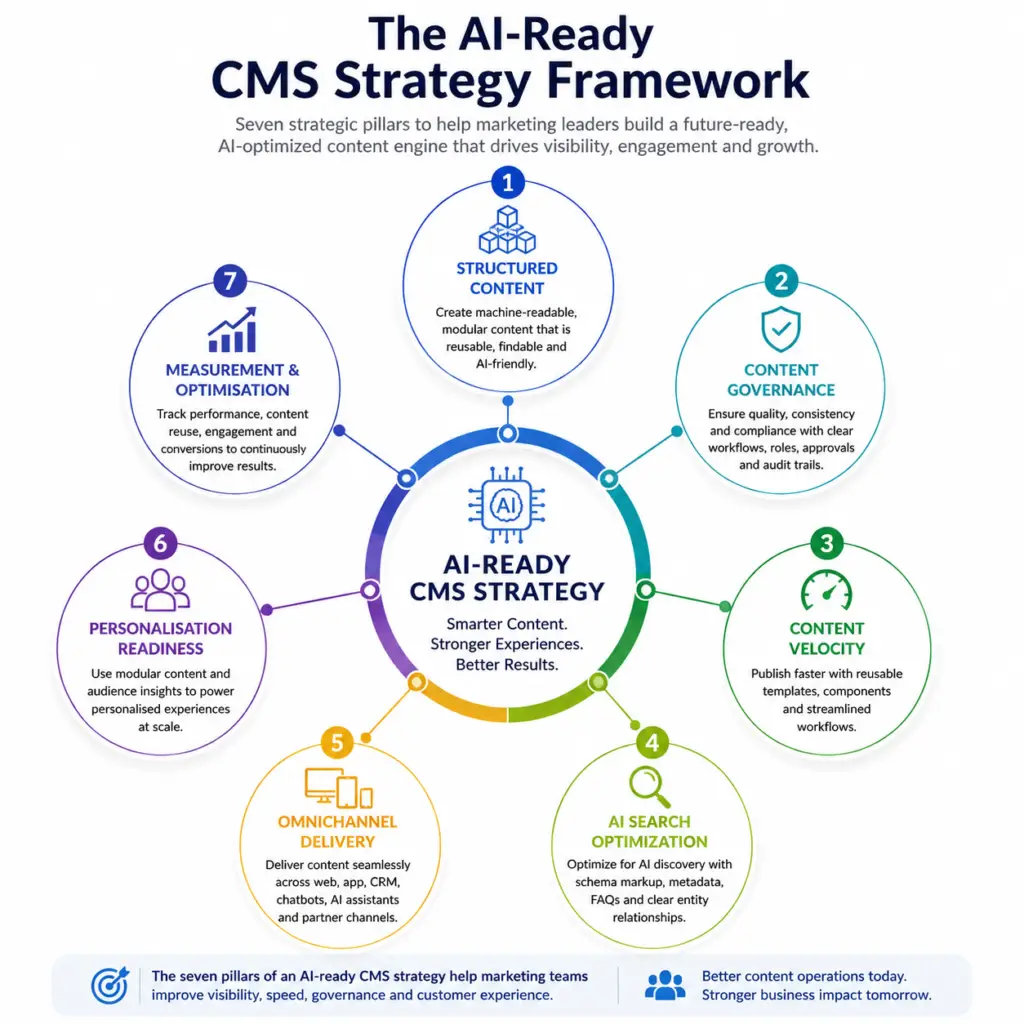
5. Seven Pillars of an AI-Ready CMS Strategy
5.1 Pillar 1 – Structured content
Structured content is the foundation of CMS strategy in the AI era. It means content is organisaed into clear fields and resuable components rather than stored only as a free-form page copy.
For example, a product page can include structured fields for benefits, eligibility, fees, FAQs, disclaimers, review date and product owner. An article can include fields for author, topic, summary, related entities, FAQ blocks and publication date.
This helps search engines and AI systems understand the meaning of content. It also helps teams reuse content across channels.
For marketers, structured content is not a technical detail. It directly affects discoverability, consistency and scale.
5.2 Pillar 2 – Content governance
Governance is the difference between fast publishing and responsible publishing.
A CMS shoudl suppport role-based access, approval workflows, version history, audit trails, scheduled reveiws, compliance checks and content ownership.
This matters because AI sincreases the cost of inaccurate content. If old or incorrect information is published or owned channels, it may be indexed, summarised and repeated by search engines or AI systems. The error can travel further than before.
An enterprise CMS strategy should therefore define who can create content, who can approve it, who owns updates, how often important pages are reviewed and what happens when regulated content changes.
5.3 Pillar 3 – Content Velocity
Content Velocity is not about producing more content for the sake of volume. It is about reducing friction between business intent and customer-facing experience.
A strong CMS helps teams launch faster through reusable page templates, content components, drag-and-drop authoring, scheduled publishing, campaign cloning, preview environments and approval workflows.
It reduces the need for developer tickets for routine content and layout changes. It also helps marketing teams react faster to market opportunities, competitor moves, product updates and customer questions.
5.4 Pillar 4 – AI search optimisation
AI search optimisation is the practice of making content easier for AI-powered search and answer systems to understand, trust and use.
It builds on SEO, but expands the focus from ranking to interpretation. AI systems needs clear answers, structured information, consistent entities and trustworthy signals.
CMS capabilities matter here. Teams need clean metadata, schema markup, logical content hierachy, internal links, canonical URLs, author information, topic clusters and fresh content.
An AI-ready CMS should make these practices easier to execute at scale. Otherwise, AI search optimisation becomes another manual checklist that teams struggle to maintain.
5.5 Pillar 5 – Omnichannel delivery
Customers do not experience brands only through websites. They interact through apps, email, paid media, search, chat, call centres, social platforms, partner ecosystems and AI assistants.
This means CMS strategy in the AI era should support omnichannel delivery. Content should be create once, governed centrally and distributed flexibly.
Headless and hybrid CMS models can help because they allow content to be delivered through APIs while still giving marketers a user-friendly authoring experience.
Magnolia’s hybrid headless approach is relevant as an example because it shows how enterprise CMS platforms can support both flexible delivery and business control. Magnolia states that its Delivery API makes content available to apps and touchpoints, while its Templating APO keeps web apps editable for marketing teams.
Again, the point is not that Magnolia is the answer for every organisation. The point is that modern CMS evaluation should look at this balance between developer flexibility and marketer control.
5.6 Pillar 6 – Personalisation and relevance
Personalisation requires more than a personalisation engine. It also requires content that can be assembled, targeted and measured.
If the CMS only stores static pages, personalisation becomes difficult to scale. Marketing teams may have customer data, but they may not have enough modular content to deliver relevant experiences.
A modern CMS should allow teams to create content variants, segment specific modules, reusable offers and dynamic content blocks. It should connect with analytics, CRM, customer data platforms and journey orchestration tools.
In this sense, an AI-ready CMS is not only about AI search. It is also about preparing the content foundation for more relevant customer experiences.
5.7 Pillar 7 – Measurement and optimisation
A CMS should help marketers learn.
Useful CMS metrics include time to publish, number of pages launched, content reuse rate, organic traffic, AI visibility, landing page conversion rate, update frequency, compliance approval time, developer ticket restriction and content refresh rate.
These metrics help reposition the CMS from a cost centre to a value driver. They also help senior leaders understand why enterprise CMS strategy matters to revenue, productivity and risk.
6. A Practical CMS Example. What Magnolia CMS illustrates about Enterprise CMS strategy
6.1 Why real-world CMS experience matters
CMS strategy can sound theoretical when discussed only through feature checklist, architecture diagrams and analyst terminology.
In practice, CMS success depends on whether marketing teams can publish faster, reuse content more easily, maintain governance and collaborate better with technology teams.
Based on my personal experience using Magnolia CMS, it provides a useful reference point for discussing enterprise CMS implementation. This is not a product recommendation. Magnolia is cited here only as an example because it reflects many of the capabilities modern marketing teams should consider when building CMS strategy in the AI era.
These include marketer-friendly authoring, reusable content structures, workflow support, integration flexibility and the ability to support more complex digital experience requirements.
6.2 Platform capability is only part of CMS success
One important lesson from working with enterprise CMS platform is that features alone do not guarantee success.
A CMS may have strong capabilities, but implementation quality, content modelling, author training, governance design, and local customer success support often determine whether the platform creates real business value.
This is where Magnolia is a helpful example. Magnolia’s official support and service pages describe product support, documentation, global support engineers and practical resources for customers. My personal experience when working with Magnolia in APAC has been excellent. The customer success team often work closely with client in implementation, ensuring that their features are fully adapted to the client’s requirements and workflows. This is unlike other product principles that leave the integration in the hands of the system integrators.
For regional enterprises, local or regional support can matters. CMS transformation is rarely plug-and-play. Teams need guidance on how to structure content, set up workflows, train authors, migrate legacy pages, design reusable components and connect the CMS to the wider MarTech ecosystem.
A strong customer success model helps ensure the CMS is not simply installed, but adopted.
6.3 What marketing leaders can learn from the Magnolia example
The Magnolia example highlights an important point for modern marketing leaders: CMS transformation is not just a technology purchase. It is a change in how content is created, approved, reused, measured and improved.
For this reason, marketing leaders should evaluate CMS platforms based on two dimensions.
First, the CMS should support the capabilities required for an AI-ready CMS, including structured content, reusable modules, governance, integration, content velocity and AI search optimisation.
Second, the vendor and implementation ecosystem should support successful adoption. Local customer success, practical implementation guidance, training and post-launch support can be critical, especially for enterprise operating in complex or regulated industries.
The lesson is not that every company should use Magnolia CMS. The lesson is that any CMS decision should consider both the platform and the support model required to make the platform successful.
7. CMS Strategy and Brand Trust in Regulated Indutries
Brand trust is often discussed as a communication topic. In the AI era, it is also a content architecture issue.
If important information is scattered, duplicated or inconsistent, trust becomes harder to maintain. This is particularly important for financial services, insurance, healthcare and other regulated industries.
Financial services brands, for example, must manage product terms, eligibility rules, repayment information, fees, disclaimers, risk warnings, FAQs and regulatory languages. If these are managed manually across multiple pages and channels, inconsistency becomes more likely.
An AI-ready CMS can reduce this risk by creating governed modules for sensitive content. Instead of rewriting a disclaimer across many pages, the team can manage one approved version and reuse it where needed.
Compliance should be built into workflow, with approval steps, audit trails, scheduled reviews, and clear ownership for high-risk pages.
The goal to make the brand website the best available source of truth. A modern content management system helps by making trusted content easier to create, update, structure and govern.
This is a critical part of CMS strategy in the AI era. If brands want AI systems with customers to understand them correctly, they must first ensure that their own content is accurate, organised and easy to interpret.
8. How to Build a CMS Strategy in the AI Era
8.1 Step 1: Audit your current content and CMS paint points
Start with an honest audit. Look at publishing speed, developer dependency, content quality, duplicated pages, outdated information, metadata gaps, broken journeys, SEO performance, conversion performance and governance risks.
Ask where the current CMS helps and where it slows the business down.
Common pain points include slow campaign launches, limited templates, poor component reuse, manual publishing processes, inconsistent metadata, weak internal linking, unclear content ownership and excessive dependency on technology teams.
8.2 Step 2: Define business outcomes
A CMS project should not be justified only as a platform upgrade. It should be linked to business outcomes.
Relevant outcomes include improving organic visibility, increasing AI visibility, reducing campaign launch time, improving landing page conversion, increasing content reuse, reducing compliance risk, improving customer experience and lowering developer workload.
This is important because senior stakeholders may not care about CMS terminology. They care about growth, productivity, risk reduction and customer experience.
A strong enterprise CMS strategy translates platform investment into business value.
8.3 Step 3: Design the content model
Content modelling is one of the most important parts of CMS transformation.
Define the content types and components that the organisation needs. Common examples include articles, product pages, campaign landing pages, FAQs, author profiles, offer modules, banners, legal disclaimers and call-to-action modules.
The goal is to make content reusable, structured and easy to govern.
This is where structured content becomes operational, not theoretical. It is also where marketing, product, SEO, UX, compliance and technology teams need to work together.
8.4 Step 4: Build governance into the operating model
Define roles clearly.
Marketing may own messaging and campaign pages. Product teams may own product accuracy. Legal and compliance may approve regulated claims. SEO may own metadata and search standards. UX may own experience quality. Analytics may own meaurement.
The CMS workflow should reflect this reality. Good governance makes the process visible, repeatable and auditable.
This is where implementation support becomes important. Many organisations underestimate the amount of change management required to make a CMS work well.
8.5 Step 5: Connect CMS to the MarTech ecosystem
A CMS becomes more valuable when it connects with the wider MarTech stack.
This may include analytics, CRM, customer data platforms, digital asset management, marketing automation, personalisation engines, experimentation tools and search platforms.
A disconnected CMS may still publish pages, but it will struggle to support modern marketing. A connected CMS can help teams build more relevant journeys, measure content performance and activate content across touchpoints.
8.6 Step 6: Measure CMS impact
Measurement should be designed from the start.
Track operational, marketing and business metrics. Operational metrics include time to publish, content reuse rate, approval cycle time and developer ticket reduction. Marketing metrics include organic traffic, AI visibility, engagement, landing page conversion and content refresh rate. Business metrics include lead generation, application starts, sales contribution, cost efficiency and risk reduction.
These metrics help prove that CMS strategy in the AI era is not just a technology discussion. It is a business performance discussion.
9 Common CMS Strategy Mistakes to Avoid
The first mistake is treating CMS as an IT-only platform.
A CMS has technical requirements, but marketing, digitial, SEO, UX, compliance, analytics and technology teams all have a stake in the outcome. The best CMS strategy in the AI era is cross-functional.
The second mistake is focusing only on AI content generation.
AI writing tools can help marketers create drafts and variations, but they do not solve the harder problems of governance, content structure, reuse, compliance and performance. The more strategic question is whether the CMS can manage AI-assisted content safely.
The third mkstake is ignoring adoption.
A powerful CMS can underperform if the organisation does not train authors, define workflows, build reusable components and measure usage. This is why customer success is so important. The platform must be implemented in a way that matches the organisation’s content operating model.
The fourth mistake is measuring CMS only by platform cost.
The better question is what business value the CMS enables: faster time to market, better conversion, stronger AI search optimisation, lower compliance risk, reduced developer dependency and a more consistent customer experience.
The fifth mistake is building content that cannot be reused.
Page-only content limits scalability. Modular content enables reuse across web, app, CRM, AI assistants and partner channels. This is one of the clearest reasons why structured content should be part of any enterprise CMS strategy.
10. What Marketing Leaders Should Ask Before Investing in a CMS
Before investing in a CMS, marketing leaders should ask several practical questions.
Doe the CMS support the organisation’s future content operating model across products, brands, markets and channels?
Can marketers launch, update and reuse content without excessive developer dependency?
Does the platform support governance through audit trails, version history, role-based permissions and approval workflows?
Can it support AI search optimisation through structured pages, metadata, schema, internal links and fresh content?
Can it help improve content velocity without creating compliance or brand risk?
Can it integrate with the wider MarTech stack?
Can the vendor, implementation partner and customer success model help the organisation succeed beyond go-live?
This last question is often underestimated. In my experience, Magnolia CMS provides a useful example of why support matters. Its platform capabilities are important, but the added value comes when customers receive the right guidance to implement, adopt and scale the CMS properly.
For enterprise buyers, customer success is not a soft benefit. It is a practical form of risk reduction.
11. The Future of CMS: From Content Management to Content Intelligence
11.1 AI will increase the need for better CMS strategy
AI will not make irrelevant. It will make CMS more important.
As AI systems consume, summarise and reuse information, organisations need cleaner, more structured and more trusted content sources.
The future CMS will not only store content. It will help teams understand content performance, recommend improvements, manage governance, automate workflows, support personalisation and improve AI search optimisation.
11.2 Content teams will work more like product teams
Content will become more iterative.
Teams will test, measure, update and optimise continuously. Articles will be refreshed. Product pages will be improved. FAQs will be expanded based on customer questions. Landing pages will be tested. AI visibility will become part of content performance reporting.
This requires a CMS that supports continuous improvement, not one-off publishing.
It also requires content team to work more like product teams: prioritising, testing, learning and improving based on user needs and business outcomes.
11.3 CMS will become part of I-ready marketing infrastructure
Modern marketing infrastructure include CRM, analytics, CDP, DAM, journey orchestration, experimentation tools and marketing automation.
The CMS sits at the centre because it manages the content customers see and the information AI systems may interpret.
That is why CMS strategy in the AI era should be a leadership agenda item. It affects how fast marketing can move, how consistently the brand communcates, how well content performs and how safely the organisation manages digital information.
A strong AI-ready CMS helps marketing leaders move from fragmented content production to trusted content operations.
12 Conclusion: CMS Strategy is Now a Marketing Leadership Priority
The AI era is changing the role of content.
Customers are discovering brand through AI summaries, zero-click search, apps, social feeds, chat interfaces and partner ecosystems. At the same time, marketing teams are expected to product more content, personalise more journeys, prove more impact and manage more risk.
In this enviroment, CMS strategy in the AI era is no longer a technical detail. It is a strategic marketing capability.
The brands that win will not simply be the brands that publish the most content. They will be the brands that structure content better, govern it better, distribute it faster and make it easier for both humans and AI systems to understand.
Based on personal expeience, Magnolia CMS is one useful example of how an enterprise CMS can support modern content operations. However, this article is not a product recommendation. The broader lesson for marketing leaders is that CMS success depends on both platform capability and implementation support.
A strong CMS should help teams improve content velocity, strengthen AI search optimisation, enable structured content, improve governance and protect the brand narrative in an AI-shaped discovery environment.
For modern marketing leaders, the message is clear: treat your CMS as marketing infrastructure. Use it to protect your brand narratives, accelerate content operations, build trust and prepare your organistion for AI-led discovery.
To continue exploring practical perspectivs on AI-ready marketing infrastructure, content strategy, AI search optimisation and modern MarTech, read more articles on AsiaTechBuzz.com.