Table of Contents
Introduction
Most APAC brands have the data. Most have invested in a customer data platform. Many have already run AI polots. Yet real-time personalization architecture APAC remains the gap between strategy and execution for many of the region’s leading B2C organizations.
The problem is rarely ambition. It is rarely budget. It is increasingly architectural.
Across Singapore, Malaysia, Thailand, Indonesia, the Philippines, Australia, and New Zealand, customer journeys have become more fragmented than the systems designed to serve them. Consumers move between owned apps, e-commerce marketplaces, social commerce, super-apps, messaging platforms, offline stores and customer service channels. Each touchpoint creates signals. Few brands can unify those signals quickly enough to make the next interaction relevant.
This is why real-time personalization architecture APAC must be treated as a strategic growth capability, not a campaign optimization project. The architecture determines whether a brand can recognise a customer, interpret live intent, decide the next best action and activate that decision across the right channel in time.
The stakes are clear. Marketing-interactive, citing Mastercard’s personalization maturity research, reported that 71% of APAC brands say personalization is a top priority, while 71% also report having in-house technical expertise to support advanced marketing initiatives. Yet only 43% have a dedicated business owner accountable for outcomes, showing a clear maturity gap between ambition, capability and operating accountability.
This article introduces the APAC Personalization Architecture Stack, or APAS. It is a four-layer framework for diagnosing where personalization breaks down and what a scalable, compliant, real-time implentation should look like. For CMOs, CDOs, VP Digital leaders and MarTech architects, APAS provides a practical blueprint for moving from fragmented personalization pilots to hyper-personalization at scale APAC.
Why APAC is the World’s Hardest Personalization Market
APAC is the mose complex personalization market because customers move across fragmented channels, privace regimes and mobile-first journeys faster than most enterprise systems can respond.
In many Western markets, customer journeys are already fragmented. In APAC, they are structurally fragmented. A single customer journey may include TikTok discovery, Shopee or Lazada product comparison, WhatsApp or LINE messaging, a brand-owned app, a payment wallet, a loyalty program and an offline store visit.
For e-commerce, fintech, retail, telco, QSR and travel brands, the customer journey is no longer owned by one channel. It is distributed across an ecosystem.
This matters because real-time personalization architecture APAC must operate across environments where data visibility differs sharply. Owned web and app channels may provide rich behavioral signals. Marketplaces and super-apps often provide limited customer-level data. Messaging platforms may support activation, but not full behavioural visibility. Offline retail and contact centres may capture valuable context, but not always in real-time.
The result is identity fragmentation. A customer may be known in a loyalty database, anonymous on a website, partially recognised in a mobile app and invisible inside a third-party marketplace. Without a unified identity layer, the brand cannot confidently determine whether the customer is new, returning, high value, at risk or already converted.
Privacy law fragmentation adds another layer of difficulty. Singapore’s PDPA governs how organizations collect, use and disclose personal data, while other APAC markets operate with their own privacy and data protection regimes. For multi-market APAC brands, a single personalization strategy must work across different consent models, data residency requirement and regulatory expectations.
The growth opportunity is equally significant. Google, Temasek and Bain’s eConomy SEA 2025 report states that Southeast Asia’s digital economy is poised to surpass US$300 billion in GMV in 2025, reflecting the scale of digital commerce across the region. This scale creates a larger opportunity for personalization, but also a bigger operational challenge.
Mobile-first expectations also raise the bar. Customers shaped by super-apps, digital wallets, marketplaces and instant messaging expect brands to respond quickly. A recommendation that arrives after the cusomer has already purchase is not personalization. It is operational lag.
These pressures do not make real-time personalization impossible in APAC. They make it architectural.
The APAC Personalization Architecture Stack
The APAC Personalization Architecture Stak is a four-layer model that connects identity, signals, decisioning and activation into one real-time personalization system.
The APAC Personalization Architecture Stack, or APAS, comprises four layers:
- Unified Identity
- Signal Intelligence
- Real-Time Decisioning
- Omnichannel Activation
Each layer is a prerequisite for the one above it. Brands that skip or underinvest in a lower layer will experience systematic failure in every layer above it. This remains true even when the brand has advanced AI tools, strong creative teams or an expensive MarTech stack.
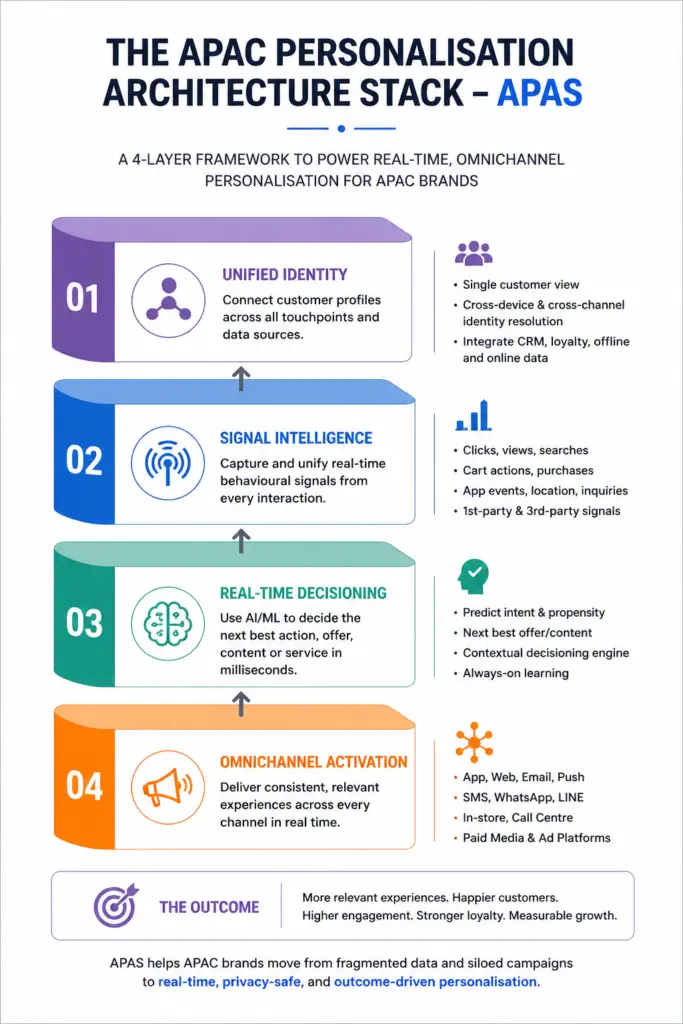
This is the most important principle behind real-time personalization architecture APAC: personalization does not usually fail at the point of activation. It usually fails earlier, when identity is fragmented, signals are stale, decisioning is disconnected or measurement loops are incomplete.
For AsiaTechBuzz readers already exploring the role of a customer data platform, this APAS framework extends the discussion from data collection to decision execution. It also connects directly to the role of a digital experience platform, because real-time decisions only create value when they can be activated across customer-facing experiences.
Layer 1 – Unified Identity and Profile
Unified Identity is the foundation of real-time personalization architecture APAC because every decision depends on knowing which customer, profile or session is being served.
This layer stitches together web, app, CRM, loyalty, in-store, transaction and third-party signals into a persistent customer profile. It must support both anonymous and known states. A customer may browse anonymously, log in later, abandon a cart, return through an app notification and complete the transaction in-store. The architecture must resolve those states without forcing the customer to restart the journey.
In APAC, this challenge is amplified by super-app ecosystems and marketplace-led discovery. Customers frequently move between brand-owned and partner-owned environments. They may interact with a brand on TikTok Shop, compare on a marketplace, ask a question on WhatsApp, and then complete the purchase on the brand’s app.
The identity layer must conect as much of this journey as legally, technically and commercially possible. It must also respect consent, data minimisation and market-specific privacy requirements.
Without this layer, personalization becomes inconsistent. A decisioning engine may recommend a produt the customer already bought. Paid media may retarget a converted customer. Customer service may not recognise a high-value loyalty member. Marketing may continue to treat a known user as a cold prospect.
In a mature APAS implementation, the unified profile is updated continuously. For action-triggered personalization, profile update latency should be measured in miniseconds, not hours. this does not mean every enterprise attribute must be updated instantly. It means the signals that influence next customer interaction must be available quickly enough to matter.
Signal Intelligence and Event Streaming
Signal Intelligence converts customer behaviour into real-time inputs that the personalization system can interpret and act on.
This layer captures behavioural signals such as click, dwell time, scroll depth, product views, search queries, cart additions, form abandonment, app sessions, payment events and service interactions. It then rouute those events into systems that need them.
This is where many organizations discover the limitation of batch-based personalization. A 24-hour data refresh may be acceptable for reporting. It is too slow for in-session decisioning. A customer wh has just searched for a product, added it to cart or abandoned an application must be recognised during the current journey, not in tomorrow’s campaign batch.
The importance of this layer is rising as marketers face increasing content and response demands. Salesforce’s State of Marketing coverage states that 83% of marketers recognise the shift toward personalised, two-way mesaging, but only one in four are satisfied with how they use data to power those moments. AI may help create content and automate journeys, but it cannot personalise effectively if the underlying signals are stale.
In APAC, signal volumes can spike sharply during regional sales moments such as 9.9, 10.10, 11.11, 12.12, Ramadan campaigns, Songkran promotions and year-end travel periods. The architecture must handle peak traffic without degrading the personalization experience.
A key decision is whether to build an open-source event streaming infrastructure or use managed services. Kafka and similar streaming technologies offer control and flexibility, but require engineering maturity. Managed event streaming services can shorten time-to-market, but may create dependency on cloud or platform ecosystems.
For a CMO, the practical questions is not why technology is fashionable. The question is which option givs the business reliable speed, governance and scale.
Layer 3 – Real-Time Decisioning Engine
The decisioning engine is the intellectual core of real-time personalization architecture APAC because it determines what experience should happen next.
A decisioning engine evaluates available signals and decides which content, offer, recommendation, service prompt or next action should be served to a specific customer at a specific moment. It is where the brand moves from knowing the customer to actiong on that knowledge.
There are two common decisioning approaches.
This first is rule-based decisioning. Rules are fast, auditable and easy to understand. For example, suppress acquisition messages after purchase. Show onboarding guidance to new users. Prioritise service content when a customer repeatedly visits help pages. Rule-based logic works well for clear business conditions.
The second is machine-learning-driven decisionining. ML models can evaluate larger combinations of signals, such as recency, frequency, cart value, product affinity, channel or origin, loyalty tier, location, time of day and propensity scores. This approach is better suited to complex APAC journeys, where customer intent may shift across multiple channels in a short period.
Mature brands usually use a hybrid model. Rules provide governance, compliance and business guardrails. Machine learning improves relevance, ranking and prediction. This hybrid structure is especially important in regulated sectors such as financial services, insurance, healthcare and telecommunications.
This is also where the distinction between Next Best Action and Next Best Offer matters. Next Best Offers is commercial. It identifies the most relevant product, promotion or incentive. Next Best Action is broader. It may determine that the best next step is not an offer at all, but a service prompt, education module, trust-building message, repayment reminder or onboarding step.
For real-time personalization architecture APAC, this distinction is critical. In high-growth e-commerce, the goal may be conversion. In fintech, telco or travel, the best outcome may be completion, retention, repayment, loyalty, service resolution or reduced churn.
Latency is a business issue here. In-session personalization should return a decision quickly enough that the customer does not notice system delay. Triggered post-session personalization, such as cart abandonment or incomplete application reminders, should activate within minutes while the intent is still fresh.
Layer 4 – Omnichannel Activation and Measurement Closure
Omnichannel Activation turns the decisioning engine’s output into cutomer-facing experience across channels.
This layer delivers the decision to the right touchpoint: web, app, push notification, email, SMS, WhatsApp, LINE, KakaoTalk, paid media, call centre or in-store experience. In APAC, this layer must be channel-agnostic because preferred communication channels differ by market. LINE is highly relevant in Thailand and Taiwan. WhatApps is central in markets such as Singapore, Malaysia and Indonesia. KakaoTalk dominates South Korea. Owned app, marketplaces and super-apps also play different roles across markets.
Dynamic creative optimization, or DCO, is an important execution mechanism. Instead of producing thousands of static creative variants, DCO assembles personalised creative from moudlar components such as headline, image, CTA, offer, benefit statement and disclaimer. This allows brands to scale relevance without overwhelming creative production teams.
This is where structured content matters. A brand cannot activate personalised experiences at scale if every message, banner and landing page is manually built. Modular content and a strong digital experience platform allow the decisioning layer to draw from approved, reusable content blocks.
Measurement closure completes the loop. Every activation event should send outcome signals back to the customer profile and decisioning engine. Did the customer click? Convert? Ignore? Unsubscribe? Ask for help? Complete the journey? Without this feedback loop, the system does not learn.
Manhattan Associates’ 2026 Unified Commerce Benchmark found that only 7% of retailers achieved true unified commerce leadership, while leaders achieved up to 2x revenue growth. This reinforces the broader point: connected customer experience remains difficult, but the commercial upside is significant.
The Five Most Common APAS Failure Points in APAC
Most personalization failures in APAC can be traced to one of the five architecture breakdowns inside the APAS framework.
Diagnosing the failed layer is the fastest way to move from symptoms to root cause.
| Failure Point | What it Looks Like | Root Cause in APAS |
|---|---|---|
| The CDP without a decisioning layers | Rich profiles exist, but campaigns remain limited to segment-based email or push notifications. | Layer 3 is missing. The CDP is used for storage and reporting, not real-time action. |
| The personalisation island | The website is personalised, but the app, email and paid-media show generic or contradictory experiences. | Layer 4 is fragmented. Each channel has its own logic and no shared decisioning feed. |
| The batch-mode AI model | Recommendations reflect last week’s behaviour, not current session intent. | Layer 2 is weak. Event streaming is absent or not connected to decisioning. |
| The identity collusion | A customer who purchased still receives acquisition ads for the same product. | Layer 1 is incomplete. Anonymous and known states are not resolved across channels. |
| The compliance default | Personalisation is limited to broad demographics because behavioural data usage is restricted | Governance is bolted on late instead of being designed into Layer 1 from the start. |
The most dangerous failure is the CDP without a decisioning layer. Many organisations assume that buying a customer data platform will automatically create personalisation. It does not. A CDP can unify data, but it does not gurantee that the organisation can decide and activate in real time.
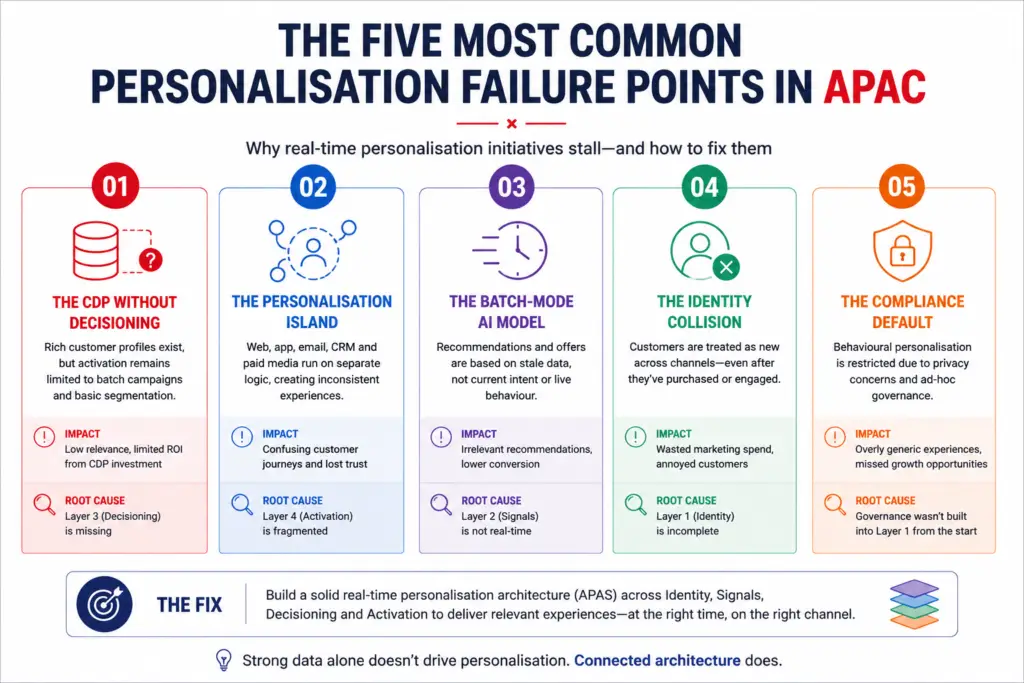
The personalisation island is also common. One team personalise the website. Another manages CRM journeys. Another controls paid media. Another owns the app. Each team optimises its channel, but no one owns the customer-level decision across channels.
The batch-mode AI model is increasingly visible as brands rush to adopt AI. AI trained on stale signals can still produce irrelevant recommendations. The model may be sophisticated, but the architecture is slow.
The identity collusion damages both efficiency and trust. It wastes media spend and signals to the customer that the brand is not paying attention.
The compliance default is the most strategic failure. Privacy teams restrict behavioral data usage because personalisation governance was not designed early. This is why real-time personalization architecture APAC must integrate privacy, consent and data minimisation from the first layer.
Why Personalization Latency is the Hidden Growth Constraint
Personalization latency s the time gap between customer intent and brand response, and it is one of the most underestimated constraints in APAC digital commerce.
For many brands, the issue is not whether they can personalize. It is whether they can personalize while the customer is still in-market.
In traditional campaign operations, a delay of several hours may appear acceptable. In APAC e-commerce, that delay can be commercially expensive. A customer comparing products during a mega-sale event may move from discovery to purchase within minutes. A shopper who abandons a cart may be evaluating competitor offers at the same time. A mobile app user who hesitates during the checkout may need immediate reassurance, not a next-day email.
This is why real-time personalization architecture APAC must be designed around decision speed. The architecture should not only ask, “Can we identify the customer?” It must also ask, “Can we interpret the signal, make the decision and activate the response before the intent dissapeaars?”
Personalization latency usually appears in three places.
The first is data latency. Behavioral signal are captured too slowly or are not routed into decisioning systems quickly enough.
The second is decisioning latency. Rules or models cannot return a next best action fast enough to influence the current session.
The third is activation latency. The selected message, offer or experience cannot be delivered into the correct channel in time.
For CMOs, this create a practical performance metric. Personalization should be measure not only by conversion uplift, but also by the speed from signal capture to customer-faciing response. A low-latency architecture is what turns a customer data platform, decisioning engine and digital experience platform into a working growth system.
APAC Brand Examples – APAS in Pratice
APAC’s strongest personalization examples show that relevance depends on connected architecture, not isolated campaign tactics.
The most successful brand connect signals, decisioning and activation across the journey.
Example 1 – E-Commerce Cart Recovery and Real-Time NBA
A Southeast Asian e-commerce platform using real-time recovery must connect Layer 2 signals with Layer 3 decisioning. The relevant signals include product view, cart addition, discount sensitivity, stock availability, session source, loyalty tier and previous purchase history.
The decisioning engine should not simply trigger a generic cart abandonment message. It should determine the next best action. For one customer, that may be a price reminder. For another, it may be free shipping. For another, it may be a product comparison module. For a high-intent returning customer, it may be a push notification rather than an email.
The Layer 4 activation must then deliver the decision through the right channel. In some APAC markets, that may be app push. In others, it may be WhatApp, LINE, Zalo, email or a retargeting audience.
The measurable outcome is not just open rate. It is recovered cart value, reduced abandonment and higher conversion within the current purchase window.
This is the APAS framework in action: signal, decision, activation and feedback.
Example 2 – Fintech or Tecco App-to-Service Personalization
A regional fintech or telco may use real-time personalization architecture APAC to connect digital and assisted channels. For example, a customer browsing a product inside the app may hesitate at pricing, eligibility or documentation. That signal can trigger edcation content, a simplified explanation or a call-centre assist prompt.
The decision engine must decide wherther the next best action is commercial or supportive. In regulated sectors, the right next action may be explain, reassure, or guide rather than push an offer. This is why Next Best Action is more useful than Next Best Offer for many APAC financial services and telco journeys.
Layer 4 activation may happen in-app, through a contact centre screen, via SMS or through a messaging app. Measurement closure then updates the customer profile based on whether the customer comleted the application, requested support or abandoned the journey.
This is where AI marketing operations becomes operationally importnat. Personalization is not only a campaign workflow. It becomes a coordinated operating model across marketing, digital service, product, data and compliance.
Example 3 – Beauty, Fashion and FMCG Dynamic Creative
Beauty, fashion and FMCG brands in APAC increasingly need to personalize across social commece, marketpaces and owned channels. A modular creative library allows the brand to assemble personalized variations without producing every asset manually.
For example, a beauty brand may combine skin concern, product category, creator content, offer type, market language and channel format into dynamic creative components. The same approved content library can support TikTok Shop, a brand website, email, app banners and CRM messages.
The APAS framework helps ensure that dynamic creative optimization does not become a creative gimmick. It becomes a activation capability connected to identity, signals and decisioning.
This distinction matters. Without APAS, DCO may simply produce more creative variants. With APAS, DCO become part of a learning system that improves relevance over time.
The 90-day Implementation Roadmap
The first 90 days should focus on diagnosing the architecture, fixing the highest impact data gaps and activating one measurable real-time journey.
CMOs do not need a full transformation program to begin. They need a disciplined starting point.
Days 1 to 14 – Diagnose
The first step is to audit the current stack against the four APAS layers.
Leadership should map how customer data flows between the CDP, analytics platform, CRM, campaign tools, app, website, data warehouse, digital experience platform and paid media platforms. The objective is to identify the primary failure point.
Key diagnostic questions include:
- Can the brand resolve anonymous and known identity across priority journeys?
- Which behavioural signals are available in real-time?
- Is there a decisioning engine, or only campaign rules?
- Which channels can activate decisions dynamically?
- Are outcome signals routed back into the customer profile?
- Is consent captured in a way that supports the intended personalisation use cases?
This diagnostic should produce a simple APAS heatmap. Each layer should be scored as mature, developing or constrained.
The point is not to create a long technology inventory. The point is to identify which architectural constraint is blocking personalization outcome.
Days 15 to 25 – Building the Foundaton
The seocond phase should focus on Layer 1 and Layer 2.
Brands should resolve the most important identity gaps first. This does not mean solving every identity problem. It means connecting the identities that matter most for the selected journey. For e-commerce, that may be anonymous browsing to logged-in cart. For Fintech, it may be app session to application status. For telcos, it may be plan browsing to service eligibility.
Next, the brand should implement event streaming for the top five behavioural signals by conversion impact. These may include product view, cart addition, form start, form abandonment and transaction completion.
Privacy governance must be embedded here. Consent, retention, data minimisation and market-specific usage rules should be designed into the profile and signal layers. This avoids the compliance default later.
At this stage, the brand should also define which data can support automated decisioning and which data requires additional review. This is especially important for regulated sectors.
Days 46 to 90 – Activate
Thie third phase should activate one high-value journey through Layer 3 and Layer 4.
The journey should be commercially important, measurable and operationally manageable. Examples include cart abandonment, product recommendation, onboarding completion, loyalty activation, application completion or churn prevention.
The team should define three core metrics.
First, personalization coverage rate. This meausre how many eligible interactions receive a personalized decision.
Second, decisioning latency. This measure how quickly the system responds after a signal is captured.
Third, incremental outcome impact. This measures whether personalization improves conve4rsion, completion, retention or customer value.
The team should also close the measurement loop by routing outcome signal back to the profile. Without this loop, real-time personalization architecture APAC does not improve over time.
Build, Buy or Compose – The CMO Decision Matrix
The right personalization technology strategy depends on existing platforms, data maturity, traffic volume and regulatory complexity.
CMOs should evaluate architecture fit before evaluating feature lists.
| Scenario | Recommended Path | Critical Consideration |
|---|---|---|
| CDP and ESP already in place, but limited ML capability | Buy a purpose-built personalization platform | Evaluate real-time event processing not just campaign features. |
| Strong data engineering team and high traffic volume | Compose streaming infrastructure, recommendation layers and channel connectors | Requires dedicated data, ML and platform operations capability. |
| Existing Adobe, Salesforce or enterprise suite licence | Extend current platform capabilities | Re-architect data flows for real-time decisioning |
| Multi-market APAC brand with data residency constraints | Compise with regional data infrastructure | Federated architecture may be required where centralised storage is not appropriate. |
A buy strategy can accelerate time-to-market. It is attractive when the organisation lacks deep ML engineering capability but needs to move quickly. The risk is platform dependency and limited flexibility.
A compose strategy offers greater control. It works best for high-volume digital businesses with strong data engineering teams. The risk complexity, longer implementation timelines and the need for ongoing ML operations.
An exten strategy is practical when the organisation already has. amajor enterprise platform. However activating a real-time module without redesigning the data flow often produces disappointing results.
For multi-market APAC brands, regulatory complexity may require a federated design. Customer data may need to remain in-market, while decisioning logic and content goverance operate regionally.
This is where an AI-ready MarTech stack becomes a strategic requirement, not a technical preference.
The Operating Model Behind Real-Time Personalisation
Real-time personalization fails when it is treated as a technology deployment rather than a cross-functional operating model.
The architecture may be technical, but the success model is organizational.
A mature real-time personalization architecture APAC requires clear ownership across marketing, data, technology, digital product, compliance and customer experience.
Marketing should own the customer strategy, use cases and value logic. Data teams should own signal quality, identity resolution and model inputs. Technology teams should own integration, scalability and platform reliability. Compliance should define privacy guardrails early, not approve use cases after they are built. Product and digital experience team should ensure that personalised journeys feel natural, helpful and consistent.
This operating model matters because real-time personalization changes how decisions are made. In a campaign-led model, marketing teams decide what message to send to which audience. In a decisioning-led model, teams define the rules, model, content modules, and guardrails that allow the system to choose the best next action dynamically.
Thie shift requires new governance rituals. APAC brands should establish a personalization council or growth architecture forum that reviews use cases, prioritises journeys, monitors decisioning performance and resolves trade-offs between revenue, customer experience and compliance.
This council should not become another approval bottleneck. Its role is to create alignment, not bureaucracy. It should clarify which journeys matter most, which data can be used, which decisions can be automated and which customer outcomes define success.
Content operations must also evolve. Salesforce’s State of Marketing coverage highlights that marketers recognise the shift toward personalised, two-way messaging, but many remain dissatisfied with the way they use data to power those moments. For APAC brands, the implication is clear: real-time personalization architecture APAC needs modular content, structured approvals and reusable creative assets.
Without this, decisioning engines will have too few approved content options to activate.
Governance Principles for Real-Time Personalization Architecture APAC
Real-time personalization only scales when trust, concsent and governance are designed into the architecture from the beginning.
Governance is not a brake on personalisation. It is the foundation that makes it sustainable.
APAC brands should apply five governance principles.
- First, consent must be explicit enough to support the intended use case. If behavioural data is used for recommendations, journey triggers or propensity models, the consent model must support that usage.
- Second, data minimisation must be practical. Brands should collect the signals needed to improve the experience, not every possible signals because it is technically available.
- Third, decisiong rules must be auditable. Marketing, compliance, risk and customer experience teams should understand why a customer receives a particular offer, message or intervention
- Fourth, sensitive use cases should have human oversight. AI decisioning should not operate without guardrails in regulated, high-impact or vulnerable-customer contexts.
- Fifth, measurement should include customer trust metrics. Unsubscribe, opt-outs, complaint rates and frequency fatigue should sit beside conversion and revenue metrics.
This is especially important as marketers adopt AI more aggressively. Salesforce’s 2026 State of Marketing coverage notes that siloed systems and poor data quality remain top barriers to AI-driven personalization. The gap is not only technical. It is operational and governance-related.
For APAC leadership teams, the key question is not whether personalization is possible. It is whether personalization can be excuted in a way that remains compliant, explainable and trusted across markets.
How to Measure Personalization ROI
Personalization ROI should be measured through incremental business impact, not isolated engagement metrics.
Open rates and click-through rates matter, but they do not prove that personalizaton is creating enterprise value.
A strong measurement model should track four categories.
- The first is conversion impact. This includes uplift in purchase, application completion, cart recovery, booking, lead submission or plan upgrade.
- The second is retention impact. This includes repeat purchase, churn reduction, loyalty activation, usage frequency and customer lifetime value.
- The third is efficiency impact. This includes reduced friction, lower service contact, fewer repeated messages, higher satisfaction and lower opt-out rates.
Manhattan Associates’ unified commerce benchmark reinforces the importance of connected experience, with only a small minority of retailers achieving true unified commerce leadership. For APAC e-commerce leaders, this suggests that personalization ROI should be linked to connected journey performance, not channel-level campaign reporting.
A useful executive metric is “decision-to-outcome visibility”. This measures whether the organization can trace a decision from signal, to recommendation, to activation, to customer response.
If that chain is broken, the business cannot confidently optimize personalization.
What CMOs Should Ask before Approving the Next Personalization Investment
The most important personalization investment question is not which vendor to buy, but which architectural constrain must be removed first.
CMOs should challenge every proposal against the four APAS layers before approving the next platform, pilot or AI initiative.
The sencond question is whether behavioural signals are available in real time. If signals are delayed, the investment should focus on layer 2.
The third question is whether there is a decisioning engine that can determine the next best action. If decisions remain campaign-based, the investment should focus on Layer 3.
The fourth question is whether the selected decision can be activated across channels. If activation is channel-specific, the investment should focus on Layer 4.
This diagnostic discipline is important because APAC brand often alreay have several personalization related. tools. Marketing-Interactive’s APAC personalization coverage shows that many brands prioritize personalization and have technical expertise, but accountability and outcome ownership are less mature. The issue is not always a lack of technology. It is often a lack of architectural connection.
For senior management, real-time personalization architecture APAC should therefore be evaluated as an enterprise capability. The business case should connect incremental revenue, retention uplift, reduced media waste, content efficiency, customer epxerience improvement and goveranance maturity.
This makes personalization easier to defend as a strategic investment rather than a tactical MarTech expense.
Conclusion – Personalization Ambition Needs Architecture
The gap between personalization ambition and personalization delivery in APAC is consistently architectural.
It is primarily a strategy problem, a creative problem or a budget problem.
Most brands already understand the need for relevance. Many already have a CDP, campaign platform, analytics stack and AI roadmap. Yet they still struggle to deliver real-time experiences because the architecture does not connect identity, signals, decisioning and activation into one operating system.
The APAC Personalization Architecture Stack provides a practical diagnostic model. Within 48 hours, a CMS and MarTech lead should be able to identify which APAS layer. isprimary constraint in their current stack.
If identity is fragmented, fix Layer 1. If signals are stale, fix Layer 2. If decisions are manual or campaign-based, fix Layer 3. If channels remain disconnected, fix Layer 4.
Mastering real-time personalization architecture APAC is not about adding another tool. It is about building the capability to recognise intent, decide intelligently, activate consistently and learn continuously across APAC’s fragmented customer journey.
In the next article in this series, we will examine how APAC’s leading brands are deploying Next Best Action marketing in APAC – and what the top-performing signal sets look like across Southeast Asia’s highest converting B2C categories.
Frequently Asked Questions (FAQs)
-
Wht is real-time personalization architecture and why does it matter for APAC e-commerce?
Real-time personalisation architecture is the system that connects customer identity, live behavioural signals, decisioning engines and activation channels. It matters in APAC e-commerce because customer journeys are highly fragmented across marketplaces, super-apps, owned apps, messaging platforms and offline touchpoints.
-
What is the difference between real-time personalisation and traditional segmentation-based marketing?
Traditional segmentation groups customers into predefined audiences and campaigns. Real-time personalisation responds to live customer intent. It can adapt content, recommendations, service prompts and offers during the current journey, making it more relevant for fast-moving APAC digital commerce environments.
-
What MarTech components are required for real-time personalisation at scale in APAC?
A scalable stack usually requires a customer data platform, event streaming infrastructure, decisioning engine, dynamic content layer, activation tools and measurement feedback loops. For real-time personalisation architecture APAC, these components must also support market-specific consent, channel preferences and data residency requirements.
-
What is a decisioning engine and how does it work in a personalisation stack?
A decisioning engine determines the best next action for a customer using available data and business rules. It evaluates signals such as behaviour, profile, product interest, loyalty status and channel context, then selects the most relevant content, offer, recommendation or service prompt.
-
How long does it take to implement real-time personalisation architecture for an APAC B2C brand?
A focused first use case can often be launched within 90 days if the brand already has basic data and activation tools. Full maturity takes longer because identity resolution, event streaming, governance, AI decisioning and omnichannel activation must be improved across multiple markets and systems.
-
What are the most common real-time personalisation failures in APAC e-commerce?
The most common failures are fragmented identity, stale batch data, disconnected channels, missing decisioning engines and late-stage compliance constraints. These failures usually occur because brands buy personalisation tools without designing the full architecture needed to support real-time activation and learning.