
Table of Contents
Introduction
Artificial intelligence is changing the rules of modern marketing, and composable martech architecture is becoming one of the most important enablers of that shift.
For years, organizations evaluated marketing technology by asking a simple question: how many capabilities can one platform deliver? That logic made sense in an era when digital channels were fewer, integration demands were lighter, and change moved at a more manageable pace. Today, however, the market is very different. AI has accelerated the speed of experimentation. Customer expectations are moving across more channels. Content needs to be created, structured, reused, and distributed faster. New tools appear constantly, and enterprise leaders are under pressure to turn AI from a promising concept into measurable operating value.
That is exactly why composable martech architecture is moving into the strategic spotlight. Rather than relying on one tightly bundled suite to do everything, a composable approach allows organizations to assemble a modular ecosystem of interoperable capabilities. Those capabilities can then be connected, orchestrated, replaced, or expanded as business needs evolve. In practical terms, composable martech architecture makes the stack more flexible, more adaptable, and more aligned to the pace of AI-driven change.
This matters because AI does not create value in isolation. It creates value when it can access the right data, interact with the right systems, plug into the right workflows, and be tested without destabilizing the broader environment. A generative assistant, a recommendation engine, an intelligent orchestration layer, or an AI-powered content workflow will only succeed if the surrounding architecture supports it. That is why composable martech architecture is not jus a technical design choice. It is a strategic business capability.
The urgency is already visible in the market. Gartner says average martech utilization dropped to 49% in its 2025 Marketing Technology Survey, suggesting many enterprises are paying for platforms and capabilities they do not fully use. (Source: Gartner). Scott Brinker’s 2025 Marketing Technology Landscape counted 15,384 solutions across 49 categories, illustrating how large and fragmented the martech market has become. (Source: Chiefmartec).
Together, these two signals tell a compelling story. Organizations need flexibility more than they need more bloated functionality, and composable martech architecture gives them a way to pursue that flexibility with more control.
For digital marketers, the appeal is immediate. A modular environment makes it easier to launch experiements, connect channels, test AI tools, and accelerate campaign execution. For the C-suite, the benefits are broader. Composable martech architecture can reduce vendor lock-in, improve resilience, create better investment discipline, and give the business more optionality as AI capabilities continue to evolve. In a market defined by constant change, optionality is not a nice-to-have. It is a serious source of competitive advantage.
The AI Era Is Redefining What Modern Martech Must Deliver
The conversation around marketing technology used to be dominated by scale, standardization, and breadth. Enterprises wanted a single platform that could centralize campaign management, customer data, analytics, content delivery, and personalization. In principle, that offered control. In practice, it often create heavy environments that were difficult to evolve.
AI is exposing the limits of that model. Modern marketing teams are now being asked to experiment with AI-assisted content creation, predictive segmentation, automated decisioning, conversational interfaces, AI-powered search experiences, and workflow automation. They need to test faster, learn faster, and operationalize what works. That kind of environment demands flexibility, not rigidity. It demands the ability to plug in new capabilities without having to redsign the whole stack each time. This is where composable martech architecture starts to become strategically important.
The wider enterprise market is moving in the same direction. McKinsey’s March 2025 global AI survey found that more than three-quarters of respondents say their organizations use AI in at least one business function, while the organizations capturing value are increasingly redesigning workflows and governance, not simply adopting new tools (Source: McKinsey). IBM also reported that 62% of companies are increasing their AI investments in 2025.
These are important indicators because they show that AI investment is rising, but value creation is becoming more dependent on how well the organization can operationalize change.
That is the real leadership issue. AI is not just a feature to be activated inside an existing platform. It is a capability that requires data access, orchestration, governance, integration, and room for experimentation. Traditional stack designs often struggle because they were built for stability and control rather than modularity and adaptability. When new AI tools arrive, organizations fund themselves constrained by closed systems, brittle integration, vendor road maps, and slow release cycles.
Composable martech architecture offers a more practical response. It allow organizations to build a stack that is modular by design. That means teams can introduce new AI services, test specific use case, and scale proven capabilities with less disruption to the rest of the environment. In the AI era, the competitive advantage is not just having AI in the stack. it is having a stack that can continously absorb and apply AI as the market changes.
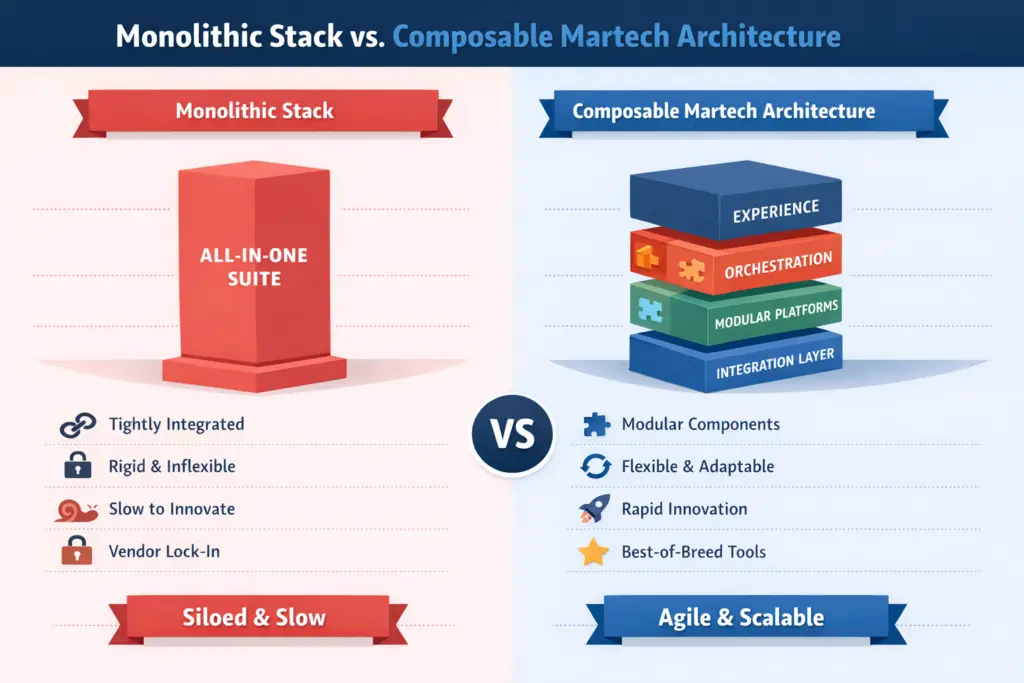
Why traditional suite-based stacks are under pressure
Traditional suites are not inherently wrong. In many cases, they brought needed discipline and consistency. But they were often optimized around broad functionaliuty rather than continuous adaptability. When every major change depends on the same central platform, experimentation slows down. One team’s innovation becomes another team’s dependency. Over time, that weakens the organization’s ability to respond to change.
Why AI changes the architectural question
AI forces leader to think differently. The question is no longer, “Which platform has the most features?”. It is increasingly, “Which architecture gives us the most flexibility to test, connect, and evolve capabilities over time?”. That question naturally leads toward composable martech architecture.
What Composable Martech Architecture Actually Means
At its core, composable martech architecture is a modular approach to building marketing technology estate. Instead of depending on one large, tightly integrated suite, the organization assembles specialized capabilities that can work together through clear interfaces and shared orchestration. Those capabilities might include a headless CMS, a customer data platform, a journey orchestration engine, an experimentation tool, analytics services, commerce services, or AI applications.
The important pint is that composable does not mean random. It does not mean collecting disconnected best-of-breed tools without discipline. Done propperly, composable martech architecture is highly intentional. It is based on the idea that capabilities should be selected for fit, connected through APIs and integraton layers, and governed through shared standards. The result is a stack that can evolve component by component rather than requiring a major replatformig every time the business needs change.
For senior leaders, this distinction matters. Composable architecture is not about buying more tools. It is about designing for adapability. It allows organizations to separate the pace of innovation in one area from the stability needs of another. For example, a brand may want to experiment aggressively in content generation or personalization while keeping identity, consent, or core customer data services more stable. Composable martech architecture makes that possible.
The model is typically built around five foundational ideas: API-first architecture, headless platforms, microservices, integration layers, and vendor interoperability. Together these elements create a system that is modular enough for change but structured enough for scale.
A business-friendly definition
A simple way to explain composable martech architecture is this: it is an approach where marketing capabilities are assembled like connected building blocks instead of being locked inside one fixed platform. Each block has a defined role, each block can connect to others, and each block can be improved to replaced with less disruption.
Why composable is different from “best of breed”
Best of breed often describes a tool-buying mindset. Composable martech architecture is broader. It is an operating model. It requires architectural standards, orchestration logic, shared governance, and a deliberate plan for how capabilities fit together. Without those elements, modularity quickly becomes fragmentation.
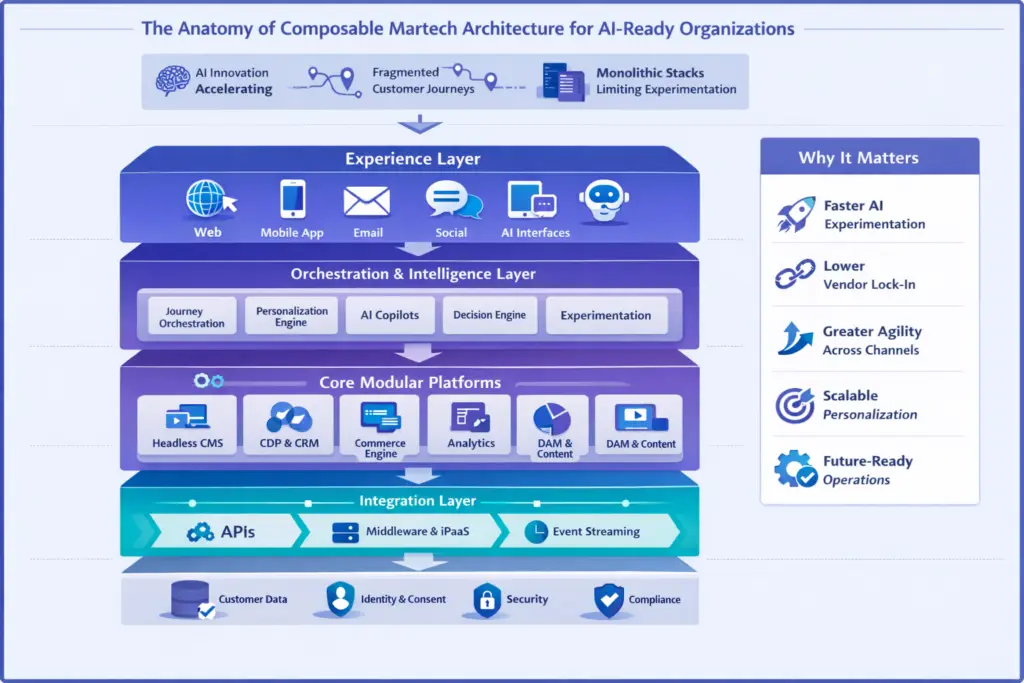
API-First Design Is the Backbone of Composable MarTech Architecture
If composable architecture has a structural backbone, it is tghe API. APIs are what allo systems to exchange data, trigger actions, and expose services in reusable ways. In an AI-ready environment, that is not a technical detail. It is essential infrastructure.
Postman’s 2025 State of the API Report found that 82% of organizations have adopted some level of an API-first approach, while 25% describe themselves as fully API-first organizations. The same report found that 89% of developers are using AI, yet only 24% are desiging APIs specifically for AI agents (Source : Postman).
The gap is revealing. AI ambition is growing quickly, but many organizations still do not have the interfaces needed to support AI at scale.
In composable martech architecture, API-first design changes the economics of experimentation. Teams do not need to reinvent every connection when a new capability is introduced. If content, customer profiles, product data, decision logic, and orchestration layers are exposed through stable APIs, new AI services can be added more quickly and tested more safely. That reduces both time and friction.
API-first design also improves governance. It becomes esaier to define who can access what, to monitor usage, to version changes, and to create more controlled handsoffs between systems. This is especially important when AI tools are involved. Marketing leaders need confidence that outputs can be traced, inputs can be validated, and controls can be enforced. Strong APIs help make that possible.
APIs as reusable business infrastructure
The most mature organizations no longer treat APIs as just technical connectors. They treate them as reussable business infrastructure. In composable martech architecture, that means a single API can support multiple channels, workflows, or AI services without requireng teams to duplicate the same logic repeatedly.
Why AI needs accessible and structured interfaces
AI capabilities are only as useful as the systems they can access. If customer data is trapped, content is unstructured, or workflows are burried inside closed applications, AI will struggle to deliver value. Composable martech architecture works because it assumes accessibility and reusability from the start.
Headless Platforms Give Composable Martech Architecture the Flexibility AI Demands
Headless architecture plays a particularly important role because it separates content or business logic from presentation. In traditional systems, the front end and back end are tightly coupled. That can make experience changes slower and content reuse more difficult. In a composable model, headless platforms help remove those constraints.
This matters because the number of delivery surfaces keeps expanding. Brands are no longer delivering experiences only through websites and apps. They also need to think about conversational interfaces, AI search results, in-product experiences, service portals, commerce flows, and emerging machine-consumed channels. A tightly coupled platform can become a bottleneck in that world.
Composable martech architecture benefits from headless design because it allows structured content and services to flow into many destinations more easily. Marketers can create content with reuse in mind. Front-end teams can build experiences with more freedom. AI tools can access structured assets more consistently. The organization gains speed because changes to one layer do not always require changes to another.
Why headless matters to marketers, not just developers
For marketers, headless means more content agility. It becomes easier to reuse assets, tailor content for different channels, and support AI-driven experiences without recreating the same material repeatedly. That is a strategic advantage in high-volume, high-velocity environments.
Why headless improves future readiness
Headless platforms help organizatios prepare for channels that do not yet exist in their current roadmap. This is one reason composable martech architecture aligns so well with AI readiness. It creates the content liquidity and delivery flexibility needed for an evolving channel landscape.
Microservices Make Composable Martech Architecture More Adaptive
Microservices are another important enabler because they break large applications into smaller, specialized services. Each service has a focused purpose and can be developed, deployed, or replaced more independently. In composable martech architecture, this creates a more adaptive environment.
The relevance to AI is straightforward. Not every AI use case will mature at the same pace. One team may eb ready to deploy AI-assisted campaign planning. Another may still be piloting a recommendation engine. Another may want to automate asset tagging or customer service summarization. A monolitic environment often forces these very different levels of maturity into one release model. A microservices-oriented model allows them to move more independently.
That flexibility reduces strategic risk. It becomes easier to test a new capability without overcommitting the entire platform. It becomes easier to retire a weak solution or upgrade a strong one. And it becomes easier to isolate failures so that one service issues does not derail the entire digital experience.
Why smaller services support faster experimentation
Smaller services are easier to change, eaier to test, and easier to replace. In composable martech architecture, that gives teams a more practical way to run experiments without causing broader disruption elsewhere in the stack.
Why microservices reduce replatforming pressure
Many enterprises spend too much time waiting for major transformation programs. Microservices shift the model toward incremental modernization. Instead of rewriting everything, organizations can improve one capability at a time.
Integration Layers Are the Hidden Enabler of Composable Martech Adventure
A modular stack only works if it can act like a connected system. That is why integration layers are fundamental to composable martech architecture. Without them, modularity quickly becomes fragmentation.
MuleSoft’s 2026 Connectivity Benchmark report found that 95% of organizations report challenges with integration, 96% agree that AI agent success depends heavily on seamless integration, and 86% say that without proper integration, agents add complexity instead of value. The same report says 50% of AI agents currently operate in isolated silos (Source: Mulesoft).
These findings are directly relevant to digital marketing and customer experience leaders. They show that the real barrier to AI value is often not the model itself, but the environment around it.
In composable martech architecture, the integration layer can include middleware, iPaaS platforms, workflow orchestration tools, event-driven services, data activation layers, or customer data platforms. Its role is to coordinate how information and actions move across the ecoysystem. It ensure that a trigger in one system can lead to the right content, decision, message, or measurement in another.
This orchestration layer is often overlooked because it is less visible than the channels and interfaces customers interact with. But strategically, it is one of the most important parts of the stack. It is what turns a collection of modular capabilities into an operating system for growth.
Why orchestration matters more in AI-drive environments
AI tools generate outputs. They do not automatically create workflows. The integration layer is what allows those outputs to trigger next-best actions, route decisions into journeys, and connect insights back into analytics and measurement.
Why integration quality determines scalability
A weakly integrated pilot may still look impressive in a demo. But it usually breaks down at scale. Composable martech architecture only delivers on its promise when the connective tissue is trong enough to support real business operations.
Vendor Interoperability Turns Composable Martech Architecture Into a Strategic Advantage
Vendor interoperability is sometimes treated as a technical checklist item, but in reality it has become a strategic question. In fast-moving AI markets, enterprises cannot afford to be trapped inside one vendor’s pace of innovation. They need the flexibility to evaluate new services, connect specialized tools, and change components when business priorities shift. Composable martech architecture is strongest when interoperability is built in from the start.
This changes how leaders should evaluate platforms. It is no longer enough to ask whether a vendor offers a broad set of features. The more important qestions are whether its APIs are open, whether its content and data model are portable, whether it supports coexistence with third-party services, and whether the platform can be extended without excessive friction.
Gartner’s 2025 finding that average martech utilization is 49% is especially relevant here (Source: Gartner). It suggests that many organizations are already paying for more bundled functionality than they can practically absorb. That should push executive teams to think less about volume and more about fit, openess, and adaptability. Composable martech architecture supports that mindset because it encourages selective investment and greater control over how capabilities are assembled.
Why vendor lock-in is riskier in the AI era
AI capabilities are evolving too quickly for any organization to assume that one vendor will always lead in every category. Vendor lock-in reduces options, slows experimentation, and weakens the enterprise’s ability to adapt.
Why openness improves investment discipline
When systems are interoperable, leaders can invest more surgically. They can back the capabilities that matter most, test innovations with less risk, and avoid large-scale platform decisions driven mainly by fear of missing out.
Why Composable Martech Architrecture Accelerates AI Experimentation
This is where the strategic case becomes most tangible. Composable martech architecture enables faster experimentation because it lowers the cost of change. New AI capabilities can be connected into specific workflows without forcing the whole stack to move at once. That makes pilots esaier to launch and much easier to scale when they prove thier value.
This matters because many AI pilots fail for reasons that have little to do with underlying model. The common failure point is the surrounding architecture. The tool cannot access the right data, cannot connect to live journeys, cannot route outputs into production workflowss, or cannot be governed at enterprise scale. Composable martech architecture addresses these issues by making the environment itself more modular and integration-friendly.
The result is a better path from proof of concept to production. IBM’s 2025 research showing that 62% of companies are increasing AI investment suggest that experimentation will continue to intensify. Mckinsey’s finding that organizations are redesigning workflows and governance reinforce the same point: value comes from operationalization, not novelty alone (Source : McKinsey).
Faster pilots with less disruption
A modular stack allows teams to test specific AI use cases in contained ways. They can introduce one service, measure outcomes, and expand only when the case is proven.
Easier scaling of what works
When APIs, content structures, and orchestration layers are already in place, successful experiments can move into broader workflows more quickly. That is one of the clearest business benefits of composable martech architecture.
The Business Benefits of Composable Martech Architecture for Marketers and C-Suites
The value of composable amrtech architecture goes well beyond technical elegance. It creates business benefits that matter to both operational teams and executive leadership.
First, it improves time to market. Teams can work in parallel, update capabilities more independently, and reduce dependence on large release cycle. That is especially valuable when campaigns, experiences, and AI use cases need to move quickly.
Second, it improves resilience. If one tool underperforms or one vendor falls behind, the organization does not have to rethink the entire estate. A modular architecture makes change more manageable and lowers the risk of being overe3xposed to any single provider.
TThird, it supports stronger capital allocation. Scott Brinker’s 2025 landscape counted 15,384 martech solutions, a vivid reminder that the market is now too large for any enterprise to assume one-size-fits-all buying logic. Gartner’s 49% utilization figure reinforces the need for more disciplined investment. Composable martech architecture encourages leaders to invest in the capabilities that matter most instead of paying for platform breadth they may never activate.
Forth, it helps align teams. Marketing, data, product, engineering, and architecture functions have to co-ordinate more clearly in a composable model. While that requires discipline, it also creates healthier interfaces between teams and makes responsibilities eaier to define.
Better alignment across business and technology teams
A composable model forces organizations to clarify interfaces, ownership, and standards. That can reduce ambiguity and speed up decisions when change is needed.
Stronger long-term adaptability
The biggest benefit may be strategic rather than operational. Composable martech architecture prepares the organization for continuous change, not just one transformation cycle.
The Risk and Realities Leaders Should Not Ignore
A balanced discussion also needs to acknowlege the trade-offs. Composable martech architecture is powerful, but it is not automatically simpler. It changes the shape of complexity rather than elimating complexity altogether.
Governance becomes more important. Organizations need standards for API design, identify, data stewardship, content modeling, security, and vendor selection. Without those standards, modularity can drift into tool sprawl. Skills also matter. Teams need a shared understanding of how services fit together and how success should be measured across the stack.
There is also a sequencing challenge. Some organizations assume that composable mean rerplacing everything at once. That is rarely the right move. In most cases, a phased approach is more practical. The business should identify the areas where modularity creates the most leverage, the modernize those domains first.
Why governance maturity matters
Composable martech architecture works best when there is strong architecture ownership, clear standards, and disciplined decision-making around integration and interoperability.
Why phased modernization is usually smarter
Trying to transform the entier stack in one move often creates more risk than value. A phased path allows the organization to learn, adapt, and build confidence over time.
How to Assess Readiness for Composable Martech Architecture
Most organizations do not wake up one day and decide to become composable for its own sake. The need usually emerges through practical bottlenecks. AI pilots stall because systems cannot connect clearly. Content te4ams recreates assets for every channel. Front-end changes require slow back-end dependencies. Vendor lock-in limits innovation. Reporting is fragmented. New use cases require too much custom work.
These are all signals that the current stack may be constraining growth. When those symtoms are visible, composable martech architecture becomes a serious option.
Readiness is not about having a perfect environment. It is about having a clear understanding of where the current architecture is slowing the business down. Leaders should ask which capabilities need more flexibility, where integration friction is highest, which platforms are too closed, and what stndards will be required to make modularity work at scale.
Common signs the stack is becoming a bottleneck
Repeated integration delays, duplicated content work, underused platform features, and stalled AI pilots are all warning signs that the current environment may need a more modular design.
Questions leaders should ask first
Where do we need experimentation? Which capabilities are over-bundled? Which domains would benefit most from openness and flexibility? These questions create a more grounded starting point for composable martech architecture.
A Practical Roadmap for Building Composable Martech Architecture
The best path is usually incremental.
Start with an audit of the current estate. Map key capabilities, dependencies, content flows, integration points, and major pain areas. This gives the organization a fractual starting point.
Next, prioritize the domains where modularity will unlock the most value. In many cases, that means content platforms, orchestration, data activation, or experience delivery. These are often the domains where AI use cases need more flexibility.
Then establish the standards. Define API principles, governance rules, content modeling approaches, interoperability expectations, and security guardrails. These are what prevent composable martech architecture from becoming unmanaged complexity.
After that, pilot specific business use cases. Do not start with architecture for architecture’s sake. Start with problems that matter, such as faster content reuse, AI-assisted campaign orchestration, better personalization, or more conneted customer journeys. Measure business impact, not just technical completion.
Finally, scale through repeatable patterns. The long-term strenght of composable martech architecture comes from reusable ways of connecting, governing, and activating capabilities. The objectives is not just to complete one successful pilot. It is to make the next pilot easier, faster, and more scalable.
Start where the business pain is real
A modular architecture becomes more easier to justify when it is linked directly to visible commercial or operational bottlenecks.
Build repeatable patterns, not one-off fixes
The goal is not simply to connect more tools. It is to create reusable patterns that make the organization more adaptive over time.
The Future of Martech Belongs to Organizations Built for Change
At the highest level, composable martech architecture is not really about modular software. It is about strategic adaptability. In an environment where AI tools, customer expectations, channels, and vendors are all changing rapidly, the organizations that thrive will be the ones that can evolve without constantly starting over.
Tat is why this architectural model matters so much right now. It gives digital marketers a more flexible environment for experimentation. It give technology teams a more manageable way to modernize. And it gives the C-suite a more resilient foundation for long-term growth.
The real question for leaders is no longer whether their stck includes AI. The more important question is whether their architecture is flexible enough to keep absorbing AI as the market evolves. Composable martech architecture is compelling because it answers that question with a model built for optinality, interoperability, and continuous change.
Final leadership takeaway
Organizations do not need a martech stack that is merely bigger. They need one that is more adaptable. That is why composable martech architecture is becoming such an important foundation for AI-ready growth.
Read more articles on AI-Optimization here.
Frequently Asked Questions (FAQs)
-
What is composable martech architecture?
Composable martech architecture is a modular approach to building a marketing technology stack using interoperable components instead of one tightly bundled platform. It allows organizations to connect, replace, and scale capabilities more flexibly.
-
Why is composable martech architecture important for AI?
It is important because AI tools need access to data, content, and workflows across multiple systems. A composable setup makes it easier to integrate new AI capabilities and test them without disrupting the whole stack.
-
How is composable martech architecture different from a traditional martech suite?
A traditional suite usually offers many capabilities inside one vendor ecosystem, while composable martech architecture combines specialized tools through APIs and integration layers. This gives organizations more flexibility and reduces vendor lock-in.
-
What are the main building blocks of composable martech architecture?
The main building blocks are API-first architecture, headless platforms, microservices, integration layers, and vendor interoperability. Together, they create a more flexible and scalable foundation for modern marketing.
-
Is composable martech architecture suitable for every organization?
Not always. It works best for organizations that need agility, have growing integration demands, and want to experiment faster with AI and digital experiences. It also requires stronger governance and technical discipline than a simplier all-in-one setup.