
Table of Contents
Introduction
Artificial intelligence is moving from marketing experimentation to enterprise infrastructure. What started as a productivity tool for drafting copy, summarizing research, and creating campaign ideas is now being embedded into content management systems, CRM platforms, customer data platforms, journey orchestration tools, analytics dashboards, paid media platforms, personalization engines, and customer-facing assistants.
This creates an important leadership opportunity. AI can help marketing teams move faster, create more relevant experiences, improve content velocity, and make better decisions from data. However, it also introduces new risks. AI can generate inaccurate claims, expose confidntial data, weaken brand consistency, reinforce bias, create copyright concerns, and make decisions that are difficult to explain.
This is why AI governance in marketing has become a senior leadership priority. The question is no longer whether marketing teams should use AI. In many organizations, they already do. The real question is whether the enterprise has the policies, controls, oversight structures, and operating discipline to scale AI safely.
AI governance in marketing should not be viewed as a brake on innovation. It should be viewed as the management systsem that allows AI to scale responsibly. It gives teams clarity on approved tools, data usage, review standards, decision rights, vendor contols, human oversight, and incident response.
For senior leaders, the goal of AI governance in marketing is simple: create enough trust, control, and accountability for AI to become a sustainable marketing capability.
Why AI Governance in Marketing has Become a Senior Leaership Issue
AI is already entering the marketing operating model
Marketing is one of the business functions most exposed to AI. Teams are using AI for content creation, campaign planning, customer segmentation, SEO, AI search optimization, social media, email, creative production, research, analytics, and customer journey design.
Salesforce reports that 63% of marketers are currently using genartive AI. Mckinsey’s 2025 global survey also shows that AI use continues to rise across business functions, while organizations are increaingly exploring agentic AI systems. These indicators show that AI is no longer a future capability. It is already entering daily workflows.
This. matters because marketing output is highly visible. When AI supports internal brainstorming, the risk is limited. When AI influences customer-facing content, product claims, customer journeys, personalization, or service answers, the risk profile changes. AI governance in marketing becomes essential because AI now touches brand, data, customers, platforms, and performance.
The risk profile of marketing has changed
Traditional marketing technolgy usually executes rules created by people. AI can generate, infer, rank, recommend, summarize, clasify, and sometimes act with more autonomy. That creates a different governance challenge.
A content tool may create an unsupported claim. A chatbot may give an incorrect answer. A personalization engine may prioritize one customer segment whille excluding another. A media platform may optimize for conversion while creating brand-safetly issues. A journey tool may recommend next-best actions that are difficult to explain.
This is why AI governance in marketing must cover more than technology approval. It must include content risk, data protection, model oversight, vendor accountability, legal review, brand standards, ethical practices, and human-in-the-loop controls.
Governance is now a condition for scale
Small AI experiments can run on enthusiasm. Enterprise AI cannot. Without governance, organizations face AI sprawl: many tools, many prompts, many use cases, many vendors, and limited visibility.
Cisco’s 2024 AI Readiness Index found that less than one-third of respondents reported high readiness from a data perspective to adapt, deploy, and fully leverage AI technologies. This readiness gap is important for marketing leaders because AI depends on trustworthy data, clear access controls, and disciplined operating processes.
AI governance in marketing is therefore not a theoretical exercise. It is the foundation required to move from experimentation to controlled adoption.
What AI Governance in Marketing Really Means
A practical definition
AI governance in marketing is the set of policies, decision rights, controls, review processes, data safeguards, model oversight practices, and accountability structures that ensure AI is used safely, ethically, legally, and effectively across marketing activities.
This definition is intentionally practical. Governance is not just a policy document. It is the way marketing team use AI every day.
A good governance model answers clear questions. Which AI tools are approved? What data can be used? Which outputs require review? Who approves customer-facing content? Which vendors are allowed? How are high-risk use cases assessed? What happens if AI output is wrong? Who owns the decision?
If these questions are not answered, teams will improvise. Improvision may work in early experimentation, but it is not enough for enterprise AI.
Governance is broader than compliance
Compliance is critical, especially in regulated sectors such as financial services, healthcare, insurance, telecommunications, and consumer lending. However, AI governance in marketing is broader than compliance.
It also protects brand trust, customer experience, content quality, campaign consistency, data integrity, and business performance. A company can meet minimum legal requirements and still damage trust if AI creates misleading, insensitive, or poor-quality marketing output.
This is why AI governance is marketing must connect marketing, digital, legal, compliance, risk, IT, data, security, procurement, and customer experience teams. Each function sees a different part of the risk.
Governance should enable speed
Many leaders worry that governance will slow marketing down. Poorly designed governacne can do that. Well-designed AI governance in marketing creates speed because it reduces ambiguity.
When teams know which tools are approved, which use cases are low risk, whcih claims are pre-approved, and which review path applies, they can move faster. AI governance in marketing should be risk-based, not one-size-fits-all.
Low-risk internal work should have simple guardrails. High-risk customer-facing or regulated use case should have stonger controls. This approach allows speed and safety to coexist.
The Five Governance Risks Marketing Leaders Must Manage
1. Content Risk
Content is often the first area where marketers use AI. It is also one of the most visible risk areas.
AI-generated content can sould polished while being inaccurate. It may invent statistics, misinterpret product details, exaggerate benefits, use unapproved claims, or create copy that does not match the brand voice. For regulated industries, this can create legal and compliance exposure.
AI governance in marketing should define how AI-generated content is reviewed before publication. Internal drafts may need only marketer review. Public-facing content should go through editorial and brand checks. Regulat4ed claims should require legal and compliance review. AI assistant answers should be tested against approved knowledge sources.
The core principle of AI governance in marketing is clear: AI can support content creation, but humans remain accountable for what is published.
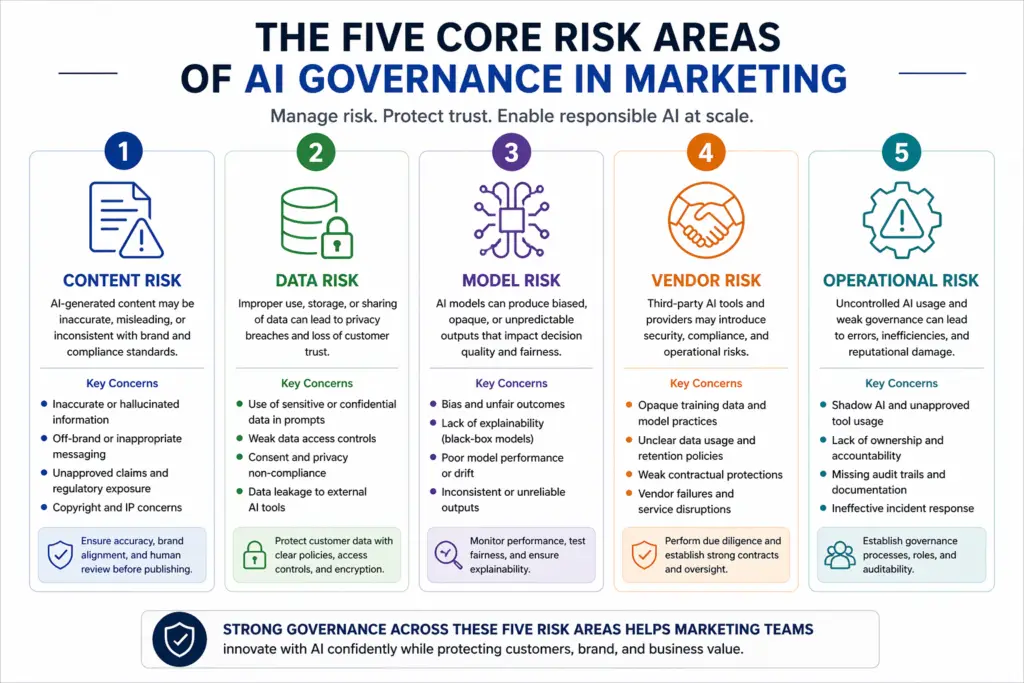
2. Data Risk
Marketing teams work with valuable customer data. This may include CRM data, behavioral data, consent data, loyalty data, web analytics, app analytics, campaign engagement, transaction signals, and segmentation models.
AI increases the need for data discipline. Teams may upload data into tools without fully understanding how that data is stored, processed, retained, or reused. Customer records, campaign exports, call transcripts, or audience segments should be entered into unapproved AI tools.
IBM’s Global AI Index found that limited AI skills and expertise, data complexity, and ethical concerns are among the main barriers preventing AI deployment. For marketing leaders, this reinforce a key point: AI governance in marketing cannot work without clear data rules.
Under AI governance in marketing, data should be classified by sensitivity. Public data, internal data, confidential information, customer-identifiable information, and regulated data should each haver different usage rules.
3. Model risk
Model risk becomes important when AI influences customer treatment. This includes personalization, next-best-action recommendations, lead scoring, offer ranking, churn prediction, customer segmentation, and chatbot reponses.
For AI governance in marketng, senior leaders do not need to understand every model parameter. But they should understand what the model is used for, what data it uses, who reviews it, how it is monitored, and what happens when it is wrong.
AI governance in marketing should apply stronger oversight when AI influences outcomes that matter to customers. A campaign headline generator is low risk. A model that prioritizes financial product offer is high risk. A chatbot that answers eligibility questions requires stronger testing, review, and monitoring than an internal summarization tool.
The more AI affects customer outcomes, the stronger the governance should be.
4. Vendor Risk
Many AI capabilities are embedded inside martech platforms. CMS, CRM, CDP, analytics, paid media, SEO, social media, journey orchestration, and creative tools increasingly include AI features.
This creates vendor risk, which makes AI governance in marketing important. Een when the model is provided by a third party, the enterprise remains accountable for the customer experience. If a vendor’s AI feature produces inaccurate, biased, insecure, or non-compliant output, customers will associate the problem with the brand.
AI governance in marketing should therefore include vendor due diligence. Leaders should ask what data the vendor processes, whether customer data is used for model training, how outputs are logged, what controls are available, whether the model is explainable, and what contractual protections exist.
5. Operational risk
The biggest risk may not be one large failure. It may be hundreds of small unmanaged uses across the organization.
One team uses AI for paid media copy. Another use it for research. Another uses it for customer segmentation. Another uses it for images. Another uses it for chatbot scripts. Each use case may seem small, but together they create complexity.
Without AI governance in marketing, leaders may not know which tools are used, which data is processed, which outputs are reviewed, or which vendors have access. This is why AI usage should be inventoried, categorized, and monitored.
Building an AI Policy Framework for Marketing Platforms
Define approved, controlled, and unrestricted use cases
A useful AI policy for AI governance in marketing should be practical. It should not simply tell teams to “use AI responsibly”. It should define wehat responsible use means.
Approved low-risk use cases may include internal brainstorming, campaign outline creation, meeting summaries, research synthesis, non-sensitive idea generation, and first-draft content for human review.
Controlled use case may include customer-facing content, landing pages, email campaigns, AI-generated images, personalization rules, chatbot scripts, customer journey recommendations, and regulated campaign materials. These activities can be allowed, but they require review, documentation, and approval.
Restricted or prohibited use case may include uploading confidential customer data into public AI tools, generating regulated claims without review, making automated customer decisions without approval, using unapproved vendors, or publishing AI-generated content without human oversight.
This structure makes AI governance in marketing usable. Teams can move quickly on lower-risk work while applying stronger control to sensitive use cases.
Establish clear data usage rules
Data rules should be specific enough for marketing teams to apply. A practical framework may classify data as public, internal, confidential, customer-identifiable, sensitive, or regulated.
Public and internal non-confidential data may be suitable for approved AI tools. Confidential campaign strategy may require enterprise-approved AI environments. Customer-identifiable or sensitive data should require strict access controls, privacy review, and approved processing arrangements.
The policy for AI governance in marketing should also address prompts. A prompt can accidently include confidential information, customer identifiers, unreleased strategy, or sensitive campaign details. AI governance in marketing should guide what employees can and cannot include in prompts.
Create risk-based review standards
Human review is one of the most important elements of AI governance in marketing. Review should match risk.
A low-risk internal draft may need only the marketer’s review. A blog article may need editorial and source checks. A paid media campaign may need brand review. A regulated product claim may need legal and compliance review. A chatbot answer library may need business, legal, risk, compliance, product, and customer experience review.
The policy should make these paths clear. Otherwise, teams will either over-escalate everything or under review important outputs.
Document higher-risk use cases
For governance purposes, documentation does not need to be complcated, but it should be consistent. For higher-risk use cases, teams should record the AI tool used, purpose, data type, output owner, reviewer, approval status, publication date, and known limitations.
This creates and audit trail and gives leaders visibility into how AI is being used across marketing platforms.
Model Governance: From Black Box Adoption to Controlled AI Usage
Apply risk tiering
Not every AI use case requires formal model governance. The level of control should match the level of risk.
Low-risk use cases include ideation, summarization, and draft outlines. Medium-risk use cases include customer-facing content, SEO content, email copy, campaign creative, and social media posts. High-risk use cases include personalization, lead scoring, next-best-action, chatbot responses, and AI-assisted customer service. Critical use cases include automated decisions that affect access, eligibility, pricing, credit, or other material customer outcomes.
AI governance in marketing helps leaders avoid two common mistakes: over-governing simple tasks and under-governing high-impact decisions.
Govern the full lifecycle
In AI governance in marketing, model governance should begin before deployment. A practical lifecycle include use-case intake, risk assessment, model or vendor selection, data approval, testing, validation, human review, deployment, monitoring, incident response, and retirement.
NIST’s AI Risk Management Framework was developed to help manage AI risks to individuals, organizations, and society. ISO/IEC 42001 specifies requiremetns for establishing, implementing, maintaining, and improving an AI management system. These frameworks reinforce that AI governance in marketing should be treated as an ongoing managmenet discipline, not a one-time checklist.
Ask better leadership questions
Senior leaders do not need to review every prompt. They need to ask better governance questions.
What is the AI being used for? What data does it use? Is the output customer-facing? Does it influence customer treatement? Who approves it? Can the organization explain the result? What happens if the AI is wrong? Who owns the risk? How is performance monitored? Is there an audit trail?
These questions make AI governance in marketing practical at the executive level.
Content Risk Management: The First Governance Priority for Marketing
AI content risk is more than quality control
AI content risk includes factual accuracy, brand consistency, legal claims, regulatory compliance, copyright explosure, cultural sensitivity, customer suitability, and reputational impact. A piece of AI-generated content can be gramatically strong and still be risky.
This is especially important as marketing teams produce more content for SEO, AI search visibility, campaign personalization, lifecycle messaging, and socual channels. More content velocity requires better content governance.
AI governance in marketing should therefore classify content by risk and apply different controls to each category.
Classify content by risk level
Green content is low risk. It includes internal drafts, brainstorming notes, meeting summaries, and early campaign ideas.
Amber content is medium risk. It includes blg articles, landing pages, email copy, paid media copy, social posts, SEO metadata, and campaign claims based on existing approved information.
Red content is high risk. It includs regulated product claims, financial or health-related statements, legal explanations, customer service answers, AI assistant scripts, personalized recommendations, and content that may influence customer decisions.
This classification makes AI governance in marketing scalable. It avoids treating every headline like a regulated disclosure while ensuring sensitive content receives proper review.
Build controls into the CMS workflow
The CMS should become a governance checkpoint for AI-generated content. AI output should not bypass review, editing, metadata, localization, legal checks, approval routing, or publication controls.
The CMS can help enforce roles, permissions, version history, structured content, approval workflows, and audit logs. This is where AI governance in marketing connects directly with AI-ready marketing infrastructure. If AI increases content velocity but the CMS cannot manage approvals and auditability, the organization may create more risk while trying to improve productivity.
Use approved claim libraries and source requirements
One practical control for I governance in marketing is an approved claim library. Marketing teams should maintain approved language for product benefits, regulatory statements, pricing language, eligibility wording, sustainability claims, and other sensitive areas.
AI tools can then be guided to use approved claims instead of inventing new ones. Source requirements are also important. If an article includs statistics, the source should be verified. If AI summarizes research, the origianl source should be checked.
AI governance in marketing should make fact-checking and source validation standard part of the content workflow.
Responsible AI Practices for Marketing Teams
Transparency builds trust
Responsible AI begins with transparency, and governance should make this practical. Customers do not need every technical detail, but they should not be misled when AI is materially involved in an interaction.
If a customer is speaking to an AI assistant, the experience should be clear. If automated recommendations influence a journey, the organization should understand how those recommendations are governed. If synthetic content is used in sensitive contexts, disclosure may be appropriate.
The EU AI act entered into force on 1 Aug 2024 and it will become fully applicable in phases, with most provisions applying from 23 Aug 2026. It also introduces transparency-related obligations for certain AI systems. Even outside Europe, this signals a broader direction: AI transparency is becoming an enterprise expectation.
Fairness prevents personalization from becoming exclusion
Personalization is one of AI’s most attractive marketing use cases. It can help deliver the right message, offer, or experience to the right customer. But it can also create fairness risks.
If models learn from historical data, they may reinforce historical patterns. Certain groups may receive fewer offers, less favorable journeys, or lower visibility. Optimizing only for short-term conversion may also worsen experiences for underserved segments.
AI governance in marketing should require fairness review for high-impact personalization use cases. Leaderrs should ask whether the model creates unintended exclusion, whether proxy variables are being used, and whether outcomes are monitored across customer groups.
Privacy must remain central
AI does not reduce privacy obligations. It increase the need for discipline.
Marketing teams should apply data minimization, consent management, access control, retention rules, vendor review, and privacy-by-design principles to AI use cases. They should ensure that AI tools do not store ore reuse customer data in ways that conflict with enterpriuse policy or customer expectations.
For regional organization in Asia Pacific, AI governance in marketing must support local regulatory requirements while maintaing enterprise consistency.
Accountability must be explicit
Every AI use case needs an accountable owner. AI governance in marketing depends on clear accountability. Accountability should not sit with the tool or the vendor. It must sit with a business function.
Marketing should own the business objective and customer-facing outcome. IT and data teams should own platform integration and technical controls. Legal and compliance should define regulatory requirements. Risk should assess exposure. Procurement and security should review vendors. Senior leadership should oversee the governance model.
Enterprise Oversight Structures: Who should Govern AI in Marketing?
AI governance cannot be owned by marketing alone
Marketing is where AI use cases appear first, but it cannot govern AI alone. The risks cross functional boundaries.
A strong oversight structure should involve marketing leadership, digital platform teams, IT, data, legal, compliance, risk, information security, privacy, procurement, customer experience, and business product owners.
The purpose is not to create a large committee for every campaign. The purpose is to define when cross-functional review is required and who has decision rights.
Create an AI Marketing Governance Council
Larger organizations may benefit from an AI Marketing Governance Council. This concil can approve AI marketing policy, maintain the list of approved tools, review high-risk use cases, define content risk standards, monitor incidents, assess vendor exposure, and report progress to senior leadership.
This council should not replace enterprise AI governance. It should translate enterprise AI principles into marketing-specific operating practices.
AI governance in marketing becomes more effective when it is connected to enterprise risk management but grounded in real marketing workflows.
Define decision rights clearly
Decision rights should be explicit. The CMO or marketing leadership should own AI marketing strategy and business outcomes. IT should support approved platforms and integrations. Data and privacy teams should approve data usage. Legal and compliance should review regulated claims. Risk teams should define assessment standards. Procurement and security should evaluate vendors. Channel or product owners should own deployment.
Without clear decision rights, AI governance in marketing becomes slow and confusing. With clear decision rights, teams know how to move idea from approval to activation.
The AI Governance Operating Model for Marketing Platforms
Layer 1 : Policy and Principles
The first layer of AI governance in marketing defines responsible AI principles, approved and prohibited use cases, data rules, transparency standards, review requirements, and accountability expectations.
This gives teams a shared language for responsible AI use.
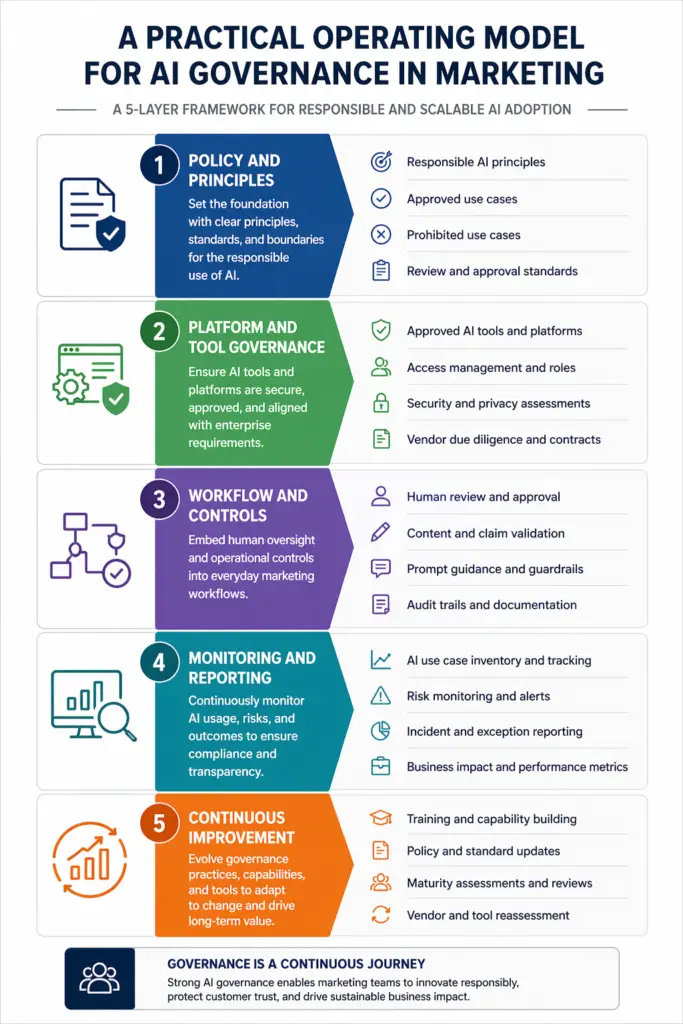
Layer 2 : Platform and tool governance
The second layer covers approved AI tools, vendor review, role-based access, security controls, data processing terms, and an inventory of AI features inside the martech stack.
AI governance in marketing should cover both standalone AI tolls and AI capabilities embedded in CMS, CRM, CDP, analytics, journey orchestration, media, and creative platforms.
Layer 3: Workflow and controls
The third layer embeds governance into campaign planning, content creation, personalization design, data access, chatbot management, and publishing.
Practical controls include intake forms, risk scoring, approval routing, prompt templates, claim libraries, content review checklists, source verification, audit logs, and exception management.
Layer 4: Monitoring and reporting
The forth layer gives management visibility. Leaders should track approved AI use cases, high-risk use cases, AI-generated content volume, review rejection rat4es, content corrections, compliance exceptions, customer complaints, vendor risks, productivity benefits, and business impact.
This reporting helps leaders see whether AI governance in marketing is working.
Layer 5: Continuous improvement
AI technology, regulation, and customer expectations will continue to evolve. Governance must evolve as well.
Policies should be reviewed regularly. Incidents should be analyzed. Approved tool lists should be updated. Training should be refreshed. Model performance should be monitored. New use cases should be assessed as they emerge.
How to Implement AI Governance in Marketing: A 90-Day Roadmap
Days 1 – 30 : Discover current AI usage
The first step in AI governance in marketing is visibility. Marketing leaders should inventory current AI usage across content, SEO, paid media, analytics, social media, CRM, customer journeys, personalization, research, chatbot operations, and agency workflows.
The goal is not to punish teams for using AI. The goal is to understand what is already happening. Which tools are being used? What data is being entered? Which outputs are customer-facing? Which vendors are involved?
Days 31 – 60: Define policy, risk tiers, and ownership
The sseond phase of AI governance in marketing is structure. The organization should define its AI marketing policy, classify use cases by risk tier, identify approved tools, define prohibited activities, create data usage rules, document review path, and assign decision rights.
This is also the right time to define training needs. IBM’s Global AI Adoption Index found that limited AI skills and expertise was the most cited barrier among enterprise exploring or deploying AI. AI governance in marketing works best when teams understand both the opportunity and the boundaries.
Days 61 – 90: Operationalize governance into workflows
The third plase of AI governance in marketing is execution. Governance should be embedded into campaign intake, content approval, CMS workflows, data access requests, vendor onboarding, personalization design, chatbot updates, and reporting routines.
Teams should receive simple templates: AI use-case intake forms, content risk checklists, data usage guidance, prompt guidance, source verification rules, and escalation paths.
Beyond 90 days: Move from control to maturity
After the 90p days, the focus should shift to maturity. This includes regular AI governance reviews, model monitoring for high-risk use cases, incident response playbooks, AI literacy programs, vendor reassessments, audit readiness, and integration with enterprise risk reporting.
At this stage, AI governance in marketing becomes part of the normal management rhythm.
Common Mistakes Senior Leaders Should Avoid
Treating AI governance as an IT-only topic
IT is essential, but AI governance cannot be delegated entirely to technology teams. Marketing AI affects brand, content, customer experience, legal exposure, data usage, and business outcomes.
Creating policies that are too generic
A broad enterprise AI policy may not be enough for marketing teams. Marketers need guidance for campaign copy, landing pages, personalization, social media, SEO content, customer segmentation, AI-generated visuals, and chatbot responses.
AI governance in marketing must be specific enough to guide real decisons.
Over-governing low-risk use cases
If every AI activity requires committee review, teams will either stop using AI or move around the process. Low-risk use cases need simple guardrails. High-risk use cases need stronger controls.
Ignoring embedded AI in martech platforms
Leaders should not only ask which AI tools teams are using. They should also ask which existing vendors have activated AI features inside the stack.
Measuring productivity but not risk
It is easy to measure faster content production or lower operating cost. But leaders should also measure content corrections, compliance exceptions, customer complaints, vendor issues, and AI incidents.
What Good AI Governance Looks Like
Teams know what is allowed
In a mature organization, marketing teams know which tools are approved, which data can be used, which use cases require review, and which activities are prohibited. This reduces shadow AI and improves confidence.
Content flows through controlled publishing processes
AI-generated content does not bypass editorial, brand, legal, or compliance standards. It flows through the CMS and follows the right approval controls.
High-risk use cases receive cross-functional review
Personalization models, AI assistants, customer decisioning, regulated claims, and sensitive customer journeys are reviewd by the right functions before deployment.
Leadership has visibility
Senior leaders receive regular reporting on AI adoption, AI risks, business outcomes, incidents, and maturity progress. This helps governance move from policy to performance management.
Governance enables innovation
The strongest sign of governance maturity is not that the organization uses less AI. It is that the organization can use more AI safely.
When governance is clear, teams can innovate with confidence. They do not need to guess what is acceptable. They can focus on creating value within a trusted framework.
Conclusion: AI Governance is the Foundation for Trusted Marketing AI
AI will increasingly shape how marketing teams create content, understand customers, personalize journeys, optimize media, and manage digital experiences. The opportunity is significant. But so is the responsibility.
Without governance, AI adoption can become fragmented, risky, and difficult to control. Teams may move quickly, but the enterprise may lose visibility over data usage, content quality, model behavior, vendor exposure, and customer impact.
For senior leaders, AI governance in marketing should be treated as a strategic business capability. It protects trust, supports compliance, improves operational discipline, and enables marketing teams to scale AI with confidence.
The goal is not to slow down AI adoption. The goal is to make AI adoption sustainable.
The next phase of marketing transformation will not be won by organizations that experiment the fastest. It will be won by organizations that can scale AI with trust, control, and strategic discipline.
For more insights on AI governance in marketing and broader future of AI-driven digital strategy, I invite you to read my other articles on AsiaTechbuzz.com. From AI search optimization to structured content and AI-ready marketing infrastructure, these articles aim to help marketers and business leaders navigate AI with greater clarity and control.
Frequently Asked Questions (FAQs)
-
What is AI governance in marketing?
AI governance in marketing refers to the policies, controls, oversight processes, and accountability structures that guide how AI is used across marketing activities. It helps organizations manage risk, protect customer trust, and ensure AI is used responsibly.
-
Why is AI governance in marketing important?
It is important because AI is now being used in content creation, personalization, analytics, and customer enagement. Without proper governance, organizations may face risks related to compliance, data misuse, inaccurate content, and brand reputation.
-
What are the main risks of using AI in marketing?
The main risks include inaccurate or misleading content, misuse of customer data, biased recommendations, lack of transparency, vendor risk, and weak human oversight. These issues can affect compliance, trust, and business performance.
-
Who should own AI governance in marketing?
AI governance in marketing should not sit with marketing alone. It should involve cross-functional oversight from marketing, legal, compliance, risk, IT, data, privacy, and security teams, with clear decision rights and executive sponsorship.
-
How can companies start building AI governacne in marketing?
Companies can start by identifying current AI use cases, defining approved and restricted uses, setting data rules, creating human review processes, assigning ownership, and embedding governance into marketing workflows and platforms.