Table of Contents
Introduction
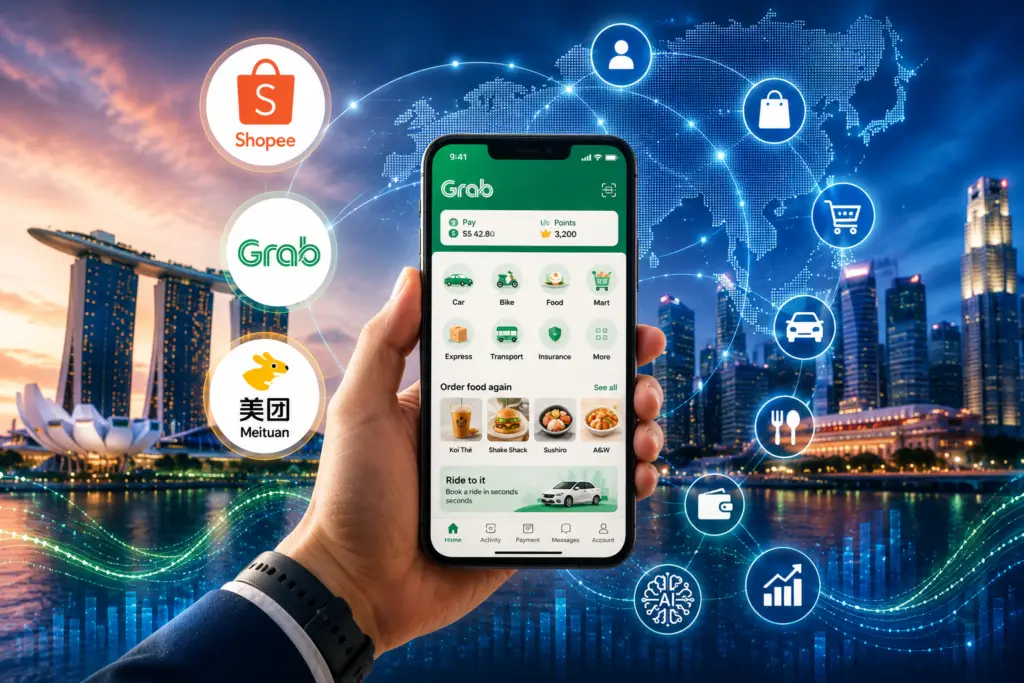
Every time a consumer in Singapore opens Shopee, in Jakarta opens Grab, or in Beijing opens Meituan, they interact with a personalisation system trained on massive behavioural datasets, refined through years of model iteration, and optimised for high frequency decisioning. Then they close that app and open yours.
That is uncomfortable benchmark for hyper-personalisation at scale APAC. The personalisation standard is no longer set by the average bank, insurer, retailer, telco, airline, or QSR brand. It is increasingly shaped by super-apps that sit across commerce, mobility, food delivery, payments, gaming, financial services and lifestyle transactions.
Shopee’s 3Q2025 results show why this matters. SEA reported that AI initiatives around search, recommendations, and discovery improved Shopee’s purchase conversion rate by 10% year-on-year, while ad revenue increased by over 70% year-on-year in the same quarter. At platform scale, a 10% conversion improvement is not a small optimisation win; it is a structural revenue advantage.
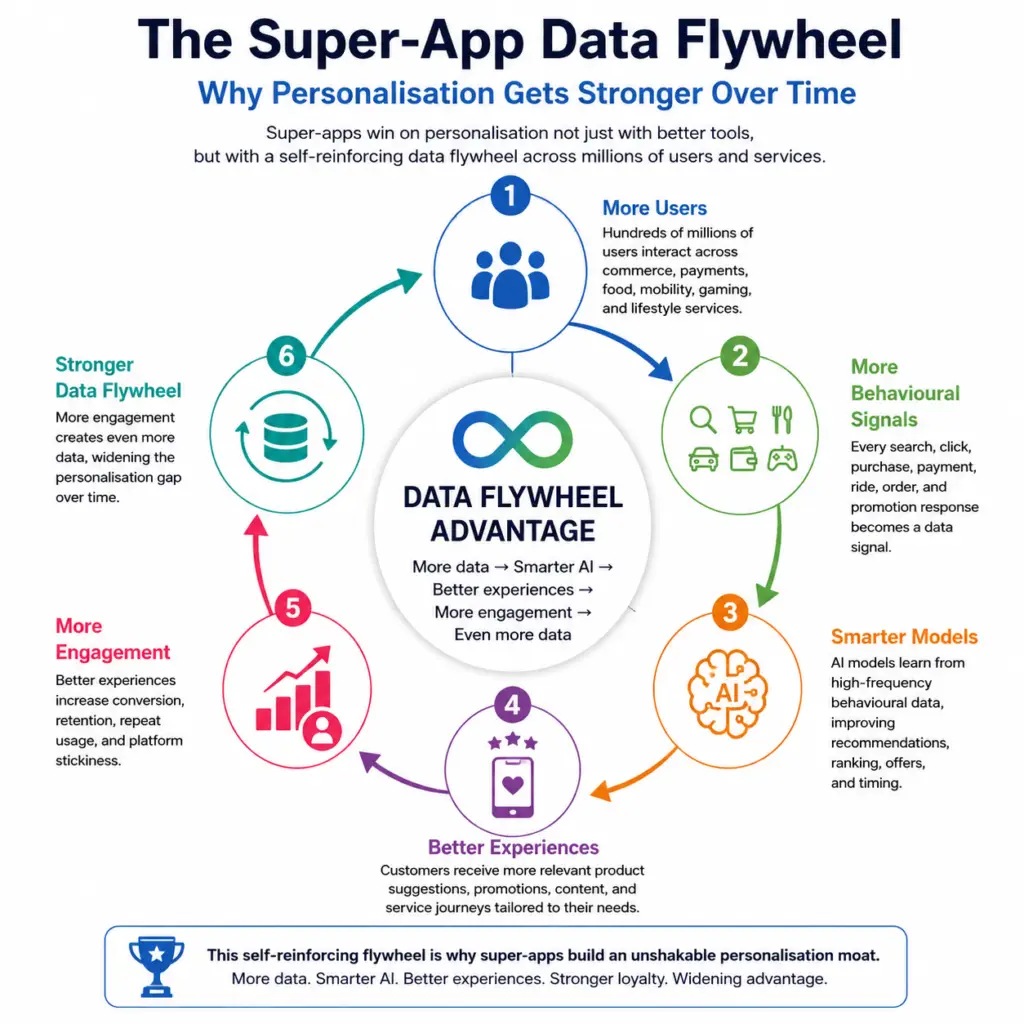
This article argues that the personalisation gap between APAC’s super-apps and conventional B2C brands is not primarily a technology gap. It is a data compounding gap. Super-apps have been operating data flywheels for years: every interaction creates behavioural signals, those signals train better models, better models improve experiences, and better experiences create more interactions.
In the first two articles of this series, we introduced the APAC personalisation Architecture Stack (APAS) and examined NBA decisioning governance. This article shows that APAC personalisation architecture stack looks like when operate at super-app scale, and what B2C brands can realistically learn from it.
1. Understanding the Super-App Personalisation Advantage, Why Scale Changes Everything
Super-apps dominate personalisation because they turn user activity into a self-reinforcing learning system. The advantage is not simply that they have ore users; it is that they capture more types of behavioural signals across more customer contexts.
A data flywheel is a compunding cycle. More users generate more behavioural signals. More signals train more accurate personalisation models. More accurate models create better experiences. Better experiences attract, retain, and re-engage more users. Over time, the cycle becomes harder for smaller operators to match.
This is the core of data flywheel personalisation. A conventional B2C brand may understand what a customer browsed, purchased, returned, or asked customer service about. A super-app may understand where the customer travels, what they eat, how they pay, what gapes they play, when they transact, what promotions they respond to, and which price points trigger action.
Sea Group illustrates the point. Digital in Asia reports that Sea’s AI strategy combines a data flywheel from more than 400 million annual active users across Shopee, Garena, and Monee/SeaMoney, alongside Sailor2 LLM and Sea AI Lab capabilities.
For a CMO, the implication is important: the lession is not “become a super-app”. Most B2C brands cannot replicate the breath of Shopee, Grab, or Meituan’s ecosystem. The lesson is to identify which parts of the flywheel can be built at brand scale.
That starts with first-party data integration. If the website, app, CRM, loyalty programme, store transactions, call centre, and campaign engagement data remain disconnected, the organisation has no realistic foundation for hyper-personalisation at scale APAC. It may have campaigns. It may have segments. It may even have a CDP. But it does not yet have a learning system.
The second compounding factor is time. Super-apps have been refining recommendation models, promotion engines, ranking systems, and customer intent models over many years. Their current advantage is not only based on today’s data volume. It also reflects accumulated A/B tests, model feedback loops, transaction histories, and operational learning.
A brand implementing personalisation in 2026 cannot buy that history. It can only start building its own compounding system. Every quarter of delay is not just a missed campaign opportunity; it is a missed learning cycle.
2. Three Super-App Personalisation Systems in Depth
APAC super-apps personalise differently because their data environments are different. Shopee’s advantage is commerce and cross-vertical behaviour, Grab’s is physical-world context, and Meituan’s is high-frequency local services at China scale.
2.1 Sea Group / Shopee – The Cross-Vertical Data Flywheel
Sea Group’s personalisation advantage comes from the combination of Shopee commerce behaviour, Garena gaming engagement, and SeaMoney financial activity. This creates a richer customer signal environment than any single-vertical e-commerce brand can normally access.
In 3Q 2025, Sea reported total GAAP revenue of US$6.0 billion, up 28.3% year-on-year with e-commerce GAAP revenue of US$4.3 billion. Shopee’s GMV reached US$32.2 billion in quarter, with 3.6 billion gross orders.
The Shopee AI personalisation engine matters because it works at this scale. Sea’s investor deck states that AI initiatives around search, recommendations, and discovery improved purchase conversion by 10% year-on-year in 3Q 2025. The same slide reports that ad revenue increased over 70% year-on-year, while ad take rate rose by more than 80 basis points.
This is the commercial evidence behind hyper-personalisation at scale APAC. Shopee is not simply recommending products more accurately. It is improving buyer engagement, seller monetisation, ad effectiveness, and marketplace economics at the same time.
The cross-vertical logic is also visible in SeaMoney. Digital in Asia reports that SeaMoney’s AI-driven credit scoring analyses Shopee purchasing behaviour, Garena gaming patterns, and payment history to access creditworthiness for customers who may not have traditional credit scores.
For marketers, the strategic lesson is broader than financial services. A customer’s product browsing history is useful. But a customer’s payment behaviour, engagement frequency, promotion sensitivity, content consumption, and service usage patterns are often more predictive when combined.
Sea’s investment in Sailor2 LLM also reveals an important APAC-specific advantage. Digital in Asia reports that Sailor2 is trained on 400 bllion Southeast Asian language tokens across 1Bm 8B, and 20B parameter variants.
That matters because Southeast Asia is not a single-language market. Personalisation systems trained mainly on English-language data often underperform in markets where customers search, browse, and express intent in Bahasa Indonesia, Thai, Vietnamese, Tagalog, Malay, Chinese, English, or mixed-language phases. Regional language optimisation is not a localisation layer; it is a model-performance layer.
Shopee’s advertising use case reinforces the same point. Google’s e-Conomy SEA 2025 report states that Shopee used AI Max for Search in Singapore and Malaysia and delivered 2X more orders, 49% higher ROI, and 23% lower cost per order.
This is where super-app personalisation architecture becomes commercially powerful. Search intent, recommendation ranking, ad targeting, final URL expansion, product discovery, and seller monetisation are no longer separate systems. They become connected decisioning surfaces inside one learning environment.
For B2C brands, the translation is clear: Shopee’s scale cannot be copied, but its architectural principle can. The brand must connect identity, behavioural signals, decisioning, and activation into a system that learns from every interaction.
2.2 Grab – The Physical-World Signal Advantage
Grab’s personalisation advantage is different from Shopee’s because Grab operates across mobility, delivery, financial services, and merchant ecosystems. Its data flywheel is grounded in real-world movement, location, time, payment, and service patterns.
Grab reported its first full-year net profit in FY 2025 and crossed 50 million monthly transacting users. Its Q4 2025 revenue grew 19% year-on-year to US$906 million, and on-demand GMV grew 21% year-on-year to US$6.1 billion.
This scale gives Grab a unique signal environment. A conventional food delivery brand may know what a user ordered. Grab can potentially connect food preferences with commute patterns, time of day, location, payment method, affordability preferences, and merchant availability, That gives the Grab personalisation AI strategy a physical-world dimension.
Digital in Asia reports that Grab serves users across more than 900 cities in eight countries and that more than 90% of Grab mobility rides are dispatched using AI. The same source notes that Grab’s 2028 target include AI efficiency gains across merchant tools, AI-driven promotions, and autonomous vehicle partnerships.
For personalisation, this matters because physical-world services create contextual intent. A user ordering lunch near the office at 12:15 pm is not the same as the same as the same user ordering dinner at home at 8:30 pm. A weekday commute, a weekend grocery trip, and a late-night food order may all belong to the same customer, but they represent different needs, budgets, and decision windows.
This is why super-app personalisation cannot be reduced to “people who bought this also bought that”. Grab’s advantage is not only recommended accuracy. It is contextual orchestration: understanding where the user is, what service they are likely to need, what time horizon matters, and what type of incentive may change behaviour.
The B2C lesson is not to replicate Grab’s mobility data. Most brands cannot. The lesson is to identify the brand’s own equivalent of contextual signals. For a bank, it may be salary cycle, app session intent, loan eligibility, repayment behaviour, and life-stage indicators. For a retailer, it may be store proximity, inventory availability, loyalty tier, cart behaviour, and replenishment timing. For a telco, it may be data usage, device age, roaming behaviour, service complaints, and contract renewal windows.
Grab shows that hyper-personalisation at scale APAC depends on context, not only customer profile data. The most useful customer model is not merely who the customer is. It is what the customer is trying to do now.
2.3 Meituan – The Generative Recommendation Frontier
Meituan represents the technical frontier of large-scale local services recommendation. Its published MTGR framework shows how recommendation systems are moving closer to generative model architectures.
The arXiv paper “MTGR: Industrial-Scale Generative Recommendation Framework in Meituan” decribes Meituan Generative Recommendation as a framework based on HSTU architecture that retains deep learning recommendation model features, including cross features. The paper also states that MTGR uses user-level compression for training and interference acceleration and has been deployed on Meituan’s main traffic.
This is important because the Meituan AI recommendation engine is not simply a larger version of a traditional recommendation model. MTGR reframes recommendation as a generative task while preserving the practical features that industrial ranking systems rely on.
In conventional recommendation systems, the model typically predicts which item a user is likely to click, buy, or engage with. In generative recommendation, the system can model longer behavioural sequences and produce ranked candidates in a way that is closer to next-token prediction in language models.
For marketers, the technical detail matters less than the strategic implication. Meituan is moving from recommendation as a campaign function to recommendation as a platform intelligence layer. The system is not selecting products. It is learning behavioural sequences across local services, food delivery, lifestyle, travel, and merchant interactions.
Meituan’s AI agent direction reinforces this shift. Bloomberg reported in September 2025 that Meituan launched the Xiaomei AI agent, powered by its LongCat model, allowing users to order meals via voice command, book restaurants, and receive food recommendations.
Harvard Business Review has also analysed China’s agentic commerce direction, describing it as a structural shift in how brand value is created and how decisions come into existence.
The end state is not just better product cards or more relevant push notifications. It is a move toward intent-based commerce, where the user expresses a need and the platform executes decisions across search, ranking, recommendation, payment, fulfilment, and service recovery.
For B2C brands, this is a preview of the future. The question is not whether every brand should build a Meituan-style model. Most should not. The question is whether the brand’s personalisation architecture can eventually support agentic journeys. If a customer says, “Help me find the best plan for my needs,” or “Show me the right offer based on my usage,” the brand needs more than content. It needs identity, eligibility, decisioning, product rules, recommendation logic, and activation working together.
That is the real meaning of hyper-personalisation at scale APAC. It is not personalisation as a marketing tactic. It is personalisation as the operating logic of the customer experience.
3. The Five Architectural Decisions That Created Super-App Personalisation Dominance
Super-app personalisation dominance was not built in a campaign planning meeting. It was created through architectural decisions tht made data, models, decisioning, and activation compound over time.
Decision 1 – Cross-Vertical Data Integration from the Start
Super-apps built identity systems that connect signals across service line. Shopee, Garena, and SeaMoney create different behavioural view of the same user. GZrab’s mobnility, food, payments, and merchant services create another cross-service view. Meituan’s local services ecosystem creates yet another.
The B2C equivalent is not cross-vertical ownership. It is cross-touchpoint integration. Bands must connect web, app, loyalty, CRM, e-commerce, customer service, in-store, and campaign engagement into a unified customer profile.
This maps directly to APAS Layer 1. Without a strong identity layer, hyper-personalisation at scale APAC becomes impossible. The decisioning layer can only be as intelligent as the customer profile it can access.
Decision 2 – Investment in Model Infrastructure, Not Only Platform Licencing
Sea Group’s Sailor2, Sea AI Lab, and Shopee AI initiatives show that leading platforms do not depend only on generic vendor settings. Meituan’s MTGR framework shows the same principle in recommendation infrastructure.
For B2C brands, the equivalent is not building a proprietary LLM from scratch. It is investing in proprietary model infrastructure where it matters: propensity model, eligibility models, churn models, purchase timing models, replenishment models, and customer lifetime value models trained on first-party data.
A CDP’s default recommendation engine may be useful, but it rarely reflects the full economics of the brand. A bank, telco, airline, or retailer should not optimise only for clicks. It may need to optimise for margin, risk, service cost, inventory, eligibility, or long-term value.
Decision 3 – Treating Personalisation as Infrastructure, Not a Campaign
Super-apps do not treat personalisation as a monthly marketing calendar activity. Recommendation, ranking, incentives, search, and discovery are embedded into platform infrastructure.
This is also wher NBA decisioning governance becomes critical. If every product team, CRM team, and media team defines its own audience logic independently, the customer experience becomes fragmented. A customer may receive conflicting offers, irrelevant messages, or duplicated nudges across channels.
In the APAC Personalisation Architecture Stack, this sits in Layer 3: real-time decisioning. The organisation must define who owns the decision logic, which rules override which models, how compliance is enforced, and how conflicts between commercial objectives are resolved.
Decision 4 – Compounding Through Feedback Loops
A personalisation system becomes powerful when outcomes flow back into the model. Clicks, purchases, skips, complaints, conversions, redemptions, call-centre escalations, cancellations, and repeat purchases all become learning signals.
This is the difference between campaign reporting and model learning. Campaign reporting tells the marketer what happened. Model learning changes what happens next.
Most B2C brands still retrain models periodically. Super-apps move closer to continuous learnbing because their interaction frequency is high and their data infrastructure is mature. A brand may not need fully continuous retraining on day one, but it should design the system so that feedback loops become faster over time.
This is APAS Layer 4 closure. Without it, data flywheel personalisation never full compounds.
Decision 5 – Regional Langauge and Cultural Optimisation
APAC personalisation is more compex than Western-market personalisation because language, culture, payment behaviour, trus norms, promotion sensitivity, and product discovery patterns vary significantly by market.
Sea’s Sailor2 LM is important because it is designed for Southeast Asian language complexity, not merely translated from English.
For B2C brands, the practical lession is to treat local-language data as a performance asset. Search queries, chatbot conversations, app reviews, customer service transcripts, and product descriptions should be processed in ways that preserve local meaning.
A recommendation model that misunderstands mixed-language search intent will underperform. A chatbot that cannot interpret local phrasing will frustrate users. A segmentation model that ignores cultural buying patterns will produce shallow personalisation.
This is why hyper-personalisation at scale APAC requires regional data strategy, not just global MarTech deployment.
4. What B2C Brands Can and Cannot Replicate
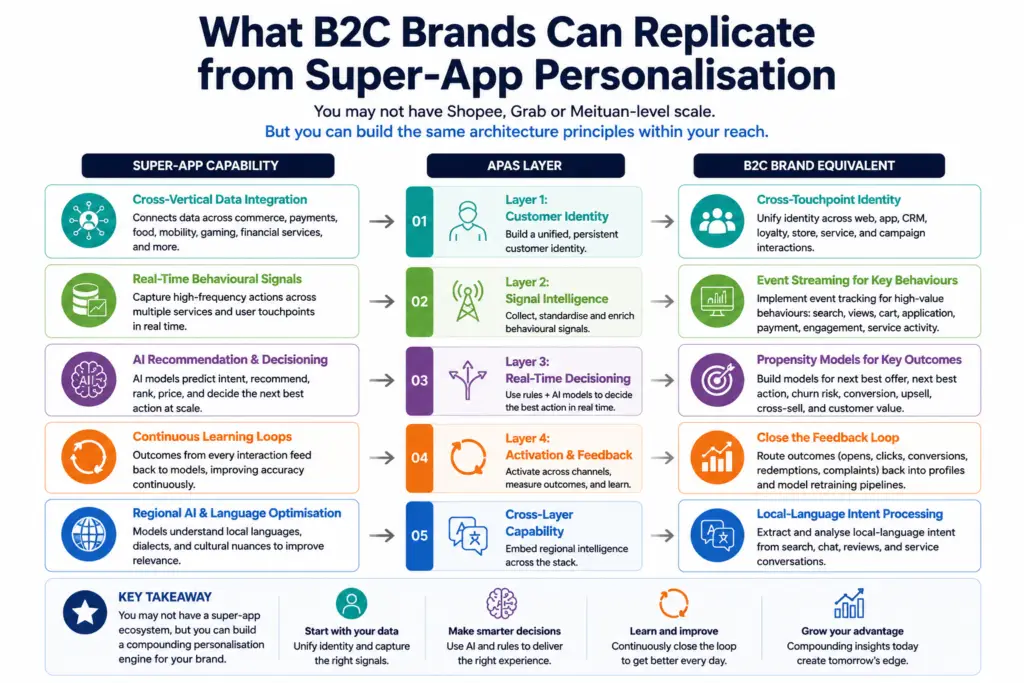
B2C brands can replicate the architectural logic of super-app personalisation, but not the full data scale. The smart strategy is to copy the flywheel components within reach while being honest about structural limits.
What B2C Brands Can Replicate
First, brands can replicate identity unification. Super-apps connect signals across service verticals. B2C brands can connect signals across customer touchpoints. This means web, app, CRM, loyalty, POS, customer service, media engagement, and product usage should feed one customer profile.
Second, brands can replicate event streaming for high-value behaviours. They do not need to stream every possible signal at the begining. They should start with the top five to ten signals most predictive of conversion or retention: search activity, cart events, product views, eligibility checks, service issues, payment behaviour, and offer engagement.
Third, bands can build a propensity model layer above rules-based campaign logic. This is the B2C version of super-app decisioning. Instead of sending the same offer to every eligible customer, the brand predicts who is most likely to respond, who should not be disturbed, who needs education, and who is likely to convert without incentive.
Fourth, brands can close feedback loops. Outcome signals must flow back into the customer profile and model retraining pipeline. This is where personalisation ROI measurement becomes essential. Marketing-Interactive reported that only 14%of APAC brands consistently link activity to business outcome such as retention of lifetime value, which shows why many organisations struggle to prove personalisation value.
Fith, brands can optimise for local-language intent. This does not require building a Sailor2-scale model. It requires extracting search queries, chatbot logs, reviews, and customer service language, then using NLP tools to classify intent more accurately by market.
These are practical B2C personalisation lessons super-app operators make visible. The goal is not super-app parity. The goal is a brand-level flywheel.
What B2C Brands Cannot Replicate
Brands cannot replicate cross-vertical data richness unless they operate an ecosystem. A skincare brand cannot know where a customer rides, what lunch they order, and how they pay across merchants. A bank cannot see every commerce and lifestyle preference unless customers interact through it owned channels.
The response is not despair. It is signal maximisation. Many B2C brands already have underused data in loyalty programmes, call centres, stores, service requests, product usage, app sessions, and repayment or renewal behaviour. The first opportunity is not to acquire new data. It is to activate the data already available.
Brands also cannot replicate the mdoel training volume of Shopee, Grab, or Meituan. Meituan’s MTGR was designed for industrial-scale recommendation and deployed on main traffic at one of the world’s largest food delivery platform.
The response is transfer learning and fine-tuning. B2C brands should start from proven models and adapt them to their own first-party data rather than attempting to train everything from zero.
Finally, brands cannot buy years of compounding model refinement. This is the most important limitation. No platform vendor can instantly provide five years of brand-sepcific learning history.
The response is to start now. The longer a brand waits, the wider the compounding gap becomes. Hyper-personalisation at scale APAC is not one-year transformation. It is a multi-year capability build.
5. The B2C Personalisation Maturity Ladder – Where to Start
B2C brands should not begin by trying to imitate the mst advanced super-app use cases. They should build the flywheel in the right sequence:signals first, decisioning second, feedback loops third, and model compounding fourth.
Stage 1 – Signal Foundation
The first stag is to unify identityh across first-party touchpoints and implement event tracking for the behavioural signals that matter most. This maps to APAS Layers 1 and 2.
For most brands, this means resolving known and anonymous users across web, app, CRM, loyalty, and service channels. It also means defining which events are commercially meaningful. Not every click deserves equal treatment. Search intent, cart creation, loan calculator usage, quote generation, payment failure, product comparison, and service complaints may be more predictive than generic page views.
Stage 2 – Decisioning Deployment
The second stage is to deploy rules-based and propensity-based decisioning for one or two high-value journeys. Examples include cart recovery, onboarding completion, renewal, loan application continuation, loyalty tier engagement, subscription upgrade, or churn prevention.
This maps to APAS Layer 3. The objective is not to personalise everything. The objective is to prove that better decisioning creates measurable business impact.
McKinsey has reported that companies with faster growth derive 40% more of their revenue from personalisation than slower-growing companies, reinforcing why personalisation should be connected to growth metrics rather than treated as UX enhancement only.
Stage 3 – Feedback Loop Closure
The third stage is to route activation outcomes backs into the customer profile and model pipeline. This is the point where the personalisation system starts becoming a learning system.
If a customer ignores an offer, that is a signal. If they convert without incentive, that is a signal. If they complain after receiving a message, that is a signal. If they abandon after seeing a complex product page, that is a signal.
Brands often lose these signals because campaign platforms, analytics tools, CRM systems, and data warehouses do not close the loop. APAS Layer 4 is designed to solve this.
Stage 4 – Model Compounding
The fourth stage is to expand decisioning across major customer journeys and invest in custom model training on the brand’s own first-party data.
This is where the flywheel begins to compound. The brand moves from “send better campaigns” to “make better customer decisions”. It starts to personalise product recommendations, next best actions, content, incentives, timing, channel, frequency, and service pathways.
At this point, super-app personalisation architecture becomes less intimidating. The brand may never match Shopee, Grab, or Meituan’s data scale, but it can build a smaller, focused, commercially useful flywheel.
That is the realistic path to hyper-personalisation at scale APAC.
6. Strategic Implications for CMOs and Digital Leaders
The most important implication for senior marketers is that personalisation must move from campaign execution to business architecture. Super-apps did not dominate by sending better emails or richer push notifications. They dominated by embedding intelligence into discovery, search, ranking, pricing, incentives, fulfilment, and service.
For CMOs, this changes the investment conversation.
The quesion is no longer, “Which personalisation tool should we buy”? The better question is, “Which customer decisions should our organisation learn to make better every day”?
That framing shifts the discussion from MarTech features to enterprise capability. It forces the organisation to define the data it needs, the models it trusts, the governance it requires, the latency it can support, and the outcomes it will measure.
It also changes the role of marketing. In many B2C organisation, marketing own campaigns but not product data, service data, app behaviour, eligibility rules, or custoer identity. That operating model cannot deliver hyper-personalisation at scale APAC.
The CMO does not need to own every system. But the CMO must influence the customer decisioning architecture. Without that influence, personalisation will remain trapped inside campaign tools while the most valuable ccustomer moments happen elsewhere.
This is where the APAC Personalisation Architecture Stack becomes useful. APAS gives business and technology teams a shared language:
- Layer 1: Defines Customer Identity
- Layer 2: Captures Signals
- Layer 3: Makes Decisions
- Layer 4: Activates, Measures, and Learns
Super-apps have built all four layers deeply. B2C brands should build them deliberately, starting with the journeys where better decisioning creates clear revenue, retention, or cost-to-serve impact.
Conclusion: The Super-App Gap is Real, But It Is Not Hopeless
APAC consumers are calibrated by the super-apps they use every day. They expect relevance, speed, contextual timing, and low-friction journeys because Shopee, Grab, Meituan, and similar platforms have made those experiences normal.
That calibration does not dissappear when the same customer opens a bank app, airline website, telco portal, retail app, or insurance journey.
The personalisation gap is real. But it is not closed by buying a personalisation platform. It is closed by building a data flywheel component by component: cross-touchpoint identity, first-party signal capture, model-based decisioning, continuous feedback loops, and regional language optimisation.
The central lesson from APAC super-apps is not that every B2C brand must become a super-app. It is that hyper-personalisation at scale APAC is bulit through compounding architecture, not campaign ambition.
The next article in this series examines Dynamic Creative Optimisation in Southeast Asia – the Layer 4 execution mechanism that makes decisioning visible to the customer. Because even the most sophisticated NBA engine creates zero value if the creative it serves is generic.
The future of personalisation in APAC will not be won by brands that simply buy more tools. It will be won by organisations that build smarter data foundations, faster decisioning systems, and more adaptive customer experiences.
For more insights on AI, MarTech, personalisation, and digital transformation across Asia, visit AsiaTechBuzz.com and explore the latest articles dsigned for marketing and digital leaders.
Frequently Asked Questions (FAQs)
-
How do APAC super-apps like Shopee and Grab personalise at scale?
APAC super-apps personalise at scale by connecting high-frequency behavioural data across services such as e-commerce, payments, mobility, food delivery, and financial services. This gives them richer customer signals than single-vertical brands, allowing their recommendation, promotion, and decisioning systems to learn continuously.
-
What is a data flywheel and how does it create a personalisation advantage?
A data flywheel is a self-reinforcing cycle where more users create more behavioural signals, better signals improve models, better models improve experiences, and better experiences create more engagement. Over time, this cycle compounds, making personalisation performance increasingly difficult for slower-moving competitors to match.
-
What is the difference between super-app personalisation and conventional B2C brand personalisation?
Super-app personalisation is usually embedded into platform infrastructure across search, ranking, incentives, payments, fulfilment, and service. Conventional B2C personalisation is often campaign-led and channel-specific. The gap is not only technology; it is the depth of data integration and feedback-loop maturity.
-
What is Meituan’s MTGR recommendation framework?
MTGR, or Meituan Generative Recommendation, is an industrial-scale recommendation framework that applies generative modelling techniques while retaining deep learning recommendation model features. It is designed to improve recommendation performance at massive scale and has been deployed on Meituan’s main traffic.
-
What can a B2C brand learn from Shopee’s AI personalisation architecture?
A B2C brand can learn that personalisation performance depends on connected signals, model learning, and activation loops. Shopee’s AI initiatives improved purchase conversion by 10% year-on-year in 3Q 2025, showing that search, recommendation, and discovery should be treated as connected growth infrastructure.
-
Why is cross-vertical data the key structural advantage of super-app personalisation?
Cross-vertical data gives super-apps a broader understanding of customer intent. A platform that sees shopping, payments, mobility, food, gaming, and financial behaviour can build richer customer models than a single-category brand. B2C brands cannot fully replicate this, but they can unify all available first-party touchpoints.