
Table of Contents
Introduction
AS search is changing how customers discover, compare and trust brands. For many years, marketers have optimised websites around search rankings, organic traffic, keywords, backlinks, conversion journeys and landing page performance. These fundamentals still matter. However, the search environment is no longer only about ranking on a search engine results page.
Customers are increasingly using AI-powered tools to ask quetions, compare options, summarise choices and validate decisions. Google AI Overviews, ChatGPT, Gemini, Copilot, Perplexity and other answer engines are changing how information is surfaced. In this new environment, the marketing question is no longer only, “Does our page rank?”. It is also, “Does AI understand our brand correctly?”.
That is why CMS for AI Search is becoming a strategic priority for marketing teams. A content management system is no longer just a place to publish articles, landing pages, campaign pages adn product content. It is becoming the control layer for brand truth, structured content, content governance and AI visibility.
Gartner predicted that traditional search engine volume would drop by 25% by 2026 as AI chatbots and virtual agents become alternative answer engines. This does not mean traditional SEO dissappears. It means the way people search, compare and make decisions is expanding across more answer-driven environments. For marketers, tht creates both risk and opportunity.
The risk is clear. If your owned content is unclear, outdated, inconsistent or difficult for AI systems to interpret, your brand may be represented by third-party sources, old campaign pages, review sites, comparision pages, forums or competitors. The opportunity is equally important. With the right CMS strategy, marketers can make brand information more structured, accurate, current and discoverable.
This is the new role of CMS for AI Search: helping brands become easier for AI systems to understand, trust, summarise and cite.
What CMS for AI Search Really Means
A Simple Definition for Marketers
CMS for AI Search is the practice of using your content management system to structure, govern, refresh and distribute brand content so that AI-powered search systems can understand and represent your brand accurately.
It is not only about SEO settings. It is not only about schema markup. It is not only about publishing more content. It is about creating a reliable content foundation that supports both human experience and machine understanding.
A traditional CMS helps teams publish pages. An AI-ready CMS helps teams manage content as structured, reusuable and governed knowledge assets. This distinction matters because AI search does not simply display a list of links. It interprets information, summarises answers and may blend multiple sources into one response.
For marketing professionals, this means the CMS must support a broader set of responsibilities. It must help the brand explain who it is, what it offers, why customers should trust it, how its products work and which information is current. It must also make those answers easy for search engines, AI crawlers and answer engines to access.
In simple terms, CMS for AI Search is about making your brand’s owned content the strongest source of truth available to both people and machines.
How It Differes from Traditional SEO
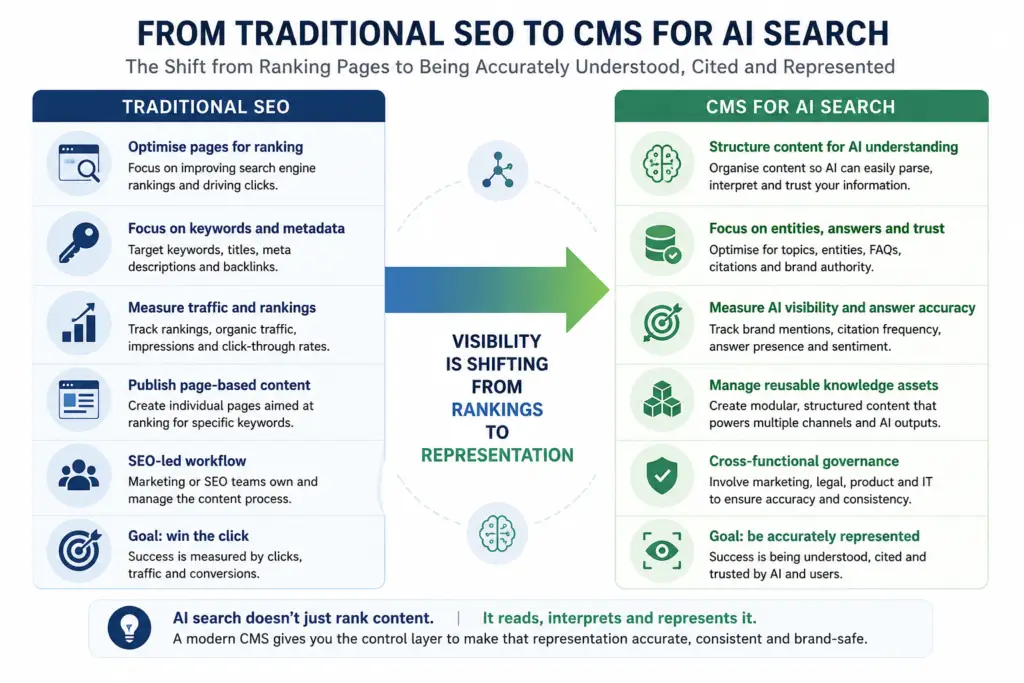
Traditional SEO forcuses heavily on ranking pages in search engine results. It relies on keyword targeting, technical SEO, metadata, internal links, banklinks, content quality and user experience. These remain important, but AI search adds another layer.
AI search is more answer-led. It often compresses the journey by giving users a summary, recommendation, explanation, or comparision before they click through to a website. This changes the role of content.
In traditional SEO, the goal is often to win the click. In AI search, the goal is also to be included in the answer, represented correctly and recoginised as a trusted source.
That is where CMS for AI Search becomes important. The CMS must help marketers create content that is not only optimised for ranking, but also structure for interpretation.
A traditional SEO page may ask:
“Is the target keyword in the title, heading and body copy?”
A CMS for AI Search approach asks:
“Can AI undertand the topic, entity, product, audience, proof points, source references, author, freshness and relationship to other content?”
This is more sophisticated content challenge. It requires better structure, stronger governance and clearer brand narratives.
Why It Is Not About Gaming AI Search
It is important to be clear. CMS for AI Search is not about tricking AI systems. It is not about stuffing keywords into pages or creating shallow AI-generated content at scale.
In fact, the opposite is true.
AI Search Optimisation should help reduce ambiguity. It should make accurate information easier to identify. It should help customers and AI systems find the clearest version of your brand story, product details, proof points and customer guidance.
This matters because AI search can amplify both clarity and confusion. If your content is well structured and governed, AI systems have a better chance of interpreting your brand correctly. If your content estate is fragmented, outdated or inconsistent, AI systems may surface the wrong version of the story.
The goal is not manipulation. The goal is accuracy, trust and discoverability.
The New Brand Visibility Challenge in AI Search
AI Search Compresses the Customer Journey
The customer journey used to be easier to map. A person searched on Google, clicked a link, visit a website, compared a few pages and perhaps converted later through remarketing, email or sales follow-up.
That journey is now becoming less linear.
A customer can ask an AI tool to explain a product category, compare brands, summarise pros and cons, shortlist vendors, recommend options or simplify a complex topic. They may form a first impression of your brand before visiting your website.
Forrester reported that 26% of US online adults use ChatGPT in the past month to search for products they were interested in buyi8ng in February 2026, up from 18% in October 2025. Google and Amazon still led product discovery, but Forrester noted that the answer engines were beginning to take a larger role in product research and discovery behaviour.
This is why marketers need to think beyond ranking and traffic. AI-powered discovery may influence brand perception before the click happends.
For B2B, the shift is also significant. Forrester reported that 94% of business buyers use AI in their buying process. It also noted that generative AI and conversational search are becoming meaningful sources of information for buyers.
This matters because many high-value decisions begin with research, comparison and synthesis. If AI systems cannot clearly understand your brand, product value, differentiation and proof points, your visibility may weaken before your sales or marketing funnel even begins.
Brand Visibility is Becoming Answer-Level Visibility
In traditional SEO, visibility often means ranking, impressions, clicks and organic sessions. In the AI search era, visibility also means answer presence.
Does your brand appear in AI-generated responses? Is your brand included in comparison answers? Are your product descriptions accurate? Are your claims represented fairly? Are your sources cited? Are old messages being surfaced? Are competitors being recommended instead?
This is the emerging challenge of brand visibility in AI search.
Marketing teams need to monitor not only how their pages rank, but also how their brand is represented inside AI-generated answers. A brand may still have strong organic rankings while being poorly represented in AI summaries. Conversely, a brand with strong structured content and topical authority may gain visibility in answer environments even when the click-through journey changes.
This is why CMS in AI Search should be part of the modern marketing operating model. It helps marketers prepare content for a world where visibility is no longer measured only by website traffic.
The Risk of AI Learning About Your Brand from Someone Else
Every brand has an official story. But AI systems do not only learn from official brand pages. They may also draw from third-party sites, partner pages, reviews, comparison articles, old campaign pages, forums, analyst content, customer support pages and media coverage.
That creates a risk for marketers.
If your website does not clearly explain your product, AI may use someone else’ explanation. If your FAQs are outdated, AI may surface old customer guidance. If your product pages lack depth, AI may rely on aggregators. If your content has conflicting terms, AI may summarise your brand inaccurately.
This is especially risky for industries where trust matters: financial services, insurance, healthcare, education, technology and B2B services. In these sectors, a wrong explanation can affect customer confidence, compliance, conversion and brand reputation.
A strong CMS for AI Search strategy helps reduce this risk by making owned content clearer, more authoritative and easier to interpret.
Why Inconsistent Content Weakens Brand Trust
Most content problems are not caused by one bad page. They are caused by accumulated inconsistency across the content estate.
One product page says one thing. A campaign page says another. A blog article mentions an outdated feature. A FAQ uses a different product name. A partner page describe an old offer. A support page contains a legacy process. A PDF still ranks in search with outdated information.
For a human reader, this is confusing. For an AI system, it can be even more problematic because the system may blend conflicting information into one answer.
That is why content governance is central to CMS for AI Search. The CMS should help marketing teams manage content ownership, review cycles, approval workflows, version history, expiry dates and reusable content modules.
Without governance, content scale becomes content risk.
Why CMS is the Control Layer for Brand Truth
Owned Content Must Become the Source of Truth
In the AI search era, your brand website should not be treated as only a digital brochure. It should become the most reliable source of truth about your brand.
This requires a mindset shift. The website is not just a destination for customers who already clicked. It is a knowledge base that search engines, AI systems, partners, journalists, prospects and customers may use to understand your brand.
That is the core reason CMS for AI Search matters.
If your owned content is complete, structured and current, it gives AI systems stronger signals. If your owned content is thin or fragmented, the brand narrative may be shaped elsewhere.
For marketers, this means the CMS becomes more than a publishing workflow. It becomes the place where brand truth is managed.
CMS Helps Centralise Approved Brand Information
A modern CMS should help centralise and manage approved content assets such as brand descriptions, product explanations, service details, customer promises, frequently asked questions, proof points, disclaimers, author profiles and thought leadership content.
This is particularly important for larger organisations where multiple teams create content. Product teams create product details. Marketing teams create campaigns. Legal teams approve disclaimers. Customer service teams manage FAQs. Sales team create pitch materials. Agencies produce articles and landing pages.
Without a CMS-led operating model, each team may create its own version of the truth.
With CMS for AI Search, the organisation can define reusable content modules that maintain consistency. For example, a product explanation can be created once, reviewed by the right stakeholders and reused across landing pages, FAQs, comparison pages, app content, email journeys and campaign pages.
This does not remove creativity. It removes unncessary inconsistency.
CMS Reduces Conflicting Messages
Re usable CMS components are one of the most practical ways to improve AI visibility and brand consistency.
Instead of rewriting the same explanation across 20 pages, marketers can maintain approved content modules. These modules may include product definitions, benefit statements, eligibility descriptions, disclaimers, statistics, summaries, FAQs and calls to action.
When information changes, the content team updates the approved module once. That change can then flow across multiple pages or templates, depending on how the CMS is implemented.
This is powerful because AI search systems need clarity and consistency. If your brand uses consistent language across high-value pages, AI syst ems have stronger signals to interpret your meaning.
A strong CMS for AI Search approach therefore supports both customer experience and machine understanding.
CMS Creates Accountability for Content Ownership
One of the most overlooked elements of AI Search Optimisation is accountability.
Who ownes the homepage narrative? Who owns product page accuracy? Who owns FAQ updates? Who reviews compliance content? Who decides when old campaign pages should be redirected? Who checks how the brand appears in AI-generated answers?
Without clear ownership, content decays over time.
An AI-ready CMS should help assign owners, reviewers and approval stages. It should also support review dates and content expiry controls. This is not only operational hygiene. It is part of brand protection.
For senior marketing leaders, CMS investment should therefore be seen as both a growth enabler and a risk management capability.
How CMS for AI Search Creates a Brand Visibility Advantage
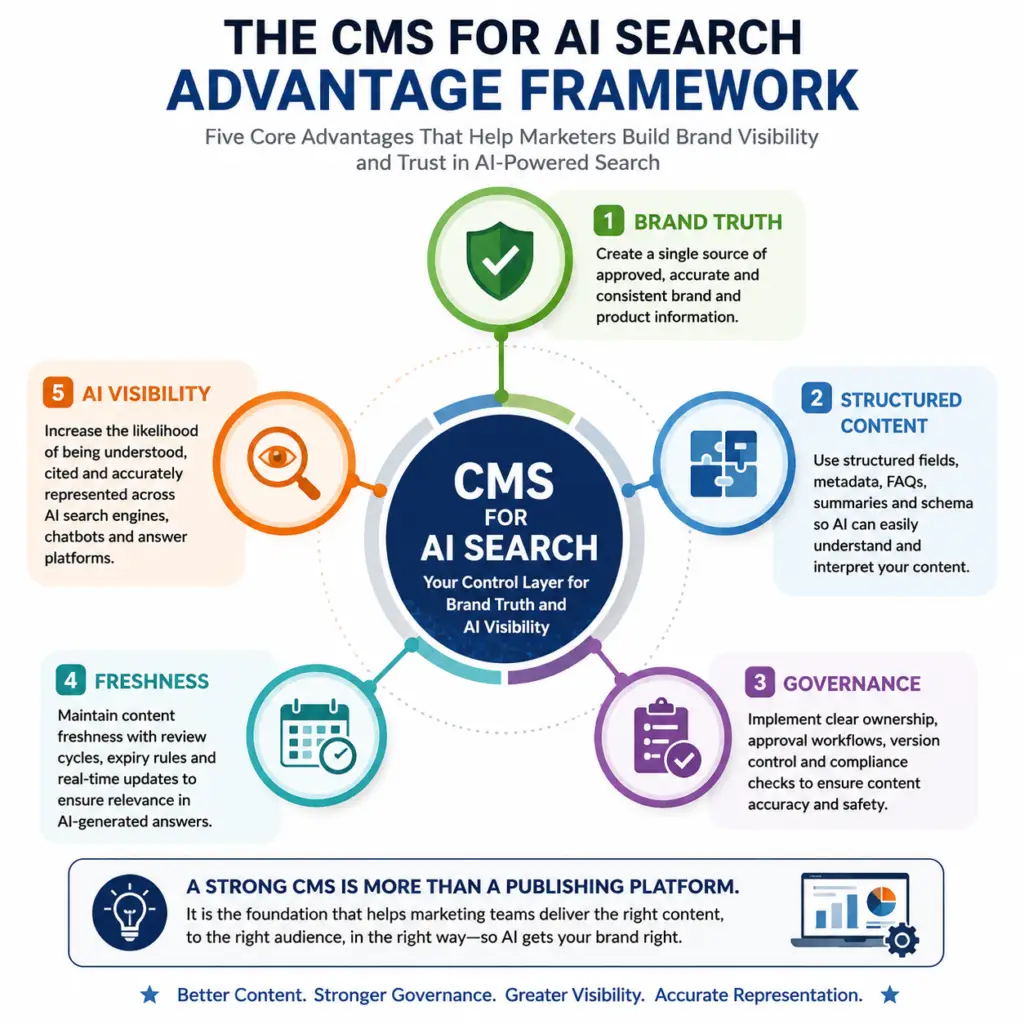
Advantage 1: Clearer Brand Understanding
AI systems need clear signals to understand a brand. They need to know what the company does, who it serves, which products it offers, which markets it operates in, what topics it has authority in and why it should be trusted.
A basic CMS may publish this information as long-form pages. A more advanced approach structures the information into fields, components and relationships.
For example, a CMS can help define brand description, product category, customer segment, market, author, reviewer, related topics, key benefits, source references, last reviewed date, FAQ questions and compliance notes.
These structured signals make the content easier to interpret. They also help marketers maintain consistency across the site.
This is one of the most important advantages of CMS for AI Search. It turns brand content into an organised knowledge layer.
Advantage 2: Stronger Content Consistency
Consistency is not about makeing every page sounds the same. It is about making sure the facts, claims and core explanations do not contradict each other.
A customer should not see one version of a product on a landing page, another version in a blog article and another version in a FAQ. AI systems should not have to guess which version is correct.
CMS-led governance helps solve this by using approved templates, shared content blocks and controlled workflows. Marketing teams can still adapt tone and context for different journeys, but the underlying facts remain consistent.
This is especially useful for brands with multiple products, markets, languages, agencies or partner channels. The larger the content estate, the more important the CMS becomes.
In this way, CMS for AI Search is not only a technical SEO topic. It is an operating model for consistent brand communication.
Advantage 3: Better AI Visibility Through Structured Content
Structured content is one of the most important foundations of AI visibility.
When content is structured into clear sections, headings, summaries, FAQs, definitions, tables and metadata, it becomes easier for both humans and machines to understand. This does not mean every article should become robotic. It means the CMS should help editors organise knowledge in a way that supports clarity.
For example, an article can include a short answer, key takeaways, source references, FAQ blocks and related topic tags. A product page can include benefits, eligibility, steps, fees, limitations and responsible disclaimers as separate structured fields.
This supports AI Search Optimisation because answer engines often need concise, extractable and trustworthy information.
A well-designed CMS for AI Search makes this easier at scale. Instead of asking every writer to manually format content perfectly, the CMS can guid the structure through templates and reusable components.
Advantage 4: Faster Content Refresh
AI search increases the importance of content freshness. This does not mean every page must be updated every week. It means important content should have a clear review cycle.
Product details, pricing pages, service information, compliance content, comparison pages, campaign pages and FAQs should not be left untouched for years. Old content can continue to influence search engines and AI systems if it remains discoverable.
A CMS can support content freshness through review reminders, expiry dates, scheduled updates, version control and workflow notifications.
This becomes even more important as content demand grows. Adobe research found that 96% of marketers have seen content demand increase at least 2 times over the last two years, with 62% saying it has increased 5 times or more. Adobe also reported that 71% of marketers expect content demand to grow mre than 5 times by 2027.
This pressure makes manual content operations unsustainable. Marketing teams need a CMS that can help them scale content without losing control.
Advantage 5: Stronger Governance and Trust
Gartner found that 53% of consumers distrust or lack confidence in the reliability and impartiality of AI search and summaries. Gartner also found that 41% of consumers say generative AI overviews make search more frustrating than traditional search methods.
This is an important reminder for marketers. AI search may be growing, but trust is not automatic.
Brands need to strengthen the quality and reliability of their owned content. They also need to make sure that AI systems can access accurate, well-researched and current information.
This is where content governance becomes a competitive advantage. A CMS with approval workflows, audit trails, content ownership, legal review and version history helps protect the brand narrative.
For regulated or trust-sensitive industries, this is not just a marketing efficiency benefit. It is part of responsible digital communication.
What an AI-Ready CMS Should Enable
Structured Content Fields
An AI-ready CMS should help marketers avoid placing all content inside one long body field. Important information should be organised into structured fields that can be reused, governed and interpreted.
Recommended fields may include:
- Executive summary
- Short answer
- Key takeaways
- Primary topic
- Secondary topics
- Product or service category
- Audience segment
- Source references
- Author
- Reviewer
- Last reviewed date
- FAQ module
- Disclaimer module
- Related articles
- Internal linking recommendations
These fields help editors create stronger conent. They also help AI systems understand context.
For example, a last reviewed date tells readers and systems that the content has been checked recently. A reviewer field can show that a subject matter expert or compliance stakeholder has validated the page. FAQ modules provide direct answers to natural-language questions.
This is how CMS for AI Search turns content from static pages into structured knowledge assets.
Topic and Entity Taxonomy
Taxonomy is one of the most underapprciated CMS capabilities.
A taxonomy helps organise content by topic, product, audience, market, funnel stage, customer need and industry. It tells the CMS how different content assets relate to one another.
For an article cluster around CMS and AI search, taxonomy might include CMS strategy, AI search, AI visibility, content governance, structured content, MarTech architecture, financial services marketing, customer experience and brand trust.
This helps marketers build topical auhtority. It also supports internal linking, content recommendations and content hub development.
A strong taxonomy makes it easier for AI systems to understaand what your site is about and where your authority lies.
Schema and Metadata Management
Metadata and schema are not new SEO concepts. However, they become more important when brands want to support AI Search Optimisation at scale.
Marketers should be able to manage page titles, descriptions, canonical tags, Open Graph fields, author information, breadcrumbs and structured data without relying on developers for every update.
Useful schema types may include Article, BlogPosting, Organisation, Person, FAQPage, BreadcrumbList and WebPage.
The point is not to add schema blindly. The point is to give search engines and AI systems clearer clues about content meaning.
A strong CMS for AI Search setup should make schema and metadata part of the publishing workflow, not a spearate technical afterthought.
Review Workflows and Approval Rules
Many marketing teams struggle because content moves through informal approval processes. A document is emailed to one person, reviewed by another, copied into a CMS, edited again, approved in a chat thread and then published.
This may work for small teams, but it breaks down at scale.
An AI-ready CMS should support clear workflows for drafting, editing, legal review, compliance approval, SEO review, publishing and post-publication updates.
This matters because AI search increases the cost of inaccurate content. A misleading or outdated page may not only confuse a human reader. It may also become part of an AI-generated answer.
Content Expiry and Refresh Controls
Every high-value content asset should have a lifecycle.
Some content is evergreen. Some content is seasonal. Some content is campaign-specific. Some content becomes risky if it remains live after the offer, regulation or product feature changes.
A CMS should support expiry dates, review dates, archive rules and redirect workflows.
High-priority content for review includes product pages, pricing pages, FAQ pages, comparison pages, campaign landing pages, regulatory pages, compliance pages, high-traffic SEO articles, partner content and customer support content.
This is a practical but powerful part of CMS for AI Search. It helps prevent old information from weakening brand visibility in AI search.
Omnichannel Content Distribution
Modern content no longer lives only on the website.
The sampe approved content may need to appear across mobile apps, email journeys, CRM campaigns, chatbots, AI assistants, sales enablement tools, partner platforms and customer service knowledge bases.
If every channel recreates content separately, inconsistency grows. If the CMS acts as a central content layer, consistency improves.
This is where CMS strategy connects to MarTech architecture. The CMS should be isolated from the rest of the marketing ecosystem. It should integrate with analytics, personalisation tools, CRM, campaign platforms and customer experience channels.
For marketers, CMS for AI Search should therfore be seen as part of a wider AI-ready marketing infrastructure.
What Marketers Should Publish for Better AI Visibility
Authoritative Brand Explainers
Every brand should have clear, authoritative content that answer basic but important questions.
What does the company do? Who does it serve? What problem does it solve? How does its product or service work? Why should customers trust it? What makes it different? What should customers know before buying?
These questions may sound simple, but many websites do not answer them clearly. They use campaign language, abstract positioning or product jargon. AI systems may struggle to extract a clear explanation.
A strong brand explainer should be concise, structured and evidence-based. It should use the language customers actually use, while maintaining brand authority.
This is one of the easiest places to start with CMS for AI Search.
Product and Service Knowledge Hubs
A product landing pager is often designed for conversion. That is important, but AI search also needs depth.
Brands should consider building product or service knowledge hubs that explain how the product works, who it is for, what benefits it provides, what limitations customers should understand and how it compares with alternatives.
A good knowledge hub may include product overview, eligibility, suitability, key benefits, how it works, common questions, use cases, comparison guidance, responsible disclaimers, related articles and customer support links.
This helps both customers and AI systems understand the product more completely.
For marketers, knowledge hubs also support internal linking, topical authority and better content reuse.
Decision-Support and Comparison Content
AI search often responds to comparison-style questions. Customers may ask which option is better, what the difference is between two products, or what they should consider before choosing.
Brands should not avoid comparison content. Instead, they should create balanced, helpful decision-support content.
This does not mean attacking competitors. It means explaining selection criteria, trade-offs, use cases and fit.
For example:
- What should customers consider before choosing a loan product?
- What is the difference between two repayment options?
- How should businesses evaluate a CMS?
- What makes an AI-ready CMS different from a traditional CMS?
This type of content is useful because it helps AI systems understand your point of view and expertise.
FAQ and Troubleshooting Content
FAQs are highly valuable for AI Search Optimisation because they match natural-language questions.
Howqever, many organisations manage FAQs poorly. They are scattered across PDFs, call centre scripts, campaign pages, product pages and internal documents. Different teams write different answers to the same question.
This creates inconsistency.
A better approach is to manage FAQs as governed CMS modules. Each FAQ should have an owner, review date and approved answer. FAQs should also be connected to relevant product pages and support content.
This makes FAQs more useful for customers and more reliable for AI search.
Evidence-Based Thought Leadership
Thought leadership is not only about opinions. In the AI search era, it should include evidence, examples, frameworks and credible sources.
Senior marketers and management audiences are more likely to trust content that explains why a trend matters, what the business implication is and how teams should respond.
For AsiaTechBuzz, this is particularly important. The site’s audience is not looking for generic SEO tips. They are looking for practical strategic guidance on MarTech, AI-ready marketing, CMS, content operations and digital transformation.
That means this article should not only say that CMS for AI Search matters. It should explain how marketing leaders can operationalise it.
CMS for AI Search in Financial Services and Trust-Sensitive Industries
Why Brand Accuracy Matters More in Financial Services
In financial services, customers need accurate information when evaluating products such as loans, credit cards, insurance, repayments, fees, eligibility and financial support options.
A small content inconsistency can create a big trust issue.
If a product page says one thing and a FAQ says another, customers may become confused. If an AI-generated answer summarises old terms, the brand may face reputation risk. If third-party pages describe outdated offers, customers may make decisions based on incorrect assumptions.
This is why CMS for AI Search is highly relevant for financial services and other regulated industries.
The CMS should help ensure that product information, customer guidance, disclaimers, and approval workflows are consistent and current.
How AI Search Can Create Brand Risk
AI search can create brand risk when content is fragmented.
For example, AI systems may surface outdated product terms, old campaign mechanics, inconsistent fee explanations, unclear eligibility criteria, conflicting repayment information, third-party summaries that are no longer accurate or partner content that does not match the latest brand position.
This does not mean brands should fear AI search. It means they should prepare for it.
The best defence is a strong owned content foundation. If the brand website provides clear, structured and current information, AI systems have a better source to work with.
CMS Governance as a Risk Management Layer
For regulated industries, content governance should be viewed as bureaucracy. It is part of responsible customer communication.
A CMS can help ensure that high-risk pages go through the right review process. It can keep a record of changes. It can show who approved content. It can help teams roll back mistakes. It can remind owners when content needs review.
This makes the CMS a risk management layer as well as a marketing platform.
For senior management, this is an important argument. CMS investment is not only about publishing speed. It is about brand trust, customer clarity, operational control and long-term AI visibility.
Practical CMS for AI Search Checklist
Content Clarity
Are your most important brand and product explanations written clearly enough for both humans and AI systems?
Avoid vague positioning. Use clear explanations. Define terms. Answer real customer questions. Make the brand’s value easy to understand.
Content Structure
Do key pages include summaries, FAQs, headings, schema, metadata, author information and source references?
Strong structure makes content easier to scan, easier to maintain and easier for AI systems to interpret.
Content Consistency
Are product names, descriptions, claims, disclaimers and customer promises consistent across pages and channels?
If not, the CMS should help create reusable modules and approved language.
Content Governance
Is there a clear owner, reviewer and approval process for high-value content?
CMS for AI Search requires accountability. Without ownership, content quality declines over time.
Content Freshness
Are key pages reviewed regularly and updated when products, regulations, campaigns or customer journeys change?
Freshness is not about changing content for the sake of change. It is about ensuring that important information remains accurate.
Content Discoverability
Can search engines and AI crawlers access the right content?
Check indexability, internal links, sitemap inclusion, page speed, canonical tags and technical SEO basics.
AI Visibility Monitoring
Is the marketing team checking how the brand appears in Google AI Overviews, ChatGPT, Gemini, Copilot, Perplexity and other AI-powered environments?
AI visibility should become part of the marketing measurement rhythm.
Common Mistakes That Weaken CMS for AI Search
Mistake 1: Treating CMS as an IT Tool Only
Many organisations still treat CMS as a technology system owned mainly by IT. This limits its strategic value.
The CMS affects marketing speed, SEO, content governance, brand consistency, personalisation, compliance and AI visibility. Marketing leaders should therefore play an active role in CMS strategy.
Mistake 2: Publishing More Content Without Better Structure
More content does not automatically improve AI visibility.
If the content is repetitive, shallow, outdated or poorly structured, it may create more confusion. AI search reqards clarity and authority, not volume alone.
A better approach is to improve the structgure and usefulness of priority content first.
Mistake 3: Leaving Old Pages Live Without Review
Old pages can still influence search and AI systems. Campaign pages, outdated blogs, expired offers and old PDFs may continue to appear in search results.
A CMS should help teams review, update, archive or redirect outdated content.
Mistake 4: Managing FAQs Outside the CMS
FAQs are often some of. themost useful content for AI search, but many organisations manage them outside the CMS.
This creates duplication and inconsistency. FAQs should be structured, governed and reusable.
Mistake 5: Separating SEO, Content, Product, Legal and Technology
CMS for AI Search cannot be owned by one team alone.
SEO teams understand discoverability. Content teams understand messaging. Product teams understand accuracy. Legal and compliance team understand risk. Technology teams understand system capability.
The CMS should bring these teams into a clearer operating model.
How Marketing Teams Should Start
Step 1: Audit the Current Content Estate
Start with the most important pages: homepage, product pages, service pages, pricing pages, FAQ pages, high-traffic blog articles, campaign landing pages, comparison pages and customer support pages.
Check whether the content is accurate, structured, consistent and current.
Step 2: Identify the Questions AI Should Answer About Your Brand
Marketing teams should map the querstions customers, partners, analysts, journalist and decision-makers may ask AI tools.
For example:
- What dies this brand do?
- Is this product suitable for me?
- How does this service work?
- What are the fees or conditions?
- How does this brand compare with alternatives?
- Why should customers trust this company?
These questions should guiide content creation and CMS structure.
Step 3: Strengthen Owned Content First
Before trying to influence AI search externally, strengthen the brand’s owned content foundation.
The website should be the clearest and most complete source of truth. Product pages should be accurate. FAQs should be governed. Thought leadership should be evidence-based. Metadata and schema should be managed properly.
This is the foundation of CMS for AI Search.
Step 4: Add Structure, Schema and Governance
Once the priority content is identified, improve its structure.
Add summaries, FAQs, definitions, internal links, author details, review dates, source references and schema where relevant.
Create approval workflows for high-risk content. Assign content owners. Build reusable modules for repeated explanations.
Step 5: Minitor and Improve AI Visibility
Finally, marketers should regularly check how their brand appears in AI-powered search experiences.
This does not need to be complicated at the start. Begin by testing important customer questions across major AI tools. Review whtehr the answers are accurate, whether your brand appears, which sources are cited and whether any outdated information is surfaced.
Over time, AI visibility can become a more formal measurement area.
Conclusion: CMS Is Becoming the Brand Control Layer for AI Search
The Future of Visibility Is Representation, Not Just Ranking
AI search changes the visibility question.
The old question was: “Do we rank?”
The new question is “Are we represented accurately?”
Tht is why CMS for AI Search matters. It helps marketing teams move beyond page publishing and build a stronger foundation for brand visibility in AI Search.
Marketers Need to Own the CMS Conversation
CMS strategy should no longer be viewed as a purely technical decision. It is a marketing leadership decision because it affects brand narrative, content velocity, governance, customer experience and AI visibility.
An AI-ready CMS gives marketers the ability to structure content, maintain consistency, refresh important information and protect brand trust.
For organisations in financial services and other trust-sensitive industries, this is especially important. Customers need accurate guidance. Regulators expect responsible communication. AI systems need clear signals. Brands need control over their narrative.
Final CTA
As AI search changes how customers discover, compare and tgrus brands, marketers need stronger control over their owned content foundation. CMS for AI Search gives brands the structure, governance and speed needed to build visibility with confidence.
For more practical insights on AI-ready marketing, CMS strategy and MarTech transformation, continue exploring AsiaTechbuzz.com