
Table of Contents
Introduction
Marketing teams are under growing pressure to move faster, publish better content, and support more digital channels with fewer delays. They are expected to launch campaigns quickly, keep information accurate, improve SEO performance, prepare for AI-powered discovery, and protect the brand from governance or compliance issues.
Yet many organisations are still trying to do all this with a content management system that was built for a simpler digital era.
A legacy CMS may still publish web pages. It may still allow updates. It may still feel familiar to the teams who use it every week. But familiarity can hide real business friction. The platform may be slowing down campaign launches, increasing dependency on IT, weakening governance, and making it harder for market to scale.
This is why Enterprise CMS is no longer just a technology discussion. It is a business performance discussion.
For marketing professionals, the question is not whether the organisation needs a newer platform. The better question is whether the current CMS helps marketing move at the speed of customers, competitors, and business priorities.
A modern content platform gives marketing teams a stronger foundation to manage content as a business asset. It helps team publish faster, govern content more confidently, reuse content across channels, and create digital enterprises that are easier to scale.
This article explains the business case for CMS modernisation through tree practical lenses: speed, governance, and growth. It is written for marketing leaders, digital teams, and MarTech professionals who need to justify investment not as a technical upgrade, but as a measurable business enabler.
Why Enterprise CMS Has Become a Strategic Marketing Investment
An Enterprise CMS is a content management platform designed for organisations wiht complex digital publishing needs. It goes beyond basic page editing by supporting workflows, governance, reusable content, multi-site management, personalisation, security, and integration with the wider Martech stack.
That distinction matters because content now plays a much bigger role in business growth.
In the past, many companies used a CMS mainly to manage a corporate website. The website was the primary destination. Marketing teams published product pages, campaign pages, press releases, articles, and simple support content.
Today, content travels much further.
A single campaign may require a landing page, app content, email copy, paid media pages, social snippets, partner content, chatbot responses, FAQs, and AI-readable information. Customers may encounter the brand through Google, LinkedIn, TikTok, a mobile app, a comparison platform, or an AI assistant.
This has changed the role of CMS. It is no longer only the place where web pages are edited. It is becoming the operational backbone for digital experience.
Customer Expectations Have Raised the Standard
Customers expect information to be clear, useful and consistent.
If a product page says one thing, an app says another, and a support article gives a different answer, customers do not see a CMS issue. They see a brand they cannot fully trust.
Salesforce reported that 88% of customers says the experience a company provides is as important as its product or services. This matters because customer experience influence brand preference, conversion, loyalty and lifetime value.
A stronger CMS foundation helps address this by giving teams a more reliable environment for managing digital content. Marketing can define approved templates, control publishing permissions, maintain version history, and reuse the latest approved information across customer touchpoints.
Marketing Speed Has Become a Competitive Advantage
Marketing opportunities often have a short shelf life.
A seasonal campaign, product launch, competitor response, or regulatory update may need to go live quickly. If the team needs several weeks to create and publish a landing page, the business loses momentum.
This is where marketing agility becomes important.
It is not about rushing work out of the door. It is about helping teams respond faster without losing quality, brand consistency, or governance.
Modern CMS platforms support this through visual editing, re-usable components, scheduled publishing, workflow automation, and role-based access. Marketers can make routine changes more independently, while the organisation keeps the right controls in place.
In larger organisation, this balance is critical. Without a modern CMS foundation, speed and control can feel like opposing forces. With the right operating model, they can support each other.
Governance is Now a Growth Requirement
Content governance is often treated as a compliance layer. That view is too narrow.
Good governance defines who can create, review, approve, publish, update and retire content. It clarifies ownership, accountability, standards, and decision rights.
Without it, content quality slowly declines. Pages become outdated. Product messages become inconsistent. Legal disclaimers are copied from old pages. Campaign teams recreate content that already exists. Over time, the digital experience becomes harder to manage and harder to trust.
A modern platform makes governance easier to operationalise. It can support approval workflows, version control, audit trails, content expiry, publishing rights, and structured ownership.
For regulated industries such as financial services, healthcare, and insurance, this is particularly important. Governance is not a nice-to-have. It is part of how the business protects customers and manages risk.
The strongest governance model does not slow marketing down. It gives teams confidence to publish faster because the right checks are built into the process.
AI Search Is Changing Content Discovery
Search is changing quickly.
Traditional SEO remains important but customers are increasingly using AI-powered tools to ask questions, compare options, and summarise information. This means marketing content must be helpful to people and understandable to machine.
Google’s Search Central guidance states that its automated ranking systems are designed to present helpful, reliable information created to benefit people. While this guidance is written for search, it also supports AI Engine Optimisation because AI systems need clear, reliable, well-structured content information accurately.
A modern CMS platform does not guarantee AI visibility on its own. However, it helps provide the foundations that AI discovery depends on, including structured content, metadata, governance, information architecture, and consistent publishing workflows.
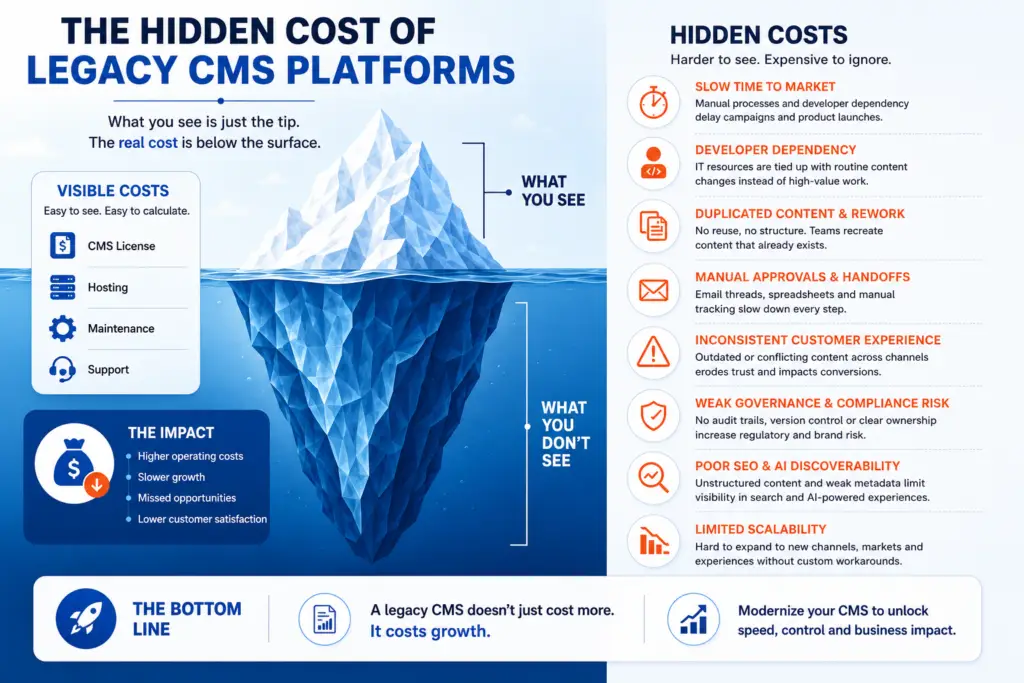
The Hidden Cost of Legacy CMS Platforms
The cost of a legacy CMS is often underdestimated.
Most organisations can see licensing, hosting, maintenance, and support costs. What they do not always see is the operational cost created by slow processes and workarounds.
A legacy CMS can look affordable because it is already in place. People have learned how to use it. Templates already exist. Processes have grown around it. But if the platform forces teams into inefficient ways of working, the true cost is much higher than the invoice.
Slow Publishing Reduces Campaign Impact
Campaign timing matters.
If a campaign launches late, demand may be missed. If product information is delayed, customers may not convert. If compliance updates take too long to publish, risk increases.
Legacy platforms often slow publishing because too many steps depends on manual coordination. A marketer may need a designer for layout, a developer for implementation, a tester for quality assurance, a legal reviewer for approval, and an administrator for publishing. Some of these steps are necessary. Others exist because the CMS cannot support a more efficient workflow.
A modern content platform reduces unnecessary friction with approved templates, reusuable components, content scheduling, and workflow automation. This helps marketing teams move from idea to execution faster.
Developer Dependency Creates a Bottleneck
Developers should focus on strategic technology work, not routine content updates.
In many organisations, marketing teams still need developer support to update banners, create landing pages, modify page layouts, publish campaign pages, or change simple content blocks.
This creates a bottleneck on both sides.
Marketing has to wait for IT capacity. IT has to spend time on tasks that are not the best use of technical talent. Over time, the relationship between marketing and technology becomes transactional rather than strategic.
A modern CMS helps solve this by giving marketers self-service publishing tools within controlled guardrails. Developers remain essential for templates, integrations, performance, security, and platform evolution. But routine content work can be handled more efficiently by marketing teams.
Inconsistent Content Weakens Brand Trust
Large organisations often create content through many teams.
Product teams write product details. Legal teams provide disclaimers. Marketing teams create campaign narratives. Agencies prepare creative assets. Customer service teams maintain FAQs. Regional teams localize messages.
Without strong governance, inconsistency becomes almost inevitable.
Customers may see different product descriptions across pages. Search engines may index outdated information. AI assistants may surface unclear or conflicting content. Internal teams may not know which version is the latest approved version.
A stronger CMS foundation helps create a single source of truth for approved content, reusable assets, standard templates, and publishing workflows. It makes it easier for teams to maintain consistency across websites, apps, partner channels, and customer support content.
Manual Content Operations Increase Cost
Content operations covers the people, processes, tools, and governance needed to create, manage, publish, measure, and maintain content.
When the operating model is weak, teams waste time on repetitive work. They search for the latest file. They copy and paste content between systems. They recreate content that already exists. They track approvals in spreadsheets. They chase feedback through email.
These actions may look small, but they become expensive at scale.
Adobe’s 2026 AI and Digital Trends report highlights that only 54% of organisations are preparing to optimise content for AI-powered discovery tools, even as customers increasingly rely on these tools to navigate digital experiences. The same report notes that only 39% of organisations have a unified customer data foundation that enables them to extract insights from data created by AI agents and conversational interfaces.
The lession for marketing teams is clear. AI readiness and digital growth require stronger foundations. CMS modernisation can play an important role by improving content structure, workflow, governance, and integration.
Legacy Platforms Limit Future Growth
Business growth create digital complexity.
Organisations may need to launch more websites, managing more brands, support more languages, expand into new markets, personalise cutomer journeys, and integrate with more marketing systems.
A legacy CMS may not scale esaily with these needs. Every new requirement may require custom development. Every new channel may require a workaround. Every new market may create another content process to manage manually.
A modern enterprise platform is designed to support scale. It can support multi-site management, localisation, structgured content, integration, reusable components, workflow automation, and enterprise-grade governance.
This does not mean every organisation needs the most complex platform. It means the CMS should match the ambition and operating model of the business.
The Business Case for CMS Modernization
CMS modernisation is the process of upgrading from an outdated or limited content platform to a more scalable, governed, and flexible content management environment.
The strongest business case is not base on feature3s alone. It is based on measurable improvements in speed, governance, efficiency, customer experience, and growth.
Executive rarely approve transformation because a platform has a better inferface. They approve investment when business case shows clear value.
Increase Marketing Agility
The first value driver is marketing agility.
A modern Enterprise CMS helps marketing teams launch campaign faster, update content more easily, and respond more quickly to business opportunities.
This matters because speed can influence revenue.
For example, a lending company launching a seasonal campaign may need to publish product pages, eligibility information, banners, FAQs, and application guidance within a short window. If each update requires manual development and multiple disconnected approvals, the campaign loses time.
With an Enterprise CMS, the team can use approved templates, predefined components, content scheduling, and governed workflows. The result is faster execution with fewer operational bottlenecks.
The business case should quantify this benefit where possible.
Useful questions include:
- How long does it tak to publish a landing page today?
- How many people ar einvolved?
- How many campaign launches are delayed?
- How much developer effort is spent on routine content requests?
- How much revenue could be influenced by faster time-to-market?
These questions help translate marketing agility into business value.
Strengthen Content Governance
The second value driver is content governance.
Content governance becomes more important as digital channels, teams, products, and regulatory requirements expand.
A modern Enterprise CMS provides the structure needed to manage content properly. This includes roles, permissions, workflows, approvals, version control, audit trails, expiry rules, and ownership models.
For marketing leaders, the business case is clear. Strong governance reduces the risk of publishing inaccurate, outdated, or non-compliant information. It also improves confidence because teams know that published content has followed the correct process.
In regulated industries, this is particularly valuable. Marketing teams can move faster because governance is bulit into the workflow rather than added manually at the end.
Good governance does not slow down marketing. It creates the conditions for marketing to scale safely.
Improve Content Operations
The third value driver is better content operations.
A modern Enterprise CMS helps teams produce, manage, and maintain content more efficiently.
Instead of creating every page from scratch, marketers can reuse approved components. Instead of duplicating content across pages, teams can manage core information centrally. Instead of tracking approvals manually, workflows can be embedded into the platform.
This improves productivity.
It also supports better quality because teams spend less time managing administration and more time improving the customer experience.
Content operations is beomcing increasingly important as organisations produce more content across more channels. With a strong operating model, content volume grows faster than content quality.
An Enterprise CMS helps marketing teams scale content without losing control.
Improve Customer Experience
Customer experience depends heavily on content.
Customers need clear product information, transparent pricing, helpful guidance, accurate FAQs, and consistent messaging across the journey.
PwC has reported that greate experiences can generate tangible business benefits, including up to a 16% price premium on products and services, plus increased loyalty.
For marketing teams, this reinforces why content platforms matter. A poor CMS does not only frustrate internal users. It can create inconsistent customer experiences that affect trust, conversion, and loyalty.
An Enterprise CMS helps by making content esaier to manage, update, govern, and distribute. Customers receive clearer and more consistent information, while teams gain a better foundation for personalisation and journey optimisation.
Improve SEO and AI Discoverability
SEO is no longer only about keywords and backlinks.
Technical performance, content quality, structured information, metadata, internal linking, and user intent all matter. AI-powered discovery adds another layer because content must be easy for machines to interpret and summarise.
An Enterprise CMS supports this by enabling better content structure, metadata control, canonical management, internal linking, page templates, schema implementation, and content lifecycle management.
It also supports AEO, or AI Engine Optimisation, by manking content clearer, more modular, and more trustworthy.
Adobe’s content management and digital trends research notes that about 48% of organisations are optimising content to be interpreted and surfaced effectively by AI-powered discovery tools.
This is a strong signal for marketing teams. AI discovery is moving from theory to practice, and content foundations are becoming a competitive advantage.
Improve CMS ROI
CMS ROI should be measured across both cost reduction and value creation.
Cost reduction may come from lower developer dependency, faster publishing, fewer manual workflows, better content reuse, and reduced maintenance effort.
Value creation may come from faster campaigns, better conversion, improved SEO performance, stronger customer experience, and greater ability to support new channels.
The mistake many organisations make it evaluating CMS ROI only through software cost. This underestimates the business value of a modern Enterprise CMS.
A stronger business case considers the full impact across marketing productivity, operational efficiency, risk reduction, and digital growth.
What Makes an Enterprise CMS Different?
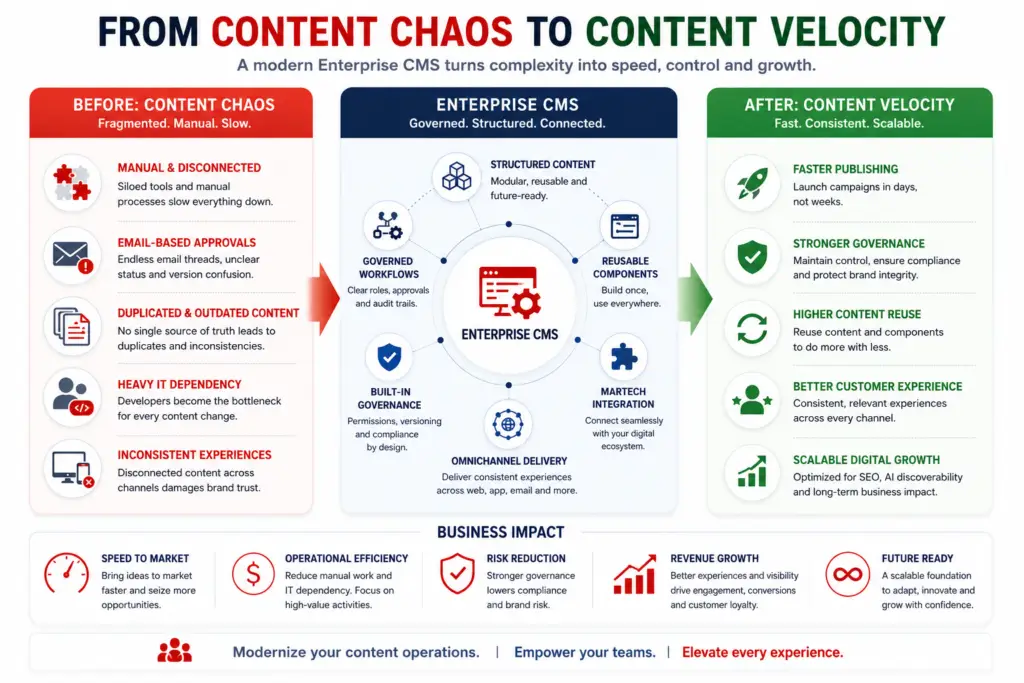
Not all content management systems are the same.
A basic CMS may work well for a small website with simple publishing needs. Enterprise organisations require more. They need platforms that support collaboration, scale, governance, integration, security, and long-term flexibility.
The difference is not only feature depth. It is the ability to support th eoperating needs of a larger organisation.
Enterprise Collaboration
Marketing rarely works alone.
A single diggital experience may involve marketing, product, legal, compliance, risk, IT, UX, analytics, agencies, and regional business teams.
An Enterprise CMS gives each team the right level of access and responsibility. Contributors can create content. Reviewers can approve it. Administrators can manage permissions. Compliance teams can audit changes.
This reduces reliance on email chains, spreadsheets, and informal approval processes.
Workflow Automation
Workflow automation allows organisation to define how content moves from draft to review, approval, publication, update, and retirement.
This is useful when content requires different approval paths based on product type, market, language, cmapaign priority, or risk level.
Automation improves speed and control at the same time.
Reusable Components
Reusuable components allow marketers to build pages from approved content blocks.
These may include banners, product summaries, testimonials, calculators, FAQs, legal disclaimers, call-to-action sections, and campaign modules.
This approach supports both speed and consistency.
Structured Content
Structured content breaks information into reusuable fields rather than treating every page as one fixed document.
For example, a product page can include fields for product name, description, eligibility, pricing, benefits, disclaimers, FAQs, and metadata.
This makes content easier to reuse across websites, apps, chatbots, partner channels, and AI-powered experiences.
Structured content also supports futgure scalability because it separates content from presentation.
Multi-site and Multi-language Management
Many enterprise organisations manage multiple websites, brands, business units and markets.
A suitable CMS can support this through multi-site management, localisation workflows, translation support, regional permissions, and shared templates.
This enables local flexibility while maintaining central governance.
Integration with MarTech
A CMS should not operate as a standalone island.
It should connect with analytics tools, customer data platforms, digital asset mangement, CRM, marketing automation, personalisation engines, experimentation tools, and search platforms.
These integrations help marketing teams create more connected customer journeys.
Security and Compliance
Enterprise organisations need strong security and compliance controls.
This include user permissions, access management, approval controls, audit trails, hosting standards, data protection, and platform resilience.
For industries with regulatory obligations, these capabilities are essentials.
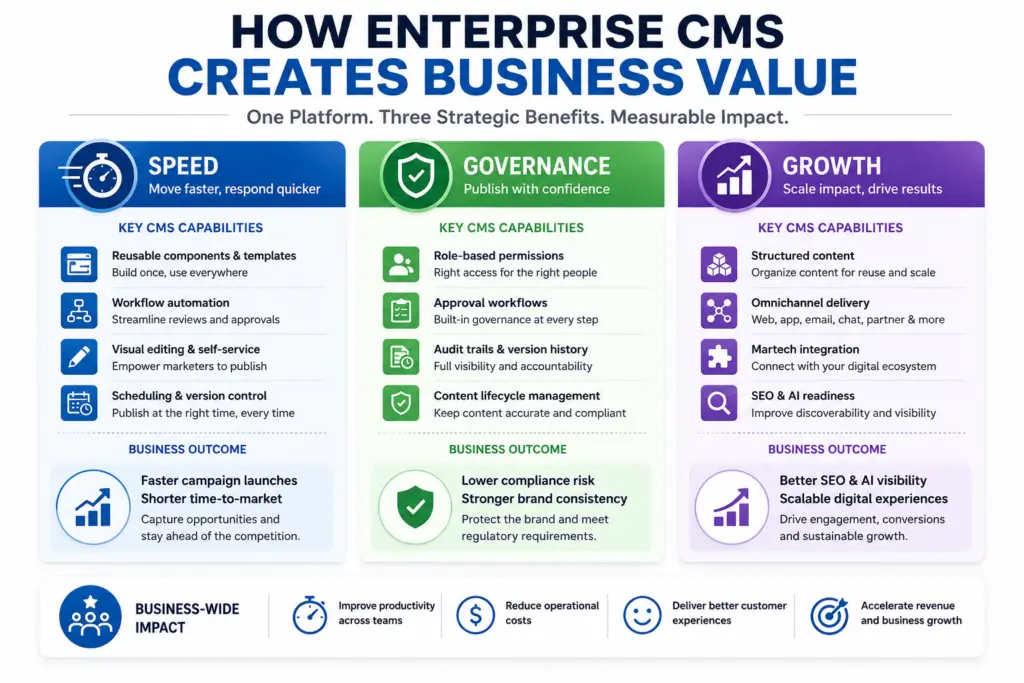
The Speed, Governance and Growth Framework
To build a compelling business case, marketing leaders needs a simple framework that executives can understand.
The Speed, Governance and Growth Framework helps translate CMS modernisation from a technolgy project into a business value discussion.
Speed: Can Marketing Move Fast Enough?
The first question is speed.
A CMS should help marketing or business respond quickly to business needs. If it takes too long to publish content, update campaigns, or launch landing pages, the platform is creating friction.
Speed-related KPIs may include average time to publish, campaign launch cycle time, developer requests for routine updates, percentage of content published through self-service workflows, and number of campaigns launched per month.
Speed is not about rushing. It is about removing unnecessary friction so teams can focus on higher-value work.
Governance: Can the Organisation Publish with Confidence?
The second question is governance.
A CMS should help organisations publish accurate, approved, and compliant content. If governance depends on manual reminders, email approvals, or individual memory, the operating model is fragile.
Governance-related KPI may include approval turnaround time, percentage of content with assigned ownership, number of expired pages, compliance exceptions, audit completion rate, and content review completion rate.
Content governance is not bureaucracy. It is the system that allows marketing to scale without losing control.
Growth: Can the CMS Support the Next Five Years?
The third question is growth.
A CMS should support the future direction of the business. If every new channel, product, or market requires major rework, the platform is limiting growth.
Growth-related KPIs may include organic traffic growth, conversion rate improvement, content reuse rate, digital revenue contribution, customer engagement, AI search visibility, and CMS ROI.
Growth is where the CMS conversation become strategic. The platform is not only supporting today’s website. It is shaping tomorrow’s digital operating model.
How to Measure CMS Success
A modernisation program should not end at launch.
To prove value, organisations should define success metrics before implementation and track performance after rollout.
The right scorecard should include marketing, operational, governance, and business outcomes.
Marketing Performance Metrics
Marketing performance metrics show whether the CMS is helping teams execute more effectively.
Examples include campaign launch time, landing page production time, organic search traffic, content engagement, converstion rate, AI search visibility, and number of campaigns launched.
Operational Efficiency Metrics
Operational efficiency metrics show whther the CMS is reducing wasted effort.
Examples include content reuse rate, manual workflow steps, developer effort spent on content updates, average approval cycle, content production cost, and duplicated assets.
These metrics help quantify productivity gains and support the CMS ROI story.
Governance Metrics
Governance metrics show whether the organisation is publishing with better control.
Examples include percentage of pages with assigned owners, expired pages, compliance exceptions, approval completion rate, version control accuracy, and content review completion rate.
Business Growth Metrics
Business growth metrics connect CMS modernisation to broader organisational outcomes.
Examples include digital lead generation, digital revenue contribution, customer satisfaction, repeat engagement, search visibility, personalisation performance, and conversion uplift.
No single metric tells the full story. The strongest measurement approach combines several indicators to show how the CMS improves speed, governance, operations, and growth.
Conclusion: Enterprise CMS Is a Business Capability, Not Just a Platform
Marketing has entered an era where speed, trust, and adaptability define competitive advantage.
Customers expect consistent digital experience. Search engines reward helpful and reliable content. AI-powered discovery is changing how people find information. Business leaders expect marketing to contribute to measureable growth while operating efficiently and responsibly.
Against this backdrop, a legacy CMS can become more than an operational inconvenience. It can become a barrier to growth.
An Enterprise CMS helps oraganisations modernise the way content is created, governed, published, reused, and measured. It improves marketing agility by reducing unnecessary bottlenecks. It strengthens content governance by embedding approval and accountability into the publishing process. It improves content operations by enabling reuse and reducing manual effort. It supports growth by creating a scalable foundation for future channels, personalisation, SEO and AI discoverability.
The strongest business case for CMS modernisation is not build around technology features. It is built around business outcomes.
- Can marketing launch faster?
- Can the organisation publish with greater confidence?
- Can content be reused more efficiently?
- Can the platform support future digital growth?
- Can the investment deliver measurable CMS ROI?
If these questions matter to your organisation, CMS modernisation deserves a place on the strategic agenda.
Continue Your AI-Ready Marketing Journey
Modernising your CMS is only one part of building a future-ready marketing organisation.
As customer expectations evolve and AI reshapes how people discover information online, marketing leaders need to rethink not only the technology they use, but also how they manage content, govern digital experiences, and measure business impact.
If you found this article helpful, you may also enjoy these related guides on AisaTechBuzz:
- AI-Ready CMS Strategy
- Content Engineering for Marketing
- Structured Content for AI
- Composable Martech Architecture
- AI Search Optimisation with CMS
At AsiaTechBuzz, we share practical insights, implementation frameworks, and real-world perspectives on marketing technology, digital experience, AI search, customer engagement, and enterprise digital transformation. Every article is written to help marketing professionals make better technology decisions that deliver measurable business outcomes.
Whether you are evaluating a new CMS, modernising your MarTech stack, or preparing your organisation for the AI era, we invite you to explore more articles at www.asiatechbuzz.com and continue building the capabilities needed for the next generation of digital marketing.
Frequently Asked Questions About Enterprise CMS
-
What is an Enterprise CMS?
An Enterprise CMS is a content management system designed for larger organisation with complex publishing, governance, and integration needs. It supports capabilities such as workflow automation, role-based permissions, reusable content, structured content, multi-site management, personalisation, security, and integration with other marketing technologies.
-
Why should organisations modernise their CMS?
Organisations should consider CMS modernisation when their existing platform slows down marketing, creates too much dependency on IT, lack governance controls, limits content reuse, or cannot support future digital growth. The goal is not just to replace technology. The goal is to improve speed, governance, efficiency, and customer experience.
-
How does a modern CMS improve marketing agility?
A modern CMS improves marketing agility by giving teams self-service publishing tools, reusuable components, workflow automation, and scheduled publishing. This reduces bottlenecks and allow marketers to launch campaigns, update pages, and respond to business needs faster while staying within approved governance processes.
-
What is CMS ROI?
CMS ROI measures the return an organisation receives from investing in a new or modernised CMS. It can include cost savings from reduced developer dependency, faster content production, improved content reuse, fewer manual workflows, lower maintenance effort, better SEO performance, higher conversion rates, and improved digital revenue contribution.
-
How is an enterprise platform different from a traditional CMS?
A traditional CMS is usually focused on website publishing. An enterprise platform supports broader business needs, including governance, workflow automation, multi-site management, structured content personalisation, integrations, security, scalability, and omnichannel content delivery.
-
Is an Enterprise CMS the same as a headless CMS?
No. A headless CMS separates content management from the presentation layer, allowing content to be delivered through APIs. An Enterprise CMS may be headless, hybrid, or traditional in architecture. The key difference is that it is designed to support enterprise-level governance, collaboration, scalability, and operational complexity.
-
How does an enterprise content platform support AI search?
It supports AI search by helping organisations create content that is structured, accurate, well-governed, and easier to interpret. It can support metadata, taxonomy, schema, content reuse, and consistent publishing workflows. These foundation helps