Table of Contents
Introduction
Marketing teams have never had more ways to connect with customers.
Websites, mobile applications, email, social media, messaging platforms and contact centres all create opportunities for engagement. Yet having more channels does not necessarily mean delivering a better customer experience.
Consider a familiar situation.
A customer begins applying for a product on a website, encounters a problem and switches to the mobile app. Later, they contact customer service for assistance. Despite these interactions, the marketing system continues sending reminders encouraging them to start an application.
Each system may be working exactly as designed. Unfortunately, the overall customer experience is disconnected.
This is the challenge a customer engagement platform (CEP) aims to address.
Rather than treating every channel as a separate communication opportunity, engagement technology helps organisations coordinate interactions around customer behaviour, needs and context.
But does every business need another technology platform to achieve this?
Not necessarily.
The more important question is whether existing CRM, marketing automation, customer data and decisioning capabilities can already support the experience the organisation wants to deliver.
This guide explores how these technologies work together, where they overlap, and how marketing leaders can determine the most appropriate investment.
What Is a Customer Engagement Platform?
A customer engagement platform is technology designed to help organisations coordinate relevant interactions with customers across multiple channels and stages of their relationship.
It connects customer information with engagement activities, enabling businesses to respond more consistently to changing behaviours.
In simple terms, it helps a brand understand what a customer is doing, determine an appropriate response and deliver that response through a suitable channel.
Customer Engagement Platform Explained in Simple Terms
Imagine a customer browsing a financial service website.
They explore a cash loan product, begin an application and leave before completing it.
A conventional campaign might automatically send a reminder after 24 hours.
An engagement platform could support a more informed response by checking whether the customer subsequently continued in the app, contacted customer service or completed the application elsewhere.
The response might be a helpful reminder, an in-app explanation or no communication at all.
The important difference is that communication becomes more dependent on context rather than simply following a preset sechedule.
What Does a Customer Engagement Platform Actually Do?
Most platforms in this category combine several capabilities.
They ingest customer events, create audiences, trigger communications and coordinate journeys across supported channels.
More advanced solutions may provide predictive analytics, experimentation, AI-assisted personalisation and real-time decisions.
However, these capabilities vary considerably between vendors.
For example, Braze describes cross-channel messaging, lifecycle orchestration and personalisation as contral components of its engagement architecture. Its documentation also illustrates how enagement tools integrate with broader customer data infrastructure.
Source: Braze, How to Choose a Customer Engagement Platform, June 2026
Why Customer Engagement Platforms Are Bcoming More Important
Customer expectations have changed.
In its Next Personalisation 2021 research, McKinsey reported that 71% of surveyed US consumers expected personalised interactions, while 76% expressed frustration when those expectations were not met.
Source: McKinsey, The Value of Getting Personalisation Right or Wrong
Although these figures are from 2021 and should not be presented as current APAC market statistics, they highlight an important challenge: relevance matters.
A separate 2024 Twillio Segment study of more than 500 business leaders found that 89% considered personalisation important to business success over the following three years.
Source: Twillio Segment, State of Personalisation Report 2024
The opportunity is not simply to increase communication frequency. It is to make each interaction more useful, relevant and appropriately timed.
Customer Engagement Platform vs CRM, CDP and Marketing Automation
One of the greatest sources of confusion in MarTech is the number of technologies promising to improve customer engagement.
CRM, CDP, marketing automation, decisioning engines and journey orchestration tools may all claim similar benefits.
The confusion arises because these technologies are often marketed as competing platforms, even though they frequently perform complementary functions.
Understanding their roles is essential before deciding what to purchase.
CRM: Managing Customer Relationships and Records
Customer Relationship Management systems traditionally help organisations manage customer information and relationship-related activities.
They may store contact details, account history, sales opportunities, servicing activities and customer interactions.
In a consumer finance business, CRM could maintain information about customer relationships, products, service requests and interaction histories.
Its central purpose is to support the management of those relationships.
Modern CRM suites may also include marketing automation, analytics and engagement capabilities. Therefore, CRM should not be assumed to mean a passive customer database.
The key question is which capabilities have actually been implemented and are available for use.
Customer Data Platform: Connecting Customer Information
A Customer Data Platform, or CDP, focuses on collecting, organising and making customer data available for analytics and activation.
For example, an organisation may have website behaviour in analytics tools, mobile activity in an app platform, transactions in backend systems and customer records in CRM.
A CDP can help combine permitted data into profiles or audiences that downstream systems can use.
Some organisations achieve similar outcomes through data warehouses, identity services and integration pipelines.
A standalone CDP is therefore not mandatory for every engagement architecture.
The important requirement is sufficiently reliable, accessible and appropriately governed customer information.
This relationship is explored further in AsiaTechBuzz’s article, Customer Intelligence: The Powerful Link Between Marketing Data and Business Growth.
Marketing Automation: Executing Campaigns and Workflows
Marketing automation reduces repetitive communication tasks.
Typical capabilities include scheduled campaigns, triggered emails, audience segmentation, lead nurtiring and automated follow-up sequences.
A marketing team might configure a welcome series that introduces a new customer to relevant products over several days.
The workflow may be effective because the sequence is predictable.
However, problems can arise when multiple workflows operate independently.
A customer may receive a promotional email from one campaign, a replayment reminder from another system and an unrelated app notification on the same day.
Every message may be individually valid, but the experience can feel poorly coordinated.
Importantly, modern marketing automation suites can also support advanced conditional journeys and cross-channel interactions. The limitation depends on the product and implementation, not the label alone.
Customer Engagement Platform: Coordinating Interactions
A customer engagement platform places greater emphasis on connecting customer context with communication execution.
Instead of asking only which campaign a customer belongs to, it considers how interactions should be coordinated across supported channels.
This may involve changing a journey when new behaviour occurs, preventing conflicting messages or updating content based on customer circumstances.
For example, a customer who completes an application in the mobile app should ideally stop receiving website abandonment reminders.
Achieving this requires an appropriate completion event, reliable customer identification and coordination between systems.
The engagement layer then helps translate those signals into action.
Journey Orchestration: Managing the End-to-End Experience
Journey orchestration is a capability rather than necessarily a separate technology category.
It connects customer signals, decisions and actions across different stages of an experience.
A journey may begin with product discovery, continue through an application and extend into onboarding, servicing and retention.
Orchestration helps manage transitions between those stages, including situations where customers switch channels or their circumstances change.
A specialist engagement tool may provide this capability, but so can a broader enterprise marketing suite or a carefully integrated technology stack.
The strategic importance of this distinction is discussed in Customer Journey Orchestration: Why Marketing Automation Is No Longer Enough for Modern Brands.
Decisioning Engine: Evaluating the Available Options
A decisioning engine considers factors such as eligibility, recent behaviour, business priorities, contact limits and predicted outcomes.
In financial services, eligibility and compliance restrictions may take precedence over commercial recommendations.
A decision should not promote a product that the customer is ineligible to receive.
Next-Best-Action: Selecting a Relevant Response
Next-best-action translates that evaluation into a recommendation action.
The result might be a reminder, educational content, service assistance, a product recommendation or no action.
The last possibility matters.
Good engagement does not mean contacting customers at every available opportunity.
Channel Execution: Delivering the Experience
Channel execution systems deliver the selected interaction.
They may include email service providers, SMS gateways, mobile push notification services, websites, in-app messaging systems and contact-centre applications.
These systems remain important even when a central orchestration capability is introduced.
An organisation does not necessarily need to replace its existing channels to improve coordination.
The relationship can be summarised as follows.
| Technology | Primary role | Central question |
|---|---|---|
| CRM | Relationship and account management | What do we know about this relationship? |
| CDP | Customer data unification and activation | What information can we connect? |
| Marketing automation | Automated campaigns and workflows | Which planned activity should run? |
| Engagement. platform | Coordinated customer interactions | How should we engage across channels? |
| Journey orchestration | Adaptive journey management | What should happen next in the journey? |
| Decisioning engine | Business rules and decision optimisation | What action is appropriate? |
| Next-best-action | Recommended customer response | What should we do now? |
| Channel execution | Delivery of interactions | How will the action reach the customer? |
These categories overlap, and some suites contain several capabilities. The table represents their primary architectural roles rather than rigid vendor boundaries.
How a Customer Engagement Platform Enables Journey Orchestration
Understanding the technology categories is useful, but their business value becomes clearer when they work together.
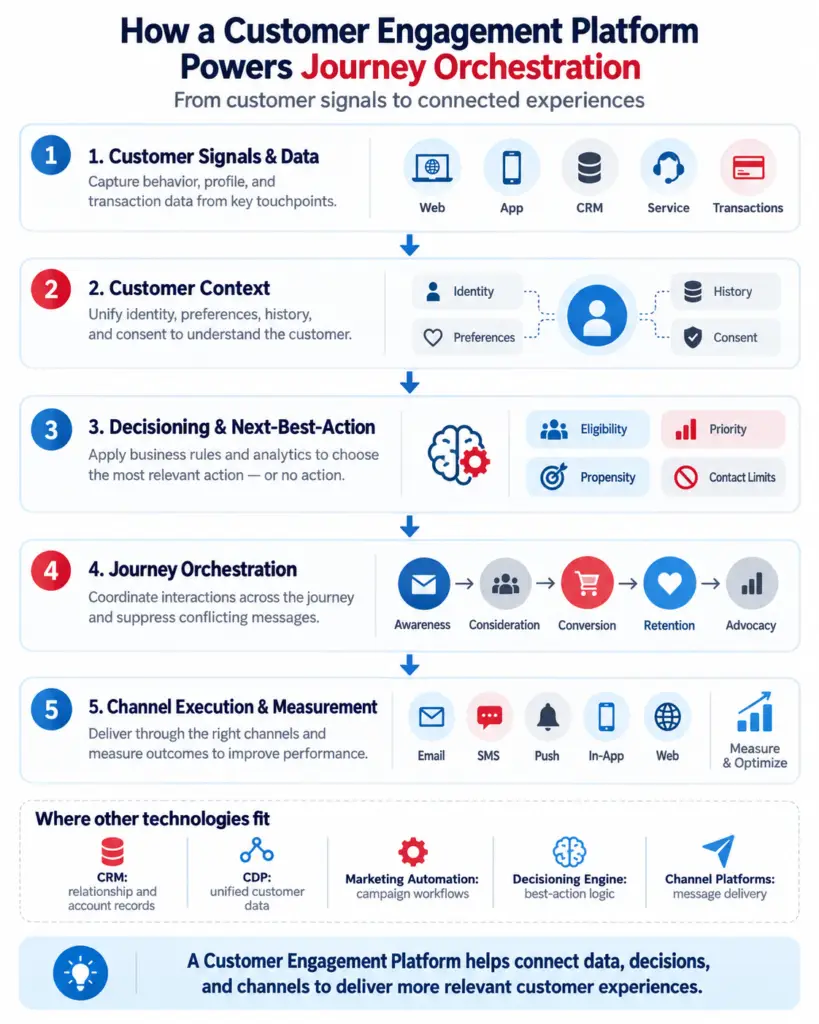
Effective orchestration is not simply a workflow that sends messages through several channels. It requires a continuous process of recognising customer behaviour, evaluating context, selecting actions and learning from outcomes.
Consider how this could work in practice.
Step 1: Capture Customer Signals
Every interaction can provide information about the customer’s current journey.
A website visit may indicate product interest. An incomplete application might suggest friction. A failed transaction could indicate a need for assistance.
Relevant signals may originate from analytics, mobile apps, backend transactions, CRM and service platforms.
However, capturing more data is not automatically better.
Organisations should prioritise signals that are useful for specific decisions, collected lawfully and sufficiently reliable to support action.
Step 2: Build Customer Context
An individual event rarely tells the complete story.
A customer leaving an application form may have enountered a technical error, become distracted or decided against the product.
Before responding, the organisation should consider available information such as application status, service history, product ownership, recent interactions and communication preferences.
Identity resolution also matters.
If a customer starts on the website and continues in the app, the systems need a reliable, permitted way to recognise that continuity.
Where identity cannot be established confidently, the experience should avoid assumptions rather than invent a connection.
Step 3: Determine the Next-Best-Action
Once the necessary context is available, decisioning logic evaluates possible responses.
Simple decisions might use predefined rules.
For example, stop an abandonment reminder when the application status changes to completed.
More sophisticated decisions may involve predictive models that estimate the likelihood of conversion churn or response.
AI can contribute to these decisions, but should not replace governance or business controls.
McKinsey’s discussion of the next frontier of personalized marketing emphasizes the combination of data, decisioning, content, distribution and measurement.
For regulated industries, decisions also need to respect eligibility, consent and relevant business restrictions.
Step 4: Orchestrate Across Channels
After selecting an action, the orchestration capability coordinates delivery.
A customer experiencing difficulty in an app might receive an in-app explanation rather than an unrelated promotional email.
If the customer contacts a service agent, that interaction could influence subsequent communication.
The objective is continuity.
This becomes particularly relevant in Southeast Asia, where customers commonly interact through combinations of brand websites, mobile apps, messaging services, marketplaces and offline channels.
The technology architecture should reflect how customers actually behave, rather than how internal departments are organised.
Step 5: Measure Outcomes and Improve
The process should not end when a message is deliverd.
Organisations need to understand whether the action improved the intended customer outcome.
Did more customers complete onboarding? Did application completion improve? Did service requests decline? Were unnecessary communications reduced?
These questions require more than delivery and click-through metrics.
Where possible, controlled experiments or suitable comparison groups should establish whether an intervention generated incremental improvement.
The resulting evidence informs future decisions.
This creates a feedback loop in which customer signals influence actions, and measured outcomes improve the strategy.
Key Customer Engagement Platform Benefits and Real-World Examples
The value of engagement technology should be evaluated through customer and business outcomes, not simply the number of campaigns it can automate.
Several potential benefits deserve consideration.
Deliver More Relevant Customer Experiences
Personalisation is often associated with inserting a customer’s name into an email.
Meaningful personalisation goes much further.
It involves understanding customer circumstances and delivering useful content, assistance or recommendations when they are relevant.
For a newly onboarded customer, that might mean explaining how to use a product.
For an existing customer experiencing a service issue, it may mean prioritising resolution before presenting another offer.
The objective is to make communication more appropriate, not merely more individualised.
Improve Conversion and Customer Retention
Connected engagement can help reduce unnecessary friction throughout the customer lifecycle.
Possible applications include recovering incomplete applications, supporting product activation, encouraging feature adoption and identifying early signs of disengagement.
However, increased engagement does not guarantee increased conversion.
A reminder may reach more customers without changing their behaviour. Similarly, high click-through rates may not translate into profitable customer relationships.
Performance measurement should therefore focus on incremental business outcomes.
This connects naturally with Lifecycle Marketing in the AI Era: A Powerful Strategy for Growth Beyond Acquisition, which examines how organisations create customer value beyond the initial sale.
Reduce Disconnected Communications
One frequently overlooked benefit is the ability to decide when not to communicate.
Centralised prioritisation and suppression rules can reduce duplicated reminders, competing promotions and poorly timed messages.
For customers, fewer but more relevant interactions may create a better experience.
For business, improved coordination can potentially reduce unnecessary messaging costs and customer complaints.
Customer Engagement Platform Examaples Across Industries
The following scenarios are illustrative examples, not reported deployments or independently measured case studies.
Financial Services: Completing a Digital Loan Application
A customer begins a cash loan application on a website and later continues in the mobile app.
An integrated engagement process recognises the updated application status and suppresses redundant reminders.
If identity verification fails, the system may provide appropriate guidance or offer assisted support.
The objective is successful journey completion, not simply another marketing conversion.
E-Commerce: Recovering an Abandoned Purchase
A shopper adds a product to their cart but leaves without purchasing.
Rather than immediately offering a discount, the system considers whether the product is still available, whether a purchase was completed elsewhere and whether another communication is warranted.
This can help protect promotional margins while improving relevance.
Telecommunications: Preventing Customer Churn
A telecommunication provider identifies declining usage alongside recent service complaints.
Instead of triggering a generic retention promotion, the decision process prioritises resolving the underlying problem.
The appropriate action may be proactive service assistance, followed by a relevant retention offer only when justified.
Across these examples, the principle is consistent: better engagement starts with understanding the customer situation.
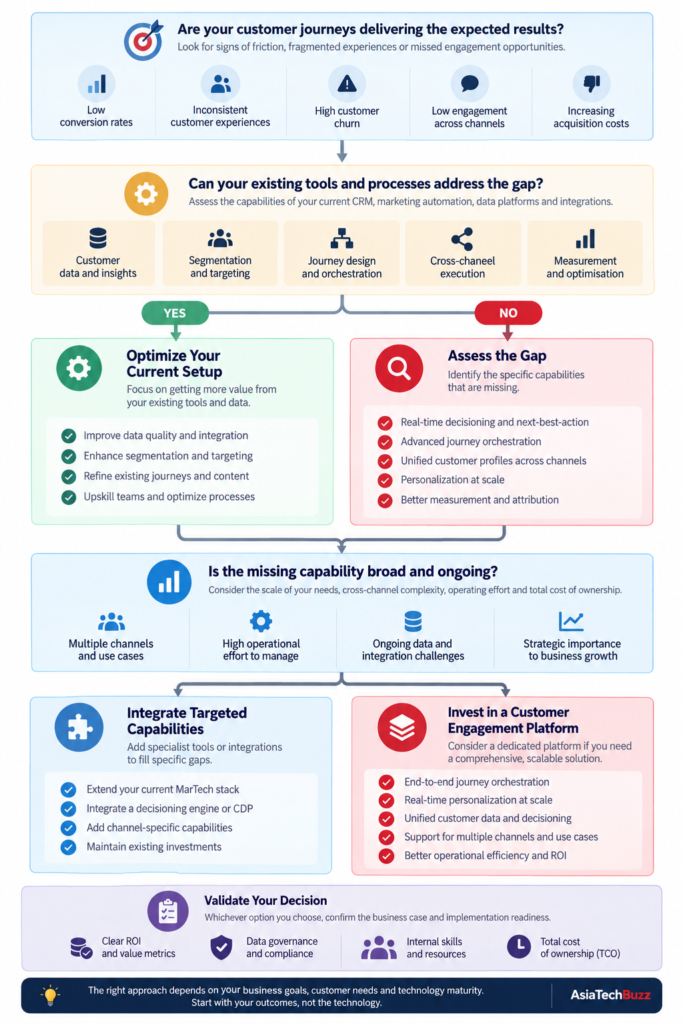
Do You Actually Need a Customer Engagement Platform?
For senior management, this may be the most important question in the entire discussion.
The technology market naturally encourages organisations to think in terms of products and platforms.
Yet buying another platform does not automatically resolve fragmented customer data, disconnected teams or ineffective journeys.
Before making an investment, organisations should determine whether the missing capability genuinely requires new software.
When Your Existing Marketing Automation May Be Enough
Not every business requires sophisticated real-time orchestration.
An organisation with a small number of communication channels and relatively predictable customer journeys may already have sufficient capabilities.
For example, a business primarily managing email onboarding, scheduled customer newsletters and straightforward reactivation campaigns may not need a specialist engagement platform.
Existing automation can also be extended with better segmentation, improved event integrtion and suppression rules.
The relevant question is whether customer needs and commercial opportunities are being constrained by current capabilities.
If existing tools can relibly support the priority journeys, replacing them may create more complexity than value.
Signs You May Need More Advanced Engagement Technology
There are situations where additional capabilities become increasingly valuable.
One warning sign is repeated communication conflict.
Customers may receive multiple reminders even afte completing an action, or promotional messages while an unsolved service problem remains open.
Another is the inability to respind to important customer events quickly enough.
A third is growing dependence on manual intervention or engineering teams whenever marketing wants to change a journey.
The strongest business case emerges when these limitations affect measurable customer outcomes and cannot reasonably be addressed through existing systems.
A complex organisation serving millions of customers across multiple products may have significantly different requirements from a smaller business operating through two primary channels.
When a New Platform Will Not Solve the Problem
Technology purchases can become attractive shortcuts to organisational problems.
If customer identity is unreliable, a new platform may still struggle to recognise the same person across channels.
If teams disagree on journey ownership, more sophisticated workflows may simply reproduce existing conflicts.
If customer event are incomplete or inaccurate, real-time execution can make incorrect decisions happen faster.
Poor content governance creates another risk.
An organisation may invest in sophisticated personalisation while still relying on outdated product information and inconsistent messages.
These are foundational problems.
They should be addressed before assuming that the technology category is the solution.
Three Practical Technology Options
Most organisations have three broad paths available.
Option 1: Optimise Existing Platforms
The first option is to improve what is already available.
This may involve enable unused capabilities, connecting additional customer events, improving segmentation or establishing consistent communication rules.
It is often the lowest-disruption option, although integration and operational improvements still require investment.
This approach works best when existing products already provide the essential capabilities.
Option 2: Integrate Best-of-Breed Technologies
The second option is to connect specialist tools.
An organisation might retain its CRM, data warehouse, analytics environment and channel platforms while introducing a focused decisioning or orchestration component.
This can preserve existing investments and provide flexibility.
However, it also creates integration, monitoring, ownership and support requirements.
The organisation must understand who is responsible for the overall customer journey when several vendors are involved.
Option 3: Invest in a Dedicated Engagement Platform
The third option is to introduce a platform that combines several engagement capabilities.
This can simplify certain journey-building activities and provide more coordinated management of supported communication channels.
The benefits depend on implementation quality, actual feature coverage and integration with existing systems.
It can also introduce additional licencing costs, migration work and platform dependency.
The choice should be driven by the ability to close a proven capability gap.
Five Questions Executives Should Ask Before Investing
Before approving a business case, leadership teams should ask five questions.
First, which customer journey is underperforming? Define the business problem using measurable evidence. An incomplete application journey is more actionbable than a general ambition to improve personalisation.
Second, what specific capability is missing? Determine whether the issue invilves customer identity, event availability, decisioning, orchestration or channel execution.
Third, can existing systems already deliver it? Evaluate unused features, integrations and operational changes before purchasing another product.
Fourth, what measurable improvement is expected? Establish KPIs such as incremental completion, activation, retention, reduced service effort or improved contribution margin.
Finally, will the value justify total ownership costs? Including licensing, integration, migration, data processing, operations, training and ongoing development.
This assessment should also consider how new technology fits the wider architecture.
The principles are explored in MarTech Stack Strategy: A Smart Guide to Avoiding Costly Overbuying.
The most suitable solution may be a new platform, an additional integration or simply better use of existing tools.
How to Evaluate the Right Customer Engagement Platform
If an assessment identifies a genuine technology gap, vendor evaluation should focus on capabilities rather than marketing claims.
Business Capabilities and Use-Case Fit
Ask vendors to demonstrate actual customer scenarios.
For example, can the solution recognise that a customer has completed an application in another channel and immediately stop unnecessary reminders?
A working demonstration provides stronger evidence than an extensive feature checklist.
Integration With Your Existing MarTech Stack
Evaluate how the platform exchanges information with CRM, analytics, data infrastructure, websites, mobile apps and transaction systems.
Consider event latency, API availability, data export, identity management and integration maintenance.
A solution with impressive functionality may still be unsuitable if connecting it to existing systems is excessively complex.
Decisioning, Personalisation and AI Capabilities
Distinguish basic workflow rules from predictive decisioning and AI-driven optimisation.
Vendors should explain how decisions are generated, what information is required and how business restrictions are enforced.
Human oversight, testing and audibility become particularly important when automated decisions influence financial products or other regulated services.
Governance, Security and Total Cost of Ownership
Evaluate privacy controls, customer consent, assess permission, data retention, operational resilience and exist arrangements.
The true cost includes more than software licensing.
It also includes integration development, data infrastructure, training, ongoing support and future changes.
A practical evaluation scorecard might use the following illustrative weights.
| Evaluation Dimension | Suggested Weight |
|---|---|
| Business capability fit | 30% |
| Integration and architecture | 25% |
| Data governance and security | 20% |
| Usability and operational fit | 15% |
| Total cost of ownership | 10% |
These weights are a proposed decision framework, not an industry benchmark. Organisations should adjust them according to business priorities and regulatory obligations.
A Practical Roadmap for Implementing Customer Engagement Technology
Successful implementation does not require transforming every customer journey immediately.
A focused approach allows teams to demonstrate value while reducing delivery risk.
Phase 1: Identify a High-Value Customer Journey
Choose one journey with a clear business problem, sufficient interaction volume and measurable outcomes.
Application completion, onboarding and service recovery are potential starting points.
Define the baseline before making changes.
Phase 2: Assess Data and Integration Readiness
Identify which customer events, profile attributes, permissions and system connections are required.
Verify data quality and determine whether the necessary information is available at the right moment.
Address critical gaps before building complicated workflows.
Phase 3: Launch a Controlled Pilot
Start with a manageable audience and a limited number of channels.
Establish clear decision rules, appropriate suppression conditions and human escalation processes.
Use control groups where feasible to distinguish genuine improvement from normal customer behaviour.
Phase 4: Measure, Optimise and Scale
Evaluate incremental conversion, journey completion, customer effort and operational costs.
Document the lessons and improve the archiecture before expanding into additional journeys.
For business purusing broader personalisation, McKinsey’s research highlights the importance of building the underlying data and decisioning foundation rather than depending on isolated campaign improvements.
Source: McKinsey, The Next Frontier of Personalised Marketing
A successful pilot should demonstrate not only that the technology works, but that it delivers a worthwhile customer or commercial outcome.
Conclusion: Better Customer Engagement Starts With Better Decisions
Modern customer engagement is no longer simply about sending more communications through more channels.
It is about understanding customer context, making appropriate decisions and coordinating interactions throughout the relationship.
A customer engagement platform can play an imporant role in enabling this capability. It can connect customer events with cross-channel journeys, support personalised communication and help organisations respond to changing behaviours.
However, it is not a universal requirement.
Many businesses already possess useful capabilities across CRM, marketing automation, data platforms and channel execution systems. The opportunity may lies in connecting and optimising those investments rather than introducing another technology product.
For leadership teams, the most effective starting point is a measurable customer problem.
Identify where journeys break down. Determine which capabilities are missing. Evaluate whether existing systems can address those gaps. Only then decide whether additional technology is justified.
Ultimately, customers do not care which platforms an organisation operates.
They care whether the brand recognises their needs, provides relevant assistance and delivers a consistent experience.
That is the real objective of modern journey orchestration.
Frequently Asked Questions About Customer Engagement Platforms
-
What is a customer engagement platform?
A customer engagement platform is software that helps businesses coordinate customer interactions across channels such as email, mobile apps, websites and messaging services. It connects customer information with communication activities to support more relevant, timely and consistent experiences throughout the customer relationship.
-
What is the difference between a customer engagement platform and CRM?
CRM primarily manages customer relationships, records and related workflows. Engagement technology focuses on coordinating communication and interactions using customer signals. Modern CRM suites may include extensive engagement capabilities, so the actual distinction depends on the products and features implemented.
-
Can marketing automation replace a customer engagement platform?
Yes, in some circumstances. Modern marketing automation may provide sufficient segmentation, triggered communication, cross-channel workflows and journey management. A dedicated engagement solution becomes more relevant when existing capabilities cannot effectively support the organisation’s required coordination and decisioning.
-
Does a customer engagement platform require a CDP?
Not necessarily. Engagement systems need reliable customer information, but that information may come from CRM, data warehouses, backend systems, APIs or integrated data services. A CDP can simplify certain data management and activation requirements, but it is not mandatory for every architecture.
-
How do you measure customer engagement platform ROI?
ROI should consider incremental revenue or contribution margin, improved conversion and retention, operational savings, and total ownership costs. Controlled experiments can help determine whether engagement improvements generated meaningful business beyond outcomes that would have occurred without the technology.