
Table of Contents
Introduction: Your Website Is No Longer Only Read by Humans
For many years, marketing teams treated the website as a digital storefront.
It was the place where campaiogns landed, prospects explored products, customers compared options, and search traffic converted. The playbook was familiar. Write compelling copy. Design strong landing pages. Optimise metadata. Improve page speed. Publish consistently. Measure traffic, rankings, leads and conversion.
That playbook still matters.
But it is no longer enough.
Today, your website is not only read by people. It is also interpreted by search engines, AI answer engines, chatbots, recommendation platforms, personalisation engines, customer service assistants, and internal knowledge tools.
These systems do not experience your website like a human visitor. They do not admire your hero banner. They do not respond emotionally to your brand visuals. They retrrieve, classify, extract, compare, summarise, and assemble information.
This is why structured content for AI-ready websites is becoming a critical foundation for modern marketing. It helps AI systems understand what your content means, not just what your web pages display.
The timing matters. Gartner predicted that traditional search engine volume would drop 25% by 2026 as AI chatbots and virtual agents gain more influence in discovery journeys.
McKinsey’s State of AI research also shows that generative AI is being adopted across business functions, including marketing and sales.
For marketing professionals, the message is clear. If your website content is trapped inside unstructured pages, AI systems may struggle to understand your products, services, expertise, eligibility rules, locations, authors, claims, and customer value propositions.
Even worse, AI systems may rely on third-party sources to interpret your brand narrative.
That creates a new marketing risk. Your website may look polished to humans, but remain unclear to machines.
Structured content for AI-ready websites helps solve this problem. It turns website content into a machine-readable, reusuale, governed, and scalable marketing asset. It supports AI search optimisation, personalisation, content governance, campaign speed, and omnichannel consistency.
In the AI era, your website is no longer just a destination. It is becoming a source of truth for intelligent digital experiences.
What Structured Content for AI-Ready Websites Actually Means
Structured content means content is created and stored in clearly defined components, fields, metadata, taxonomies, and relationships.
Instead of managing every web page as one large block of text, structured content breaks information into meaningful parts.
Take a typical product page.
A traditional product page may include the product name, product description, benefits, eligibility criteria, fees, FAQs, proof points, disclaimers, related articles, and a call to action. On the front end, everything may look well designed. But inside the CMS, all this information may sit in one large content field.
That makes the page easy to publish, but harder to reuse, govern, or interpret.
A structured approach works differently.
The product name becomes a specific field. Benefits become reusable content components. Eligibility criteria become clearly defined data pints. FAQs become independent content objects. Disclaimers are connected to relevant products or claims. Articles are mapped to topic clusters. Authors are linked to expert profiles. CTAs are connected to journey stages.
That is the practical meaning of structured content for AI-ready websites.
It does not mean removing creativity from marketing. It does not mean every page must look the same. It does not mean marketers need to become developers.
It simply means the content foundation is designed so that both humans and machines can understand it.
A beautifully designed website can still be struc turally weak. A well-written page can still be difficult for AI to interpret. A large content library can still fail to support AI search optimisation if the content is inconsistent, duplicated, outdated, or poorly connected.
Traditional website content is page-based. Structured website content is component-based.
Traditional content is written mainly for visual display. Structured content is designed for humans, search engines, AI systems, and marketing platforms.
Traditional content is often difficult to reuse. Structured content can be reused across the website, mobile app, chatbot, email, paid landing page, customer service script, and AI assistant.
Traditional content is hard to govern. Structured content can include ownership, review dates, approval status, compliance notes, and version history.
That is why structured content for AI-ready websites should not be treated as a technical project only. It is part of the modern marketing operating model.
It changes how teams plan, create, manage, publish, reuse, and measure content.
Why AI-Ready Websites Need More Than Good Copy
Good copy still matters.
Brand voice still matters. Storytelling still matters. Clear messaging still matters. A weak message will not become effective simply because it is structured.
But AI-ready websites need more than good copy.
AI systems need context. They need to understand what each piece of content represents. Is it a product? A service? A customer need? A market? A regulation? An expert view? A price? A disclaimer? A benefit? A location?
A human visitor can often infer meaning from layout. If a fee appears below a product section, the visitor understands the connection. If a disclaimer appears near a claim, the vistor can interpret its relevance. If an FAQ appears under a product page, the visitor assumes the answer applies to that product.
AI systems need stronger signals.
This is where structured content for AI-ready websites becomes important. It gives machines clearer context about what each piece of content means and how it relates to the rest of the website.
Traditional SEO was largely page-oriented. Marketers optimise titles, headings, meta descriptions, keywords, backlinks, internal links, and page speed. These remain important.
But AI search optimisation goes further.
AI sstems may not simply rank your page. They may extract a passage, summarize a product, compare your claim against another source, retrieve an FAQ, or generate an answer using selected pieces of your content.
That changes the role of the website.
A website is no longer just a collection of pages. It is becoming a structured knowledge systems.
Modern marketing teams should not only ask, “How many pages did we publish?”
They should also ask, “Can our content be understood, trusted, reused, and activated by AI?”
Traditional SEO vs the AI Search Era: What Changes in Content Architecture
For many years, website content architecture was shaped mainly by traditional SEO.
The goal was clear. Build pages around keywords. Organize them into categories. Optimse metadata. Create internal links. Publish helpful content. Earn authority over time.
This approach still matters. Traditional SEO is not dead. Search engines still need crawlable pages, strong technical foundations, relevant keywords, useful content, internal links, and clear site structure.
But the AI search era changes what content aarchitecture needs to do.
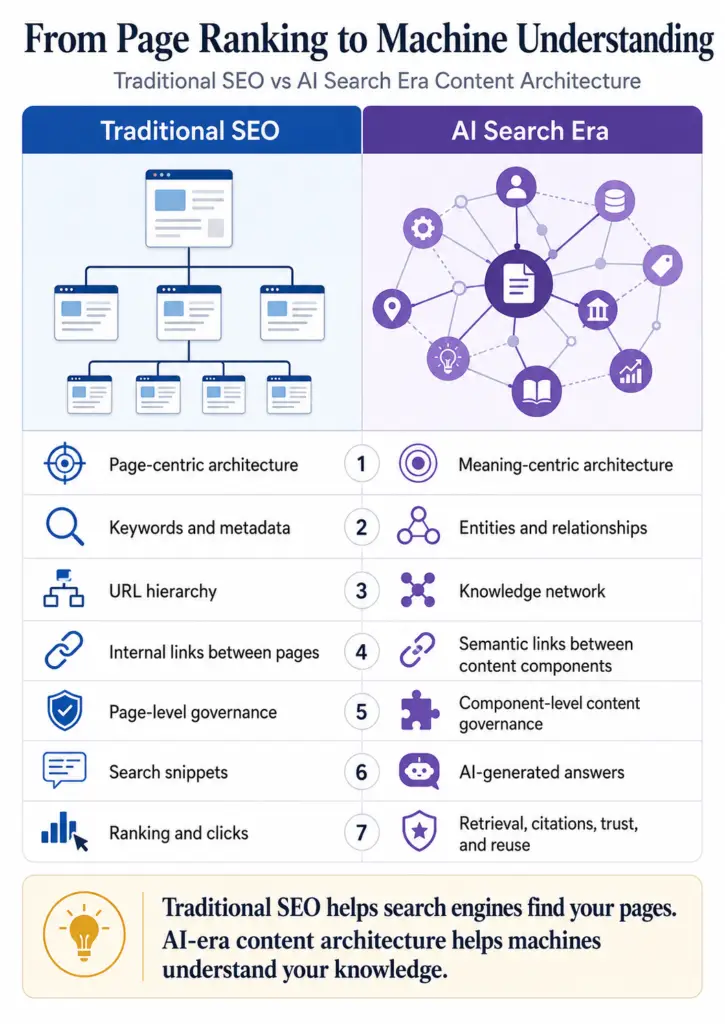
In traditional SEO, the website is often structured around pages.
In the AI search era, the website needs to be structured around meaning.
Traditional SEO asks:
“How do we help search engines find, crawl, index, and rank this page”?
AI search optimisation asks:
“How do we help AI syhstems understand, retrieve, summarise, and trust the right content”?
That is a major shift for marketing teams.
Traditional SEO is Page-Centric
Traditional SEO content architecture is usually built around pages, URLs, keywords, categories, and internal links.
A common SEO structure may include the homepage, product pages, service pages, blog categories, pillar pages, supporting articles, FAQ pages, and campaign landing pages.
This structure is useful because it helps serch engines understand the hierachy of the website. It also helps users move from broad topics to more specific content.
But the limitation is that traditional SEO architecture often treats the page as the main unit of value.
The page is optimise. The page ranks. The page gets traffic. The page converts.
In the AI search era, that is no longer enough.
AI Search is Meaning-Centric
AI systems do not always use the full page as the main unit of value.
They may extract one paragraph. They may tretrieve a single FAQ answer. They may summarise a product benefit. They may compare eligibility information. They may identify an author’s expertise. They may connect multiple content fragments across different pages.
This means website content architecture must help AI systems understand the meaning of individual content elements.
For AI-ready websites, the key content units may include entities, definitions, product attributes, benefits, features, FAQs, eligibility rules, pricing information, author profiles, expert quotes, compliance notes, customer use cases, topic relationships, and source-of-truth content blocks.
This is where structured content for AI-ready websites become essential.
If these elements are burried inside long-form pages, AI systems may still interpret them, but with more uncertainty. If they are structured, tagged, governed, and connected, AI systems receeiver clearer signals.
That is why AI-ready website content architecture needs to move beyond page hierachy and into semantic structure.
The difference in Content Architecture
The simpliest way to explain the difference is this:
Traditional SEO architecture helps search engines find your pages.
AI-era conmtent architecture helps machines understand your knowledge.
In traditional SEO, the main objective is to help pages rank. In the AI search era, the objective is to help content be understood, retrieved, and trusted.
In traditional SEO, the core unit is the web page. In the AI search era, teh core unit may be a content component or knowledge object.
In traditional SEO, the optimization focus is keywords, metadata, links, headings, and crawlability. In the AI search era, the focus expands to entities, relationships, schema, metadata, context, and content governance.
In traditional SEO, measurement often focuses on rankings, clicks, traffic, and conversions. In the AI search era, marketers also need to consider AI visibility, citations, retrieval, content reuse, freshness, and answer accuracy.
Both models matter. But they serve different needs.
From Keyword Mapping to Entity Mapping
In traditional SEO, marketers often begin with keyword mapping.
They identify search terms, group them by intent, and assign them to pages. This remains useful because customers still search using words and phases.
But in the AI search era, keyword mapping needs to be supported by entity mapping.
An entity is clearly indentifiable thing, concept, person, product, brand, service, location, or topic.
For example, a financial services website may need to clearly define entities such as personal loan, credit card, eligibility, interest rate, repayment, customer support, mobile app, author, expert, and regulatory disclosure.
A keyword tells the system what phase people use.
An entity tells the system what the content actually means.
That is why structured content for AI-ready websites should not only focus on keyword density. It should also clarify entities, attributes, and relationships.
From Topic Clusters to Knowledge Networks
Traditional SEO often uses topic clusters.
A pillar page covers a broad topic, while supporting articles cover subtopics in more dertails. Internal links connect the cluster and help build topical authority.
The AI search era still benefits from topic clusters, but the model needs to evolve.
Instead of thinking only about clusters of pages, marketers need to think about networks of knowledge.
A topic cluster may connect articles.
A knowledge network connects articles, products, FAQs, azuthors, definitions, statistics, customer needs, use cases, schema, and related entities.
This gives AI systems a richer understanding of the topic. It also helps users move through content more naturally.
From Page-Level Governance to Component-Level Governance
Traditional SEO governance often happens at the page level.
A page is written, reviewed, approved, published, and updated. This works when content is mostly consumed as a page.
But AI syst ems may retrieve only one part of the page.
That means content governance needs to become more granular.
For AI-ready websites, marketers need to know who owns FAQ answer, when a product benefit was last reviewed, whether pricing information is still valid, whether a disclaimer has been approved, which markets can use a content block, and which content is the official source of truth.
This is why content governance become part of website content architecture.
In the AI search era, a page may be published once, but its components may be reused many times.
If those components are not governed, brands risk spreading outdated or inconsistent information across multiple channels.
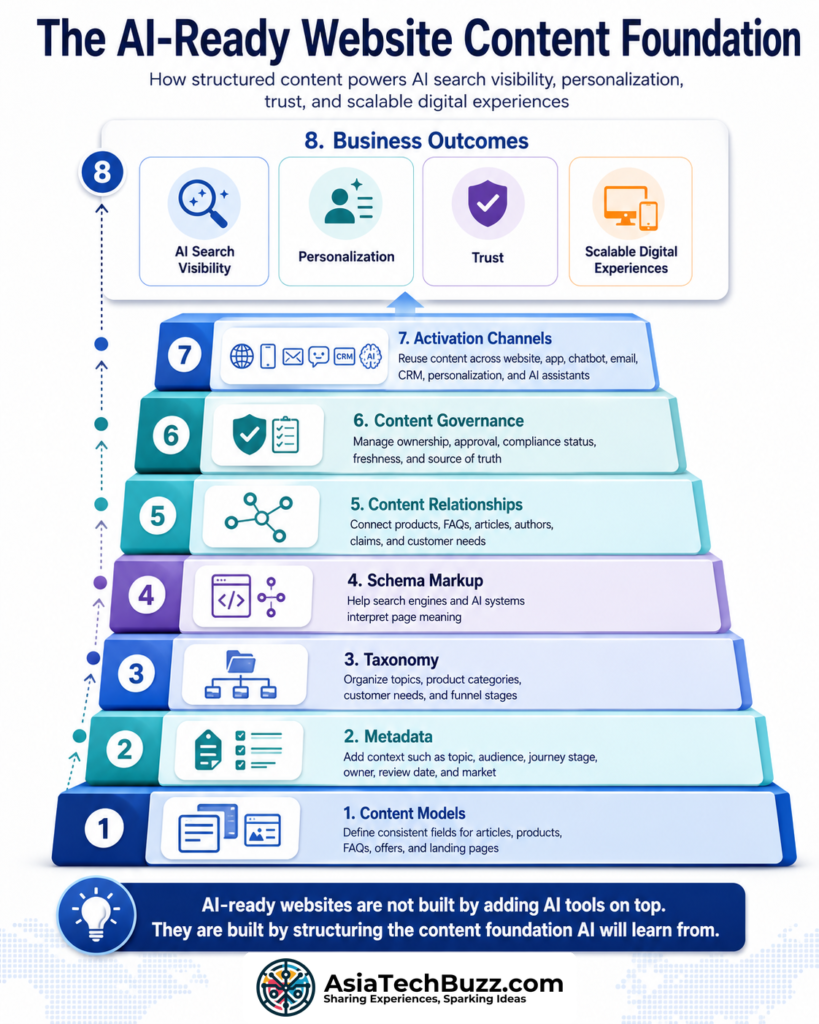
The Five Building Blocks of Structured Content
To make structured content practical, marketers need to understand its core building blocks.
These are not just technical concepts. They directly affect AI search visibility, campaign agility, personalisation, governance, and customer experience.
1. Content Models
A content model defines the structure of a specific content type. It determines which fields are required, how information is organised, ahd how one content object relates to another.
For example, an article model may include article title, summary, author, published date, updated date, topic category, primary keyword, related articles, FAQ section, and schema type.
A product page model may include product name, product description, customer needs, benefits, features, eligibility, pricing, required documents, FAQs, disclaimers, CTA, related products, and review status.
Content models help marketing teams create consistency. They reduce missing information. They make content easier to reuse. They also help AI systems interpret the role of each content element.
Structured content for AI-ready websites fixes inconsistency by making important content types more consistent, complete, and machine-readable.
2. Metadata
Metadata is information about content.
It tells systems what a piece of content is about, who it is for, where it should be used, and how it should be governed.
Useful metadata for marketers can include topic, audience segment, journey stage, product category, market, language, content owner, compliance status, last reviewed date, source of truth, campaign relevance, and personalisation eligibility.
Metadata is powerful because it allows content to be managed intelligently.
A personalisation engine can use metadata to decide which message fits which audience. A CMS can use metadata to surface outdated content. An AI assistant can use metadata to prioritise approved content.
For AI-ready websites, metadata should not be treated as an afterthought. It should be designed into content model fro the beginning.
3. Taxonomy
Taxonomy is the classification system behind your content.
It defines how topics, products, customer needs, industries, segments, and journey stages are organised.
Without taxonomy, teams often use inconsistent labels. One team may say “personal loan”. Another may say “cash loan”. Another may say “quick loan”.
Over time, the wbeiste becomes harder to manage and harder for AI systems to interpret.
A good taxonomy creates shared meaning.
For AI-ready websites, taxonomy should connect topics, product categories, customer nees, funnel stages, markets, content formats, campaign themes, and service journeys.
Taxonomy may not sound exciting, but it is one of the foundations that separates a content library from a content system.
4. Schema Markup and Structured Data
Schema markup helps search engines and other systems understand what a webpage contains.
Google Search Central states that most structured data for Google Search uses Schema.org vocabulary.
Schema.org describes itself as a collaborative community activity that creates, maintains, and promotes schemas for structured data on the internet.
For marketers, the key point is this: schema markup is important, but it is not the whole strategy.
Schema helps external systems understand the page. But deeper structure should begin inside the CMS.
If the CMS stores everything as one large text field, schema implementation becomes harder to scale. With structured content, schema can be generated more consistently because the content is already organised into defined fields.
5. Relationships Between Content
AI systems do not only need individual facts. They need relationships.
A product is related to a customer need. A benefit is related to a feature. An FAQ is related to a product. A topic is related to a cluster. An author is related to an area of expertise. A compliance note is related to a claim.
When these relationships are not defined, AI systems must infer them.
Inference creates risk.
Structured content reduces this risk by making relationships explicit. It helps the website communicate not only what content exists, but how that content connects.
This is where structured content becomes more than a CMS feature. It becomes a marketing intelligence foundation.
How Structured Content Improves AI Search Optimisation
AI search optimisation is becoming a serious marketing priority.
Traditional SEO is not disappearing, but it is expanding. Marketers now need to consider how their content appears in AI-generated summaries, conversational search results, answer engines, and AI assistants.
Structured content for AI-ready websites improves AI search optimisation because it makes information easier to retrieve, interpret, and cite.
First, structured content makes entities clearer. AI systems need to know what your brand offers, who your content is for, what each product means, and how different concepts relate.
Second, structured content reuces ambiguity. When pricing, eligibility, features, benefits, disclaimers, and FAQs are placed in defined fields, machines can interpret them more accurately.
Third, structured content supports passage-level retrieval. AI systems often took for specific answer fragments. A well-structured FAQ answer or product explanation may be easier to retrieve than a long, unstructured page.
Fourth, structured content strenghens freahness. If every content object has an owner and review date, marketers can update critical information more relibly.
Fifth, structured content improves consistency. If one approved product benefit is reused across multiple channels, there is less risk of conflicting messages.
This is why AI search optimisation is no longer only about keywords.
Keywords still matter. Backlinks still matter. Technical SEO still matters. But meaning now matters more.
A website that clearly defines entities, topics, authors, products, relationships, and ansers give AI systems stronger signals.
In the AI era, visibility is not only about being found. It is about being understood.
How Structured Content Supports Personalisation
Personalisation is one of the strongest business reasons to invest in structured content.
Many marketing teams want personalisation. They want to show different messages to different users. They want to tailor product recommendations. They want to adjust content by segment, lifecycle stage, intent, channel, and behavior.
But personalisation often fils because the content foundation is not ready.
The data may exist. The decisioning logic may exist. The personalisation platform may exist. But if content is not modular, tagged, approved, and reusable, personalisation becomes manual and slow.
A team may need to create 20 versions of a landing page. Another team may copy and paste messages into email templates. The app team may rewrite website content for mobile. The CRM team may create its own version of a product benefit.
This is how inconsistency grows.
Structured content changes the model.
Instead of creating separate content for every channel, marketers create approved content components that can be reused and assembled based on context.
A first-time visitor may see educational content. A returning visitor may see comparison content. A customer with high intent may see a stronger CTA. A chatbot may retrieve the approved FAQ answer. An AI assistant may summarise the official product explanation.
Personalisation needs content that can move.
That is why structured content for AI-ready websites is not only an SEO topic. It is also a customer experience topic.
It helps marketers move from campaign-by-campaign personalisation to scalable personalisation infrastructure.
How Structured Content Strengthens Content Governance and Trust
As AI becomes more deeply embedded in marketing, content governance becomes more important.
The more content is reused, summarised, personalised, and activated by machines, the more important it becomes to cntrol the source material.
This is especially important for industries such as financial services, healthcare, insurance, telecom, travel, education and e-commerce.
In these sectors, inaccurate content is not just inconvenient. It can create compliance risk, customer confusion, reputational damange, and lost of trust.
Structure content strenghtens governance because it gives marketing teams better control over ownership, approval, versioning, and usage.
In an unstructured website, governance is often manual. A compliance team may review a pae, but the same claim may appear elsewhere in another format. A product update may be made on the main product page, but not in related FAQs.
Structured content helps by makingt governance part of the content model.
A content object can include content owner, reviewer, approval status, last reviewed date, expiry date, product association, market association, compliance category, source-of-truth status, and usage restrictions.
For AI-ready websites, content governance is the trust layer.
It protects brand consiste3ncy. It supports compliance. It reduces duplication. It improves auditability. It helps AI systems retrieve approved information instead of outdated or conflicting material.
In the AI era, trust is not only created through brand messaging. It is also created through website content architecture.
The Role of a Structured CMS in AI-Ready Websites
A website cannot become AI-ready if the CMS is only used as a page editor.
Many organisations still use their CMS mainly to create and publish pages. The CMS stores the title, body, copy, images, SEO metadata, and maybe a few design components.
That may work for basic publishing, but it limits the organisation’s ability to support AI search optimisation, personalisation, governance, and omnichannel activation.
A structured CMS gives marketers the ability to manage content as reuseable, governed, machine-readable assets.
A mdern CMS or digital experience platform should support content modeling, reusuable components, metadata fields, taxonomy management, schema support, worflow and approval, version history, localisation, API-based content delivery, content relationships, role-based permissions, and integration with analytics and personalisation tools.
This does not mean every organisation needs the most complex enterprise platform immediately. But it does mean marketers should evaluate whether their current CMS can support where marketing is heading.
If the CMS cannot structure content, teams will compensate manually. Developers will create custom workarounds. SEO teams will add schema after the fact. Content teams will maintain spreadsheets. Campaign teams will duplicate pages. Governance team will rely on manual reviws.
That is not scalable.
For marketers, the CMS should no longer be viewed only as a publishing tool. It should be seen as a content intelligence platform.
A weak CMS foundation makes AI readiness harder. A strong structured CMS makes AI readiness operational.
Common Mistakes Marketers Make with Structured Content
Structured content can create significant value, but many organisations approach in the wrong way.
The issue is usually not lack of ambition. It is lack of practical alignment between marketing, SEO, content operations, technology, and governance.
Mistake 1: Treating Structured Content as an SEO Plugin
Some teams assume structured content means adding schema markup to existing pages.
Schema is important, but it is only one layer. Stuctured content starts earlier. It begins with content modeling, metadata, taxonomy, and relationships.
If the underlying content is messy, schema alone will not solve the problem.
Mistake 2: Over-Engineering the Content Model
The opposite mistake is making the content model too complex too quickly.
Some teams create too many fields, too many content types, and too many approval steps. This frustrates marketers and slows publishing.
Start with high-value content types, such as product pages, articles, FAQs, offers, author profiles, and landing pages.
The goal is practical structure, not theoretical perfection.
Mistake 3: Confusion Design Components with Content Components
A design component is not always a content component.
A card, carousel, tab, or banner is usually a presentation element. A product benefit, FAQ answer, disclaimer, author profile, or eligibility rule is a content component.
This distinction matters because AI systems need meaning, not just layout.
Mistake 5: Forgetting Content Governance
A structured CMS without governance can still become messy.
Fields may be filled inconsitently. Tags may multiply. Old content may remain active. Duplicate components may appear.
Governance keeps structure useful.
A Practical Roadmap for Marketing Teams
Marketing teams do not need to restructure the entire website at once.
The best approach is to start with the content that matters most to discovery, conversion, trust, and customer experience.
Step 1: Audit High-Value Website Content
Start with product pages, service pages, pricing pages, FAQ pages, blog articles, comparison pages, help content, campaign landing pages, location pages, and author to expert pages.
Review whether the information is clear, current, consistent, supported, structured, properly sourced, connected to related topics, and free from unnecessary duplication.
This audit will show where structured content for AI-ready websites can create the fastest value.
Steo 2: Identify Reusable Information
Look for information that appears repeatedly across pages and channels.
Common examples include product descriptions, benefits, features, eligibility rules, required documents, fees, FAQs, CTAs, disclaimers, proof points, expert bios, and campaign messages.
If teams are copying and pasting the same information manually, that is a strong signal that the content should become structured and reusable.
Step 3: Define Core Content Models
Do not start with 30 content models.
Start with a small set that matters.
For many marketing websites, the first models could be Article, Product, FAQ, Offer, Author Profile, Landing Page, and Compliance Disclosure.
Step 4: Builds a Useful Taxonomy
Create a taxonomy that reflects how customers search, how the business organises products, and how marketing activates content.
Useful taxonomy dimensions may include topic, product category, customer need, journey stage, market content type, campaign theme, and audience segment.
Avoid creating too many tags. A taxonomy should help teams classify content, not overwhelm them.
Step 5: Add Metadata and Governance Fields
Useful fields include content owner, last reviewed date, review cycle, compliance status, market language, audience, funnel stage, product association, and source-of-truth status.
These fields help content remain accurate and useful over time.
Step 6: Implement Schema Where It Adds Value
Use schema strategically.
Article schema, FAQ schema, Organisation schema, Product schema, Breadcrubm schema, and Person schema are often relevant for marketing websites.
The key is accuracy. Schema should reflect real content on the page.
Step 7: Connect Structured Content to Activation Channels
Structured content becomes more valuable when it is used beyond the website.
Connect content to mobile app experiences, email campaigns, CRM journeys, chatbots, AI assistants, paid landing pages, customer service scripts, sales enablement, and personalisation engines.
Step 8: Measure the Impact
Useful KPIs include organic visibility, AI search visibility, featured snippet inclusion, content reuse rate, publishing speed, content freshness, duplicate content reduction, conversion rate, personalisation converage, compliance review cycle time, and reduction in manual production effort.
Structured content should be measured by whether marketing become faster, clearer, more consistent, and more visible in AI-driven discovery.
What Good Looks Like: A Simple Financial Service Example
Consider a financial services website with a personal loan product.
In a traditional page-based model, the product page may include a long description, benefits, eligibility details, required documents, repayment information, FAQs, and a CTA.
The same information may also appear in blog posts, campaign pages, mobile app screens, contact center scripts, and chatbot responses.
If each team creates its own version, inconsistency becomes almost unavoidable.
With structure content, the same product knowledge can be separated into reusable and governed components.
The product name is stored once. The official description is stored once. The eligibility rules are structured. The benefits are tagge by customer need. The FAQs are linked to the product. The disclaimer is attached to specific claims. The CTA is mapped to the journey stage. The review date is visible. The compliance status is known.
Now the same approved content can support multiple experiences.
The website can display the full product page. A chatbot can retrieve an approved FAQ answer. An AI search engine can understand the product more clearly. A mobile app can show a shorter version of the benefits. A CRM journey can use the correct CTA. A campaign page can reuse the approved product description.
This is the practical value of structured content for AI-ready werbsites.
It reduces duplication. It increases consistency. It supports AI interpretation. It improves marketing speed.
It also protects the brand narrative.
When customer ask AI systems about your product, you want those systems to understand the official information from your own website, not rely mainly on fragmented third-party interpretations.
The Strategic Payoff for Marketing Professionals
The strongest reason to invest in structured content is not technical elegance.
It is marketing performance.
Structured content improves AI search optimisation because content becomes clearer, more specific, and easier to retrieve.
It improves personalisation because content becomes modular, tagged, and reusable.
It improves content governance because ownership, review status, and compliance rules can be embedded into the content lifecycle.
It improves customer experience because information becomes more consistent across website, app, email, chats, and service channels.
This is why structured content for AI-ready website should matter to marketing leaders, not just CMS administrators or SEO specialists.
Marketing teams are under presure to produce more content, support more channels, personalise more journeyhs, and respond faster to market changes.
But simply producing more content is not sustainable.
More unstructured content creates more complexity.
The better strategy is to structure content so it can work harder.
In the AI era, the winning marketing teams will not be the ones that only publish more. They will be the ones that make their content easier to understand, trust, reuse, and activate.
Conclusion: AI-Ready Websites Start with Structured Content
AI-ready websites are not created by adding an AI tool on top of an old website.
They are created by improving the foundation that AI systems learn from, retrieve from, and rely on.
That foundation is content.
More specifically, it is structured content.
Structured content for AI-ready websites gives marketing teams a practical way to make their websites more machine-readable, reusable, governed, and scalable.
It helps brands improve AI search optimisation, strengthen trust, support personalisation, reduce duplication, and turn the website into a reliable source of truth.
This is a major shift for marketing professionals.
The website can no longer be managed only as a collection of pages. It must be managed as a structured knowledge system.
That does not mean creativity becomes les important. It means creativity needs a stronger operating foundation.
Great storytelling still matters. Strong positioning still matters. Useful content still matters. But in the AI era, marketing content must also be understanable to machines.
The future of digital marketing will reward brands that make their kwnowledge clear, connected, and trustworthy.
That is why structured content for AI-ready website is no longer a technical nice-to-have.
It is an essential foundation for modern marketing.
Continue Exploring AI-Ready Marketing
Structured content is only one part of the broader shift toward AI-ready marketing. As search, content operations, personalisation, and MarTech architecture continue to evolve, marketing teams need to rethink how their digital foundations are built.
To go deeper, you may also find these articles useful:
- Structured Content for AI: Strategic Advantage explores how structured content supports AI retrieval, discoverability, and scalable marketing infrastructure.
- AI Search Optimisation Starts with Your CMS explains why CMS content architecture now plays a critical role in AI visibility.
- Structured Marketing Data: Powerful AI Marketing Backbone looks at how structured data supports AI retrieval, personalisation, analytics, and connected MarTech
- The AI-Ready MarTech Stack outlines the technlogy layers marketers need to support AI-driven experiences.
- Mastering Real-Time Personalisation Architecture APAC shows why personalisation success depends on the right data, decisioning, content, and activation architecture.
AI-ready websites are not built in isolation. They are part of a larger marketing transformation where content, data, technology, governance, and customer experience must work together. If this topic is relevant to your marketing roadmap, continue exploring more insights on AsiaTechBuzz.com
Frequently Asked Questions
-
What is structured content for AI-ready websites?
Structured content for AI-ready websites is content organized into reusable fields, components, metadata, taxonomy, schema, and relationships so humans, search engines, AI systems, and marketing platforms can understand and activate it more effectively.
-
Why does structured content matter for AI search optimization?
Structured content matters because AI systems need clear entities, consistent answers, and machine-readable meaning. It helps AI systems retrieve, interpret, summarize, and cite website content more accurately.
-
Is structured content the same as schema markup?
No. Schema markup is one part of structured content. Structured content also includes CMS content models, metadata, taxonomy, reusable components, governance fields, and relationships between content objects.
-
How does structured content support personalization?
Structured content supports personalization by making content modular and tagged by audience, product, journey stage, customer need, and channel. This allows personalization systems to assemble more relevant experiences at scale.
-
Do marketers need a new CMS to create structured content?
Not always. But marketers need a structured CMS capability that supports content models, reusable fields, metadata, taxonomy, workflow, schema, and API-based delivery. If the current CMS only supports page-based editing, it may limit AI readiness.