Table of Contents
For years, marketing growth stategies have concentrat3ed heavily on acquisition. Brands invested in paid media, search, content, social platforms and lead-generation campaigns to bring more prospects into the top of the funnel.
Acquisition remains important. Every business needs a reliable way to attract new customers. However, acquiring a customer is only the begining of the commercial relationship.
The larger opportunity often emerges after the first conversion.
Will the customer complete onboarding? Will they experience the value of the product? Will they continue using it, buy again, adopt another service, renew their subscription or recommend the brand to someone else?
These questions sit at the heart of lifecycle marketing.
Lifecycle marketing helps organisation manage the entire customer relationship, from initial awareness and acquisition to activation, retention, expansion, loyalty and advocacy. Instead of treating as the final objective, it focuses on helping customers progress towards greater value over time.
Artificial intelligence is making this strategy significantly more powerful.
Traditional lifecycle progrmmes relie on braod segments, predetermined schedules and rule-based campaigns. AI can now analyse customer signals, predict likely behaviours, personalise content and indentify the next-best experience for each customer. This is changing how brands approach their lifecycle marketing strategy, particularly as customer journeys become more fragmented and less predictable.
The opportunity is not simply to send more personalised communications. It is to build an adaptive growth system that recognises what customers need at different moments in the relationship.
For marketing leaders, this represents an important shift. Sustainable growth can no longer depend only on acquiring more customers. It must also come from creating more value from every customer relationship.
What is Lifecycle Marketing?
Lifecycle marketing is a customer-centered strategy that adapts communcation, offers and experiences according to a person’s evolving relationship with a brand.
It considers the complete relationship, rather than focusing only on the point of acquisition.
A customer may first discover a brand through search, social media or advertising. They may then explore the brand’s content, compare products, complete a purchase, activate a service, become a frequent user, purchase additional products or gradually stop engaging.
Each moment creates different customer needs and business opportunities.
A prospect comparing products may need education and reassurance. A new customer may need onboarding support. An active customer may benefit from feature recommendations, while a customer showing signs of disengagement may need help rather than another promotional offer.
An effective lifecycle marketing strategy recognises these differences.
It aligns engagemetn with customer’s current context, expected needs and potential value. This makes customer interactions more relevant while helping the organisation improve activation, retention and customer lifetime value.
Lifecycle Marketing is More Than Email Marketing
Lifecycle marketing is sometimes treated as another term for automated email campaigns. Email is certainly an important channel, but the strategy extends far beyond it.
Mordern lifecycle programmes may coordinate experiences across:
- Websites
- Mobile applications
- SMS and messaging platforms
- Push notifications
- Paid media
- Social channels
- Contact centres
- Physical locations
- Sales teams
- Customer-service interactions
The channel is only the delivery mechanism.
The more important decisions are who should receive an interaction, why the interaction is relevant, when it should happen and which custmer outcome the business hopes to influence.
A reminder encouraging a customer to complete onboarding can be useful. Sending the same reminder after the customer has contacted support about a technical problem may appear insensitive.
Lifecycle marketing must therefore consider context, not just campaign schedules.
Lifecycle Marketing Versus Funnel Marketing
Traditional marketing funnels generally represent a linear path from awareness to consideration and conversion.
The funnel remains useful for analysing acquisition performance, but it gives limited attention to what happens after a customer converts. In some models, customers effectively dissappear once thye reach the bottom of the funnel.
Customer relationships do not work that way.
A customer can move forwards, backwards or sideways. They may engage heavily for several weeks, become inactive, return with a new need and eventually purchase a different product. They may also occupy several lifecycle states at once.
For example, a banking customer could be a loyal user of a saving account but only a prospect for a credit card. An ecommerce customer may purchase one product regularly while still considering another category.
The customer lifecycle stages are therefore not always fixed labels. They are evolving customer stat3es shaped by behaviours, needs and product relationships.
Lifecycle Marketing Versus Marketing Automation
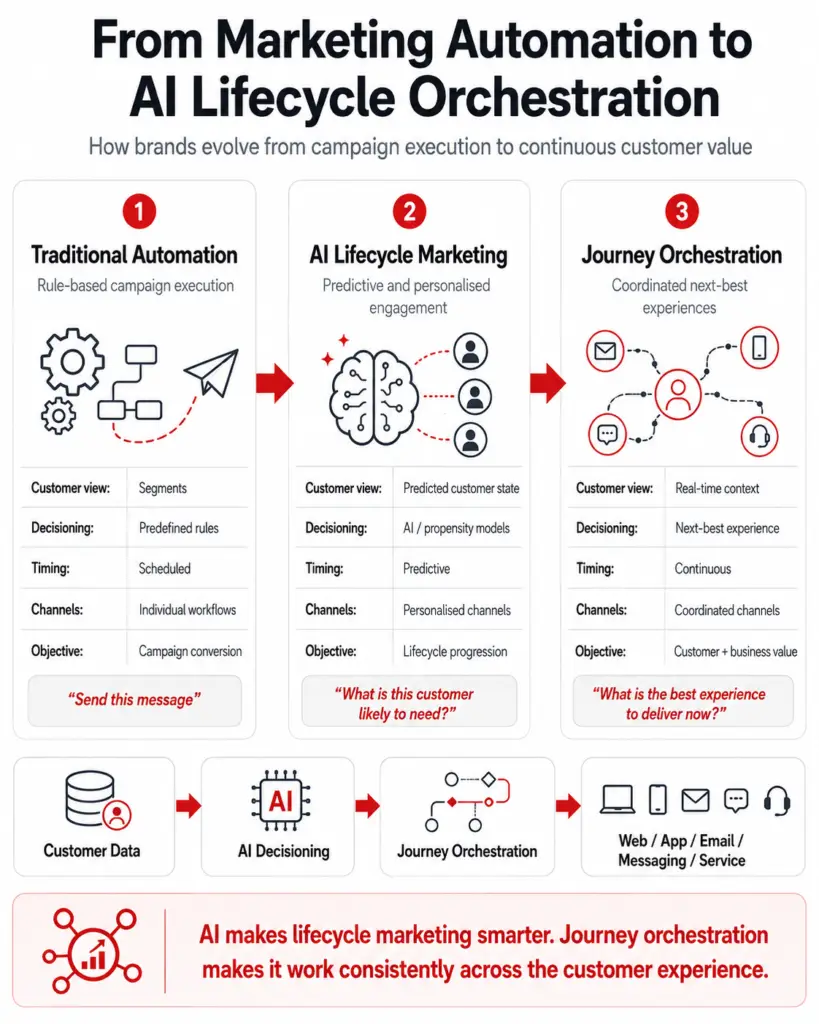
Marketing automation executes predefined actions. It can send a welcome message, trigger a reminder, assign an audience segment or move a contract into a campaign.
Lifecycle marketing provides the strategy behind those actions.
It determines which customer progression matters, what behavioyrs indicate3 success or risk, and how the organisation should respond at different stages of the relationship.
Automation can support this process, but it does not automatically create an effective customer retention strategy. A business can automate hundreds of campaigns while still delivering fragmented or irrelevant customer experiences.
This is one reason modern brands are moving towards customer journey orchestration. Journey orchestration coordinates signals, decisions and experiences across channels, rather than allowing each automated workflow to operate independently.
You can explore this shift in the AsiaTechBuzz pillar article, Journey Orchestration: Why Marketing Automation Is No Longer Enough for Modern Brands.
Why Growth Beyond Acquisition Matters
Acquisition is visible, familar and relatively easy to measure. Marketing teams can monitor impressions, clicks, leads, conversions and acquisition costs through established dashboards.
Onboarding may sit with product teams. Retention may involve marketing and customer service. Corss-selling may belong to sales, while loyalty programmes could be managed by another department entirely.
From the customer’s perspective, however, these are not separate functions. They are all part of one relationship with the brand.
A disconnected operating model can create situations in which one department attempts to sell a product while another is resolving an unresolved complaint. The customer may receive an onboarding message after already completing the action, or a retention offer that ignores the reason they become inactive.
Lifecycle marketing creates a shared view of how value develops throughout the relationship.
The Economics of the Relationship Extend Beyond Conversion
A first purchase provides only a partial view of customer value.
Long-term value may also come from:
- Repeat purchases
- Subscription renewals
- Increased product usage
- Cross-selling
- Upgrading
- Referrals
- Lower servicing costs
- Reduced churn
- Longer relationships
These outcomes contribute to customer lifetime value, which estimates the value of a customer creates throughout their relationship with the business.
This makes lifecycle marketing commercially important. Improving acquisition without improving activation or retention can create the appearance of growth while underlying customer value remains weak.
A company may acquire thousands of new users, for example, but receive limited value if most of them fail to complete onboarding or stop using the product shortly afterwards.
The business does not necessarily needs more acquisition. It may need a a better activation and customer retention strategy.
Retention Is Becoming a Larger Marketing Priority
Marketing leaders are recognising this opportunity.
According to the Braze 2025 Global Customer Engagement Review, 42% of marketing leaders spend the majority of their budgets on retention. This suggests that retention is increasingly being treated as a core growth priority rather than a secondary responsibility.
The same Braze analysis highlights the compounding value of stronger customer engagement. Longer relationships can increase lifetime value, while higher lifetime value improves the economics of acquisition.
Retention should not, however, be reduced to a set of win-back campaigns. By the time a customer becomes formally inactive, the organisation may have already missed multiple warning signals.
A more effective customer retention strategy begins earlier. It addresses onboarding friction, weak product adoption, service problems and declining engagement before they develop into churn.
Customers Expect Brands to Recognise Changing Needs
Customers also expect brands to become more responsive.
Salesforce reports that 73% of customers expect better personalisation as technology advances, while 65% expect companies to adapt to their changing needs and preferences. Furthermore, 80% say the experience a company provides is as important as its products and services.
These expectations are directly relevant to lifecycle marketing.
A customer’s needs will change as the relationship develops. The information required before purchase is different from the support needed during onboarding. A long-standing customer should not always receive the same introductory content as a new prospect.
Brands that continue communicating through broad, static segments risk appearing disconnected from the customer’s reality.
Understand the Customer Lifecycle Stages
There is no single lifecycle model that works for every organisation. The appropriate framework depends on the industry, business model, product and definition of customer value.
A subscription company may forcus heavily on activation, adoption and renewal. A retailer may proritise repeat purchase and category expansion. A financial-services company may need to consider product eligibility, responsible usage, repayment behaviour ad long-term financial needs.
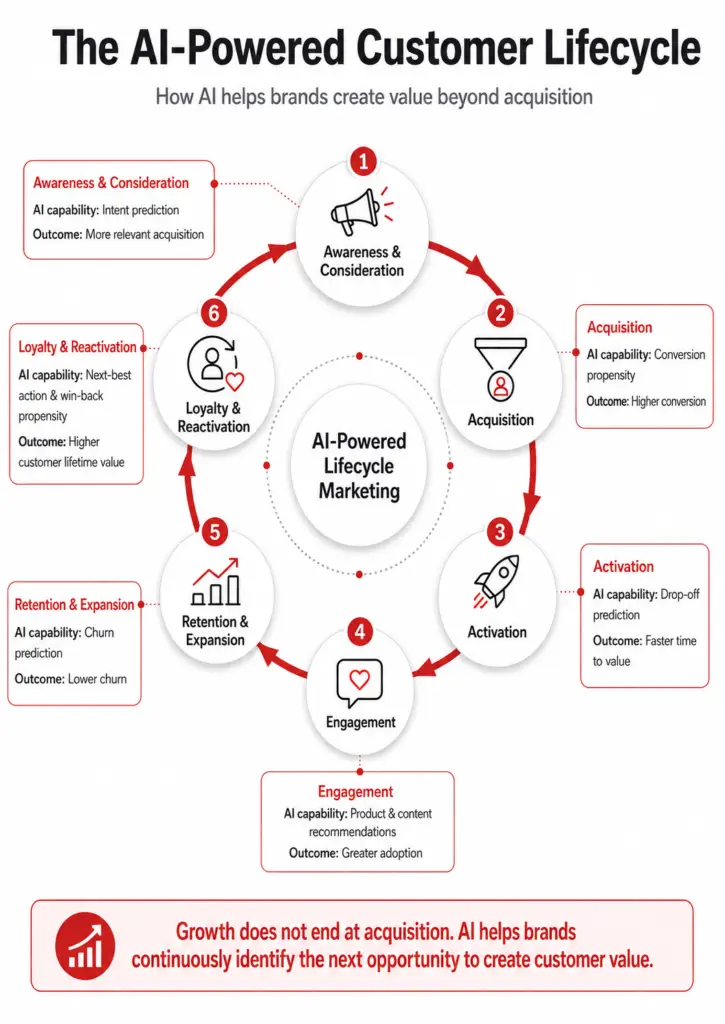
Nevertheless, most customer lifecycle stages can be organised around six broad phases.
Stage 1: Awareness and Consideration
At this stage, the customer is becoming aware of a need and evaluating possible solutions.
The marketing objective is not simply to create visibility. It is to establish relevance, provide useful information and reduce uncertainty.
Important signals may include:
- Search behaviour
- Content consumption
- Product-page visits
- Webinar registrations
- Price comparisons
- Downloads
- Repeated visits
- Engagement with reviews or FAQs
Ai can help analyse these signals to identify intent. However, brands should avoid assuming that every interaction represents immediate purchase readiness.
A prospect reading an educational article may still be exploring a problem. Pushing a strong sales message too early could weaken trust.
The role of lifecycle marketing is to support customer progression, not force every customer directly towards conversion.
Stage 2: Acquisition and Conversion
The acquisition stage is where a prospect takes a commercially meaningful action, such as purchasing a product, submitting an application, creating an account or subscribing to a service.
Common lifecycle initiatives include:
- Abandoned-cart recovery
- Application-completion reminders
- Product comparison tools
- Eligibility guidance
- Social proof
- Assisted sales support
- Personalised landing pages
- Simplified checkout experiences
The objective should be remove genuine barier rather than merely increase communication pressure.
For example, a customer who abandons an application because they are missing a required document needs a different response from someone who stopped because they no longer want the product.
AI lifecycle marketing can help distinguish these scenarios by analysing interaction patterns, previous behaviours and customer context.
Stage 3: Onboarding and Activation
Acquisition does not guarantee activation.
A customer may create an account but never complete the setup process. They may purchase software but fail to use its most valuable feature. They may download an app but never reutrn after the first session.
Activation occurs when the customper experiences meaningful value.
For a payment application, that moment might be completing the first transaction. For a streaming platform, it could be watching the first programme. For enterprise software, it may involve integrating data or inviting a team member.
Effective lifecycle marketing identities this first-value moment and helps customers reach it quickly.
Typical onboarding initiative include:
- Welcome journeys
- Account-completion guidance
- Personalised setup checklists
- Tutorials
- Feature education
- Progress reminders
- Contextual assistance
- Human support for complex tasks
Activation should be measured through customer behaviour, not just message engagement. An email open may show interest, but it does not prove the customer achieved value.
Stage 4: Engagement and Adoption
After activation, the goal shifts towards deeper and more consistent product usage.
Customers may know how to use the basic service but remain unaware of features that could provide additional value. Others may use the product occasionally without developing a regular habit.
Lifecycle marketing can support adoption through timely education and recommendations based on actual behaviour.
For example, a customer repeatedly using one feature could receive guidance on a complementary capability. A customerr who has not used an important function may need a simple demonstration rather than a promotional offer.
This stage is particularly important for subscription products, applications and platforms where ongoing usage predicts retention.
Relevant measures may include:
- Active-user frequency
- Feature adoption
- Transaction frequency
- Repeat purchases
- Depth of product usage
- Time between interactions
- Completion of key behaviours
Stage 5: Retention and Expansion
At the retention stage, the organisation aims to sustain the relationship while identifying opportunities to create additional customer value.
Retention is not the same as preventing cancellation at the final moment. It includes the experience that make a customer want to continue the relationship.
These may include reliable service, relevant support, consistent product value, transparent communication and appropriate recognition.
Expansion can involve:
- Cross-selling a complementary product
- Recommending an upgrade
- Increasing usage
- Adding services
- Reviewing a subscription
- Moving into a higher-value relationship
A responsible lifecycle marketing strategy should balance commercial value with customer sustainability. The objective is not to sell every available product. It is to identify offers that genuinely address customer needs.
Stage 6: Loyalty, Advocacy and Reactivation
Loyal customers can create value beyond their own purchases. They may provide reviews, refer new customers, participate in communities or other useful feedback.
However, loyalty should not be measured only by programme membership or reward points. True loyalty is reflected in continued preference, trust and positive behaviour.
Lifecycle initiatives at this stage may include:
- Recognition programmes
- Exclusive services
- Referral initiatives
- Anniversary communications
- Community participation
- Feedback opportunities
- Early access to products
- Personalised newards
Reactivation is also part of this stage. Some inactive customers may still have future value, but not every inactive customer should receive the same win-back offer.
A customer may have stopped engaging because of price, poor service, reduced need, competitive alternatives or a temporary change in circumstances.
Understanding the likely reason is more valuable than sending a generic discount.
How AI Is Transforming Lifecycle Marketing
Traditional lifecycle programmes often rely on predetermined business rules.
A new customer enters a welcome journey. A customer who has not purchased for 60 days enters a reactivation campaign. A subscriber approaching renewal receives a reminder.
These rules remain useful because they are transparent and relatively easy to manage. Their limitation is that customers within the same segment may have different needs and intentions.
AI lifecycle marketing introduces a more adaptive approach.
AI can process larger numbers of behavioural, transactional and contextual signals. It can estimate the likelihood of future outcomes and help marketers decide which intervention is most appropriate.
The result is a shift from static customer stages towards dynamic customer states.
From Broad Segments to Predictive Customer States
Traditional segmentation may classify customers by age, geography, purchase history or time since the last interaction.
Predictive models can introduce more meaningful variables, including:
- Likelihood to activate
- Probability of churn
- Product affinity
- Purchase propensity
- Expected customer lifetime value
- Channel preference
- Price sensitivity
- Likelihood to respond
- Optimal engagement time
- Potential need for service intervention
This does not mean traditional customer lifecycle stages become irrelevant. Instead, AI adds greater precision within each stage.
Two new customers may both be in onboarding, but one may be progressing normally while the other is likely to abandon the process. The second customer may need assistance, while the first may not require any additional communication.
The ability to recognise this difference can improve the customer experience and reduce unnecessary messaging.
From Next-Best Offer to Next-Best Experience
Many early personalisation programmes focused on the next-best offer. The system attempted to identify which product a customer was most likely to buy.
This can improve conversion, but it still approaches the relationship primarily from the brand’s perspective.
A next-best-action model asks a broader questions: what should the organisation do next?
A next-best action model asks a broader questions: what should the organisation do next?
A next-best-experience model goes further: what would create the most useful experience for this customer at this moment?
The answer may be:
- Providing educational content
- Offering help
- Resolving a service issue
- Suppressing a promotion
- Recommending a feature
- Sending a reminder
- Presenting an appropriate offer
- Taking no action at all
McKinsey argues that AI-enable next-best experiences can help brands increase conversion, retention and upselling by combing predictive analytics, machine learning, recommendation engines and generative AI.
This distinction is important. Effective AI lifecycle marketing should not simply produce more accurate sales targeting. It should improve the overall customer relationship.
From Reactive Churn Campaigns to Early Intervention
Traditional churn programmes commonly activate after a customer has been inactive for a fixed period.
By that point, the relationship may already be difficult to recover.
AI can help organisations identify earlier signs of declining engagement, such as:
- Reduced login frequency
- Lower transaction volume
- Repeated failed actions
- Declining feature usage
- Negative feedback
- Increased customer-service contacts
- Abandoned high-intent journeys
- Changes in purchasing patterns
These signals can help the business intervene before the customer reaches a formal churn threshold.
The appropriate response depends on the suspected cause.
A customer struggling with a product should receive support. A customer who no longer sees sufficient value may need education or a different proposition. A high-value customer experiencing repeated service failures may require proactive human intervention.
This is a more useful customer retention strategy than relying entirely on last-minute discounts.
From Manual Content Production to Adaptive Experiences
Lifecycle marketing requires a large volume of content.
Different customers may need variations by lifecycle stage, product, channel, language, behaviour, location and context. Producing all these variations manually can become difficult and expesive.
Generative AI can help teams create and adapt:
- Subject lines
- Message variations
- Product explanations
- Onboarding guidance
- Recommendations
- Summaries
- Service responses
- Channel-specific formats
- Local-language content
However, generative AI should operte within clear boundaries.
Customer-facing content may contain product claims, regulated information, eligibility conditions or service commitments. Uncontrolled generation can create factual, reputational and compliance risks.
AI-generated lifecycle content should therefore be grounded in approved information and governe through review processes, templates and clear content rules.
The AsiaTechBuzz article Powerful AI Governance in Marketing explores why governance becomes essential when AI influences customer-facing content, personalisation and journeys.
From Periodic Optimisation to Continuous Learning
Traditional campaigns are often planned, launched and reviewed after completion.
An AI-enabled lifecycle marketing strategy can support a more continuous cycle. Customer responses and business outcomes provide feedback that improves future decisions.
They system can learn which combinations of timing, message, channel and action are more likely to produce a meaningful outcome.
McKinsey reports that personalisation can reduce acquisition cost by as much as 50%, life revenue by 5% to 15%, and increase marketing return on investment by 10% to 30%. It also found that faster-growing companiese derive 40% more revenue from personalisation than slower-growing orgtanisations.
These figures should not be treated as guaranteed outcomes. Results depend on data quality, execution, customer context and organisational maturity.
Nevertheless, they illustrate why personalisation and lifecycle decisioning are increasingly treated as strategic growth capabilities.
Practical Lifecycle Marketing Campaigns
The following examples show how lifecycle marketing can be applied throughout the customer relationship.
Acquisition and Conversion Campaigns
At the acquisition stage, brands can respond to customer intent rather than relying only on broad retargeting.
Example include:
- Personalised educational content based on browsing behaviour
- Application or cart recovery based on the point of abandonment
- Product comparisons for customers considering several options
- Human assistance for complex or high-value purchases
- Eligibility or affordability guidance
- Frequently asked questions matched to customer concerns
AI lifecycle marketing can help determine which customers need another message and which are unlikely to respond. This can reduce wasted spending and unnecessry communication.
Onboarding and Activation Campaigns
A strong onboarding programme helps customers reach value quickly.
Useful interventions may include:
- A personalised setup checklist
- Reminders linked to incomplete steps
- Guidance based on the customer’s chosen product
- In-app assistance during difficult tasks
- Explanations triggered by repeated errors
- Recognition when the first-value milestone is reached
The programme should stop or change as soon as the customer completes the relevant action. Continuing to send onboarding reminders after completion damages confidence in the brand’s data and personalisation capabilities.
Engagement and Product-Adoption Campaigns
Engagement campaigns should help customers use the product more successfully.
A financial application might explain a useful payment feature to customers who have never used it. A software platform could recommend a workflow based on the customer’s role. A retailer could introduce a complementary category based on purchase behaviour.
The purpise is not engagement for its own sake. The objective is progression towards greater customer value.
Retention and Service-Recovery Campaigns
Retention campaigns can rspond to signs of declining engagement or dissatistfaction.
Example include:
- Proactive support after repeated failed transactions
- A service follow-up after a complaint
- Renewal reminders that clearly reinforce value
- Education for customers using a small part of the product
- Payment assistance for eligible customers
- Churn-prevention outreach triggered by declining behaviour
Some situations should be routed to a human employee. AI may identify the signal, but human judgement can be more appropriate for sensitive, emotional or financially significant interactions.
Expansion and Loyalty Campaigns
Expansion should be based on likely relevance, eligibility and customer value.
Examples include:
- Recommending a complementary service
- Suggesting an upgrade when usage indicates a genuine need
- Offering benefits based on relationship history
- Recognising anniversaries or milestones
- Providing early access to useful features
- Inviting suitable customers into a referral programme
A customer lifetime value model can help prioritse investment, but it should not become the only measure of customer importance. Fairness, service obligations and long-term trust must remain part of the decision.
Reactivation and Win-Back Campaigns
Inactive customers are not a single audience.
A useful reactivation programme separates customers according to likely causes and future potential.
Possible approaches include:
- Service recovery for customers affected by poor experiences
- Product education for customers who did not reach activation
- Relevant updates for customers who needs may have changed
- Incentives for genuinely price-sensitive customers
- Feedback requests when the cause of inactivity is unclear
- Suppression when further communication is unlikely to help
This is more effective than applying the same discount to every inactive customer.
Why Marketing Automation Is No Longer Enough
Marketing automation remains valuable. It provides the execution layer for many essential tasks, including scheduling, triggering audience selection and message delivery.
The problem arises when an organisation expects automation alone to manage a complex customer relationship.
Traditional tools often operate through separate workflows. Each workflow may perform correctly while the overall experience remains inconsistent.
A customer could simultaneously qualify for an onboarding campaign, a sales offer, a service notification and a retention journey. Without coordination, each workflow may send its own message.
The result is technically successful automation but a poor customer experience.
Rule-Based Workflows Have Limited Context
Rules generally evaluate a defined set of conditions.
For example:
- Send a reminder after three days
- Enter the customer into a campaign after 30 days of inactivity
- Recommend a product after a specific purchase
- Send a renewal message seven days before expiration
These actions are predictable and explainable, but they may not account for changing circumstances.
The customer might have completed the action through another channel. They may be handling a service issue. They may have explicitly rejected the offer, or a more important customer need may be emerged.
AI lifecycle marketing can evaluate broader context, but models also need a mechanism that coordinates the final decision.
Lifecycle Growth Requires Journey Orchestration
Journey orchestration connects customer data, decisioning and channel execution.
It can determine:
- Which journey has priority
- Whether the customer should receive a communication
- Which channel is appropriate
- Whether a service action should overwrite a promotional action
- How recent behaviour changes the next step
- When human involvement is required
- How frequently the customer should be contacted
Life cycle marketing defines the customer growth strategy. Journey orchestration provides the operational capability needed to coordinate that strategy across channels and systems.
This is why the two subjects naturally belong within the same content cluster.
For a deeper explanation, read Journey Orchestration: Why Marketing Automation Is No Longer Enough for Modern Brands
The Technology Foundation for AI Lifecycle Marketing
A successful strategy does not begin with buying an AI tool.
It begins with the foundation required to understand customers, make responsible decisions and deliver coordinated experiences.
Unified and Usable Customer Data
Customer Information is often distributed across CRM platforms, websites, mobile applications, service systems, transaction databases and campaign tools.
When these systems do not share data effectively, the brand cannot reliably understand the customer’s current state.
Adobe reports that 71% of customers expects brands to anticipate their needs, but only 34% of brands successfully do so. Adobe also found that 78% expect consistent experiences across digital and physical channels, while only 45% of brands deliver that consistently successfully.
A unified profile does not necessarily require every piece of information to be stored in one platform. It requires reliable identity resolution, shared definitions and access to the right signals at the right time.
The AsiaTechBuzz guide Unlock Success with AI Marketing Data Infrastructure explains how behavioural, transactional and content data support prediction, orchestration and AI-driven engagement.
Analytics and Predictive Intelligence
The analytics layer transforms customer data into insights and predictions.
Capabilities may include:
- Churn scoring
- Propensity modelling
- Product-affinity analysis
- Customer lifetime value prediction
- Journey analytics
- Anomaly detection
- Channel-response prediction
- Incrementally measurement
Not every lifecycle use case requires machine learning. A clear business rule may be more appropriate when the condition is simple, the risk is high or the available data is limited.
The objective is not to maximise the use of AI. It is to select the most reliable decisioning method for each use case.
Structured and Governed Content
Personalisation depends on content that can be reused and adapted across channels.
If product information exists only inside long webpages, presentations or disconnected documents, AI systems may struggle to retrieve and transform it safely.
Structured content separates information into re-usuable components such as product descriptions, benefits, eligibility conditions, FAQs, disclaimers and calls to action.
These components can then be assembled into experiences suited to different stages and channels.
For more detail, read Structured Marketing Data: A Powerful AI Marketing Backbone and Unlocking Success with CMS Strategy in the AI Era.
Journey Decisioning and Channel Execution
The orchestration layer determines which action should happen. Execution platforms delivers the selected experience through email, mobile, web, paid media, messaging or service channels.
A modern architecture may include:
- CRM
- Customer data platform
- Content management system
- Analytics and machine-learning platforms
- Journey orchestration
- Mobile engagement tools
- Experimentation platforms
- Customer-service systems
The exact combination will vary. Organisations should avoid purchasing overlapping tools without first defining the required lifecycle capabilities.
A composable approach can help brands ad or replace components without rebuilding the entire environment. The article Composable MarTech Architecture: Powerful Growth for the AI Era examines this architecture in more detail.
How to Build a Lifecycle Marketing Strategy
Technology alone will not create lifecycle growth. Organisations also need clear priorities, measurement and cross-functional ownership.
Step 1: Define Stages Around Customer Value
Begin by identifying the behaviours that show a customer is receiving or creating value.
Avoid copying a generic lifecycle diagram without adapting it to the business.
For each stage, define:
- The customer’s likely objective
- The value the customer should experience
- Observable progression signals
- Common barriers
- Relevant business outcomes
- Conditions for entering or leaving the stage
The customer lifecycle stages should reflect real behaviour rather than internal campaign structures.
Step 2: Identify High-Value Customer Moments
Map the moment that have the greatest influence on progression, satisfaction or risk.
These might include:
- Completing account setup
- Making a first purchase
- Using a key feature
- Reaching a renewal date
- Experiencing a failed transaction
- Contacting customer service
- Becoming eligible for another product
- Showing a sustained declined in activity
These moments provide a stronger foundation than attempting to personalise every possible interaction immediately.
Step 3: Prioritise a Small Portfolio of Use Cases
Trying to transform the entire lifecycle at once creates complexity.
Start with three to five use cases that have clear customer and commercial value. Suitable example include:
- Improving onboarding completion
- Increasing first-product activation
- Preventing early inactivity
- Supporting renewal
- Identifying next-best products
- Reactivating valuable customers
Access each use case according to value, data readiness, implementation effort, customer impact and risk.
Step 4: Establish Eligibility, Priority and Suppression Rules
A responsible lifecycle marketing strategy must define not only who should receive an action, but also who should not.
Suppression rules can prevent:
- Inappropriate offers
- Communication during unresolved complaints
- Excessive message frequency
- Repeated offers after rejection
- Conflicting journeys
- Contact through channels without valid consent
These rules are especially important when AI increases the speed and scale of decision-making.
Stepo 5: Combine Rules, AI and Human Judgement
Rules, predictive models and people each have different strengths.
Rules are useful when decisions need to be transparent and consistent. Predictive models can identify patterns across large datasets. Generative AI can adapt content and summarise context. Human employees provide empathy, accountability and judgement.
A mature programme uses the right combination.
For example, a model might detect that a valuable customer has a high probability of leaving. A rule could prevent promotional messaging while an unresolved complaint remains open. The final case could then be assigned to a human service specialist.
Step 6: Measure Incremental Impact
Clicks and opens are useful diagnostic measures, but they do not prove that lifecycle marketing created additional value.
A programme should measure whether an intervention caused an improvement compare with what otherwise have happened.
Relevant outcomes include:
- Higher activation
- Increased feature adoption
- Improved retention
- Reduced churn
- Higher repeat purchase
- Increased customer lifetime value
- Lower service cost
- Better customer satisfaction
Control groups and structured experiments help separate genuine incremental impact from behaviour that would have occurred anyway.
Step 7: Create Cross-Functional Ownership
Lifecycle marketing spans marketing, products, sales, service, data, technology and compliance.
Without shared governance, teams may optimise their own activities while weakening the overall customer experience.
Cross-functional governance should establish:
- Shared lifecycle definitions
- Common outcome metrics
- Journey priorities
- Communication policies
- Data ownership
- Model accountability
- Content approval
- Escalation processes
Senior management support is particularly importnat because many lifecycle barriers cannot be resolved within the marketing department alone.
Lifecycle Marketing Metrics That Matter
The right metrics depend on the customer lifecycle stages and the business model.
A useful measurement framework should connect programme activity to customer progression and commercial value.
Acquisition and Activation Metrics
These may include:
- Customer acquisition cost
- Conversion rate
- Onboarding completion
- Activation rate
- Time to first value
- Cost per activated customer
Activation is especially important because it distinguishes customers who converted from customers who began receiving value.
Engagement and Adoption Metrics
Relevant measures include:
- Active-customer rate
- Frequency of meaningful activity
- Feature adoption
- Product usage
- Repeat-purchase rate
- Breadth of usage
- Time between transactions
These metrics should focus on behaviours associated with value, not superficial activity.
Retention and Value Metrics
A customer retention strategy may monitor:
- Cohort retention
- Churn rate
- Renewal rate
- Repeat-purchase frequency
- Cross-sell rate
- Upgrade rate
- Customer lifetime value
- Reactivation rate
Cohort analysis is particularly useful because it shows whether retention is improving for customers acquired during different periods.
Customer Experience and Journey Metrics
Lifecycle performance should also include:
- Journey-completion rate
- Customer effort
- Satisfaction
- Complaint rate
- Contact rate
- Opt-out rate
- Message fatigue
- Time to resolution
A programme that increases short-term sales while increasing complaints or opt-outs may not create sustainable value.
AI and Decisioning Metrics
AI lifecycle marketing introduces additional measures, such as:
- Model accuracy
- Incremental uplift
- Recommendation acceptance
- False-positive rates
- Suppression accuracy
- Human override rate
- Content quality
- Bias and fairness indicators
Models should be evaluated by business and customer outcomes, not only technical performance.
Common Lifecycle Marketing Mistakes
Several recurring mistakes prevent organisations from achieving the expected value.
Treating Lifecycle Marketing as a Communication Calendar
A schedule of welcome emails, birthday messages and reactivation offers is not a complete lifecycle marketing strategy.
The strategy should define customer progression, decision rules and coordinated experiences across channels.
Using Demographics as the Main Source of Relevance
Demographic information may be useful, but behaviour and context often provide stronger signals.
Knowing that a customer is within a certain age group may be less valuable than knowing they repeatedly failed to complete a task or recently began exploring a new product.
Optimising Channels Independently
An email team may optimise opens while a mobile team optimises push-notification engagement and a paid-media team optimises conversions.
Individually, each channel may appear successful. Collectively, the customer may receive too many messages or inconsistent propositions.
Lifecycle marketing should optimise the relationship rather than each channel in isolation.
Using AI to Increase Message Volume
The easiest use of AI is producing more content. That is not necessarily the most valuable use.
AI should improve decisions, relevance and customer outcomes. Generating more messages without better prioritisation can increase fatigue and reduce trust.
Measuring Engagement Instead of Progression
An open or click does not necessarily indicate improved customer value.
The more meaningful question is whether the customer activated, adopted, renewed, remain active or expanded the relationship.
Ignoring Trust and Governance
Salesforce reports that 74% of customers are concerned about unethical AI use, while 80% believe it is important for a human to validate AI output.
These expectations show why AI lifecycle marketing needs transparency, data protection, human oversight and responsible governance.
A Practical Lifecycle Marketing Maturity Model
Organisations do not need to reach advanced AI maturity immediately. A progressive model allows capabilities to develop alongside data, technology and governance.
Level 1: Campaign-Based
At this level, the organisation operates through channel calendars and broad segments.
Reporting focuses mainly on campaign engagement and conversion.
Level 2: Trigger-Based
The organisation introduces behavioural triggers, onboarding journeys and basic suppression rules.
Experience become more timely, but workflows may still be isolated.
Level 3: Data-Connected
Customer data becomes more unified. Teams share lifecycle definitions and begin measuring cross-channel progression.
The organisation can recognise customers more consistently across touchpoints.
Level 4: Predictive
AI models support churn prediction, propensity scoring, product affinity and customer lifetime value estimation.
Audience and actions become more dynamic.
Level 5: Orchestrated and Adaptive
The organisation coordinates journeys through real-time decisioning, journey prioritisation and continuous experimentation.
Generative AI adapts approved content, while governance and human oversight manage risk.
The objective is not reach the final level as quickly as possible. The right maturity depends on business value, customer expectations, data readiness and regulatory requirements.
The Future of Lifecycle Marketing is Continuous
Acquisition will remain an essential part of marketing. Brands still need to reach new audiences and create demand.
However , sustainable growth cannot depend entirely on acquiring more customers at higher cost.
The larger opportunity is to improve what happens after acquisition.
Lifecycle marketing gives brands a framework for helping customers activate, adopt, remain engaged, expand their relationship and become advocates. It connects customer needs with long-term commercial value.
AI makes this strategy more responsive. It helps organisations interpret customer signals, predict future behaviour, personalise content and identify the next-best experience.
Yet AI alone is not the strategy.
Success requires reliable data, structure content, clear customer lifecycle stages, journey decisioning, responsible governance and a cross-functional operating model.
The strongest organisations will not use AI merely to automate more campaigns. They will use it to improve the quality of every customer decision.
This is the difference between campaign automation and continuous lifecycle growth.
Lifecycle marketing provides the growth strategy. Journey orchestration provides the connective capability needed to execute that strategy across customer moments, teams and channels.
To continue exploring this subject, read Journey Orchestration: Why Marketing Automation Is No Longer Enough for Modern Brands. You can also discover more practical perspectives on AI, customer experience, content infrastructure and modern MarTech across AsiaTechBuzz.
Frequently Asked Questions About Lifecycle Marketing
-
What is Lifecycle Marketing?
Lifecycle marketing is a customer-centered strategy that adapts communications, offers and experiences according to a customer’s evolving relationshop with a brand. It covers the entire journey, including awareness, acquisition, onboarding, activation, engagement, retention, expansion, loyalty and reactivation.
-
What are the Main Customer Lifecycle Stages?
The main customer lifecycle stages are awareness and consideration, acquisition, onboarding and activation, engagement and adoption, retention and expansion, and loyalty or reactivation. Organisations should adapt these stages to their own products, customer behaviours and definitions of value.
-
How Does AI Improve Lifecycle Marketing?
AI lifecycle marketing analyses customer data to predict behaviour, identify churn risk, recommend products, determine suitable channels and personalise experiences. It helps brands move beyond broad segments and fixe schedules towards more adaptive, context-aware customer engagement.
-
How is Lifecycle Marketing Different From Marketing Automation?
Lifecycle marketing defines how a brand creates value throughout the customer relationship. Marketing automation executes predetermined actions such as sending messages or updating segments. Automation is an execution capability, while lifecycle marketing is the broader customer and growth strategy.
-
Which Lifecycle Marketing Metrics Should Brands Track?
Important metrics include activation rate, time to first value, product adoption, cohort retention, churn, repeat purchases, cross-selling, renewal rate, customer satisfaction and customer lifetime value. Brands should also measure incremental impact to determine whether lifecycle interventions genuinely changed customer behaviour.