
Table of Contents
Introduction
Marketing technology has become essential to modern marketing. CRM platforms, analytics tools, content management systems, marketing automation, customer data platforms, personalisation engines, and AI services now sit behind many of the experiences customers take for granted.
The problem is no longer whether marketers need technology. The harder question is how much technology they really need.
For years, many organisations built their MarTech stack one purchase at a time. A new channel created a new requirement. A new campaign introduced another tool. A new leader arrived with a preferred platform. A vendor bundled additional capabilities into an enterprise agreement. Each decision may have made sense on its own, but the combined result was often a complicated technology estate with overlapping functions, fragmented data and capabilities that were never fully activated.
That gap is becoming harder to ignore. Gartner’s 2025 Marketing Technology Survey found that MarTech utilisation had fallen to 49%. Gartner also reports that only 15% of organisations qualify as high performers, defined as organisations that meet strategic goals while demonstrating positive return from their technology investment (Source: Gartner: Maximise ROI with Marketing Technology)
This should change the way marketers think about MarTech strategy.
The goal is not to assemble the most impressive collection of platforms. It is to build the smallest effective set of capabilities that can support the business, customer journeys and marketing operating model, with enough flexibility to evolve.
That requires a different buying discipline. Instead of beginning with products and features, organisations should begin with business outcomes, customer use cases and the capabilities needed to deliver them.
This guide explains how to do that.
What is a MarTech Stack
A MarTech stack is the collection of technologies an organisation uses to plan, create, deliver, manage and measure marketing and customer experiences.
Depending on the organisation, that can include CRM, CMS, customer data platforms, marketing automation, campaign management, analytics, experimentation, advertising technology, social media management, personalisation, journey orchestration, content operations and, increasingly, AI.
But a useful definition goes beyond a list of software.
A modern marketing technology stack also includes the data flows, integrations, identity services, governance rules and operating processes that allow those products to work together. Two companies may license exactly the same platforms and still achieve very different results because one has connected them around a coherent operating model while the other has simply accumulated tools.
MarTech Stack vs MarTech Platform
The distinction matters when making investment decisions.
A MarTech platform is an individual product or technology service. A CRM, CMS or marketing automation platform is a platform.
A MarTech stack is the wider ecosystem in which those platforms operate.
This means marketers should rarely evaluate a new platform in isolation. The better question is how it will fit with existing data, workflows, customer journeys, and systems.
Forrester makes a similar point in its 2026 B2C Marketing Technology Tech Tide. It describes MarTech as in interconnected ecosystem and notes that different categories have different levels of maturity, business value and ROI. In other words, not every technology category deserves the same level of investment at the same time. (Source: Forrester: Understand the MarTech Ecosystem to Optimize Investment Planning).
Why the Stack Keeps Getting More Complex
AI is accelerating the convergence between technology categories.
Gartner reported in June 2026 that 98% of CMOs were already piloting or using AI, while 15% of marketing budgets were going to AI. Yet one in three senior marketing leaders said they were not seeing the returns they expected. (Source: Gartner: Scaling AI Skills to Power Marketing’s Future)
The lesson is not to slow innovation. It is to become more disciplined about where each capability should live.
The Real MarTech Overbuying Problem
Overbuying rarely starts with a bad intention.
Most platforms are purchased because somebody has identified a genuine problem. The difficulty is that buying decisions are often made around individual projects or departments instead of the wider capability architecture.
Over time, that creates several forms of waste.
Feature-Led Procurement
A typical technology evaluation starts with a long spreadsheet.
Vendors are asked whether they support hundreds of requirement. Each answer is converted into a score. The product with the most ticks can appear to be the safest choice.
This approach looks rigorous but often rewards breadth rather than fit.
If your organisation needs 30 capabilities and one vendor offers 200, the additional 170 are not automatically value. They may become future options, but they can also become unused complexity that increases licensing, implementation and training requirements.
A better evaluation asks how well the platform supports the small number of capabilities that matter most.
Vendor Bundling Makes More Look Cheaper
Enterprise agreements can make additional modules appear almost free.
The licence discount may be real, but the cost of a capability does not end with the licence. Somebody still has to configure it, connect data, build workflows, train users, establish governance, monitor performance and support it.
A “free” module that requires six months of implementation effort is not free.
AI Is Creating a New Wave of Overlap
Almost every major marketing technology vendor now has an AI story.
That creates a new challenge for marketing leaders. Generative content, predictive models, customer intelligence, campaign optimisation and AI agents may be available across several products already in the orgnisation.
Gartner found that 45% of MarTech leaders said vendor-offered AI agents failed to meet expectations for promised business performance. Half also reported that their organisations laced the technical and data-stack readiness required for AI agents deployment.
Source: Gartner: AI Agents Expectations and MarTech Readiness
Those findings reinforce a familiar lesson: buying capability before the organisation is ready to use it rarely creates value.
Start With Business Outcomes, Not Technology
The most effective way to avoid overbuying is to change where the selection process begins.
Do not begin with the question, “Which platform should we buy?”
Begin with, “What outcome are we trying to improe?”
Define the Business Problem First
Suppose a marketing team say it needs a CDP.
That may be true. But the label should not be the requirement.
Ask what tht team cannot do today.
Perhaps anonymous website behaviour cannot be connected with known customer profiles. Maybe campaign teams cannot create audiences without waiting for data engineers. Perhaps app, CRM and transaction signals cannot be combined quickly enough to support a relevant next action.
Those are business and operating problems.
Once they are clear, the organisation can determine whether the missing capability requires a new CDP, an extension of existing data infrastructure, better identity resolution, different integration, or simply improved processes.
Translate Outcomes Into Use Cases
A business objective such as “increase customer retention” is still too broad to guide a platform decision.
Break it into use cases.
For example:
- Detect early signs of disengagement
- Identify customer approaching a renewal point
- Prioritise service interactions over promotional messages
- Select the next best action based on customer context
- Suppress communications when a customer has an unresolved issue
- Personalise offers using recent behaviour
Each use case give technology teams something concrete to design around.
Translate Use Cases Into Capabilities
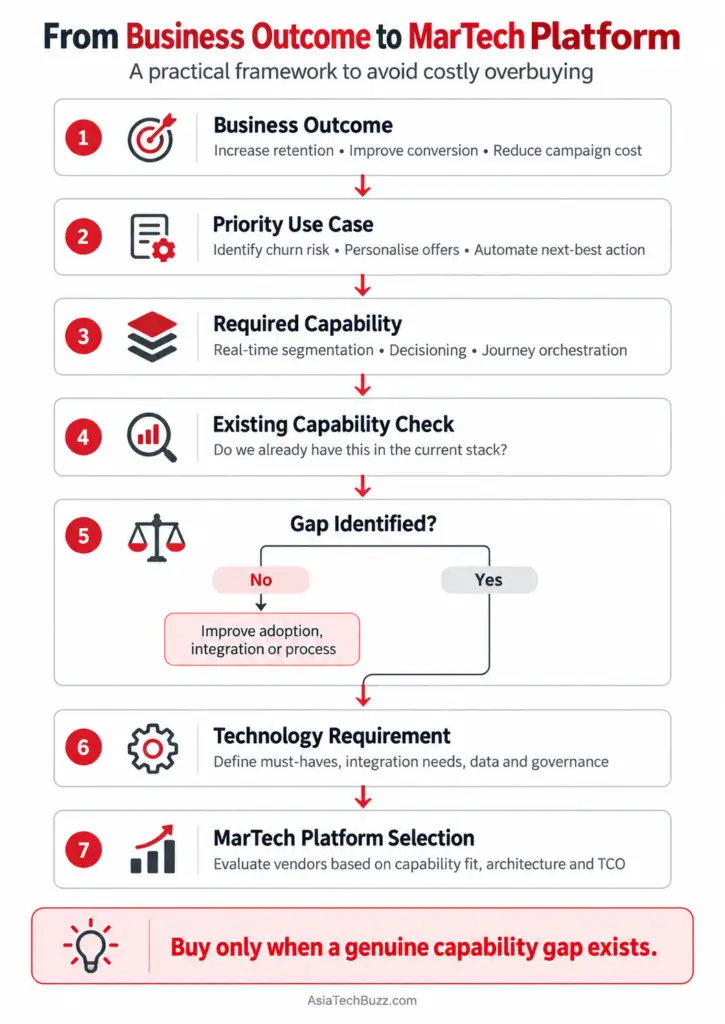
The sequence should be simple:
Business outcome -> Customer or marketing use case -> Required capability -> Technology requirement -> Platform
That order matters.
It stops a product category from becoming the answer before the problem has been defined.
It also creates a useful filter. If a vendor feature cannot be connected back to a priority use case, ask why the organisation is paying for it.
Audit Your Existing MarTech Stack Before Buying Anything
New technology should not automatically be the answer to a new requirement.
Before entering MarTech vendor selection, organisations should understand what they already own.
Gartner recommends auditing the internal ecosystem before begining vendor selection and placing greater emphasis on activated capabilities rather than measuring a vendor or platform in isolation.
Step 1: Build a Technology Inventory
Start with a simple inventory.
For every major platform, document the owner, business users, contract value, renewal date, capabilities, integrations, critical data and primary use cases.
Do not limit the exercise to software formally owned by marketing. Customer experience increasingly crosses CRM, data platforms, commerce, service, identity, content and enterprise AI services.
Step 2: Map Capabilities Across Platforms
Next, stop looking at product names and map what each platform can actually do.
You may discover that segmentation exists in the CDP, CRM, marketing automation tool and analytics platform. Personalisation may exist in the CMS, experimentation platform and journey solution. Generative content may now appear in almost every tool.
This does not mean all overlapping capabilities are identical.
Dept, performance and intended use cases may differe considerably. But the overlap should be understood before another platform is introduced.
For readers exploring this architectural question in more depth, AsiaTechBuzz’s Composable MarTech Architecture: Powerful Growth explains how specialist capabilities can be assembled deliberately without turning best-of-breed into a collection of disconnected tools. Read Composable MarTech Architecture on AsiaTechBuzz.
Step 3: Measure Actual Utilisation
Platform adoption and capability utilisation are not the same thing.
A team may log into a product every day while using only a small part of what the licence includes.
Gartner’s 49% utilisation figure is useful precisely because it shifts attention from whether a product exists to whether is capability are actually activated.
For each significant capability, ask:
- Is it configured?
- Is it connected to the required data?
- Is somebody trained to use it?
- Does it support a live business process?
- Is performance measured?
- Does it create a measurable outcome?
That gives leaders a much clearer view than simple login statistics.
Step 4: Classify What You Find
A practical audit can place capabilities into five groups.
Core
Actively used and strategically important.
Underused
Valuable capability exists, but adoption, skills or implementation are incomplete.
Duplicated
Similar capabilities exisst across multiple products.
Missing
A validated business requirement cannot be supported adequately by the current stack.
Retire
The technology or capability provides little value relative to its cost and complexity.
Only after this exercise should the organisation begin looking at new products.
Build Requirements Around Capabilities
Traditional RFPs often grow into hundreds of requirements because every stakeholder adds everything they might conceivably need.
The result is a document that becomes very good at measring feature quantity and less effective at identifying strategic fit.
A smarter MarTech strategy separates requirements by importance.
Must-Have Capabilities
These directly support approved use cases or critical non-functional requirements.
If the platform cannot provide them, it should not remain on the shortlist.
Should Have Capabilities
These ahve clear potential value but are not essential to the initial business case.
Nice-to-Have Capabilities
These may be interesting, innovative or useful in the future.
They should receive a low weighting unless there is a credible adoption plan.
Test Capability Depth, Not Labels
Feature names can be misleading.
Two vendors may both claim “real-time personalisation”, “AI-powered optimisation” or “Customer 360”. Their ability to support your actual use case may be very dfferent.
Ask vendors to demonstrate the end-to-end scenario.
What data is required? How quickly does it update? Who can configure it? How is consent respected? How is the decision exposed to another channel? How is performance measured?
Capability depth becomes visible when the conversation moves from labels to execution.
Choose the Right MarTech Architecture
Platform selection is also an architecture decision.
A product can be excellent on its own and still be the wrong addition if it creates excessive integration work, duplicates a strategic platform or locks key data inside a proprietary model.
Suite vs Best-of-Breed
There is no universal winner.
A suite can reduce the number of vendors, simplify procurement and provide stronger native integration between selected products.
Best-of-breed can provide deeper specialist capability and more flexibility.
The right answer depends on where differentiation matters.
A business may reasonably standardise commodity capabilities while choosing specialist platforms for areas that create competitive advantage.
What Composable Really Means
Composable architecture is sometime misunderstood as buying many specialist tools.
That is not the objective.
A good composable approach selects capabilities intentionally and connects them through well-defined APIs, shared data models and governance standards.
AsiaTechBuzz’s The AI-Ready MarTech Stack: The Strategic Blueprint for Modern Marketing Infrastructure expands this idea through a broader architecture that connects structured content, trusted data, AI intelligence, integration and orchestration. Read The AI-Ready MarTech Stack on AsiaTechBuzz.
The important point for platform buyers is that modularity only creates agility when the modules can work together.
Avoid Integration Debt
Every new platform introduces relationships with other systems.
A low licence price can therefor hide a large integration burden.
Before approving a product, map what must connect to it, how data will move, which interfaces are native, which require custom development and who will support those connections after launch.
This matters because MarTech stacks are becoming harder to simplify. MarTech’s 2025 Replacement Survey found that 59.9% of respondents had replaced a marketing technology application in the previous year, down from 69.8% at the 2022 peak. At the same time, stacks continued to grow, suggesting organisations are increasingly adding around core systems rather than continually replacing them. MarTech: Why MarTech Stacks Are Getting Messier.
Architecture decisions compound. A shortcut today can become tomorrow’s technical debt.
Evaluate MarTech Vendors Differently
Once the required capabilities and architecture are clear, vendor selection become much easier.
The objective is not to discover which platform looks best in a demonstration. It is to determine which option fits the organisation’s real operating environment.
Use Real Business Scenarios
Give shortlisted vendors the same scenarios and ask them to demonstrate them.
Use realistic customer journeys, data constraints, channels and governance requirements.
If cross-channel journey management matters, do not settle for a slide showing that the capability exists. Ask the vendor to build the decision flow.
If structured content distribution matters, show how content moves from creation to web, app, partner API and AI consumption.
If the requirement involves customer intelligence, ask how identity, behavioural data and traction signals are combined and made available to marketers.
This makes comparisons much more meaningful.
Test Critical Capabilities With a Proof of Concept
For strategic or uncertain capabilities, use a forcused proof of concept rather than relying solely on a product demonstration.
Test the areas most likely to determine success, such as a difficult integration, decision latency, marketer usability, identity resolution or content reuse.
Speak to Customers Who Operate at Similar Scale
Customer references can reveal the gap between the product that was sold and the platform that teams actually use.
Ask about adoption, custom development, unused capabilities, support after implementation, renewal costs and what the customer would do differently.
Calculate the True Cost of the MarTech Stack
Licence price is visible. Total cost is not.
A sound investment decision should consider the full economic impact across several years.
Use a Total Cost of Ownership Model
A practical model is:
MarTech TCO = Licence + Implementation + Integration + Data + People + Operations + Change + Exit Cost
Implementation can involve system integrators, internal engineering and migration.
Integration includes APIs, middleware, testing and ongoing maintenance.
People includes administrators, campaign specialists, analysts and technical support.
Change includes training, process redesign and temporary productivity loss while teams adkpt the platform.
Exit cost includes migration effort, contract constraints and replacing workflows that become dependent on proprietary technology.
An analysis published by MarTech in March 2026 argues that standard consolidation business cases frequently miss adoption gaps, integration work and renewal pricing. It cites one mid-market B2B example where US$850,000 in annual software licences translated into US$2.1 million in full loaded annual stack cost. That example should not be treated as a universal benchmark, but it illustrates why licence-to-licence comparisons can be misleading. MarTech: Why MarTech Consolidation Business Cases Fall Short.
Model the Adoption Ramp
Business cases often assume value begins when implementation ends.
Reality is slower.
Teams need to learn the product, data needs to stabilise, processes have to change and campaigns must migrate.
A platform that delivers significant theoretical value after two years may still be a poor investment if the organisation needs results within six months.
Model when capabilities become usable, not just when software become available.
Calculate ROI at the Capability Level
Platform-level ROI can be difficult to interpret because one product often supports many use cases.
Capability-level measurement is more useful.
For example, measure the incremental value from better lead prioritisation, reduced campaign production time, improved conversion, lower media waste or increased retention.
Then compare that value with the cost of activating and operating the capability.
This is consistent with Gartner’s recommendation to prioritise measurement of activated capabilities instead of focusing only on a single vendor or platform.
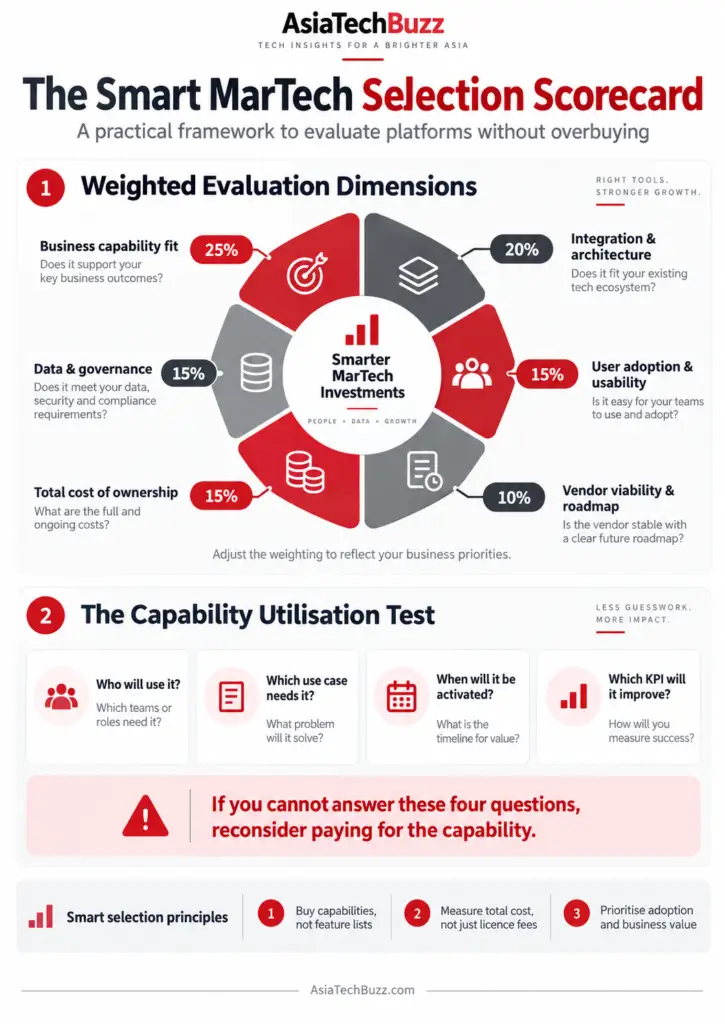
Use a Smarter MarTech Platform Selection Scorecard
A scorecard helps prevent the loudest stakeholder or most polished vendor presentation from domination the decision.
A practical evaluation could assess:
- Business capability fit
- Integration and architecture
- Data and governance
- User adoption and usability
- Total cost of ownership
- Vendor viability and roadmap
The precise weighting should reflect the organisation’s priorities.
Add a Capability Utilisation Test
For every major capability included in the business case, ask four questions:
- Who will use it?
- Which will be activated?
- When will it be activated?
- Which KPI should improve?
If nobody can answer those questions, reduce its weighting.
This one step can prevent a large number of attractive but unnecessary features from inflating the decision.
People, Process and Adoption Matter as Much as Technology
A sophisticated platform does not create sophisticated marketing by itself.
Gartner’s 2026 AI research provides a useful warning. Sixty-six percent of marketers said learning new technologies takes significant time away from day-to-day work.
That is not simply a training issue. It is a capacity issue.
Assess Organisational Readiness
Before buying advanced capability, consider whether the organisation has the required:
- Data quality
- Technical integration
- Operating processes
- Governance
- Specialist skills
- Business ownership
- Measurement framework
If several foundations are missing, the implementation roadmap should address them.
Do Not Buy Faster Than the Organisation Can Absorb
Organisational readiness also connects with the wider marketing operating model.
AsiaTechBuzz has explored how AI-era marketing increasingly requires stronger collaboration between marketing, IT, data and governance teams rather than treating technology as a standalone marketing purchase. The article The Marketing Operating Model in the Age of AI Search Optimization examines this organisational shift in more detail. Read the Marketing Operating Model article on AsiaTechBuzz.
A new platform without the people and process needed to activate it simply adds another layer of unrealised potential.
Build a Roadmap Instead of Buying Everything at Once
Rather than purchasing every perceived requirement together, organise investment around the capabilities the business can realistically activate.
Stage 1: Foundation
Establish reliable content, customer data, identity, consent, analytics, and core integration.
Without these foundations, more advanced technology often creates another disconnected layer.
AsiaTechBuzz’s Structured Marketing Data: The Powerful Backbone of AI-Driven Marketing explores machine-readable, connected information is becoming increasingly important as analytics, personalisation and AI consume marketing data. Read Structured Marketing Data on AsiaTechBuzz.
Stage 2: Activation
Enable teams to use data and content effectively across campaigns and channels.
This may include audience management, marketing automation, digital experience and experimentation.
Stage 3: Orchestration
Once data and channels are connected, the organisation can coordinate decisions across customer journeys.
This is where customer journey orchestration becomes relevant.
As explored in AsiaTechBuzz’s pillar article Customer Journey Orchestration: Why Marketing Automation Is No Longer Enough for Modern Brands, the objective is not simply to automate more campaigns. It is to coordinate the most appropriate interaction across channels based on customer context. Read Customer Journey Orchestration on AsiaTechBuzz.
Stage 4: Intelligence and AI
AI can then enhance decisioning, content operations, customer intelligence and automation.
The sequence is not rigid. Some organisations will introduce AI earlier. The principle is that advanced capability should build on sufficient data, process and governance readiness.
When Should You Consolidate Your MarTech Stack?
Overbuying eventually creates pressure to consolidate.
Common warning signs include overlapping platforms, low utilisation, rising integration effort, duplicated data, fragmented customer journeys and difficulty explaining ROI.
Consolidation can help, but fewer vendors should not become a goal on its own.
Consolidation Can Create New Risks
Moving five products into one large suite can simplify contracts while increasing dependency on a single vendor.
It may also replace specialist functionality with weaker native modules, require expensive migration and create new workflow constraints.
MarTech’s 2026 analysis of consolidation argues that business cases often underestimate integration, adoption and renewal economics. It also notes that organisations frequently continue using alternative products even when similar functionality is available in their primary platform.
That is an important reminder.
Optimisation should focus on the right capabilities at the right cost, not simply the smallest possible vendor count.
MarTech Strategy in the AI Era
AI raises the stakes becaause it touches almost every layer of the marketing technology stack.
Content platforms are adding generative tools. CRM platforms are adding agents. Analytics platforms are adding natural-language interfaces. Journey tools are adding predictive decisioning. Customer data platforms are adding AI audiences and intelligence.
If each capability is purchased independently, AI can recreate the fragmentation organisations have spent years trying to remove.
Decide Where AI Should Live
Marketing leaders should ask whether an AI capability belongs inside an existing platform, within shared enterprise AI services, or in a specialist solution.
The answer depends on the use case.
Embedded AI may be ideal when it improves a workflow already contained within a platform.
Shared AI services may be better when the same intelligence needs to work across multiple systems and channels.
Specialist products may justify themselves when they provide differentiated capability that core platforms cannot match.
Build an AI-Ready Stack, Not an AI-Heavy Stack
The distinction is important.
An AI-heavy stack contains many AI products.
An AI-ready stack has trusted data, structured content, APIs, governance and reusable business processes that allow AI to work across the organisation.
This architecture is discussed in more detail in AsiaTechBuzz AI-Ready MarTech Stack blueprint.
The strategic principle remains unchanged: do not buy AI because the feature exists. Buy or activate it because it solves a validated business problem.
An Eight-Step MarTech Stack Selection Framework
A practical selection process can be summarised in eight steps.
1. Define the Business Outcome
Identify the commercial, customer or operational result that needs improvement.
2. Identify Priority Use Cases
Describe how the organisation expects to achieve that outomce.
3. Map the Required Capabilities
Determine what people, process, data and technology capabilities are needed.
4. Audit Existing Capabilities
Understand what the organisation already owns and what s genuinely usable.
5. Identify the Real Gaps
Separate missing capabilities from underused or poorly implemented ones.
6. Evaluate Architecture and Vendors
Assess how shortlisted options fit the wider ecosystem, not just the feature list.
7. Calculate TCO and Expected ROI
Include implementation, integration, operations, people, adoption and exit cost.
8. Activate, Measure and Optimise
Track capability utilisation and business value after launch.
If the expected capability is not being used, find out why before buying the next tool.
This framework turns platform selection from a procurement exercise into an ongoing portfolio-management discipline.
Frequently Asked Questions About MarTech Stack Strategy
-
What is a MarTech stack?
A MarTech stack is the collection of technologies, data, integrations and operating processes an organisation uses to support marketing and customer experience. It can include CRM, CMS, analytics, automation, customer data, personalisation, journey orchestration, advertising technology and AI.
-
How do you build a MarTech stack?
Start with business outcomes and priority customer use cases. Translate those use cases into required capabilities, audit what already exists, identify genuine gaps and only then evaluate new technology. This reduces unnecessary purchases and improves the likelihood and new capabilities will actually be used.
-
How many tools should be a MarTech stack?
There is no ideal number. A simple business may perform well with relatively few platforms, while a multinational company with many brands, channels and markets may require a more complex ecosystem. The better measure is whether each product has a clear role, integrates effectively and produces enough value to justify its total cost.
-
How do you choose the right MarTech platform?
Evaluate business capability fit, architecture, integration, data and governance, usuability, total cost of ownership and vendor viability. Use realistic business scenarios rather than relying only on feature lists and product demonstrations.
-
What is MarTech stack consolidation?
MarTech stack consolidation is the process of reducing unnecessary technologies or combining overlapping capabilities. It can reduce complexity, but consolidation should be based on capability, cost and architecture analysis rather than simply reducing the number of vendors.
-
How should marketers measure MarTech ROI?
Measure the business value created by activated capabilities and compare it with their full cost. Useful outcomes can include incremental revenue, conversion improvement, retention, productivity, lower media waste or faster time to market. Platform logins alone are not evidence of ROI.
Build a MarTech Stack You Can Actually Use
Marketing technology will continue to expand. AI will create new categories, established vendors will add more functionality and specialist platforms will continue to solve problems that large suites cannot address deeply.
Marketing leaders therefore need a better filter.
The question is not, “How much technology can we afford?”
It is, “Which capabilities will create enough value for us to activate, operate and continuously improve them?”
That shift changes the entire buying converrsation.
It encourages teams to audit before purchasing, define use cases before writing requirements, test capability rather than feature labels, model total cost rather than licence price and measure adoption after implementation.
Most importantly, it treats MarTech strategy as an ongoing business discipline rather than a series of technology projects.
For organisations trying to connect this investment discipline with a broader customer strategy, the AsiaTechBuzz article Digital Experience Strategy: Powerful Boardroom Growth Guide provides the next logical step. It explores how content, data, channels, orchestration and AI need to work together around the customer rather than around individual platforms. Read Digital Experience Strategy on AsiaTechBuzz.
The smartest MarTech stack is rarely the one with the most tools.
It is the one the organisation can actually use, and can prive is creating value.