Table of Contents
For years, choosing a content management system was largely a technology decision. Marketing defined what it needed from the website, IT selected a platform, developers built the templates, and content teams learned how to publish within whatever environment was provided.
That model is becoming harder to sustain.
Modern marketing teams are publishing far more than webpages. Content needs to work across websites, mobile applications, campaign landing pages, customer portals, search engines, AI assistants, partner ecosystems and personalised journeys. At the same time, marketers are under pressure to launch faster without giving up brand control, regulatory governance or content quality.
Content demand is also accelerating. Adobe research involving more than 1,600 marketers found that 96% had experienced at least a doubling of content demand over the previous two years, while 62% said demand had increased fivefold or more. Another 71% expected content demand to increase by more than five times by 2027.
Source: Adobe, Research finds demand for content will grow 5x by 2027. Adobe research on content demand.
Against this backdrop, the headless CMS vs hybrid CMS debate has moved well beyond APIs and frontend frameworks.
The important question for marketing leaders is not simply:
“Which architecture is more modern?“
It is:
“Which architecture gives our organisation the right balance between developer flexibility, marketing autonomy, content governance and long-term operating complexity?“
That distinction matters because a technically sophisticated CMS can still create a poor business outcome if marketers cannot use it efficiently.
For organisations reviewing their broader CMS direction, this article builds on the ideas covered in CMS Strategy in the AI Era, where I explored why CMS has become part of the strategic marketing infrastructure rather than simply a website publishing tool.
The next decision is architectural.
What Is a Headless CMS?
A headless CMS separates the system used to create and manage content from the frontend that presents that content to customers.
In a traditional CMS, the backend and frontend are closely connected. Authors create content within predefined pages or templates, and the CMS also controls how those pages are rendered.
A headless model removes that direct connection.
Content is stored centrally as structured information and made available through APIs. Developers can then use that content within a website, mobile application, digital product, customer portal, smart device or another experience.
In simple terms:
Content creators -> CMS -> APIs -> multiple digital experiences
This architecture became attractive as the number of digital channels expanded.
Why Headless CMS Became Popular
One of the biggest advantages is frontend flexibility.
A development team can choose the technology best suited to each experience rather than being forced to use the CMS’s built-in presentation technology.
That can make a headless approach particularly relevant when an organisation operates:
- multiple websites
- native mobile applications
- customer portals
- e-commerce experiences
- partner platforms
- interactive digital products
- conversational interfaces
- emerging AI-powered experiences
The underlying content can be created once and consumed by many interfaces.
This is also why headless architecture fits naturally into the broader idea of a composable CMS and composable technology stack.
I explored this architectural shift in more detail in Composable MarTech: Why Modular Platforms Are Powering AI-Ready Organisations. In a composable environment, individual capabilities can evolve independently rather than forcing the organisation to replace an entire every time its requirements change.
The Limitation Marketing Leaders Need to Understand
The strength of headless architecture can also create its most important business challenge.
Removing the presentation layer gives developers freedom, but it can also remove some of the visual tools marketers previously relied on.
A poorly implemented headless environment can leave marketers entering information into forms and fields without clearly seeing the final customer experience.
The result may be technically excellent content delivery combined with increased business dependency on developers.
This is where the comparison between headless CMS vs hybrid CMS becomes important.
What is a Hybrid CMS?
A hybrid CMS attempts to combine the architectural freedom of headless content delivery with the authoring experience associated with more traditional content management systems.
Developers can still consume structured content through APIs and build modern frontend applications.
At the same time, marketers may receive capabilities such as:
- visual page composition
- live preview
- reusable page components
- drag-and-drop layouts
- workflow management
- localisation tools
- scheduled publishing
- campaign management
- in-context content exiting
Magnolia CMS, for example, describes its hybrid-headless approach as combining API-based delivery for developers with visual authoring capabilities for marketers.
Source: Magnolia, Cross channel marketing & hybrid headlless. Magnolia hybrid-headless overview.
The objective is not to reverse headless architecture. It is to restore business-user context on top of it.
That creates an important middle ground.
Developers retain control over how digital experiences are engineered, while marketers gain more control over what those experiences contain and how pages are assembled.
Headless CMS vs Hybrid CMS: What is the Real Difference?
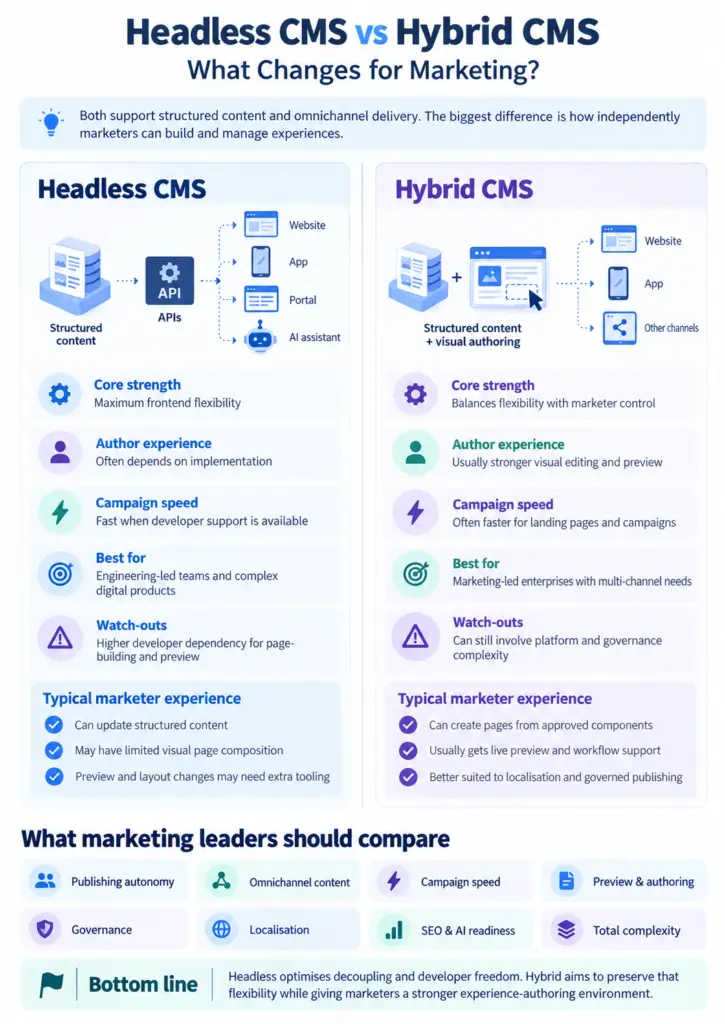
At first glance, both models may support APIs, structured content and omnichannel publishing.
The biggest difference is often not content delivery.
It is the operating model around content creation.
| Capability | Headless CMS | Hybrid CMS |
|---|---|---|
| Structured content | Strong | Strong |
| API-based delivery | Strong | Strong |
| Frontend flexibility | Very high | High to very high |
| Omnichannel delivery | Strong | Strong |
| Visual page building | Depends on platform | Usually stronger |
| Live preview | Often requires configuration | Often integrated |
| Marketing autonomy | Implementation-dependent | Typically prioritised |
| Developer flexibility | Very high | High |
| Enterprise governance | Platform-dependent | Often extensive |
| Experience composition | May require additional tooling | Often built in |
The distinction is becoming less rigid because many previously pure headless vendors are adding visual authoring capabilities, while traditional enterprise platforms are becoming increasingly API-first.
The market is converging.
That means buyers should be careful about selecting a platform simply because it carries a particular architectural label.
A better approach is to examine the capabilities that matter to your operating model.
Author Experience Is an Architectural Requirement, Not a Nice-to-Have
One of the most overlooked considerations in the headless CMS vs hybrid CMS discussion is author experience.
This matters because developers are rarely the people making hundreds or thousands of content changes every month.
The daily CMS users may include:
- content authors
- SEO specialists
- campaign managers
- product marketers
- brand teams
- local-market teams
- communication teams
- compliance reviewers
- digital product owners
If most daily users are business users, author experience deserves the same level of consideration as API performance or frontend architecture.
Adobe’s Universal Editor illustrates how the market is evolving. Adobe describes it as a visual authoring environment that supports WYSIWIG editing for both headful and headless experiences while allowing developers to remain decoupled from the presentation layer.
Source: Adobe Experience Manager, Universal Editor Introduction. Adobe Universal Editor documentation.
The objective is revealing: modern platforms increasingly recognise that headless flexibility should not require marketers to sacrifice visual context.
Content Edititng Is Not the Same as Experience Authoring
This distinction is particularly important when evaluating headless platforms.
A business user may be able to change:
- headline
- body copy
- product information
- FAQs
- images
- metadata
- promotional messages
That is content authoring.
But can the same user create a new landing page, add a hero component, rearrange product cards, insert an FAQ module, add a form, configure SEO metadata and preview the entire experience?
That is content authoring.
The two capabilities should not be confused.
What Good Author Experience Should Include
Visual Page Composition
Can marketers assemble pages from approved components without creating a development ticket?
Live Preview
Can they see how content looks across desktop and mobile before publication?
Layout Control
Can marketers rearrange components while remaining inside approved design-system guardrails?
SEO Controls
Can authors manage titles, descriptions, canonical URLs, redirects, structured data and indexing rules without changing code?
Localisation
Can regional teams translate and adapt experiences while maintaining global governance?
Workflow and Approval
Can the organisation configure author, reviewer, legal, compliance and publisher roles?
These capabilities directly influence marketing productivity.
If every campaign page still requires frontend development, architectural modernisation may not have delivered operating-model modernisation.
Developer Experience and Author Experience Need to Coexist
The answer is not to prioritise marketers at the expense of developers.
Both groups need appropriate independence.
| Developer Experience | Author Experience |
|---|---|
| APIs | Visual editing |
| SDKs | Live preview |
| Framework freedom | Page composition |
| CI/CD | Campaign creation |
| Extensibility | Localisation |
| Content models | SEO controls |
| Performance optimisation | Approval workflows |
| Integration flexibility | Publishing autonomy |
The strongest CMS operating model establishes a contract between the two groups.
Developers create reusable components, content structures, APIs and design-system guardrails.
Marketers then use those approved building blocks without requiring development for routine publishing.
This creates controlled autonomy.
Optimizely CMS 13 demonstrates this direction clearly. Its Visual Builder allows content managers to create layouts using reusable sections while developers continue to control the underlying platform architecture. Optimizely says its headless applications can deliver through Graph while content teams work independently.
Source: Optimizely CMS 13 documentation. Optimizely CMS 13 overview.
Headless CMS vs Traditional CMS vs Hybrid CMS
For many organisations, the decision is still framed as headless CMS vs traditional CMS.
That comparison is useful, but increasingly incomplete.
Traditional CMS
A traditional CMS tightly connects content management with presentation.
Its strengths often include:
- simple authoring
- visual page creation
- established workflows
- fewer moving parts
The limitation is that content and presentation may become closely coupled, making reuse across new channels more difficult.
Headless CMS
Headless architecture separates the layers.
This improves flexibility and makes structured content easier to reuse across digital products.
However, the organisation assumes responsibility for more the experience layer.
Hybrid CMS
Hybrid architecture attempts to provide both.
Content can be API-delivered while marketers maintain contextual page-building and preview capabilities.
The better question is therefore no longer simply:
“Traditional or headless”
It is:
“How much decoupling does our organisation actually need, and where should marketers retain control?”
10 Factors Marketing Leaders Should Compare
Architecture should ultimately be evaluated against business requirements.
1. Publishing Autonomy
Ask how much marketers can accomplish independently.
Can the team launch a campaign page without waiting for a development sprint?
Can content changes be published safely within predefined templates?
Reducing routine technology dependency can materially change campaign velocity.
2. Omnichannel Content Delivery
If the organisation needs the same information across web, apps, service channels and AI experiences, structured API-accessible content becomes increasingly valuable.
This is also important for AI readiness.
As explored in Structured Content for AI, content becomes more reusable when it is modelled as entities, attributes and relationships rather than being locked inside complete webpages.
3. Campaign Speed
A CMS should shorten the distance between idea and execution.
Consider a Monday campaign brief requiring a six-page microsite by Friday.
Can marketing built it??
Or does every new page require frontend coding?
That practical scenario will often reveal more about platform suitability than an architecture diagram.
4. Preview and Authoring
Marketers need confidence before publishing.
This is particularly important in regulated industries, where a headline, fee, eligibility criterion or disclaimer may have commercial or compliance implications.
Magnolia has cited research among CMS users where 82% of marketers said they were confident using a traditional CMS compared with 42% for headless CMS, attributing part of that difference to the lack of a visual frontend. As vendor-sponsored research, this should be treated as directional rather than independent market measurement.
Source: Magnolia, Digital experience, driving the push for visual headless. Magnolia CMS user research.
5. Governance
Publishing autonomy cannot mean unlimited freedom.
Enterprise platforms need:
- permissions
- approval workflows
- audit histories
- reusable templates
- brand controls
- publishing rights
- scheduled reviews
The best governance operates as guardrails rather than bureaucracy.
6. Localisation
For multi-market organisations, localisation is much more than translation.
Regional teams may need local content, offers, disclaimers and SEO while global teams need common branding and governance.
The CMS should allow both.
7. Personalisation
Neither architecture automatically creates personalisation.
Personalisation depends on the broader ecosystem, including customer data, analytics, decisioning and experimentation.
The CMS provides the content that these systems activate.
8. SEO and AI Search Readiness
A modern CMS should support both traditional search optimisation and increasingly machine-consumed content.
That includes:
- structured fields
- schema markup
- metadata
- internal linking
- canonical controls
- clean URLs
- content relationships
- crawability
That is why CMS architecture increasingly intersects with AI visibility.
The AsiaTechBuzz article CMS for AI Search explores this further, including how structured and governed owned content can improve the ability of search engines and AI systems to understand a brand correctly.
9. Developer Dependency
Do not ask whether the platform needs developers.
Every serious digital platform does.
Ask instead:
Which activities should require developers?
Building a new component probably should.
Changing a campaign headline should not.
Creating a landing page from approved components may not.
That boundary is critical.
10. Total Complexity and Cost
Platform licence cost is only one component of CMS economics.
Consider:
- frontend development
- integrations
- hosting
- testing
- security
- maintenancer
- upgrades
- localisation
- support
- content operations
- developer resources
- implementation partners
Gartner’s 2025 Marketing Technology Survey reported average MarTech utilisation falling to 49%, reinforcing the importance of evaluating actual adoption and business use rather than purchasing capability for its own sake.
Source: Gartner, Maximize ROI With Marketing Technology. Gartner MarTech Utilisation Research.
When Does a Headless CMS Make Sense?
A headless approach can be compelling when the organisation has strong engineering capabilities and content needs to serve many digital products.
Typical conditions include:
- several frontend applications
- major mobile-app requirements
- highly customised customer experiences
- strong internal frontend engineering
- API-first architectural standards
- substantial structured-content reuse
- frequent creation of new digital products
A digital-native business may willingly accept greater frontend responsibility because frontend engineering is already a core competency.
The organisation should still evaluate the authoring layer carefully.
Headless does not need to mean poor author experience, but achieving a strong business-user experience may require additional configuration or tools.
When Does a Hybrid CMS Make Sense?
A hybrid approach can be attractive where the organisaiton wants modern content delivery but the website remains a major marketing and acquisition platform.
Typical requirements include:
- frequent campaign launches
- significant SEO operations
- large marketing teams
- many regional authors
- strong brand governance
- regulated publishing workflows
- page-level experimentation
- marketer-created landing pages
- multiple digital channels
In this environment, marketing independence may carry significant business value.
The organisation still benefits from APIs and structured content but does not need to abandon visual experience management to obtain them.
Where Does Composable CMS Fit?
Headless and composable are related concepts, but they are not interchangeable.
Headless describes separation between content management and presentation.
Composable describes a broader technology strategy in which different capabilities can be assembled from modular services.
A composable architecture might include:
- CMS
- digital asset management
- search
- commerce
- customer data
- personalisation
- experimentation
- analytics
- AI services
This give organisations flexibility to choose specialised capabilities.
It also introduces another consideration: integration.
More modularity means more interfaces, vendors, data flows and governance requirements.
Flexibility therefore has an operating cost.
The objective should not be maximum composability. It should be the level of composability the organisation can successfully operate.
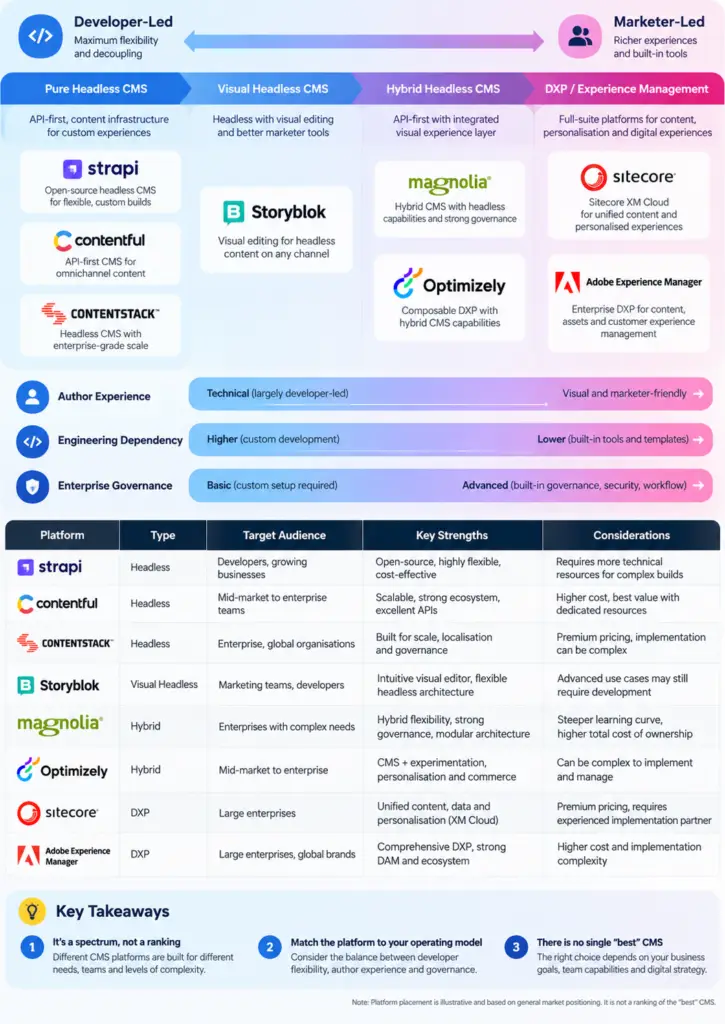
Enterprise CMS Landscape: Which Platforms Are Built for Whom?
There is no universal CMS architecture for every enterprise.
The following comparison is deliberately not a ranking. It shows how different platforms broadly positioned themselves and what marketing leaders should investigate during selection.
| Platform | Broad Model | Typical Audience | Strengths to Evaluate | Trade-offs to Evaluate |
|---|---|---|---|---|
| Adobe Experience Manager | Hybrid / DXP / headless-capable | Large global enterprises | Governance, visual authoring, DAM, multi-site operations, Adobe Ecosystem | Platform breadth, skills and implementation complexity |
| Sitecore XM Cloud | Hybrid-headless / composable | Large enterprises and sophisticated digital teams | Visual page building, personalisation, multisite management, composability | Ecosystem and implementation complexity |
| Magnolia CMS | Hybrid headless | Enterprise balancing marketers and developers | Visual authoring, API flexibility, gradual modernisation | Smaller implementation ecosystem than the largest DXP vendors |
| Optimizely CMS | Hybrid / Headless | Marketing-led enterprises | Visual Builder, experimentation, content management, Graph delivery | Broader platform architecture and .NET considerations |
| Contentful | Headless / composable | Product and engineering-led enterprises | Structured content, API maturity, ecosystem, Studio | Platform operating model and authoring requirements should be tested |
| Contentstack | Enterprise headless | Large organisations required structured omnichannel content | Governance, APIs, Visual Editor, emerging visual composition | Studio is still evolving; engineering capability remains important |
| Storyblok | Visual headless | Digital teams balancing developers and marketers | Component approach, visual editing, API-first delivery | Enterprises should validate governance and broader DXP requirements. |
| Strapi | Open-source headless | Developer-led organisations wanting architectural control | Open source, extensibility, self-hosting options, flexibility content modelling | Experience composition requires more deliberate implementation |
Adobe Experience Manager
Adobe is designed for large organisations where content management operates within a wider digital experience ecosystem.
AEM’s Universal Editor gives authors visual editing across headless and headful experiences while allowing developers to work with decoupled architectures.
Best aligned with: global enterprises requiring sophisticate governance, digital assets, multi-site capabilities and extensive marketing operations.
Strengths: enterprise governance, authoring depth, Adobe ecosystem integration and broad digital-experience capabilities.
Trade-offs: organisations should determine whether they need the breadth of the platform and whether they have the operating maturity to support it.
Sitecore XM Cloud
Sitecore positions XM Cloud as a cloud-native hybrid-headless CMS with visual tools for marketers alongside API flexibility for developers. Sitecore has also expanded marketer self-service capabilities including multi-site management and experimentation.
Best aligned with: enterprises with sophisticated web estates, personalisation ambitions and composable architecture strategies.
Strengths: visual experience management, reusable components, multisite support and digital-experience capabilities.
Trade-offs: organisations should asses ecosystem, implementation complexity and the level of internal skills required.
Magnolia CMS
Magnolia CMS is an example of a platform that explicitly positions itself around hybrid headless.
Its Visual SPA Editor is designed to give marketers control over layout and content while developers maintain a separated frontend.
Best aligned with: enterprises that want modern architecture while maintaining strong marketer control over websites and campaigns.
Strengths: visual authoring, frontend flexibility, integration orientation and incremental modernisation.
Trade-offs: local implementation skills and partner ecosystem should be assessed in each market.
Optimizely CMS
Optimizely CMS 13 brings headless delivery and visual composition closer together.
Its Visual Builder provides drag-and-drop composition, real-time preview and reusable sections, while Optimizely Graph supports content delivery across channels.
Best aligned with: marketing-led organisations that combine content management with experimentation and digital optimisation.
Strengths: authoring, experimentation ecosystem, reusable experiences and marketer independence.
Trade-offs: organisations should evaluate the broader Optimizely ecosystem and their architectural requirements rather than assessing the CMS in isolation.
Contentful
Contentful historically represented the API-first headless model, but its authoring proposition has expanded considerably.
Contentful Studio now enable marketers to visually create and update pages while using templates, design tokens and governance controls.
Best aligned with: enterprises requiring strong structured content and omnichannel delivery, particularly those with established product and engineering teams.
Strengths: content modelling, APIs, ecosystem, reusable content and increasingly capable visual composition.
Trade-offs: buyers should test real marketing workflows rather than assuming either its historical headless reputation or newer visual tooling tells teh complete story.
Contentstack
Contentstack provides enterprise headless content management with visual editing capabilities.
Its newer Studio experience adds visual page composition so authors can rearrange sections and build pages from developer-created components. As of September 2026, Contentstack documents Studio as being in limited beta, so organisations considering it should validate product maturity and availability directly.
Best aligned with: enterprises needing structured omnichannel content, governance and an API-first architecture.
Strengths: enterprise content operations, APIs, visual editing and governance.
Trade-offs: frontend engineering remains important and emerging experience-building functionality should be tested thoroughly.
Storyblok
Storyblok represents the increasingly important visual headless category.
Developers create reusable components while marketers work through a Visual Editor, allowing both groups to retain appropriate control.
Best aligned with: digital organisations wanting headless flexibility without reducing marketers to form-based content editing.
Strengths: visual editing, component architecture and frontend freedom.
Trade-offs: large enterprises should validate governance, integration and wider digital-experience requirements against their operating model.
Strapi
Strapi provides an important contrast to the large enterprise suites.
It is an open-source headless platform with flexible content modelling, APIs and deployment control. Enterprise features include audit logs and review workflows, while newer Live Preview functionality improves the editing experience.
Best aligned with: engineering-led organisations that prioritise extensibility, architecture control and custom digital products.
Strengths: open-source foundation, extensibility, flexible structured content, deployment choice and developer control.
Trade-offs: marketers may be able to edit and preview content, but full experience composition can require more deliberate frontend implementation than platforms designed around marketer-led page building.
That distinction makes Strapi particularly useful in this comparison.
A business user being able to changer text is not the same as being able to independently construct a campaign experience.
A Practical CMS Decision Framework for Marketing Leaders
Instead of beginning vendor selection with a list of features, start with five operating questions.
1. Who Will Use the CMS Most Often?
If hundreds of marketers use the CMS and a relatively small engineering team manages the platform, auther experience should carry substantial weight.
2. How Many Experiences Must the Content Serve?
If content primarily serves one corporate website, maximum architectural decoupling may deliver limited additional value.
If the same content must serve web, app, partners and AI experiences, API-based reuse becomes much more important.
3. How Independent Must Marketing Be?
Define what marketers should be able to accomplish without engineering.
Do not leave this vague.
List the acutal tasks
4. How Strong Is Your Engineering Capability?
A highly composable environment may be powerful, but someone must build, integrate, secure, monitor and maintain it.
Architecture should reflect organisational capability.
5. What Complexity Can You Sustain for Five Years?
Buying technology is easier than operating technology.
Evaluate:
business value / long-term complexity
rather than features alone.
The Future of Enterprise CMS Is Not Simply Headless
The CMS market is already moving beyond a binary architecture debate.
Pure headless vendors are introducing visual editors.
Enterprise DXP platforms are adding API-first delivery.
Visual headless platforms are combining structured content with experience composition.
AI is creating another requirement: content increasingly needs to serve both humans and machines.
This means the future will probably be defined less by whether a platform calls itself headless or hybrid and more by whether it can support four things simultaneously:
structured content + omnichannel delivery + excellent author experience + enterprise governance
This also connects directly to the broader idea of an AI-ready content foundation.
As discussed in the AI-Ready MarTech Stack, structured content becomes increasingly important when the same knowledge must support websites, applications, personalisation engines and AI-powered interfaces.
The architecture should make that reuse easier without making everyday marketing unnecessarily difficult.
Final Takeaway: Choose the Operating Model, Not the Architecture Trend
The headless CMS vs hybrid CMS decision should not begin with technology fashion.
It should ebgin with the organisation.
What does marketing need to publish?
How many channels need the content?
How frequently does it change?
How important is visual authoring?
How much governance is required?
What development capability exists internally?
Where should marketing operate independently, and where should technology retain control?
For engineering-intensive organisations building highly customised digital products, a headless approach may provide the flexibility they need.
For enterprises where websites, campaigns, SEO, localisation and business-user publishing remain strategically important, a hybrid apprach may provide a stronger balance between architectural flexibility and marketing autonomy.
Neither architecture is automatically superior.
The strongest CMS strategy aligns technology with the way the organisation actually works.
And perhaps the most important principle is this:
If marketers and business teams are the primary users of the CMS, author experience should be treated as an architectural requirement, not a usability nice-to-have.
A CMS modernisation programme has not truly improved marketing operations if the technology becomes more sophisticated while marketers become more dependent on developers.
For more perspective on CMS strategy, structured content, AI visibility and the future of marketing technology, continue exploring AsiaTechBuzz.com, including the guides on Digital Experience Strategy, CMS Strategy in the AI Era and CMS for AI Search.
Frequently Asked Questions
What is the difference between headless CMS and hybrid CMS?
A headless CMS separates content management from presentation and delivers structured content through APIs. A hybrid CMS retains this decoupled delivery capability but adds stronger visual page building, preview or experience-authoriing tools for business users. The practical difference is often how independently marketers can create complete digital experiences.
Is a hybrid CMS the same as a headless CMS?
Not exactly. A hybrid platform can usually operate headlessly, but it also provides capabilities associated with experience management, such as visual editing and page composition. This gives organisations more flexibility in deciding which experiences are fully decoupled and which remain marketer-managed.
Is headless CMS better for SEO?
Not automatically. SEO performance depends on frontend implementation, rendering, metadata, structured data, internal linking, site performance and crawlability. A headless architecture can support excellent SEO, but poor implementation can also create technical SEO problems.
Is a headless CMS more expensive than a hybrid CMS?
There is no universal answer. Licence cost is only part of the equation. A headless implementation may require additional frontend development and integration, while large hybrid platforms can cary higher platform and implementation costs. Enterprises should calculate total cost of ownership rather than comparing subscription fees alone.
Which CMS architecture is better for enterprise marketing teams?
The appropriate architecture depends on the organisation’s operating model. Enterprise with strong engineering resources and many custom digital products may place greater value on headless flexibility. Marketing-heavy organisations running frequent campaigns, multiple markets and substantial web operations may place greater value on hybrid authoring capabilities. The correct choice depends on content channels, author needs, governance requirements and engineering capacity.