
Table of Contents
For years, the enterprise CMS had a relatively straightforward job: help organisations create, manage and publish digital content.
That job is becoming considerably more complicated.
Marketing teams are now expected to support websites, apps, campaign landing pages, email, social media, customer-service journeys, personalised experiences and increasingly AI-powered interfaces. At the same time, organisations are producin more content than ever.
Adobe research published in 2025 illustrates the scale of the challenge. Based on a servey of more than 1,600 marketers, 96% said content demand had at least doubled during the previous two years, while 62% said it had increased fivefold or more. Perhaps more significantly, 71% expected demand to grow by more than five times again by 2027.
Source: Adobe – 71% marketers say content demand will grow 5X or more by 2027. Adobe research on growing content demand.
The obvious response might be to produce content faster.
But that only solves part of the problem.
The more important questions are becoming:
What content do we already have?
Which information is still accurate?
What is performing?
What should be reused?
Where are the gaps?
Which content should be upgraded rather than recreated?
And increasingly, what should artificial intelligence be allowed to generate, recommend, retrieve or distribute?
This is where content intelligence become important.
It represents a shift from managing content primarily as pages and files towards understanding content as structured, measurable and reusable business information.
The enterprise CMS is therefore evolving again.
The next generation will not simply help organisations publish more. It will increasingly help them understand what they have, determine how it should be used and make better decisions about what happens next.
What Is Content Intelligence?
Content intelligence is the use of content data, metadata, analytics, taxonomy, automation and artificial intelligence to better understand, organise, evaluate and activate an organisation’s content.
In simple terms, traditional content management answers:
“Where is the content and how do we publish it?“
Content intelligence adds a new set of questions:
“What does this content mean, how is it connected, how is it performing and what should we do with it?“
That distinction is important.
Content intelligence is sometimes presented as another name for generative AI. It is not.
Generative AI may form part of the capability, but the underlying concept is much broader. It includes content models, metadata, taxonomy, semantic relationships, analytics, lifecycle information, governance and reusable content components.
Without those foundations, an AI tool may be able to generate more words, images and variants, but it does not necessarily understand which information should be trusted, which content is authoritative or whether something already exists.
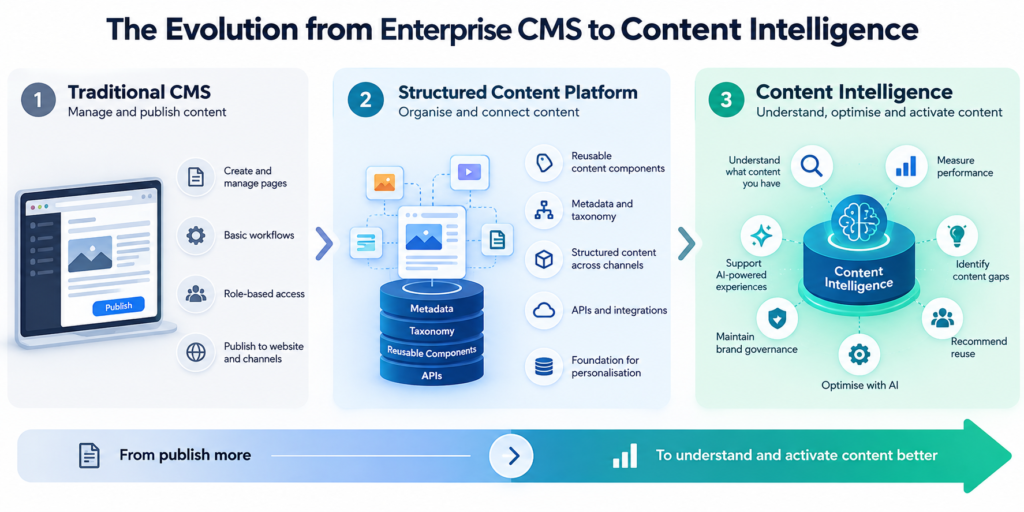
Content Management Versus Content Intelligence
A traditional CMS can store an article, product page or campaign landing page.
A more intelligent content environment can potentially understand that the content relates to:
- a specific product;
- a target customer segment;
- a stage in the customer journey;
- particular campaign objectives;
- related FAQs;
- supporting images;
- regulatory disclaimers;
- a geographic market;
- an expiry date;
- other relevant content
The richer understanding changes what the organisation can do with its content.
Instead of depending on an editor to remember that a product description also appears across five other pages, systems can increasingly use metadata and relationships to identify where the information is being reused.
And instead of producing a completely new asset whenever another channel needs content, marketers can find and adapt approved building blocks that already exist.
Why the Shift Matters Now
The timing is important because enterprises face two changes simultaneously.
The first is a rapid expansion in content demand.
The second is the growing use of AI systems that need access to reliable organisational information.
Gartner predicted that 40% of enterprise applications would include task-specific AI agents by the end of 2026, compared with less than 5% in 2025.
Source: Gartner – 40% of Enterprise Apps Will Feature Task-Specific AI Agents by 2026 Gartner AI agent forecast
As AI moves deeper into enterprise applications, content architecture starts to matter in a different way.
Content is no longer consumed only by people navigating menus and webpages.
Machines increasingly need to retrieve it, interpret it and understand the relationships between different pieces of information.
Why Traditional Enterprise CMS Thinking Is No Longer Enough
Traditional CMS platforms solved a major business problem: they separated content publishing from hard-coded website development.
That remains valuable.
The challenge is that many organisations still manage content primarily at page level.
A marketer creates a product page. Another creates a landing page. A customer-service team creates FAQs. An app team writes another version. A campaign team creates yet another variation.
Over time, information becomes fragmented.
The problem is not necessarily that the CMS cannot store the information. The problem is that the organisation lacks a clear understanding of how all that information is connected.
Enterprise Content Has Become Difficult to See
A large organisation may own thousands of articles, product descriptions, landing pages, campaign assets, FAQs, videos, PDFs and images.
Knowing precisely what exists can be surprisingly difficult.
That creates operational problems.
Teams recreates assets because they cannot find existing ones.
Outdated pages remain online.
Multiple versions of the same product information circulate across channels.
Different teams use different terminology.
Performance information sits in an analytics platform while the content itself sits somewhere else.
The Content Marketing Institute’s 2025 enterprise research highlights how widespread some of these challenges remain. Among enterprise marketers surveyed, 61% cited communication across organisational silos as a challenge, 54% struggled with measuring results and 47% identified content repurposing as a content-creation challenge.
Even more revealing, only 48% agreed that their organisation measured content performance effectively, while 66% reported difficulty tracking customer journeys and 63% struggled to attribute ROI to content activities.
Source: Content Marketing Institute – Enterprise Content Marketing Benchmarks, Budgets, and Trends: 2025
Content volume, therefore, is not the same as content maturity.
Page-Centric Content Creates Hidden Duplication
Consider a consumer financial product such as a personal loan.
A traditional product page might contain:
- product name;
- key benefits;
- eligibility criteria;
- representative rates;
- application requirements;
- repayment information;
- FAQs;
- regulatory statements;
- calls to action
If all this information exists only inside the page body, it is easy for humans to read but harder to reuse systematically.
A structure approach treats these elements as individual content objects.
That means eligibility information can potentially be reused on the product page, mobile app, application journey and customer-service interface while remaining governed from an authoritative source.
This principle is explored in greater depth in AsiaTechBuzz’s Structured Content for AI-Ready Website, which examines why modular content is increasingly important for both omnichannel publishing and machine understanding.
Read: Structured Content for AI-Ready Websites
Structured content creates the foundation.
Content intelligence adds understanding and decision-making on top of it.
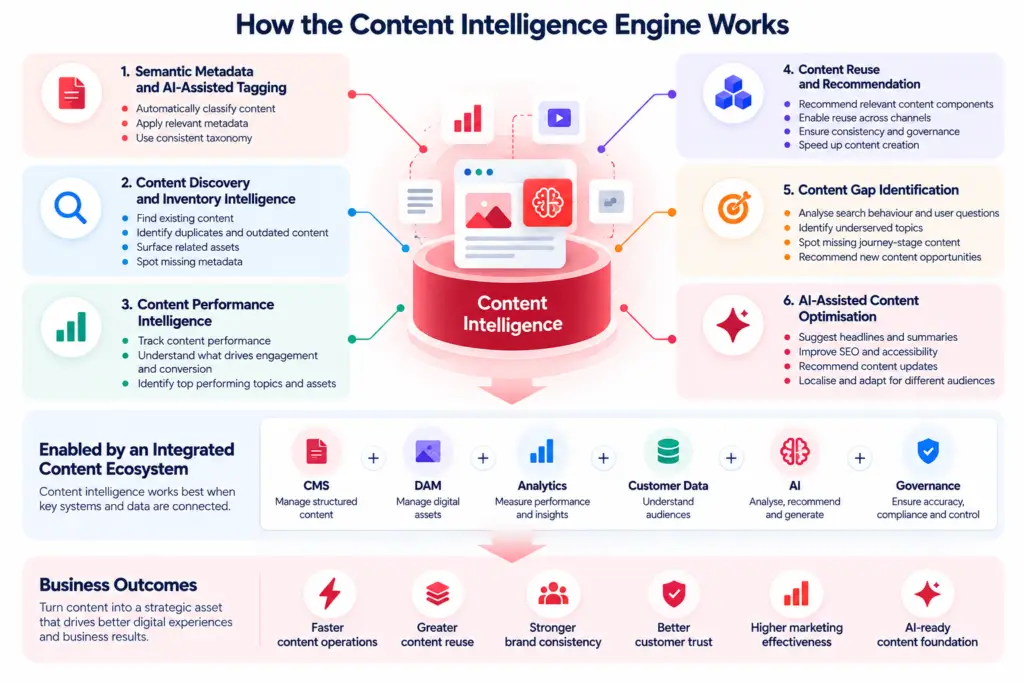
Six Capabilities That Define Content Intelligence
A mature content intelligence capability does not come from installing a single AI feature.
It emerges when content structure, analytics, metadata, governance and automation start working together.
Six capabilities are particularly important.
1. Semantic Metadata and Intelligent Tagging
Metadata give content context.
Basic metadata may describe an author, category or publication date.
More advanced metadata can describe audience, product, journey stage, geographic market, campaign objective, content format and relationships with other entities.
This becomes particularly powerful when combined with semantic understanding.
From Manual Tags to AI-Assisted Classification
Historically, tagging has often been manual.
An editor publishes an article and selects several categories.
At enterprise scale, that approach can become inconsistent. Two people may use different tags to describe the same topic. Important attributes may be missed entirely.
AI-assisted classification can recommend metadata based on the content itself.
For example, a system could recognise that an article discusses credit cards, targets first-time cardholders, belongs to the consideration stage and relates to several existing FAQs.
Human governance remains important. AI should assist taxonomy discipline rather than replace it.
But the result is richer information about what the organisation actually owns.
2. Content Discovery and Inventory Intelligence
One of the most practical applications is simply understanding the content estate.
A content intelligence platform could help organisations identify:
- duplicated content;
- outdated information;
- similar assets;
- unused content;
- orphaned pages;
- missing metadata;
- incomplete content;
- potential relationships between assets.
This matters because producing more content is not always the best answer.
Sometimes the best decision is to update an existing article.
Sometimes five pages should become one stronger page.
Sometimes an approved asset already exists but the marketing team simply cannot find it.
Content intelligence turns discovery into an operational capability rather than depending entirely on organisational memory.
3. Content Performance Intelligence
Most organisations already have analytics.
The challenge is connecting performance to the content itself.
A typical dashboard may tell marketers that a product page received 50,000 visits and achieved a certain conversion rate.
Useful – but limited.
What marketers increasingly want to understand is :
- Which proposition created engagement?
- Which FAQ helped customers continue?
- Which content component contributed to conversion?
- Which topic repeatedly brings high-quality organic traffic?
- Which messages work for one audience but not another?
This requires deeper integration between the CMS, analytics environment and potentially customer or campaign data.
The distinction matters because page-level measurement assumes the page is the unit of value.
In modular digital environments, the unit of value may instead be an offer, explanation, image, comparison table, FAQ or proposition that appears across multiple experiences.
A stronger measurement layer allows teams to learn not merely which pages perform, but which content works.
4. Content Reuse and Recommendation
Modern marketing produces enormous duplication.
A team launching a product may need content for the website, mobile application, email, paid advertising, sales enablement and customer support.
If every channel starts from a blank page, content operations become difficult to scale.
Structured content changes the model.
Approved pieces of information can be reused and assembled for different experiences.
An intelligent layer makes reuse easier by recommending relevant components.
For example, when a marketer creates a new campaign landing page, the system could surface existing approved:
- product benefits;
- customer testimonials;
- FAQs;
- campaign imagery;
- compliance statements;
- related articles;
- calls to action.
It is to stop creative teams from spending valuable time recreating basic information that already exists.
AsiaTechBuzz explores this broader operating-model shift in Content Engineering for Marketing, where content is treated less like a series of isolated creative projects and more like a structured, reusable production system.
Read: Content Engineering for Marketing
5. Content Gap Identification
Content intelligence is not only about understanding existing assets.
It can also help identify what is missing.
Imagine combing information from:
- site search;
- search-engine queries;
- customer-service questions;
- website behaviour;
- campaign performance;
- product journeys;
- existing content inventory.
Patterns begin to emerge.
Customers may repeatedly search for information that the website does not answer.
A product may have strong awareness content but very little consideration-stage guidance.
An important topic may receive significant organic demand while the organisation has only one outdated article covering it.
These are content gaps.
AI can help analyse those patterns at a scale that would be difficult to manage manually.
The value is not simply “AI can write the missing article”.
The more important capability is identifying what deserves to be created in the first place.
6. AI-Assisted Content Optimisation
Generative AI naturally plays a role, but optimisation should extend beyond content generation.
AI can potentially assist with:
- summaries;
- metadata suggestions;
- alternative headlines;
- localisation;
- tone alignment;
- accessibility checks;
- SEO recommendations;
- content refresh suggestions;
- related-content recommendations;
- taxonomy classification.
McKinsey has estimated that generative AI could create productivity value equivalent to 5% to 15% of total marketing spending, with content creation and personalisation among the relevant applications.
Source: McKinsey – The Economic Potential of Generative AI
But generating more content should not become the objective.
The stronger opportunity is using AI to help marketing teams make better decisions throughout the content lifecycle.
How Content Intelligence Changes the Role of the Enterprise CMS
The enterprise CMS has already evolved significantly.
Early system were primarily publishing tools.
Modern platforms increasingly support structured content, APIs, localisation, workflow, personalisation, experimentation and multi-channel delivery.
Content intelligence represents another stage in that evolution.
The CMS begins moving from:
publishing system -> content platform -> intelligent content layer
From Managing Pages to Managing Knowledge
This shift changes the strategic role of the CMS.
Instead of thinking only about pages, organisations begin managing entities and relationships.
A bank, for example, may define entities such as:
- products;
- rates;
- benefits;
- eligibility rules;
- customer segments;
- FAQs;
- branches;
- authors;
- expert reviewers.
These entities can then relate to one another.
The CMS becomes part of a broader organisational knowledge layer rather than merely the place where webpages are edited.
This is also why enterprise content management increasingly overlaps with data management, search, analytics and AI architecture.
AsiaTechBuzz’s CMS Strategy in the AI Era explores this broader shift, arguing that the CMS increasingly acts as digital infrastructure feeding websites, apps, search engines, AI assistants and campaign journeys.
Read: CMS Strategy in the AI Era
CMS + DAM + Analytics + AI
Content intelligence also highlights why organisations should not evaluate content technology in isolation.
Several systems may contribute.
The CMS manages structured editorial content.
The DAM manages images, videos, and other digital assets.
Analytics shows how audiences interact with content.
Customer data provides audience context.
AI can analyse, classify, recommend and generate.
Governance determines what is authoritative and what actions are permitted.
The intelligence comes from connecting these capabilities.
Why Integration Matters More Than Buying One Giant Platform
This is an important consideration for senior management.
An organisation does not necessarily need a single vendor to provide every capability.
A modern architecture may combine specialist platforms through APIs and shared data models.
The important question is whether the ecosystem allows content, metadata, analytics and intelligence to work together.
That principle alines closely with the approach described in AsiaTechBuzz’s article on Composable MarTech Architecture, where modular capabilities can evolve independently while remaining connected through common architecture and governance.
Read: Composable MarTech Architecture
Content Intelligence and the Rise of AI Search and AI Agents
Perhaps the most important reason to reconsider enterprise content architecture is that digital content increasingly has two audiences:
humans and machines.
Customers continue to browse websites and apps.
But AI search platforms, copilots, recommendation systems, conversational assistants and AI agents increasingly retrieve and process the same information.
That changes that good content architecture looks like.
AI Systems Need Clear, Structured Information
Humans are surprisingly good at interpreting message webpages.
We can infer that one sentence is a disclaimer, another is a product benefit and another is a promotional condition.
Machines benefit from greater structure.
Content models, metadata, semantic relationships and consistent entities help software understand what information represents.
This is one reason AI-ready CMS architecture is receiving greater attention.
Acquia, for example, argues that content architectures designed primarily for human navigation can become difficult for AI agents to navigate because the relationships between content types, fields and taxonomies may not be sufficiently accessible to machine-driven workflows.
This does not mean every organisation suddenly needs autonomous agents editing its website.
It means that content architecture decisions increasingly affect whether machines can find, interpret and responsibly act on enterprise information.
Content Intelligence as an AI-Readiness Layer
This is where the distinction between generative AI and content intelligence becomes especially valuable.
Generative AI answers:
“Can we create this?“
Content intelligence asks:
“Should we create it, do we already have it, is it accurate, which source is authoritative, and where should it be used?“
This a a fare more strategically important set of questions.
It also connects directly to AI search.
AsiaTechBuzz’s CMS for AI Search explains why structured fields, governance, freshness and consistent brand information matter as customers increasingly use AI-powered interfaces to discover and compare products.
Read: CMS for AI Search
Content structure does not guarantee that a brand will appear in an AI-generated answer.
Nor does adding AI functionality to a CMS automatically improve search visibility.
What it can do is reduce ambiguity and make content more consistent, interpretable and reusable – the qualities increasingly needed when both humans and machines consume organisational information.
Content Intelligence Improves More Than Marketing Productivity
The business case should not be reduced to producing content faster.
The potential impact extends across productivity, governance, customer experience and brand trust.
Faster Content Operations
When marketers can find existing assets quickly, identify authoritative versions and receive relevant recommendations, less time is spent searching and recreating.
That improves speed without simply increasing workload.
Greater Content Reuse
Reusable content reduces unnecessary duplication.
A validated product benefit, for example, can potentially be adapted across multiple experiences rather than rewritten from scratch every time.
This becomes especially valuable when organisations operate across multiple markets or channels.
Stronger Brand Consistency
Content inconsistency is often treated as a copywriting problem.
At enterprise scale, it is usually an architecture and governance problem.
If multiple teams maintain separate version of the same information, differences inevitably emerge.
Managing critical information as shared content objects reduces the number of versions that need to be maintained.
Better Customer Trust
Accuracy matters.
Imagine a customer seeing one set of eligibility requirements on a product page, another in an FAQ and a third inside an AI asistant.
Even if the dependency is accidental, trust suffers.
A stronger content foundation helps ensure that customer-facing systems use approved and current information.
This is particularly important in regulated industries, where outdated or inconsistent product information can create risk beyond marketing performance.
Better SEO and AI Search Readiness
Content architecture alone does not determine search rankings.
However, structured information, clear relationships, consistent terminology, meaningful metadata and well-maintained content make it easier to create high-quality digital experiences.
Those same qualities also make information easier for machine systems to interpret.
The objective should therefore not be to “optimise for an alogrithm”.
It should be to create an information environment that is clear, authoritatative and useful whenever content is consumed.
What Content Intelligence Looks Like in Practice
Consider a financial-services organisation offering a personal loan.
Today, information about that product may exist across:
- the corporate website;
- mobile application;
- campaign landing pages;
- FAQs
- call-centre scripts;
- CRM communications;
- partner websites;
- AI assistants.
Each channel may have developed independently.
That creates multiple copies of similar information.
Moving From Pages to Reusable Product Knowledge
A more structured model could define reusable content objects for:
- product name;
- key benefits;
- eligibility criteria;
- interest-rate information;
- required documents;
- repayment methods;
- fees;
- frequently asked questions;
- compliance disclaimers.
These become the authoritative building blocks.
Different channels can still present the information differently.
A mobile app may use a shorter version.
A product page may provide more detail.
A customer-service assistant may answer a specific question.
The presentation changes, but the underlying facts remain governed.
Adding the Intelligence Layer
Now add analytics and AI.
The organisation could begin asking:
- Which product questions are customers searching for?
- Which FAQs reduce abandonment?
- Which explanations correlate with successful applications?
- Which product information is approaching its review date?
- Which pages contain outdated versions?
- Which topics deserve additional content?
- Which approved information should the AI assistant retrieve?
This is where intelligent content management becomes materially different from simply maintaining a website.
The organisation starts learning from the content itself.
How to Build a Content Intelligence Capability
Organisations do not need to transform everything at once.
A practical approach is to build progressively.
Step 1 – Understand the Existing Content Estate
Start with an inventory.
Identify major content types, owners, duplication, outdated material and high-value content.
Without visibility, it is difficult to improve the system.
Step 2 – Move Towards Structured Content
Break important information out of long page bodies.
Product facts, FAQs, offers, author profiles, disclaimers and other reusable elements are strong starting points.
The objective is not to structure every sentence.
Structure the information that needs to be reused, governed, searched or understood systematically.
Step 3 – Establish Taxonomy and Metadata
Agree on common business language.
Define products, audiences, topics, journey stages, markets and content types consistently.
Poor taxonomy creates poor intelligence.
AI may help automate classification later, but the organisation first needs a clear semantic model.
Step 4 – Connect Content With Performance Data
Bring analytics closer to the content model.
Teams should be able to understand not only how a webpage performs but increasingly how topics, modules and assets contribute to outcomes.
This is often where content strategy becomes materially more data-driven.
Step 5 – Introduce AI-Assisted Intelligence
Once the foundations are stronger, AI can assist with classification, recommendations, summarisation, discovery and optimisation.
This order matters.
Adding AI before addressing fragmented content may simply automate fragmentation.
Step 6 – Establish Governance
Finally, determine:
- who own content;
- which systems are authoritative;
- when information must be reviewed;
- who can approve changes;
- what AI can modify;
- which outputs require human review;
- which content AI systems may access.
Governance is not the opposite of speed.
Good governance makes safe scaling possible.
What Marketing Leaders Should Look for in a Content Intelligence Platform
As vendors add more AI functionality to CMS, DAM and digital-experience products, buyers should avoid evaluating platforms purely according to the number of AI features advertised.
A more useful evaluation starts with the content foundation.
Core Capabilities to Evaluate
Depending on organisational requirements, leaders should examine:
- structured content modelling;
- metadata and taxonomy management;
- automated tagging;
- semantic search;
- DAM integration;
- content analytics;
- recommendation capabilities;
- API availability;
- AI integration;
- workflow automation;
- localisation;
- governance controls;
- versioning;
- auditability;
- human review of AI actions.
The exact architecture will differ between organisations.
An organisation with a large commerce catalogue has different requirements from a financial institution with extensive regulatory controls.
The key is to understand the operating model first and technology second.
Avoid the AI Feature Checklist Trap
It is easy to be impressed by demonstrations where an AI CMS generates a landing page within seconds.
That capability can certainly be useful.
But it is not necessarily the most important part of the system.
Senior leaders should ask:
- Does the platform understand our content model?
- Can it identify authoritative information?
- Can content be reused across channels?
- Can analytics connect back to content?
- Can AI actions be governed?
- Can we audit what happened?
- Can we change AI providers if required?
Those questions reveal whether an organisation is building sustainable content capability or simply adding an AI assistant to an existing publishing workflow.
The Future of Enterprise CMS Is Content Intelligence
Enterprise CMS has evolved repeatedly.
First it made web publishing easier.
Then it supported richer digital experiences.
Headless and composable architectures expanded content delivery across channels.
Now AI is forcing the next questions:
Can the organisation’s content infrastructure understand and active its own content intelligently?
That does not mean the CMS becomes autonomous.
It means the content layer becomes more structured, measurable, connected and machine-readable.
The competitive advantage will therefore not come from producing the most content.
Adobe’s research already suggests that content demand is rising faster than traditional operating models can comfortably support.
The advantage will increasingly come from organisatgions that know what they have, what customers need, what performs, what can be reused, what is outdated and which information AI systems can safely activate.
That is the real promise of content intelligence.
It turns enterprise content from a growing collection of pages and assets into a governed business resource that can continuously become more useful.
For marketing leaders, the message is straightforward:
The next evolution of enterprise CMS is not simply a faster way to publish., It is a smarter way to understand and use content.
Frequently Asked Questions About Content Intelligence
What is content intelligence?
Content Intelligence combines content data, metadata, taxonomy, analytics, automation and AI to help organisations understand, organise, measure and optimise their content.
Rather than treating content only as pages or files, it creates more information about what content means, how it relates to other assets, how it performs and where it can be reused.
How is content intelligence different from a CMS?
A CMS primarily manages the creation, storage, governance and publishing of content.
Content intelligence adds a layer of understanding and analysis.
It can help identify relationships, recommend existing assets, detect gaps, surface outdated material, analyse performance and support automated classification.
Modern enterprise CMS performs may increasingly provide some of these capabilities directly or through integrations.
What is a content intelligence platform?
A content intelligence platform is technology that helps organisations analyse and activate content using capabilities such as metadata, semantic understanding, search analytics, AI and automation.
It does not necessarily need to be a standalone product.
For many enterprises, the capability may emerge from integrating a CMS, DAM, analytics tools, AI services and governance systems.
Does content intelligence require generative AI?
No.
Generative AI can enhance content intelligence through summarisation, recommendations, classification and optimisation, but many of the fundamental capabilities pre-date modern generative AI.
Structured content, taxonomy, metadata, semantic search, analytics and lifecycle governance are all important foundations.
How does content intelligence support AI search?
Content intelligence can help organisations maintain information that is structured, current, consistent and semantically clear.
Those qualities can make enterprise information easier for search engines and AI-powered systems to interpret and retrieve.
However, implementation content intelligence does not guarantee inclusion or ranking in AI-generated search results.
Its value is in creating a stronger information foundation: reducing ambiguity, improving governance and making authoritative content easier for both people and machines to understand.
For organisations preparing for this shift, AsiaTechBuzz’s AI Search Optimisation Starts with Your CMS explores in more detail how structured content architecture supports retrieval and machine comprehension.
Final Thought
AI is making content easier to generate.
That may prove to be the easy part.
The harder – and ultimately more valuable – challenge is helping organisations understand the content they alrady own and use it intelligently.
That is why content intelligence deserves to be viewed not as another AI feature, but as the next stage in the evolution of enterprise content management.