Table of Contents
Imagine a customer starting a cash loan application on a website. They answer several questions, then leave before reaching the final step. An hour later, they receive a reminder. Unfortunately, they have already completed the application in the company’s mobile app. The next day, another message invites them to apply for the same loan.
The marketing system has done exactly what it was told to do. It captured an event, started a journey and delivered the message. Yet the customer sees a company that cannot recognise what has already happened.
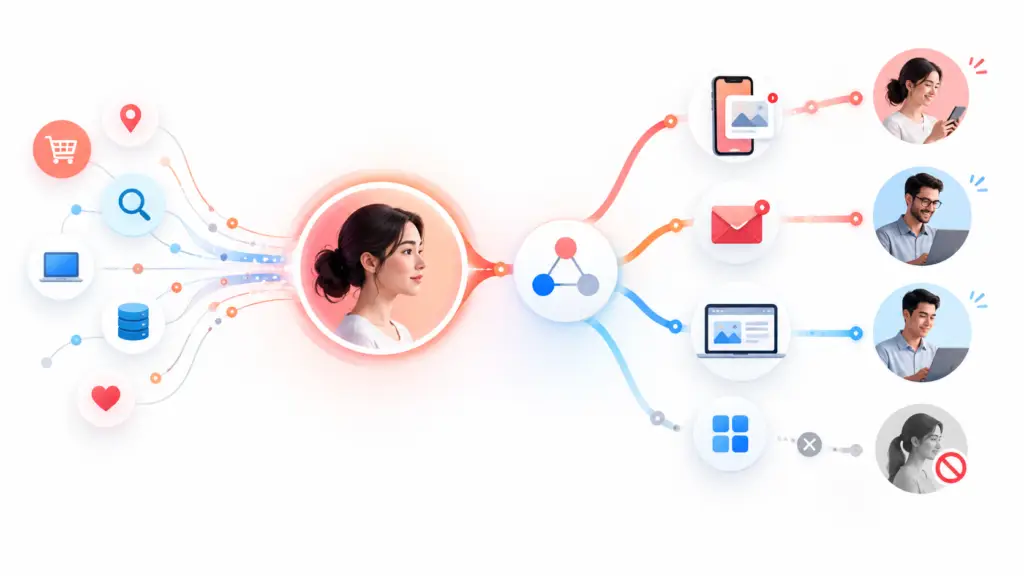
This is the problem that trigger-based marketing should solve. It is not just about sending messages faster. It is about responding to a meaningful event while considering the customer’s current situation. A useful response might be a reminder, a piece of advice, a service intervention or no message at all.
For marketing leaders, effective trigger-based marketing requires a change in mindset. Instead of asking which campaign should go out next, we should ask what customer needs now, whether we have enough information to act and which action will help. This article explains the principles, practical use cases, technology and measure that make that change possible.
1. What is Trigger-Based Marketing?
Trigger-based marketing uses a customer action or business event to start a relevant process. Instead of relying only on a campaign calendar, the organisation listens for changes that may call for a response.
A new customer completes registration. Someone puts a product in a shopping cart but does not buy it. A subscription is close to renewal. An application encounter an error. Each event could lead to a helpful action, provided the business understands what the event means.
A Trigger Is a Signal, Not an Instruction to Send
An event tells a system that something happened. It does not always explain why it happened. Someone who leaves an application may be comparing offers, looking for documents or dealing with a technical issue. Sending the same reminder to everyone assumes those situations are identical.
Modern real-time marketing automation tools can use trigger to start, chagne or end a journey. Microsoft documents, for example, how an order being placed can end a purchase-reminder journey. The complete order matters as much of the original abandonment event.
Source: Microsoft Customer Insights, Journeys triggers.
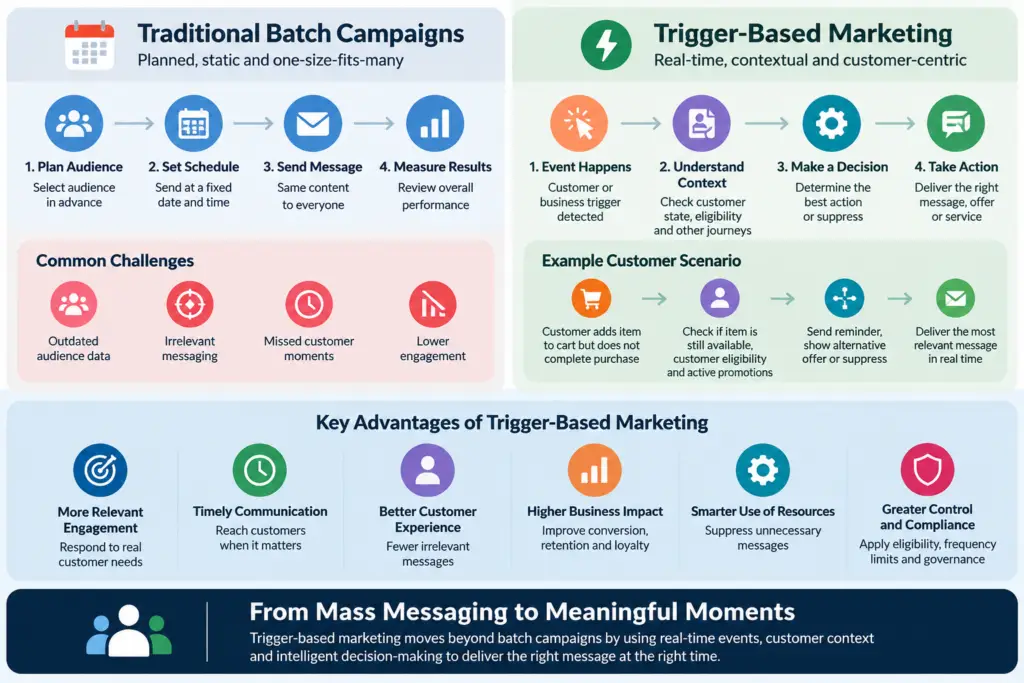
How Batch Campaigns Differ
A batch campaign usually starts with an audience and a schedule. A trigger-led journey starts with an event and my use fresh information before deciding what happens next.
| Dimension | Batch Campaign | Trigger-led Journey |
|---|---|---|
| Starting point | Planned campaign date | Customer or business event |
| Audience | Selected in advance | Qualified when the event occurs |
| Timing | Fixed schedule | Linked to customer activity |
| Main advantage | Efficient planned reach | Greater situational relevance |
| Common risk | Outdated audience data | Too many automatic reactions |
When Batch Campaigns Still Work
Newsletters, brand announcements, seasonal offers and planned education often suit scheduled delivery alongside trigger-based marketing. Many companies will need both methods. The goal is not to rep;ace every campaign with an event. It is to choose the method that makes sense for customer’s need and the business objective.
2. Why Marketing Must Move Beyond the Campaign Calendar
Customer journeys are rarely neat or predictable, which makes trigger-based marketing useful. People move between websites, apps, stores and service channels. They can start a transaction on one device and finish it on another. Meanwhile, the marketing calendar continues to move forward.
Customers Expect Relevant Experiences
A widely cited McKinsey survey published in 2021 found that 71% of surveyed US consumers expected personalised interactions, while 76% felt frustrated when that did not happen. The survey included 1,013 adults sampled and weighted to reflect the US population; these figures should not be treated as current Vietnam-specific results.
Source: McKinsey, The Value of Getting Personalisation Right or Wrong Is Multiplying.
Personalisation is often discussed in terms of names, product suggestions and tailored content. Yet recognising that a customer has already completed an action may matter more than any personalised greeting. A relevant message begins with accurate knowledge of the customer’s situation.
Static Audience Grow Stale
Suppose a bank selects eligible customers on Monday and sends an offer on Tursday. During those three days, some people may have applied, changed products or become ineligible. If the system never checks again, an apparently well-targeted campaign can deliver the wrong message.
Event-driven marketing does not require abandoning segmentation. Segments remain useful for planning and finding audiences. But decisions that depend on current eligibility shoud use a reliable, recent source before the business acts.
Internal Silos Become Customer Problems
Acquisition, retention and service teams often manage separate journeys. Each may work well on its own. Together, however, they can overwhelm customers with competing offers and reminders.
Braze’s 2025 Global Customer Engagement Review surveyed 2,300 marketing leaders across 18 countries. It reported that 50% of respondent brands used a unified platform for cross-channel engagement. That is a vendor-sponsored industry survey, not a universal measure of platform adoption.
Source: Braze 2025 Global Customer Engagement Review and Braze Official Announcement
For trigger-based marketing, the practical lesson is that a connected customer experience needs coordination. Faster delivery from disconnected tools can make an already fragmented experience feel even worse.
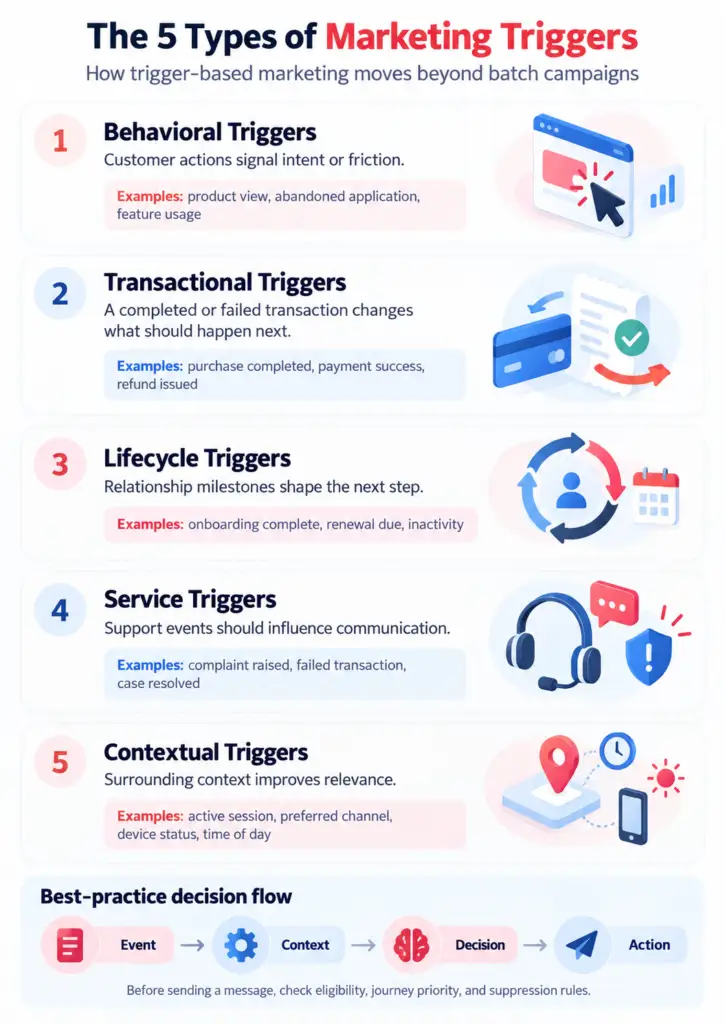
3. Five Types of Marketing Triggers Worth Understanding
Different events reveal different needs. A useful design starts by asking what information an event can provide and what decisions it can reasonably support.
Behavioral Triggers
Behavioral triggers in marketing arise from actions on website, apps and other digital channels. Examples include viewing a product, using a calculator, opening an account screen or leaving a checkout unfinished. Behavioral triggers in marketing are useful because they can reveal an immediate point of interest or friction.
Application and Cart Abandonment
In trigger marketing, abandonment does not always mean a customer wants a reminder. A person may have completed the process elsewhere to stop. The system should check the current transaction state before sending anything. If an error is known, guidance may be more useful than an incentive.
Browsing and Feature Engagement
With trigger-based marketing, a customer comparing credit cards might benefit from information about fees or eligibility. Someone exploring a new app feature may welcome an explanation when they return. Neither event automatically proves purchase intent. Good design keeps the response proportionate to what is actually known.
Transactional Triggers
Purchases, repayments, refunds, order shipments and success applications are transactional events. These signals can support confirmations and service updates. They can also stop outdated marketing journeys. A completed purchase should usually prevent a reminder to finish the same checkout.
In event-driven marketing, transactional messages and promotional messages may have different purposes and legal requirements. Marketing teams should not assume that permission to send one automatically permits the other.
Lifecycle Triggers
For trigger-based marketing, lifecycle events mark changes in a customer’s relationship with a business. Examples include registration, completion of onboarding, renewal eligibility, long periods of inactivity and membership milestones.
Someone who has just joined a service may need orientation. A long time customer may be ready for advanced features. A person who is struggling may need support before another sales pitch. These events help translate a broad lifecycle strategy into specific customer moments.
For a wider view of retention, adoption and long-term value, read AsiaTechBuzz’s Lifecycle Marketing: A Powerful AI Growth Strategy.
Service Triggers
Service events include complaints, failed transactions, support requests and the resolution of reported issues. They are sometimes missing from marketing data because they live in separate systems.
That creates a serious blind spot. A customer who cannot complete a payment should not receive a cheerful prompt to make another purchase as though nothing happened. Sharing an appropriate service status can help marketing delay campaigns and let support take priority.
Contextual Triggers
In trigger marketing, contextual signals include, time, channel, current session activity and permitted device information. These signals can improve the response to another event.
For example, a customer who is actively using a mobile app may find on-screen guidance more helpful than an email. Location data may be useful for a store-related service, but should be collected and used only where justified and permitted.
The best real-time marketing automation design does not gather every available signal. It collects what is necessary to provide a useful, respectful response.
4. The Shift From Automatic Messages to Intelligent Decisions
This is the most important distinction in event-driven marketing. Simple automation connects a condition to an action. Intelligent orchestration evaluates the condition before choosing an action.
The Old Approach: Event, Then Message
Imagine a rule that sends an SMS thirty minutes after an incomplete loan application. The rule is easy to operate and may work for some customers. But it can also contact people who finished in the app, called customer service or failed an eligibility check.
Every message may be delivered successfully while the experience remains poor. A high delivery rate tells us that the system worked. It does not tell us whether the system made a good decision.
The Better Model: Event -> Context -> Decision -> Action
A better trigger-based marketing frame work separates four questions. What happened? What do we know now? What is appropriate? What should actually happen? Each question improves the quality of the next.
| 01 EVENT What happened? | 02 CONTEXT What do we know now | 03 DECISION What is appropriate | 04 ACTION What should happen |
Event: Establish What Happened
A trigger-based marketing system first captures a clear signal, such as an application that remains unfinished after a defined period. Good event design includes a timestamp, a stable identifier where permitted, and a consistent meaning. A page exit should not automatically be labeled as abandonment.
Context: Check the Current Customer State
Next, the system examines relevant facts. Is the application complete? Is there an active service issue? Has another channel contacted the customer? Does the person have valid marketing consent? These checks should use reliable records instead of assumptions drawn from a single click.
Decision: Choose the Most Appropriate Response
In trigger-based marketing, business rules then assess whether the action is allowed and useful. In more advanced environments, a decision engine can compare several options. A customer may benefit from technical assistance, a reminder, a call-back offer or no further contract.
Action: Engage, Wait, Escalate or Suppress
Real-time marketing automation can deliver the selected action through email, SMS, mobile push, in-app guidance or a service process. It may also be delayed until the next suitable moment. Suppressing a message is a valid and sometimes valuable outcome.
Why Suppression Matters
Marketing dashboards usually celebrate what was sent. They rarely highligh the messages that should never have been sent. Yet preventing an irrelevant reminder can protect trust and reduce contact fatigue.
A customer who has completed an application does not need another submission prompt. Someone dealing with an unresolved complaint may not welcome a cross-sell offer. When a suppression rule prevents such messages, the system is working well.
The key idea is simple: the trigger creates an opportunity to decide, not an obligation to communicate. That principle separates basic trigger marketing from a more mature customer engagement approach.
5. Why Customer Context Changes the Outcome
In trigger-based marketing, a single event is rarely enough to support a confident decision. Context allows marketers to consider the wider relationship, not just the most recent interaction.
Customer State and Eligibility
For event-driven marketing, a financial service company may need to know whether an application is active, whether a product is helod already and whether the customer is eligible for an offer. A retailer may need order status, stock information and the latest purchase record.
The critical point is ownership of truth. Analytics may tell the business that a person left a form. The core application system should normally conform whether that application is still incomplete. Mixing those responsibilities can create conflicting customer experiences.
Journey Priority and Contact Rules
Organisation often run several journeys at once. A new acquisition offer might compete with an onboarding message, a renewal notice or a service response. Without a priority framework, the customer becomes the meeting point for internal silos.
Teams should define which messages take precedence, how frequently promotional communciation is allowed and when one journey should stop another. These policies should be visible to campaign owners and tested before launch.
Consent, Privacy and Trust
A trigger-based marketing systems’s ability to identify a customer is not the same as permission to market to that customer. Consent, opt-outs, channel preferences and the purpose of data collection must be respected.
This is especially important in regulated sectors. Rules will vary by market, product and channel. Legal and privacy teams should be involved early, not asked to approve a finished automation at the last moment.
What Next-Best-Action Really Means
In trigger-based marketing, next-best-action is not more impresive name for the next product offer. It is the practice of comparing possible responses and selecting one that is suitable for the current situation.
Sometimes the answer is educational content. Sometimes it is assistance, an offer or silence. Better customer understanding makes that choice possible. AsiaTechBuzz explores the foundation in Customer Intelligence: The Powerful Link Between Marketing Data and Business Growth.
6. Real-Time Versus Near-Real-Time: Speed With a Purpose
Marketers often describe a platform as real time without explaining what that means. The phrase may refer to fast event collection, rapid customer-profile update or immediate message delivery. These are difficult capabilities.
Real-Time Processing Is Not Instant Messaging
Real-time marketing triggers such as a checkout error might need guidance while the customer is sitll on the page. A suspected payment problem may call for a prompt service alert. In these cases, delay can reduce the value of the response.
By contrast, an unfinished loan application may deserve a considered follow-up after the customer has had time to gather documents. Delivering the message within seconds may feel intrusive rather than helpful.
When Near-Real-Time Is Enough
Some event-driven marketing journeys work perfectly well when events are evaluated every few minutes or at defined intervals. Renewal education, onboarding follow-ups and inactivity checks are examples where a modest delay may have little impact.
The right design starts with customer needs, then sets a suitable processing requirement. It does not begin by demanding the lowest possible technical latency.
Define the Meaningful Moment
Separate three point in time: when an event occurs, when the organisation can make a reliable decision and when the customer should receive the response. They need not be the same moment.
This distinction can salve cost and improve the experience. Real-time marketing triggers are valuable when they allow the business to act while the information is still relevant, not merely because a message arrives quickly.
7. Practical Examples Across Five Industries
The following trigger-based marketing scenarios are illustrations, not published case studies or promises of performance improvement. Their purpose is to show the decisions tht sit between an event and a customer-facing action.
Financial Services: Incomplete Loan Application
In a trigger-based marketing example, a customer begins a cash loan application on the website and leaves halfway through. The initial event suggests an unfinished journey, but it cannot reveal the reason.
Before acting, the business checks the application system. If the customer completed the process in the app, the reminder ends. If an error prevented progress, a support option may be appropriate. If the customer uis no longer eligible, a promotional reminder should not encourage an unsuitable application.
Only when the customer is still eligible, the application remains open and contact is permitted does a reminder become a reasonable option. Even then, the message can offer help ratehr than pressure the customer to apply.
E-Commerce: Shopping Cart Recovery
A shopper adds a product to a cart but does not check out. A basic campaign sends a discount code. The company may end up giving away margin to someone who was going to return anyway.
A better journey checks whether the item is still available, whether a purchase was completed and whether any other promotion is active. It might send a reminder without a discount, provide product information or simply wait. A controlled test can reveal which response actually changes purchasing behaviour.
Subscriptions: Renewal and Retention
Consider trigger-based marketing when two customers approach renewal on the same date. One uses the product every day. The other has experienced repeated service problems. The same promotional message is unlikely to be equally useful to both.
The engaged customer may need a simple renewal notice. The second may need support, a clear explanation of the issue and a chance to resolve it. The renewal date is the trigger, but recent experience should shape the decision.
Retail Banking: Failed Transaction
In trigger-based marketing, a banking customer miught encounter a payment failure while also qualifying for a cross-sell campaign. From the customer’s point of view, the payment problem is likely more urgen than the offer.
A coordinated approach can prioritze a service update and postpone optional marketing. Once the issue is resolved, the promotional journey can reassess whether contact is still relevant. This is an example of operational signals improving a marketing decision.
Mobile Apps: Better Onboarding
A new app user registers but does not finish setting up an important feature. Rather than sending repeated generic notifications, the app can show hlep when the user returns to the relevant screen.
If setup is complete, the guidance disappears. If an error keeps occurring, a support option is show instead. The experience becomes part of the product, not just another outbound campaign. It also respects the user’s immediate task.
8. The Technology Needed to Make It Work
Real-time marketing automation depends on several connected capabilities. But that does not mean an organisation needs to buy every platform in the market. Many useful journeys can be built with existing analytics, customer records and campaign tools.
Event Collection and Data Quality
Real-time marketing triggers can come from website analytics, mobile apps, CRM systems, service platforms and transaction systems. Each events needs an agreed name, timestamp, definition and relevant identifiers.
Poor definitions create poor decisions. If one system records an application as submitted while another records it as abandoned, the engagement process cannot reliably choose an action. Event governance is therefore a business responsibility as much as a technical one.
Identity and Current Customer Records
Customers move between devices and channels. Connecting interactions can help a business recognise that the same person began a journey on the website and finished in an app.
That connection should use permitted identifiers and appropriate confidence checks. Anonymous activity cannot always be tied reliably to a known customer. When identity is uncertain, the system should avoid making strong personal claims or taking risky actions.
Rules, Decisioning and AI
A trigger-based marketing rules engine can check consent, application status, eligibility, frequency limits and conflicting journeys. Many high-value use cases require nothing more complex.
Predictive models may later help estimate which response has the best chance of helping. AI can support content choices or recommend an action, but it introduces needs for validation, monitoring and oversight. Starting with trustworthy rules often creates a stronger base than introducing advvanced models before the data is ready.
Journey Orchestration and Channels
In real-time marketing automation, an orchestration layer coordinates what happens across email, SMS, push, app, web and service touchpoints. It should allow journeys to stop when the customer completes the desired action. Microsoft’s trigger-based journey guidance describes abandoned-cart entry conditions and purchase-completion exit rules.
Businesses should also consider how decisions reach their delivery channels. A connected architecture is more important than having a long list of features in separate tools.
AsiaTechBuzz’s Composable MarTech Architecture: Powerful Growth for the AI Era explains how modular capabilities can be connected and governed without making the entire environment dependent on one platform.
Observability and Accountability
Teams need to know whether an event arrived, what decision was taken, which rule applied and whehter an action succeeded. Logs, alerts and clear ownership make failures easier to diagnose.
These records are also important when a customer questions a communication or a team needs to understand why a message was suppressed. Governance is not separate from good engagement. It makes good engagement possible at scale.
9. A Practical Implementation Roadmap
The fastest way to make trigger-based marketing complex is to automate every available event at once. A better approach begins with one customer moment and builds from there.
Step 1: Pick a High-Value Problem
For your first trigger-based marketing journey, choose a point where customers regularly struggle or where communication is clearly outdated. An unfinished application, stalled onboarding or repeated service issue may be a good starting point. Define what improvement would look like for both the customer and the business.
Step 2: Agree on the Event Definition
Write down exactly what should count as the trigger. Identify the system that records it and the data required to make a decision. Agree on what happens when records arrive late, the same event is sent twice or customer identity cannot be confirmed.
Step 3: Build Eligibility and Suppression First
Before launching trigger marketing reminders, establish when no reminder should be sent. Check consent, completed transactions, active service cases, customer eligibility and frequency limits. this work may prevent more poor experiences than clever creative content ever could.
Step 4: Start with Clear Rules
With real-time marketing automation, implement the simplest useful response. A basic journey with a current-status check and reliable suppression may already outperform a more complex journey that acts on stale data. Do not make AI a requirement when simple logic can solve the problem.
Step 5: Test and Improve
Use a holdout group where practical, and compare outcomes against customers who did not receive the intervention. Test message content, timing, channel and rules separately when possible. Review mistakes as carefully as successes, especially unnecessary contact and missed service needs.
As the team learns, add new event types and more coordinated decisions. Scale should follow evidence, not enthusiasm for platform features.
10. How to Measure Success Beyond Sends and Clicks
The familiar campaign dashboard still matters for trigger-based marketing, but it tells only part of the story. A useful measurement framework should cover customer outcomes, incremental business value and system reliability.
Engagement and Journey Outcomes
For event-driven marketing, track delivery, clicks, response rate and the completion of the intended customer task. Also watch opt-outs, complaints and repeat contacts. A message that wins a click but interrupts a service journey may not represent an overall improvement.
Incremental Business Impact
A conversion following a reminder is not proof that the reminder caused it. Some customers would have returned without help. A randomized holdout group provides a more credible estimate of incremental impact, as long as the test is large enough and designed carefully.
For commercial journeys, assess incremental completed applications, purchases or retained subscriptions alongside the costs of incentives and communication. For service journeys, task resolution and reduced friction may be more meaningful.
Operational Quality
For real-time marketing automation, measure event delays, missing data, duplicate messages, failed decisions and outdated customer states. Also examine the number of messages correctly suppressed, while checking for cases where suppression mistakenly blocked useful communication.
The ideal result is not the largest possible number of triggered messages. It is a reliable system that improves customer outcomes without creating unnecessary contact.
11. The Future is More Thoughtful Customer Engagement
The move to trigger-based marketing is not really a race to send the next message sooner. It is a move toward understanding a customer moment before deciding what to do.
Events give businesses timely signals. Customer data provides context. Rules and decisioning tools help select an appropriate response. Connected channels then deliver that response, or deliberately choose not to interrupt.
Organisations do not need to become fully AI-driven to begin. They can make progress by defining better events, checking current customer status and coordinating the journeys they already run.
That is the lasting promise of trigger-based engagement: fewer disconnected reactions and more interactions that respect what the customer is actually trying to achieve. The best customer experience may be a timely offer, clear help or simply the absence of an unnecessary message.
Frequently Asked Questions
-
What is Trigger-Based Marketing?
Trigger-based marketing uses customer actions or business events to start relevant journeys. Examples include onboarding guidance, an unfinished checkout reminder or a renewal notice. Good design checks context before deciding whether to communicate.
-
How Is It Different from Batch Marketing?
Batch marketing starts with an audience and a schedule; trigger-based marketing begins with events. Trigger-led journey begins when a relevant event occurs. Both have a place: planned announcements suit batch delivery, while time-sensitive needs may benefit from event-led responses.
-
Does Trigger Marketing Require Artificial Intelligence?
No. Reliable events, current customer records and clear business rules can support effective journeys. AI may help compare possible actions later, but it is not a requirement for useful automation.
-
What Are Common Examples of Marketing Triggers?
Common real-time marketing triggers include incomplete applications, abandoned carts, successful purchases, onboarding milestones, subscription renewals, app inactivity and service issues. Each trigger should have a purpose and a clear rule for when no action is needed.
-
How Does Real-Time Marketing Differ from Journey Orchestration?
Real-time marketing automation concerns responding to events while they remain relevant. Journey orchestration also coordinates actions, timing and priorities across channels and customer journeys. It can decide to send, wait, offer help or suppress communication.